
Allowable Expenses Self-Employed UK: What You Can Claim Before 5 April 2026
Allowable expenses self-employed UK rules explained with practical examples before 5 April 2026, so you can claim correctly and avoid HMRC issues.
Allowable Expenses Self-Employed UK: What You Can Claim Before 5 April 2026
Allowable expenses self-employed UK rules matter most in late March, because once the tax year ends on 5 April 2026, you cannot go back and create evidence you did not keep. If your records are clean now, your 2025/26 Self Assessment is usually straightforward. If they are messy, the same return becomes stressful, slower, and often more expensive than it needed to be.
Most people do not struggle because they are careless. They struggle because the boundary between business and personal spending is not always obvious. Mileage, phone bills, home working costs, software subscriptions, training, and small online purchases can all become grey areas if you do not have a clear method.
Quick summary: separate business and personal costs, claim only the business portion, choose your expense method consistently, and make sure your evidence is in place before 5 April 2026.
If you want a second pair of eyes before filing season, we can help through our Self Assessment service, bookkeeping service, and self-employment support.
Why allowable expenses are a March priority, not a January task
A lot of sole traders leave expense cleanup until January because that is when filing pressure is visible. The trouble is that your evidence quality is usually better in March or April than ten months later. Bank feeds are easier to reconcile, supplier emails are still easy to find, and you still remember why a mixed-use cost was partly business.
There is also a cash-flow reason to do this now. If your expenses are under-claimed, your taxable profit looks higher than it really is, which can inflate both your balancing payment and your payments on account. Correcting that before year-end gives you a cleaner tax estimate and fewer surprises.
For 2025/26, keep these dates in one place:
| Date | What it means | Practical action |
|---|---|---|
| 5 April 2026 | End of tax year | Finalise 2025/26 records and capture missing evidence |
| 6 April 2026 | New tax year starts | Start fresh ledger categories from day one |
| 5 October 2026 | Register for Self Assessment if newly required | Tell HMRC if this is your first filing year |
| 31 January 2027 | Online Self Assessment deadline and balancing payment | File and pay on time to avoid penalties |
| 31 July 2027 | Second payment on account deadline | Budget in advance if payments on account apply |
Official deadline source: Self Assessment tax return deadlines (GOV.UK).
What counts as allowable expenses for self-employed UK businesses
The core rule is simple, even if real life is not. You can generally claim costs that are wholly and exclusively for your business. If a cost is partly private and partly business, only the business element is claimable.
HMRC explains this clearly in its guidance on expenses if you are self-employed.
Common categories where people usually have claimable costs include:
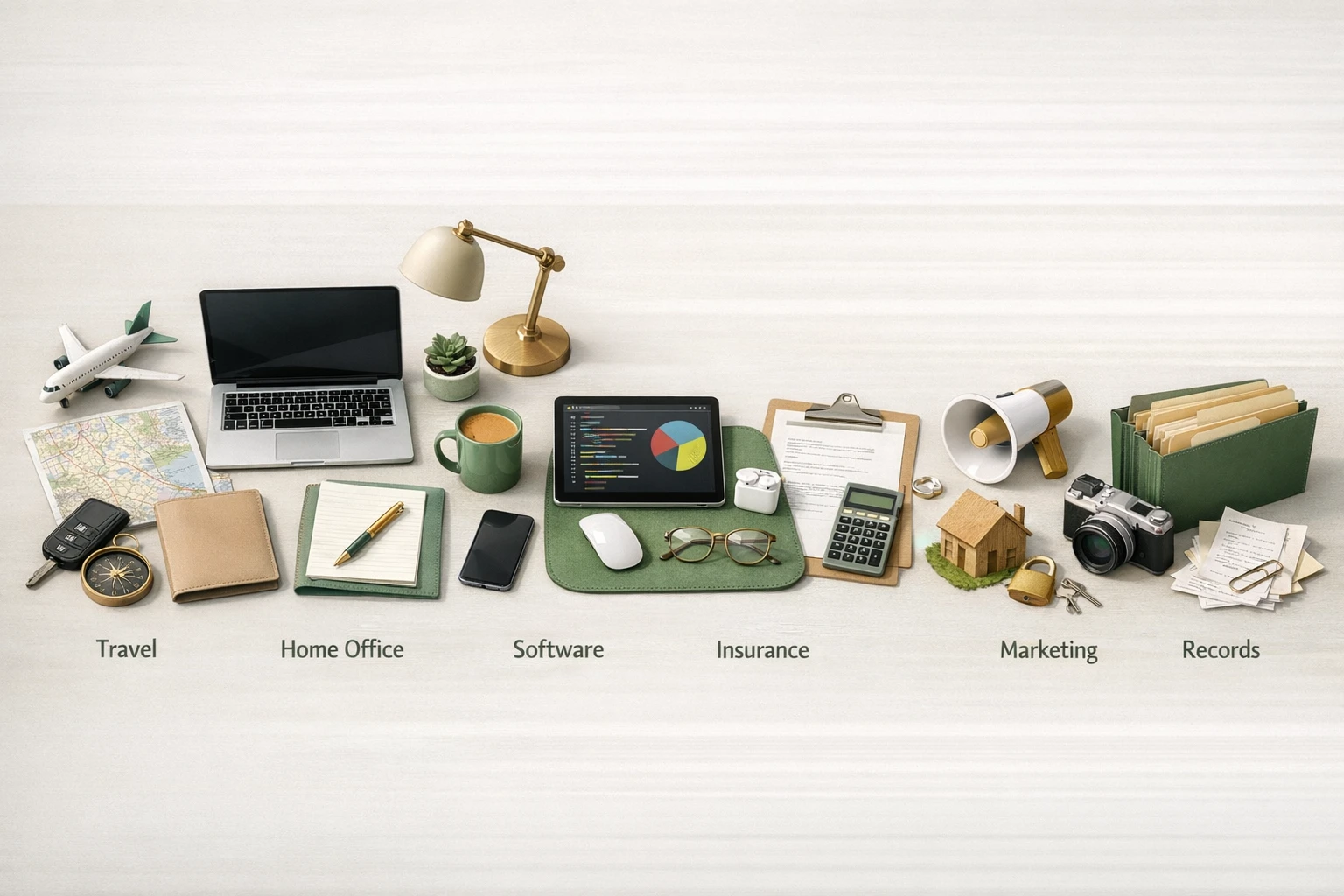
| Category | Typical claim examples | Common mistake to avoid |
|---|---|---|
| Office and admin | stationery, postage, software, accounting fees | claiming personal app subscriptions |
| Travel | business mileage, train tickets for business trips, parking | claiming normal commuting |
| Premises and utilities | rent for business premises, business rates, power | claiming full household bills without apportionment |
| Staff costs | wages, employer NIC, pension contributions for staff | mixing contractor and employee treatment |
| Marketing | website hosting, online ads, branding, domain fees | claiming client entertainment as marketing |
| Insurance and finance costs | business insurance, bank charges, eligible interest | claiming personal insurance premiums |
Worth saying clearly, client entertaining is usually disallowed for Income Tax purposes even if it feels business-related. Meals with clients can still be a genuine business activity, but that does not automatically make them tax deductible.
Actual costs or simplified expenses: choose the method that fits your records
Many sole traders know they can claim expenses, but do not realise they have method choices in some areas. You can either use actual apportioned costs or, where HMRC allows, simplified flat rates.
Simplified expenses can be used for:
- vehicles
- working from home
- living at your business premises
Source: Simplified expenses if you are self-employed (GOV.UK).
Simplified vehicle rates (2025/26)
For cars and vans, the flat rates are currently:
- 45p per mile for the first 10,000 business miles
- 25p per mile over 10,000 business miles
For motorcycles and bicycles:
- 24p per mile for motorcycles
- 20p per mile for bicycles
If you use mileage rates, you cannot also claim fuel, servicing, repairs, insurance, and similar running costs for that same vehicle as separate expenses. That double-claim issue is one of the most common errors we see.
Simplified home working rates
If you work from home 25 hours or more per month, HMRC allows monthly flat rates:
- 25 to 50 hours: GBP 10 per month
- 51 to 100 hours: GBP 18 per month
- 101 hours or more: GBP 26 per month
If your real apportioned costs are higher and you have solid records, actual-cost apportionment may give a larger claim. If record keeping is weaker, flat rates can reduce friction and still keep your return credible.
Worked example 1: mileage method vs actual vehicle costs
Assume Priya drives 8,400 business miles in 2025/26 using her car.
Using simplified mileage:
- 8,400 x GBP 0.45 = GBP 3,780 allowable expense
Now assume her actual annual car costs were:
- fuel: GBP 2,600
- insurance: GBP 720
- servicing and repairs: GBP 880
- road tax and other running costs: GBP 300
- total: GBP 4,500
If business use is 60%, actual-cost claim would be:
- GBP 4,500 x 60% = GBP 2,700
In this example, simplified mileage gives a higher claim by GBP 1,080.
That does not mean mileage is always better. It means you should test both methods before locking in your approach.

Home office claims without guesswork
Home office claims are often where people feel least confident. The practical route is to choose one defensible method and apply it consistently.
If you use actual-cost apportionment, a common method is:
- identify total relevant home costs (for example electricity, heating, rent, council tax, broadband)
- apportion by reasonable business use (rooms and/or time)
- keep a note of the logic in case HMRC asks
Worked example 2: actual home cost apportionment
Assume Omar works from home 3 days a week in a 5-room home, using one room as an office during working hours only.
Relevant annual household costs:
- electricity and gas: GBP 2,400
- broadband and phone: GBP 720
- council tax and rent element used for this method: GBP 10,800
- total considered costs: GBP 13,920
Illustrative apportionment:
- room basis: 1/5 = 20%
- time basis: 3/7 days = about 42.86%
- combined business fraction: about 8.57%
Claim estimate:
- GBP 13,920 x 8.57% = GBP 1,193 (rounded)
If Omar chose simplified home working and worked above 101 hours each month:
- GBP 26 x 12 = GBP 312
In this example, actual apportionment is much higher. That said, it also needs stronger records and a clear method note.
Expenses you can claim only in specific conditions
Some costs are not a simple yes or no. They depend on what the expense is for and how you use it.
Mobile phone and internet
If bills are mixed personal and business use, claim only the business proportion. A clear percentage method backed by usage pattern is usually better than random rounding.
Training courses
Training that updates existing business skills is often allowable. Training that gives you a new skill outside your current trade can be treated differently.
Clothing
Everyday clothing, even if you wear it only for work, is generally not allowable. Specialist protective clothing and uniforms are usually treated differently.
Use of cash basis
Under cash basis, treatment can differ in some areas, including capital spending treatment for vehicles. If you are using cash basis, it is worth checking each major category rather than assuming accrual-style rules.
For reference, HMRC guidance on self-employed expenses explains how the rules apply where costs have both private and business use, and where simplified expenses can replace actual calculations.
What poor expense records cost in real money
People often think expense mistakes are small. Sometimes they are not.
Worked example 3: under-claiming expenses and tax impact
Assume taxable profit before review is GBP 42,000. After a proper expense review, you identify an extra GBP 4,000 of valid allowable costs that were missed.
Revised profit becomes GBP 38,000.
Potential tax and NIC effect for 2025/26 (illustrative):
- Income Tax saved at 20% on GBP 4,000 = GBP 800
- Class 4 NIC saved at 6% on GBP 4,000 = GBP 240
- total immediate saving = GBP 1,040
That is before considering payments on account effects.
Now flip it the other way. If GBP 4,000 of private spending is incorrectly claimed as business and later disallowed, the bill can rise by similar amounts, and penalties may be in play depending on behaviour and disclosure.
This is why we prefer a boring, evidence-led process. It is less dramatic and usually much cheaper.
Record keeping standard HMRC expects
You do not normally submit all receipts with your return, but you should keep records that support each figure in case HMRC asks.
A practical evidence pack includes:
- digital copies of receipts and invoices
- bank and card statements
- mileage log with dates, purpose, and distance
- a short note for apportionment methods (home office, phone, internet)
- bookkeeping reports that tie to the return totals
How long should records be kept? HMRC requires records for at least 5 years after the 31 January submission deadline of the relevant tax year.
For 2025/26 returns filed by 31 January 2027, that generally means keeping records until at least 31 January 2032.
Official source: Self-employed record keeping requirements (GOV.UK).

Mistakes we see repeatedly in March and April
The same errors show up every year, even with experienced freelancers and sole traders.
1) Claiming personal costs because they feel business-adjacent
If the private element is significant, HMRC may challenge the whole amount. Mixed-use costs need apportionment, not assumptions.
2) Mixing expense methods for the same cost area
Using mileage and actual fuel/repairs together for the same vehicle is a classic double-claim error.
3) No audit trail for home office percentages
A percentage without a method note is weak evidence. One short calculation note can make your file much stronger.
4) Leaving digital cleanup until January
By January, missing invoices and lost context become much harder to fix. March is the better window.
5) Forgetting that better bookkeeping helps more than tax
Clean monthly records also improve pricing decisions, cash-flow planning, and debt chasing. Tax accuracy is only one benefit.
Practical 5 April 2026 checklist for allowable expenses self-employed UK
Use this as a one-session review.
| Task | What good looks like | Status |
|---|---|---|
| Separate business transactions | Dedicated account or tagged ledger entries | ☐ |
| Review top 20 expenses by value | Evidence exists and business purpose is clear | ☐ |
| Check mixed-use costs | Apportionment method documented | ☐ |
| Choose method for vehicles | Simplified mileage or actual costs, not both | ☐ |
| Check home office method | Simplified flat rate or actual cost basis chosen | ☐ |
| Reconcile receipts to ledger | Missing evidence list created and chased | ☐ |
| Estimate tax impact | Profit, Income Tax, and Class 4 NIC estimate updated | ☐ |
| Save year-end backup | Reports and evidence stored in one folder | ☐ |
If you want help applying this quickly, book a review with our team and we can sense-check the numbers before year-end closes.
Where this fits with your wider compliance plan
Expense quality affects more than one return. Good data supports:
- cleaner Self Assessment filing
- better monthly bookkeeping control
- earlier warning if you are moving towards VAT obligations
- easier transition to digital reporting requirements as your business grows
If you are also dealing with year-end planning decisions, this guide may help: Year End Tax Planning for Limited Company Directors: 5 April 2026 Checklist.
FAQ: allowable expenses self-employed UK
Can I claim my full mobile phone bill if I use it for business?
Usually no, unless it is genuinely 100% business use. Most people need to claim only the business element.
Can I claim food and coffee while working?
Ordinary day-to-day meals are usually not allowable. Business travel subsistence can be allowable in the right circumstances, but routine lunches are generally private.
Do I need receipts for every expense?
You need reliable evidence for your figures. Digital receipts, statements, and bookkeeping records can all help. If evidence is weak, the claim is weak.
Should I use simplified expenses or actual costs?
It depends on your numbers and record quality. Test both where allowed, then stick to one defensible approach for that cost area.
What if I made mistakes in my expense claims last year?
Do not ignore it. Corrections may be possible, and acting early is usually better than waiting for HMRC contact.
Is this personal tax advice?
No. This is general guidance for UK self-employed taxpayers. Your position depends on your income sources, records, and circumstances, so personal advice may be needed.
Start with one practical step today: run the checklist, fix your top-value categories, and lock your evidence before 5 April 2026. It is the quickest way to lower filing stress and improve accuracy.

About Golden Tree Consulting
AAT Licensed | ACCA Affiliated
Golden Tree Accounting & Business Consulting provides expert tax, bookkeeping, and advisory services to sole traders and SMEs across Croydon, London, Surrey, and Kent. With multilingual support and decades of combined experience, we help businesses stay compliant and grow.
More Articles You Might Like
Continue exploring our financial insights

Pension Tax Relief UK Before 5 April 2026: Practical Guide for Sole Traders and Directors
Pension tax relief UK rules explained for 5 April 2026, with annual allowance limits, carry forward, and worked examples for business owners.

MTD for Income Tax UK: April 2026 Checklist for Sole Traders and Landlords
MTD for Income Tax starts in April 2026 for many sole traders and landlords. Use this practical checklist to get ready, avoid penalties, and file with confidence.

Side Hustle Tax UK: 5 April 2026 Checklist to Avoid Costly Mistakes
Side hustle tax UK rules are easy to get wrong. Use this 5 April 2026 checklist to track income, claim expenses correctly, and avoid HMRC penalties.