Making Tax Digital for Landlords 2026: Quarterly Updates and Digital Records
Making Tax Digital for landlords in 2026 explained, with thresholds, quarterly update dates, joint lets, records, and worked examples.
 Golden Tree Accounting 15 May 2026 16 min read
 On this page Show
- Making Tax Digital for landlords 2026: who is in scope?
- Worked example 1: rental income plus sole trade income
- What landlords need to keep digitally
- One UK property business, not one update per house
- Jointly let property: record your share properly
- The quarterly update dates landlords need in the diary
- What actually gets sent to HMRC?
- Property allowance, Rent a Room, and low-level rental income
- Choosing software for rental records
- A monthly landlord MTD routine that works
- FAQ: Making Tax Digital for landlords
- Final practical next step
Making Tax Digital for landlords 2026 is now a live admin issue, not a distant tax change. If your gross property income and self-employment income put you above £50,000, you may need to keep digital records from 6 April 2026 and send quarterly updates to HMRC using compatible software. For landlords, the awkward bit is often working out what counts as property income, how joint lets are handled, and whether every rental property needs its own separate file.
The short answer is that MTD for Income Tax is not just “Self Assessment online with extra buttons”. It changes the rhythm of your records. Rent, repair costs, agent fees, mortgage interest records, and shared-property figures need to be kept digitally through the year, then summarised to HMRC at fixed points.
Quick summary: landlords in the first MTD wave need to use compatible software if their qualifying income is over £50,000. The threshold drops to £30,000 from April 2027 and £20,000 from April 2028. Under standard update periods, the first quarterly update for 2026/27 covers 6 April to 5 July 2026 and is due by 7 August 2026.
If you want us to check whether you are in scope and set up a sensible property record process, we can help through our Self Assessment service, bookkeeping service, and contact page.

Making Tax Digital for landlords 2026: who is in scope?
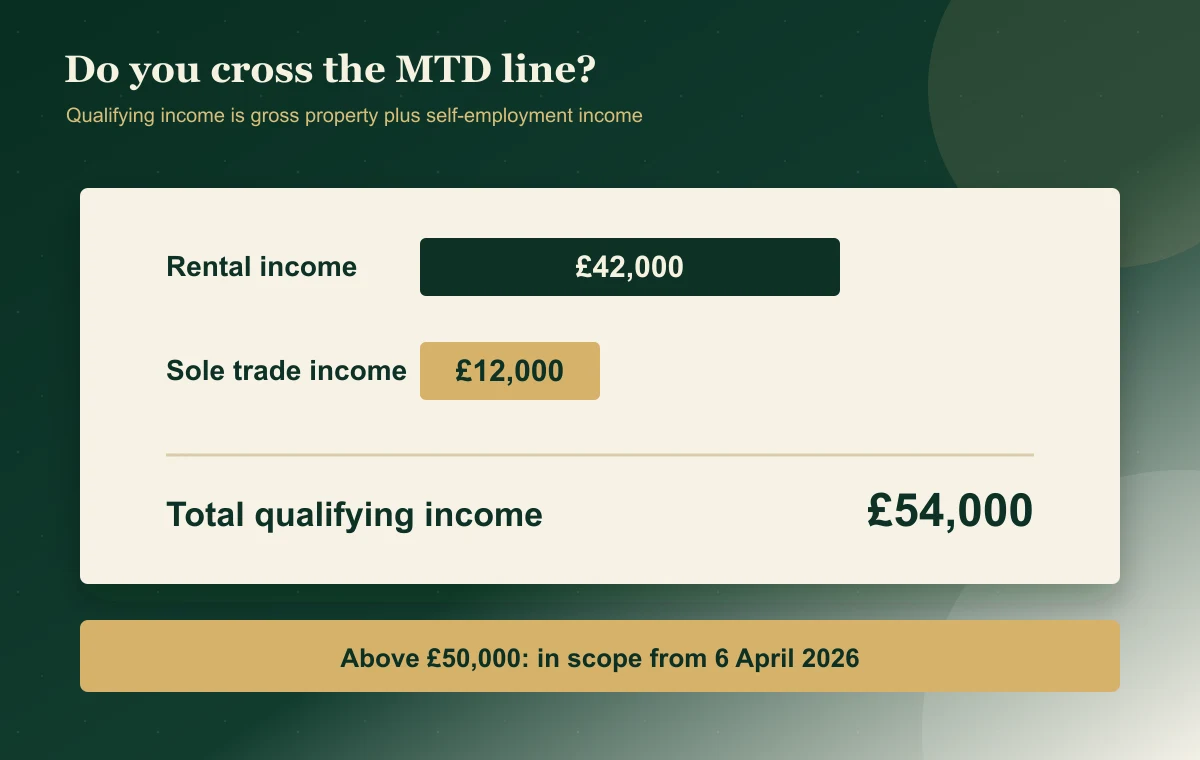
HMRC’s first phase applies from 6 April 2026 to sole traders and landlords with qualifying income above £50,000. Qualifying income is gross income from self-employment and property before tax allowances or expenses are deducted. That point matters.
For landlords, the test is not based on profit after mortgage interest, repairs, insurance, or agent fees. It starts with the rent and other property receipts before deductions. If you also have sole trader income, the two are added together for the threshold test.
| Phase | Who it catches | Start date |
|---|---|---|
| Phase 1 | Qualifying income over £50,000 | 6 April 2026 |
| Phase 2 | Qualifying income over £30,000 | 6 April 2027 |
| Phase 3 | Qualifying income over £20,000 | 6 April 2028 |
Official references worth bookmarking:
- Use Making Tax Digital for Income Tax
- Create digital records for MTD for Income Tax
- Send quarterly updates for MTD for Income Tax
- Making Tax Digital quarterly update direction
If you read only one thing before choosing software, read HMRC’s digital record guidance. It includes details that matter to landlords, such as how UK property, foreign property, and jointly let property records are treated.
Worked example 1: rental income plus sole trade income
Assume Nadia owns two UK rental properties and also works as a freelance consultant.
For 2024/25, her income was:
| Source | Gross income | Expenses | Profit |
|---|---|---|---|
| UK rental property | £42,000 | £16,000 | £26,000 |
| Freelance consulting | £12,000 | £3,500 | £8,500 |
| Total | £54,000 | £19,500 | £34,500 |
For the MTD entry test, the key figure is not the £34,500 profit. It is the £54,000 gross qualifying income. Nadia is above the £50,000 first-wave threshold, so she should expect to be in scope from 6 April 2026, assuming the other conditions are met.
That surprises a lot of landlords because the tax bill may feel much smaller than the income figure suggests. MTD is about reporting duties, not whether the property portfolio is highly profitable.
There is a second trap here. Employment income is not part of the MTD qualifying income test, but property and self-employment income are. A PAYE salary can still affect your final tax bill, but it is not what puts you over the MTD threshold.
What landlords need to keep digitally
HMRC says a digital record is a record of income or an expense created and stored in software that works with MTD for Income Tax. You still need normal supporting records, such as invoices, statements, receipts, lease documents, and evidence used for your tax return. MTD does not remove the need to keep proof. It changes how the figures are recorded and sent.
For UK landlords, digital records can include:
- rent received
- premiums for the grant of a lease
- reverse premiums and inducements
- repairs and maintenance
- letting agent fees
- insurance
- finance cost information, including mortgage interest records
- service charges and other property costs
Each record needs enough detail to support the Self Assessment category used by the software. HMRC’s guidance says records should include the amount, the date, and the category. A bank feed can help, but it is not a complete record on its own if the category, property context, or missing transaction detail is unclear.
Right, so a landlord who receives a monthly rent payment of £1,250 from a tenant should not leave it sitting in the software as “bank credit”. It should be recorded as property income. If the letting agent deducts fees before paying the landlord, the landlord may need the gross rent and the fee recorded separately rather than only the net amount received.
One UK property business, not one update per house
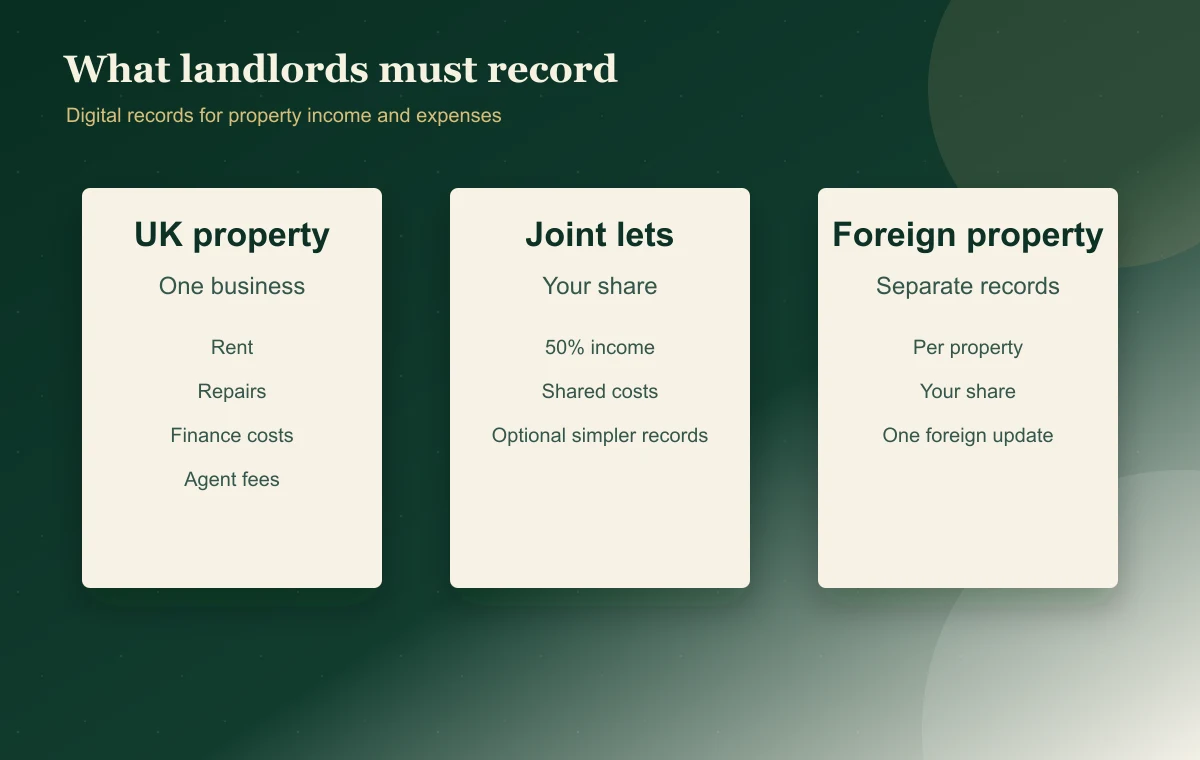
Here is a useful bit of landlord-specific HMRC guidance. If you have one or more UK properties, they are treated as one UK property business for MTD record purposes. You do not need a separate quarterly update for each UK property you own.
That does not mean you should throw every property into one messy pot. You may still want property-level tracking for repairs, agent fees, profitability, and future sale planning. The MTD submission point is narrower: compatible software adds together the relevant UK property records and includes them in one quarterly update for the UK property business.
For example, if you own:
- a flat in Croydon with £1,200 monthly rent
- a house in Sutton with £1,650 monthly rent
- a studio in Bromley with £950 monthly rent
Your UK property business rent for a full quarter could be:
- Croydon flat: £1,200 x 3 = £3,600
- Sutton house: £1,650 x 3 = £4,950
- Bromley studio: £950 x 3 = £2,850
- Total quarterly UK property income: £11,400
Your software may track those properties separately for management purposes, then report one UK property update total. That is a sensible split: detail for you, summary for the MTD update.
Jointly let property: record your share properly
Joint lets are where MTD for landlords gets a bit fiddly. HMRC says that if you are a landlord with jointly let properties, you only need to create digital records that relate to your share of income and expenses from those properties.
You can choose, in your quarterly updates, to include either all income and expenses for jointly let properties, or only your property income without expenses for those jointly let properties. If you leave out the shared-property expenses in the quarterly update, you must report them before you finalise your Income Tax position and submit your tax return.
Worked example 2: a jointly owned rental property
Assume Sam and Alex jointly own a rental flat 50:50. The monthly rent is £1,600 and the letting agent charges 10%, so the agent fee is £160 per month.
For one three-month period:
| Item | Whole property | Sam’s 50% share |
|---|---|---|
| Rent | £4,800 | £2,400 |
| Agent fees | £480 | £240 |
| Repair invoice | £600 | £300 |
Sam’s digital records should reflect Sam’s share, not the whole-property figures, unless the software and ownership process are deliberately set up to split them correctly. If Sam records the whole £4,800 as his own rental income, his quarterly data is overstated. If he records only the net bank transfer and misses agent fees, the expense picture is incomplete.
For jointly let properties, agree the process early. Who holds the invoices? Who records the repair costs? Does each owner have their own software file? Are the ownership shares fixed? Those are boring questions, but boring questions are exactly what stop tax admin turning unpleasant.
Your specific situation may differ if ownership shares are not equal, if there is a partnership, or if the property is held through a company. Company-owned property is outside this individual landlord MTD guide and needs different advice.
The quarterly update dates landlords need in the diary
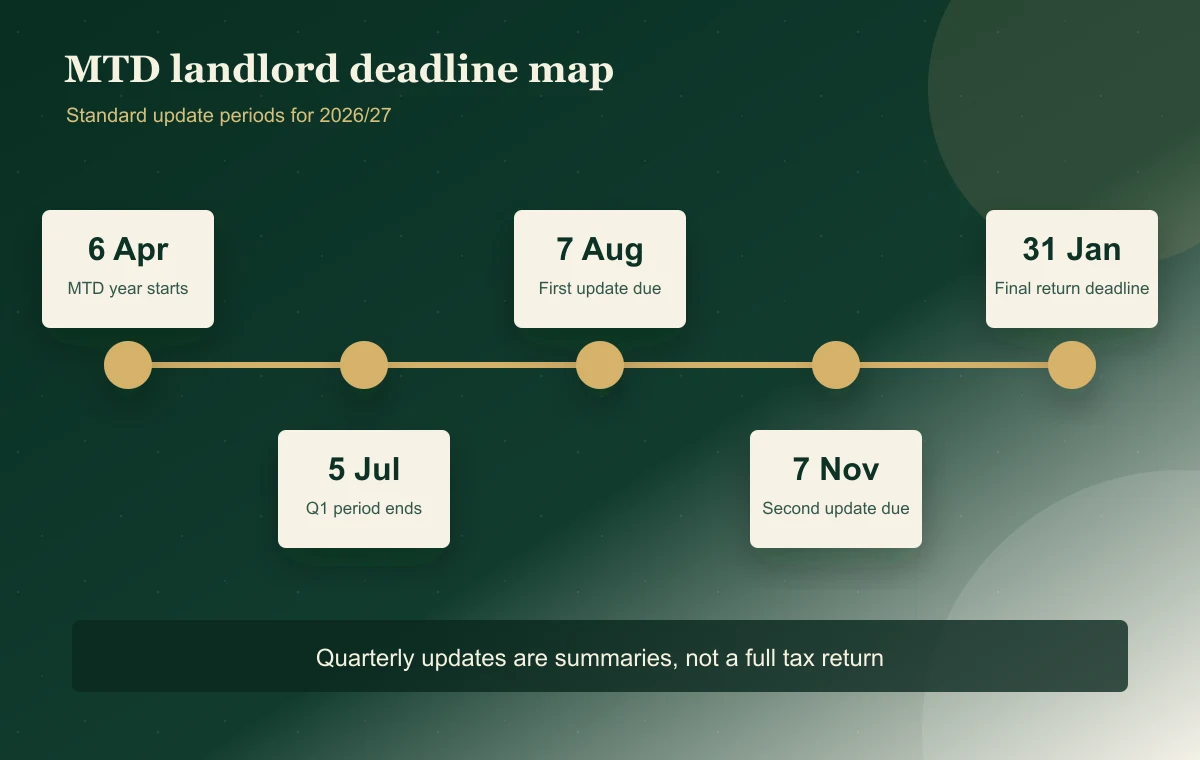
Under standard update periods, HMRC’s MTD quarterly dates for 2026/27 are:
| Update | Period covered | Deadline |
|---|---|---|
| Q1 | 6 April 2026 to 5 July 2026 | 7 August 2026 |
| Q2 | 6 April 2026 to 5 October 2026 | 7 November 2026 |
| Q3 | 6 April 2026 to 5 January 2027 | 7 February 2027 |
| Q4 | 6 April 2026 to 5 April 2027 | 7 May 2027 |
HMRC’s wording is slightly odd because each later quarterly update can include records from the start of the tax year and corrections already made. The practical diary point is simple: do the bookkeeping monthly and review it before each deadline.
If your accounting period runs from 1 April to 31 March, HMRC says you should use calendar update periods, if your software supports them. For 2026/27, the calendar update periods are:
| Calendar update | Period covered | Deadline |
|---|---|---|
| Q1 | 1 April 2026 to 30 June 2026 | 7 August 2026 |
| Q2 | 1 April 2026 to 30 September 2026 | 7 November 2026 |
| Q3 | 1 April 2026 to 31 December 2026 | 7 February 2027 |
| Q4 | 1 April 2026 to 31 March 2027 | 7 May 2027 |
You need to select calendar update periods in the software before your first update is sent. HMRC says you cannot change the accounting period after you have sent a quarterly update, so check this before the first submission.
One welcome point for the first year: HMRC says it will not apply penalty points for late quarterly updates for the first 12 months if you are required to use MTD from 6 April 2026. That is helpful breathing room, not a reason to ignore the system. You still need the quarterly updates before you can submit the tax return, and late tax returns remain separate.
What actually gets sent to HMRC?
Quarterly updates are category totals from your digital records. HMRC says it will receive totals for each relevant income and expense category, not the details of every individual record.
That means you are not sending HMRC a scanned tenancy agreement, every repair invoice, or a line-by-line bank statement each quarter. You are sending totals created from the digital records in compatible software.
Still, the records behind those totals matter. If the software has rent in the wrong category, if repairs are mixed with capital improvements, or if mortgage capital repayments are treated as deductible finance costs, the quarterly view can become misleading. The final tax return is where tax and accounting adjustments are made, but bad quarterly data can still cause poor tax estimates and more year-end clean-up.
Worked example 3: repair cost versus improvement cost
Assume a landlord spends £1,800 replacing a broken boiler with a similar modern boiler. In many ordinary cases, that may be treated as a repair expense, assuming there is no major improvement beyond restoring the property to a usable condition.
Now assume the landlord spends £9,500 on an extension that adds a new room. That is not the same kind of cost. It is likely to be capital in nature and may affect capital gains tax records rather than being claimed as a normal rental expense.
If both amounts are dumped into “repairs” during the year, the quarterly update may look neat, but the final tax work becomes harder. A better digital record would separate:
- £1,800 boiler replacement record, repair category subject to review
- £9,500 extension cost, capital record kept outside ordinary rental expense claims
This is one of those areas where the facts matter. Similar costs can be treated differently depending on what was done and why. If a repair bill is large, unusual, or linked to an upgrade, ask before filing.
Property allowance, Rent a Room, and low-level rental income
The property allowance is £1,000. Rent a Room relief can let you earn up to £7,500 tax-free from letting furnished accommodation in your only or main home, or £3,750 if the income is shared with someone else.
These reliefs do not make every record-keeping question disappear under MTD. HMRC’s digital record guidance includes examples where someone who claimed the property income allowance on a previous return may still need to create digital records and include the income in quarterly updates if their wider qualifying income puts them in scope.
Here is a simple example.
Maria has:
- self-employment income of £64,000
- occasional parking-space rental income of £1,800
- property allowance claimed on her last tax return
She is over the £50,000 MTD threshold because of her self-employment income. HMRC’s guidance indicates that if she claimed the property income allowance and declared property income above the allowance threshold, she may need digital records for the property income too. The allowance can still be claimed at year-end through compatible software, but it is not a reason to ignore the record during the year.
Small amounts can create admin friction. That does not mean they create large tax bills. It means the process needs to be set up correctly.
Choosing software for rental records
The software question for landlords is not just “Can it submit MTD updates?” It should also answer:
- Can it separate UK property, foreign property, and sole trade records where needed?
- Can it track property-level income and expenses even if the MTD update is one UK property business?
- Can it handle joint ownership shares without manual rewriting every quarter?
- Can it record finance costs clearly?
- Can your accountant access and correct records without exporting a mess?
- Does it support calendar update periods if you use a 31 March year-end?
Spreadsheets may still have a role if they are used with software that creates proper digital links. HMRC’s guidance is clear that cut-and-paste moving of records is not a digital link. If your process involves copying figures from a spreadsheet into a separate submission screen by hand, check it before relying on it.
For landlords with one straightforward property, a simple product may be enough. For landlords with joint lets, agent statements, overseas property, or mixed sole trader income, saving a few pounds on software can be expensive if the records are wrong every quarter.
We can help map the software setup to your actual rental records through our bookkeeping service and Self Assessment support. If you already use cloud accounts for a trade or VAT, we can also check whether the existing setup can be adapted rather than replaced.
A monthly landlord MTD routine that works
Quarterly reporting becomes much easier if you treat it as three monthly closes, not one quarterly scramble. A practical routine looks like this:
| When | What to do |
|---|---|
| Monthly | Reconcile rent receipts, agent statements, mortgage interest, and repair invoices |
| Monthly | Attach evidence for unusual or high-value costs |
| Monthly | Split personal, capital, and rental costs rather than leaving them for January |
| Before quarter deadline | Review category totals and check any missing rent or duplicate costs |
| After quarter deadline | Note corrections to pick up in the next update or final return |
If you use a letting agent, download monthly statements promptly. Agent statements are often where rent, management fees, repairs, and tenant deductions are bundled together. Recording only the net cash paid into the bank can leave the digital records thin.
If a property is jointly owned, make sure the split is recorded in a way you can explain later. “We usually split it somehow” is not a record.
FAQ: Making Tax Digital for landlords
Do I need MTD if I only have one rental property?
Possibly. The number of properties is not the main test. The first-wave threshold is based on qualifying income above £50,000, including gross property income and self-employment income.
Is the £50,000 threshold based on rent or profit?
It is based on gross qualifying income before expenses and tax allowances. A landlord with high mortgage interest or repairs can still cross the threshold if gross rental income is high enough.
Do I send a separate quarterly update for each UK property?
No. HMRC says one or more UK properties are treated as one UK property business for these purposes. You may still track each property separately in your own records.
What if I have a jointly owned rental property?
You need digital records for your share of income and expenses. HMRC also gives specific options for jointly let properties, including reporting income only in quarterly updates and adding expenses before finalising the tax return.
Can I still claim the property allowance?
In many cases, yes, but the timing matters. You may still need digital records and quarterly updates during the year, then claim the allowance when you submit your tax return using compatible software.
What should I do before 7 August 2026?
Check if you are in scope, authorise your software, confirm whether you use standard or calendar update periods, record income and expenses from the start of the period, and test the first quarterly update well before the deadline.
Final practical next step
If you are a landlord and your gross rent plus self-employment income may be over £50,000, run the numbers now. List each income source, check whether any property is jointly owned, choose the correct update period in software, and reconcile April and May before June ends. That gives you time to fix the process before the first 7 August 2026 update, rather than discovering the problem in deadline week.
If you want a second pair of eyes on the threshold test or software setup, send us the income sources and property structure through our contact page. We will tell you what needs recording, what can wait until the final return, and where your current bookkeeping needs tightening.

About Golden Tree Consulting
ACCA Affiliated | MBA Qualified
Golden Tree Accounting & Business Consulting provides expert tax, bookkeeping, and advisory services to sole traders and SMEs across Croydon, London, Surrey, and Kent. With multilingual support and decades of combined experience, we help businesses stay compliant and grow.
Offices in Croydon and London Bridge.
Related guides

MTD Quarterly Update Deadlines 2026/27: Sole Trader and Landlord Guide
MTD for Income Tax quarterly update deadlines for 2026/27 explained for sole traders and landlords, with the next 7 November 2026 update, records, examples and filing steps.

MTD for Income Tax UK: April 2026 Checklist for Sole Traders and Landlords
MTD for Income Tax starts in April 2026 for many sole traders and landlords. Use this practical checklist to get ready, avoid penalties, and file with confidence.

Cash Basis Accounting for Sole Traders 2026: Rules, Examples, and When to Use Traditional Accounting
Cash basis accounting for sole traders in 2026, with current HMRC rules, worked examples, MTD points, and when traditional accounting is better.