

New Tax Year Checklist for Small Business Owners UK 2026/27
New tax year checklist for small business owners UK 2026/27, with April deadlines, payroll updates, MTD actions, and worked examples.
New Tax Year Checklist for Small Business Owners UK 2026/27
This new tax year checklist for small business owners UK 2026/27 is the one to keep open between 3 April 2026 and the first payroll and VAT deadlines in May. The tax year ends on 5 April 2026 and the new one starts on 6 April 2026, which means there is a very short window to close old records, update payroll, check director pay plans, and make sure any business affected by Making Tax Digital for Income Tax is ready from day one.
April is usually awkward because several deadlines overlap. You are wrapping up 2025/26 while new rates have already started to bite, especially on wages from 1 April 2026 and on director tax planning from 6 April 2026.
Quick summary: before 6 April, tidy your books and capture anything that still belongs in 2025/26. From 6 April, update payroll settings, check whether MTD for Income Tax now applies, review VAT and director pay decisions, and put the next fixed deadlines in the diary now rather than when HMRC starts sending reminders.
If you want us to handle the crossover properly, we can help through our bookkeeping service, payroll services, VAT returns service, Self Assessment service, annual accounts service, and contact page.
New tax year checklist 2026/27: the dates that matter first
You do not need fifty dates in your head. You do need the next few.
| Date | What changes or falls due | Why it matters |
|---|---|---|
| 5 April 2026 | End of the 2025/26 tax year | Last day to finalise year-end tax planning and make sure records are complete |
| 6 April 2026 | Start of the 2026/27 tax year | New tax year rates and reporting rules apply |
| 6 April 2026 | MTD for Income Tax starts for qualifying sole traders and landlords with income over £50,000 | Digital records and quarterly updates now become mandatory for those in scope |
| 19 April 2026 | Final FPS or EPS generally due for 2025/26 | Payroll year-end filing deadline for most employers |
| 7 May 2026 | VAT return deadline for quarter ending 31 March 2026 | Easy to miss because it lands just after tax-year crossover work |
| 22 May 2026 | PAYE, NIC and CIS electronic payment deadline for April liabilities | Cash-flow pinch point for employers |
| 31 May 2026 | P60 deadline | Employees employed on 5 April 2026 must receive a P60 by this date |
| 31 July 2026 | Second payment on account for many Self Assessment taxpayers | Worth budgeting for now if January was painful |
That list gives you the shape of the month. Close the old year cleanly, then get straight into the first live obligations of the new one.
Official references:
- Use Making Tax Digital for Income Tax
- Rates and thresholds for employers 2026 to 2027
- Register for VAT
Close 2025/26 properly before you start acting like it is all done
Plenty of owners treat 6 April as a clean emotional reset. HMRC does not. If there are missing receipts, unpaid director reimbursements, unposted supplier bills, or payroll items still sitting in a half-finished state, they belong to the old year and should be dealt with before the new one becomes your distraction.
For sole traders, this means checking that your 2025/26 income and expense records are genuinely complete. For limited companies, it means making sure the bookkeeping around the year-end period is in a fit state for management accounts, Corporation Tax work, and dividend paperwork if dividends have been taken.
There is also a practical reason to do this now. A messy handover between tax years distorts your first-quarter numbers. If your April books still contain March problems, every later report becomes harder to trust.
Use a short pre-6 April sweep:
- reconcile all main bank accounts and credit cards to date
- upload missing purchase invoices and receipts
- review unpaid invoices and bad debt risk
- check payroll has captured the final pay runs that belong in 2025/26
- separate personal and business costs while details are still fresh
- save notes for anything unusual, such as mixed-use costs or one-off director transactions
It is boring admin. It also saves money.
Worked example 1: the cost of leaving March in a suspense account
Assume a sole trader finishes March 2026 with £46,000 profit showing in the software. On 4 April 2026, they find:
- £1,800 of valid software and subcontractor costs not posted
- £650 of travel and parking receipts still sitting in email
- £550 of bank charges and merchant fees not coded correctly
That is £3,000 of additional deductible costs.
Revised profit:
- original profit: £46,000
- less missed expenses: £3,000
- corrected profit: £43,000
Illustrative tax effect for a basic-rate taxpayer:
- Income Tax saved at 20% on £3,000 = £600
- Class 4 NIC saved at 6% on £3,000 = £180
- total immediate saving = £780
That is why we would rather fix the old year in April than discover the same problem in January.
Update payroll for the April 2026 changes before the first underpayment turns into arrears
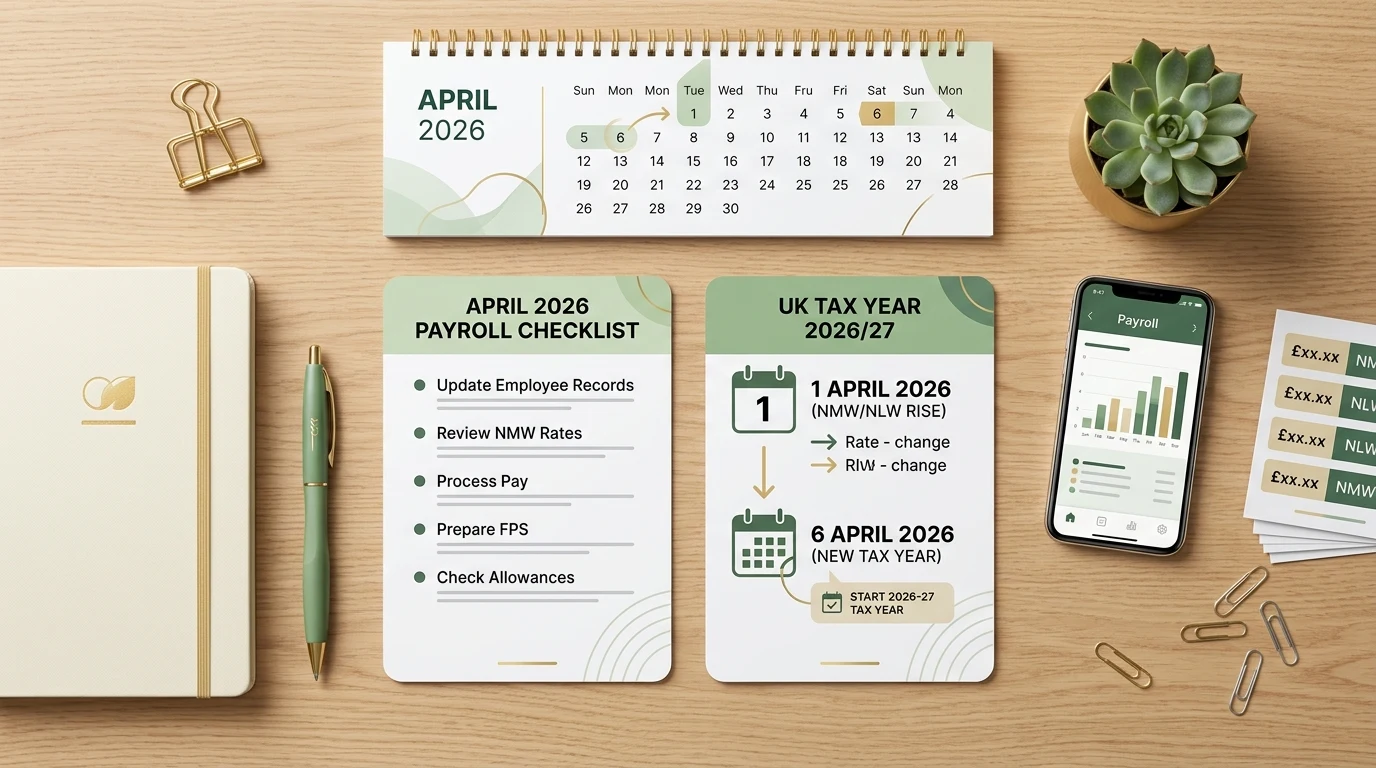
From 1 April 2026, the National Living Wage rises to £12.71 for workers aged 21 and over. The 18 to 20 rate rises to £10.85. The 16 to 17 rate and apprentice rate rise to £8.00. Then from 6 April 2026, the 2026/27 payroll tax settings apply, including employer National Insurance at 15% and an annual secondary threshold of £5,000.
The awkward bit for small employers is the split timing. Wage rates change from 1 April, but the tax year itself changes from 6 April. If your payroll software is not updated cleanly, you can end up with the wrong hourly rate, the wrong NIC setup, or both.
Your April payroll checklist should include:
- check each worker is on the correct age-related minimum wage rate from the first pay reference period beginning on or after 1 April 2026
- update payroll software for 2026/27 tax codes and thresholds
- check student loan and postgraduate loan settings on the first run
- confirm pension contribution percentages still match your current auto-enrolment setup
- schedule the final FPS or EPS for 2025/26 by 19 April 2026
- plan P60 delivery well before 31 May 2026
If you only have one or two staff, it is tempting to think this will take ten minutes. Sometimes it does. Sometimes a stale payroll file or a missed wage-rate update creates an avoidable clean-up job.
Worked example 2: what the April wage rise means in real monthly cost
Assume a café employs 3 team members, each aged 21 or over, each working 35 hours a week.
Old hourly rate from 2025/26:
- £12.21
New hourly rate from 1 April 2026:
- £12.71
Increase per hour:
- £0.50
Extra weekly gross pay cost:
- 3 staff x 35 hours x £0.50 = £52.50
Approximate extra monthly gross pay cost:
- £52.50 x 52 weeks / 12 = about £227.50
That is before employer NIC and pension effects.
Now add a simple employer NIC illustration on the extra pay at 15%:
- £227.50 x 15% = about £34.13
Rough monthly employment cost increase:
- £261.63
That is not catastrophic. It is still worth budgeting for, especially if margins are tight.
Check whether Making Tax Digital for Income Tax applies from 6 April 2026
The biggest structural change in this year’s checklist is for sole traders and landlords. From 6 April 2026, HMRC requires some people with qualifying income over £50,000 from self-employment and property to keep digital records and send quarterly updates using compatible software.
The key point is that the test is based on qualifying income, not profit. That means turnover or gross property income matters here, before expenses are deducted.
If you are already using clean cloud bookkeeping, the jump may feel manageable. If you are still relying on spreadsheets, paper folders, or a January-only tidy-up routine, the change is bigger than it looks.
You should check four things now:
- whether your 2024/25 qualifying income was over £50,000
- whether your current software is compatible with MTD for Income Tax
- whether self-employment and property income are being tracked separately where needed
- who will actually submit quarterly updates, you or your accountant
Do not assume quarterly updates mean quarterly tax payments. They do not. Tax is still finalised through the year-end process, and payment dates still sit where they usually do. The new workload is about records and submissions.

Worked example 3: a sole trader who thought MTD was “for next year”
Assume Lina has:
- self-employment turnover of £44,000 in 2024/25
- property income of £12,500 in 2024/25
- total qualifying income of £56,500
Because the test uses combined qualifying income from self-employment and property, Lina is over the £50,000 threshold for the first wave from 6 April 2026.
If she keeps using a spreadsheet with no compatible filing bridge or accounting software, she now has a compliance problem.
Assume she moves to software costing £22 a month from April:
- annual software cost: £264
That looks like an extra cost. Compare it with the time risk and error risk of trying to patch together quarterly submissions manually, then fixing them later. For most people in scope, buying the right system is cheaper than improvising.
We covered the deeper mechanics in our Making Tax Digital checklist for 2026. Right now, the important question is simpler: are you in, and if you are, is the software ready this week?
Review your director pay plan because 6 April changes the maths again
If you run a limited company, the start of the new tax year is the point to review salary, dividends, pension contributions, and how much cash you want to keep inside the company.
The headline change for many directors is that from 6 April 2026, the dividend ordinary rate rises to 10.75% and the upper rate rises to 35.75%. The dividend allowance stays at £500. On the payroll side, employer NIC remains a real drag where companies cannot use Employment Allowance, which is often the case for single-director companies with no other employees on secondary Class 1 NIC.
That means the old “just do what we did last year” approach deserves a challenge.
For a quick review, check:
- your expected company profit for 2026/27
- whether Employment Allowance is available in your structure
- whether pension contributions from the company would work better than higher dividends
- whether your mortgage or personal income needs point towards a different salary level
- whether retained profits need preserving for VAT, Corporation Tax, or growth plans
If you want the detail, our recent salary vs dividends guide for 2026/27 runs through the numbers in depth. The short version is that the answer is still “it depends”, but the tax cost of getting lazy has gone up.
Check VAT, filing cycles, and cash flow while the quarter turns over
The VAT registration threshold remains £90,000 of taxable turnover on a rolling 12-month basis. That figure has not changed with the new tax year, but April is still a good checkpoint because a lot of businesses see strong year-end billing and then forget to test their rolling turnover properly.
There is also the timing issue. If your VAT quarter ended on 31 March 2026, the return and payment are generally due by 7 May 2026. That deadline comes round quickly after year-end payroll work and new tax-year setup.
If turnover is growing, ask yourself:
- have you checked the rolling 12-month VAT test, not just annual sales
- is your software ready for the next VAT filing period
- have you ring-fenced the VAT cash already collected from customers
- does April include any large contracts that could trigger the 30-day forward look registration test
For businesses close to the line, one calm hour reviewing the figures now is far better than a panicked late registration later. If you need the detail around the rolling test, our VAT registration threshold guide covers it.
Put the next cash obligations in the diary now
The new tax year always feels full of fresh-start energy for about three days. After that, normal trading takes over and deadlines become something you “will deal with next week”.
That is how bills ambush people.
The minimum dates to schedule this month are:
- 19 April 2026 for final FPS or EPS filing for 2025/26
- 22 April 2026 for any postal PAYE, NIC or CIS payments
- 22 May 2026 for electronic PAYE, NIC or CIS payments relating to April
- 7 May 2026 for a VAT return due after a 31 March 2026 quarter end
- 31 May 2026 for P60 delivery
- 31 July 2026 for the second payment on account if your Self Assessment bill requires it
There is nothing clever about this part. Put the dates in the calendar, assign an owner, and make sure the money is there before HMRC asks for it.
A practical ring-fencing rule
If you know you have PAYE, VAT, or Self Assessment payments coming up, move the cash out of your trading balance mentally or physically as soon as the income lands. We often see stress caused not by the size of the tax bill, but by the fact the business spent the money on ordinary running costs first.
The best version of this checklist is a short monthly finance routine
April matters because of the tax-year changeover, but the owners who handle it best are usually the ones who do not rely on April heroics. They keep a steady monthly finance routine.
A sensible routine looks like this:
- bookkeeping updated at least monthly, not yearly
- payroll checked before each run, not after
- VAT reviewed as a rolling turnover test, not a once-a-year thought
- director pay reviewed when circumstances change, not only at year-end
- tax cash ring-fenced as you go
That routine matters more in 2026/27 because HMRC is pushing harder towards digital reporting and cleaner real-time records. Waiting until something becomes urgent is getting less workable every year.
If your systems are still half-manual, April is a good month to fix the plumbing rather than promise yourself that July will somehow be calmer. It usually is not.
FAQ
What is the first thing to do before the new tax year starts?
Finish the old one properly. Reconcile bank accounts, post missing expenses, check payroll year-end figures, and make sure anything belonging to 2025/26 is not drifting into April by accident.
Does Making Tax Digital for Income Tax start on 6 April 2026 for everyone?
No. From 6 April 2026, it starts for sole traders and landlords in scope with qualifying income over £50,000, unless exempt. The threshold is based on qualifying income from self-employment and property, not profit.
What payroll changes do employers need to make in April 2026?
Employers should update minimum wage rates from 1 April 2026, then make sure the payroll software is using the 2026/27 tax-year settings from 6 April 2026. They should also schedule the final FPS or EPS for 2025/26 and plan P60 delivery by 31 May 2026.
Has the VAT registration threshold changed for 2026/27?
The compulsory VAT registration threshold remains £90,000 of taxable turnover. What matters is checking it on a rolling 12-month basis, not just by tax year or accounting year.
Should limited company directors review salary and dividends every April?
Yes, usually. April is the natural point to check salary, dividends, pension contributions, and cash flow because a new tax year starts on 6 April and tax rates or thresholds may have shifted.
Your next step is not to build a perfect finance system in one weekend. It is to clear the crossover tasks that only April can solve, then keep the monthly routine boring enough that January and July stop feeling dramatic.

About Golden Tree Consulting
AAT Licensed | ACCA Affiliated
Golden Tree Accounting & Business Consulting provides expert tax, bookkeeping, and advisory services to sole traders and SMEs across Croydon, London, Surrey, and Kent. With multilingual support and decades of combined experience, we help businesses stay compliant and grow.
More Articles You Might Like
Continue exploring our financial insights

VAT Registration Threshold UK: When to Register, Deadlines, and Worked Examples for 2026
VAT registration threshold UK rules for 2026 explained with deadlines, worked examples, voluntary registration pros and cons, and common mistakes to avoid.

National Minimum Wage Rates April 2026: UK Employer Guide for Payroll and Compliance
National minimum wage rates April 2026 explained for UK employers, with payroll examples, apprentice rules, and common underpayment traps.

Best Accounting Software for Sole Traders UK in 2026: Xero vs QuickBooks vs FreeAgent
Best accounting software for sole traders UK compared for 2026, with MTD readiness, pricing, feature gaps, and which package suits you.