

PAYE Year End Checklist UK 2026: Final FPS, EPS and P60 Deadlines
PAYE year end checklist UK for 2025 to 2026: final FPS and EPS deadlines, P60 tasks, Class 1A planning, and practical steps for small employers.
PAYE Year End Checklist UK 2026: Final FPS, EPS and P60 Deadlines
PAYE year end checklist UK tasks become urgent in March, because the tax year closes on 5 April 2026 and key payroll submissions follow quickly after that. If you run payroll for even one employee, you need to confirm your final Full Payment Submission (FPS), send an Employer Payment Summary (EPS) when needed, and issue P60s by 31 May 2026. Missed dates can trigger penalties, interest, and a lot of avoidable rework.
Most small employers do not get caught out by complicated tax planning. They get caught by timing, incomplete payroll records, or one step that looked optional but was not. A short, practical process now is usually enough to avoid the annual scramble.
Quick summary: close your payroll records before 5 April, file your final FPS by 19 April, submit EPS where required, issue P60s by 31 May, and schedule Class 1A/P11D actions for July.
If you want us to run this process with you, we can support you through our Payroll Services, Bookkeeping Service, and contact page.
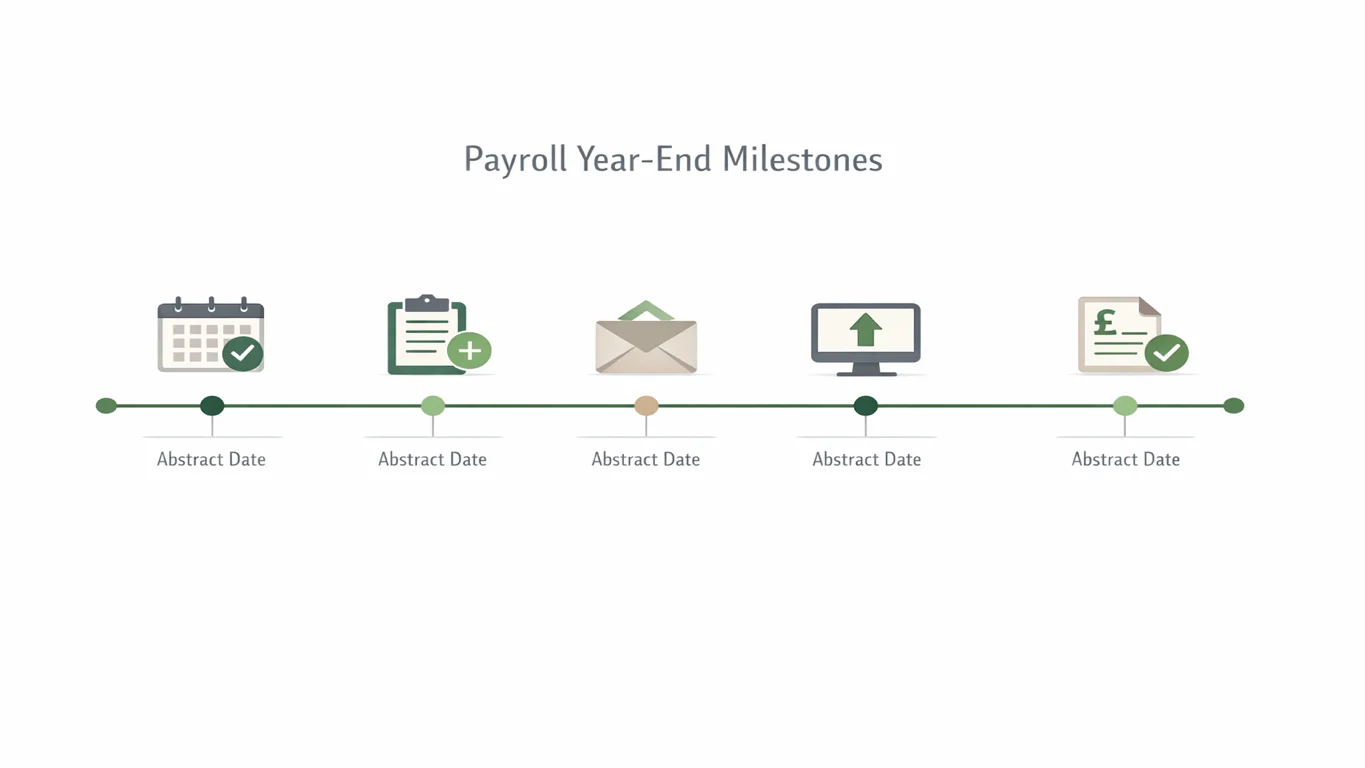
PAYE year-end deadlines for 2025 to 2026
Let us pin down the core dates first.
| Date | What it covers | Action you should take |
|---|---|---|
| 5 April 2026 | End of 2025 to 2026 tax year | Finalise payroll records and year-end checks |
| 6 April 2026 | Start of 2026 to 2027 tax year | Apply new tax codes and settings from first pay run |
| 19 April 2026 | Final FPS or EPS due for 2025 to 2026 | Mark the final submission and file on time |
| 31 May 2026 | P60 deadline | Give P60s to all employees on payroll on 5 April |
| 6 July 2026 | P11D and P11D(b) filing deadline (where applicable) | Report benefits and expenses where required |
| 19 or 22 July 2026 | Class 1A National Insurance payment deadline | Pay Class 1A NIC due on benefits |
HMRC’s employer guidance confirms the year-end timeline and filing responsibilities:
Worth saying clearly, the 19 April filing date is close to year-end. If your payroll data is not clean by 5 April, everything becomes rushed.
What has to be correct before you file the final FPS
A final FPS is not just another monthly run with a different label. HMRC treats it as the closing submission for the tax year, so the numbers need to tie up.
Before you file, check:
- year-to-date taxable pay and tax for every employee
- National Insurance category letters and year-to-date NI values
- statutory payments recovered, if any
- leavers and starters coded in the right period
- any benefits already payrolled through the year
Payroll software can catch obvious errors, though software does not know your real-world context. If a director bonus was posted to the wrong period or a leaver payment was missed, the system may still accept the file while your year-end figures drift.
A quick payroll reconciliation can save days in May and June.
Final FPS vs EPS in plain English
A lot of employers ask whether they need both a final FPS and an EPS. Fair question, because the answer depends on your payroll position.
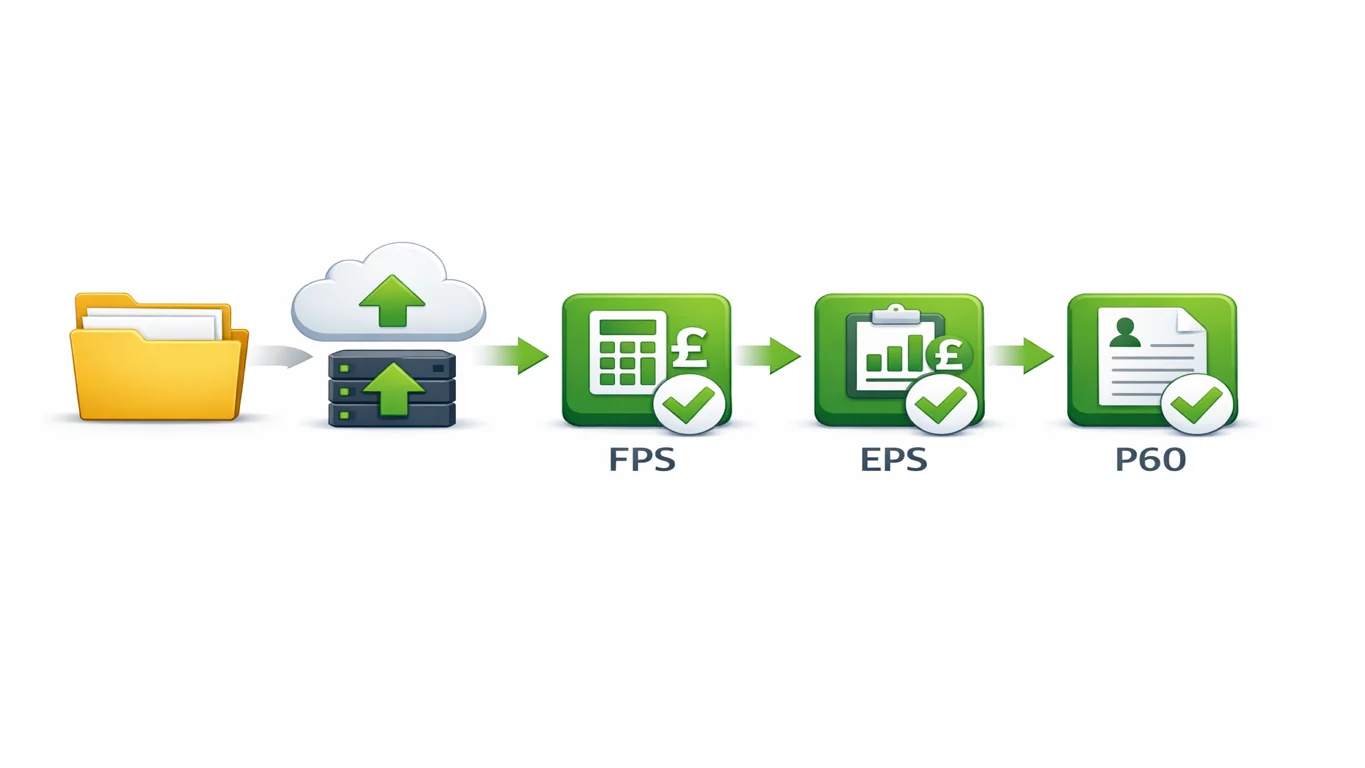
- FPS reports employee payments and deductions for the period
- EPS reports values that are not in the FPS, such as statutory payment recovery or apprenticeship levy details, and can also notify HMRC if no payments were made
For many employers, year-end means filing a final FPS and, where relevant, an EPS as well.
Worked example 1: when an EPS is still needed after the final FPS
Assume your March payroll includes:
- gross pay: GBP 18,500
- PAYE tax deducted: GBP 2,940
- employee NI: GBP 1,410
- employer NI: GBP 1,690
During the year, you also recovered statutory maternity pay of GBP 1,250.
Your final FPS reports pay and deductions. Recovery values are reported through EPS. If the EPS is missed, HMRC can overstate your PAYE bill by the unrecovered amount.
In this simple case, missing the EPS can leave your account looking around GBP 1,250 higher than it should be until corrected.
That is not a theoretical issue. We see it every year with otherwise well-run businesses.
A practical March checklist for small employers
March is where good intentions need to turn into booked actions. Here is the checklist we use with clients.
1) Reconcile payroll to your books
Match year-to-date payroll totals against your bookkeeping ledger and payroll control accounts.
Even a small mismatch should be explained now, while records are fresh.
2) Confirm leavers, starters, and irregular payments
Check employee status and one-off payments. Directors paid quarterly or annually often create timing mistakes.
3) Validate statutory payment records
If you recovered statutory maternity, paternity, adoption, or parental bereavement pay, make sure values are complete and ready for EPS reporting.
4) Check tax code updates for the new tax year
From 6 April, your first payroll run in 2026 to 2027 should use the right code basis from HMRC guidance.
5) File final FPS and EPS by 19 April
Do not leave filing to the final evening. Portal logins, payroll file errors, and sign-off delays always seem to happen at the worst time.
6) Issue P60s by 31 May
Every employee still on payroll at 5 April needs a P60. Build this into your May process now, not as an afterthought.
Worked example 2: late filing costs can grow quickly
Let us use a realistic late-filing scenario for a small company with 7 employees.
Assume:
- final FPS due: 19 April 2026
- submission actually filed: 4 June 2026
- PAYE due for period: GBP 6,800
Potential impact:
- HMRC late filing penalty exposure, depending on filing history and frequency
- interest on any late paid PAYE amount
- internal admin cost to investigate notices and align payroll records
Now compare that to prevention cost.
If a payroll manager spends 90 minutes in late March and 45 minutes in early April on year-end checks, that can avoid weeks of back-and-forth later. For many businesses, the admin time saved is worth more than the headline penalty amount.
Your exact penalty position depends on filing pattern, size, and history, so treat this as a planning example rather than a fixed bill.
P60s: what employers often get wrong
P60s sound simple until they are left too late.
The basic rule is clear. If an employee is employed by you on 5 April, they need a P60 by 31 May.
Common mistakes include:
- assuming a leaver in April still needs a P60 from that employer
- issuing a draft P60 before final payroll corrections
- forgetting directors with irregular pay patterns
- treating the P60 step as optional because employees can see figures online
HMRC’s P60 page is short and worth bookmarking:
Worked example 3: who gets a P60 in a mixed workforce
Assume your payroll has 5 people around year-end:
- Employee A: on payroll all year and still employed on 5 April
- Employee B: leaves on 20 March
- Employee C: starts on 1 April and is employed on 5 April
- Director D: paid quarterly and still employed on 5 April
- Employee E: leaves on 8 April
Who should get a P60 from you?
- A: Yes
- B: No, usually P45 route applies on leaving
- C: Yes
- D: Yes
- E: Yes, because employed on 5 April
Result: 4 P60s due by 31 May.
Small edge cases like this are exactly where employers lose time in May.
2026 to 2027 setup: what to check from 6 April
After closing 2025 to 2026, you need a clean handover into the new year.
Focus on:
- updated tax codes and code basis from HMRC guidance
- NI thresholds and payroll settings for the new year
- student loan and postgraduate loan deduction settings
- director NI calculation method carried forward correctly
- pension contributions and salary sacrifice settings
Do not assume your software has every rule right by default. Check release notes and run a test payroll if you can.
HMRC publishes annual employer rates and thresholds, and those values should be part of your April payroll review:
How this links to benefits reporting and July deadlines
Year-end PAYE work in April is one part of the wider employer compliance cycle.
If your business provides taxable benefits, keep July in view while closing April tasks:
- P11D and P11D(b) filing deadline is usually 6 July
- Class 1A NIC payment follows on 19 July by post or 22 July electronically
That timing matters for cash flow. Teams often focus on April and forget that July can bring another compliance peak.
If you need context on benefit reporting choices, we recently covered payrolling benefits in kind and the 2026 deadline window in detail:
The process we recommend for owner-managed businesses
Owner-managed companies are usually balancing payroll, bookkeeping, VAT, and director tax at the same time. Year-end payroll works better when it is one joined-up process, not a series of isolated tasks.
Our practical sequence is:
- close bookkeeping month by month until March is complete
- run payroll reconciliation and correct material issues
- file final FPS and any required EPS early in April
- issue P60s in the first half of May
- schedule July benefits and Class 1A tasks in the diary now
That gives you fewer surprises and better numbers for planning dividends, pension contributions, and cash reserves.
If you want support with the whole cycle, start with our Payroll Services, Company Accounts support, or book a review via our contact page.
FAQ: PAYE year end checklist UK
What is the final submission deadline for payroll year-end 2025 to 2026?
The final FPS or EPS for the 2025 to 2026 tax year is generally due by 19 April 2026.
Do I always need to file an EPS at year-end?
Not always. You file an EPS when information is needed that is not included in FPS submissions, such as statutory payment recovery or no-payment notifications.
Who must receive a P60?
Employees who are employed by you on 5 April must receive a P60 by 31 May.
What if I discover an error after filing the final FPS?
Do not ignore it. Review the payroll record and use the appropriate correction route in your payroll software and HMRC process as soon as possible.
Are rates and thresholds the same every year?
No. HMRC can update rates, thresholds, and guidance each tax year. Check current-year publications before your first pay run in April.
Is this personal tax advice?
No. This guide is general information for UK employers. Your payroll and tax position depends on your circumstances, so take tailored advice before acting on complex points.
Close your year-end payroll before it becomes urgent. If your final FPS, EPS, and P60 plan is not already scheduled, put the dates in your calendar today and assign clear ownership for each step.

About Golden Tree Consulting
AAT Licensed | ACCA Affiliated
Golden Tree Accounting & Business Consulting provides expert tax, bookkeeping, and advisory services to sole traders and SMEs across Croydon, London, Surrey, and Kent. With multilingual support and decades of combined experience, we help businesses stay compliant and grow.
More Articles You Might Like
Continue exploring our financial insights

Payrolling Benefits in Kind UK: 5 April 2026 Deadline Guide for Employers
Payrolling benefits in kind can cut year-end admin. Use this UK guide to meet the 5 April 2026 deadline, avoid P11D mistakes, and plan Class 1A NICs.
National Minimum Wage Rates April 2026: UK Employer Guide for Payroll and Compliance
National minimum wage rates April 2026 explained for UK employers, with payroll examples, apprentice rules, and common underpayment traps.

Salary vs Dividends UK 2026/27: Director Tax Guide for the New Tax Year
Salary vs dividends UK 2026/27 explained for directors, with new dividend tax rates from 6 April 2026, worked examples, and practical planning tips.