HMRC Time to Pay for Self Assessment: 31 July 2026 Guide
HMRC Time to Pay for Self Assessment explained before 31 July 2026, including payment plans, interest, examples and what to prepare.
 Golden Tree Accounting 29 July 2026 10 min read
 On this page Show
The HMRC Time to Pay question becomes urgent when your second Self Assessment payment on account is due on 31 July 2026 and the money is still in your customers’ hands, stock, or next month’s expected income. HMRC has said that customers can set up weekly or monthly payment plans, but a plan is not a button to press instead of checking the figure. You need to separate three very different situations: an amount that is wrong, an amount that is right but unaffordable this week, and a future bill you want to fund before it lands.
That distinction can save you from making the wrong request. A genuine drop in profits might justify reducing a payment on account. A correct tax bill that you cannot meet in full may call for a Time to Pay arrangement. If you are already up to date and simply want January to feel less brutal, a Budget Payment Plan may be the calmer option.
Quick summary: the second Self Assessment payment on account is due by midnight on 31 July 2026. HMRC says each payment is usually half of the previous year’s tax bill. If the bill is right but you cannot pay in full, use HMRC’s payment-plan eligibility service or contact HMRC early with a realistic proposal. Interest can still apply. If the bill will genuinely be lower, consider a payment-on-account reduction instead.
Our Self Assessment service, bookkeeping support, and contact page are useful if the due figure, records or cash forecast need checking before you make a commitment.
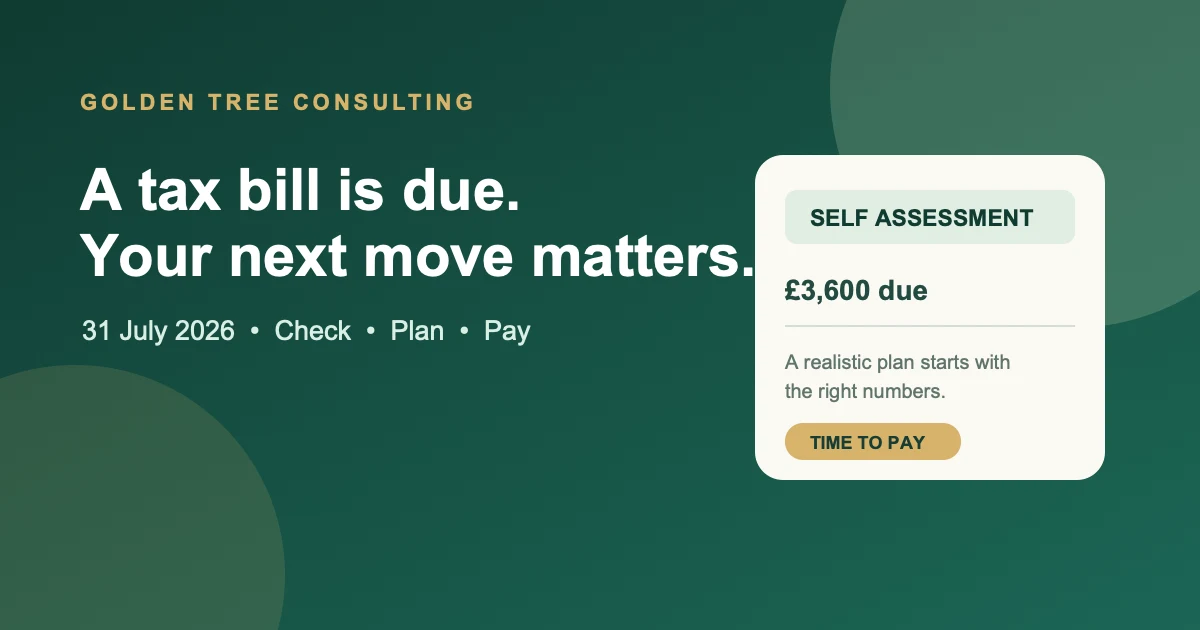
HMRC Time to Pay for Self Assessment: what it does
Time to Pay is HMRC’s name for an arrangement to clear tax debt over time. It is an agreement, not an automatic right and not a tax reduction. GOV.UK says you may be able to set up a plan for an overdue tax bill in monthly instalments. The online service checks eligibility. Where that route does not fit, HMRC asks about the amount you can repay each month, income, regular spending, other taxes, savings and investments.
For a sole trader, freelancer or landlord facing 31 July, the practical point is to act before an ignored bill turns into a more difficult conversation. HMRC’s June 2026 reminder says payments already made through monthly or weekly plans count towards the next Self Assessment bill. That is helpful, but it does not change the legal due date or make late tax cheap.
HMRC’s payment-plan guidance says it expects savings or assets to be used to reduce the debt as much as possible. Company debts can involve a deeper review of stock, vehicles, shares, lending and the director’s proposal. Keep the request factual. A promise that looks generous on Tuesday and fails in August is worse than a smaller payment you can actually maintain.
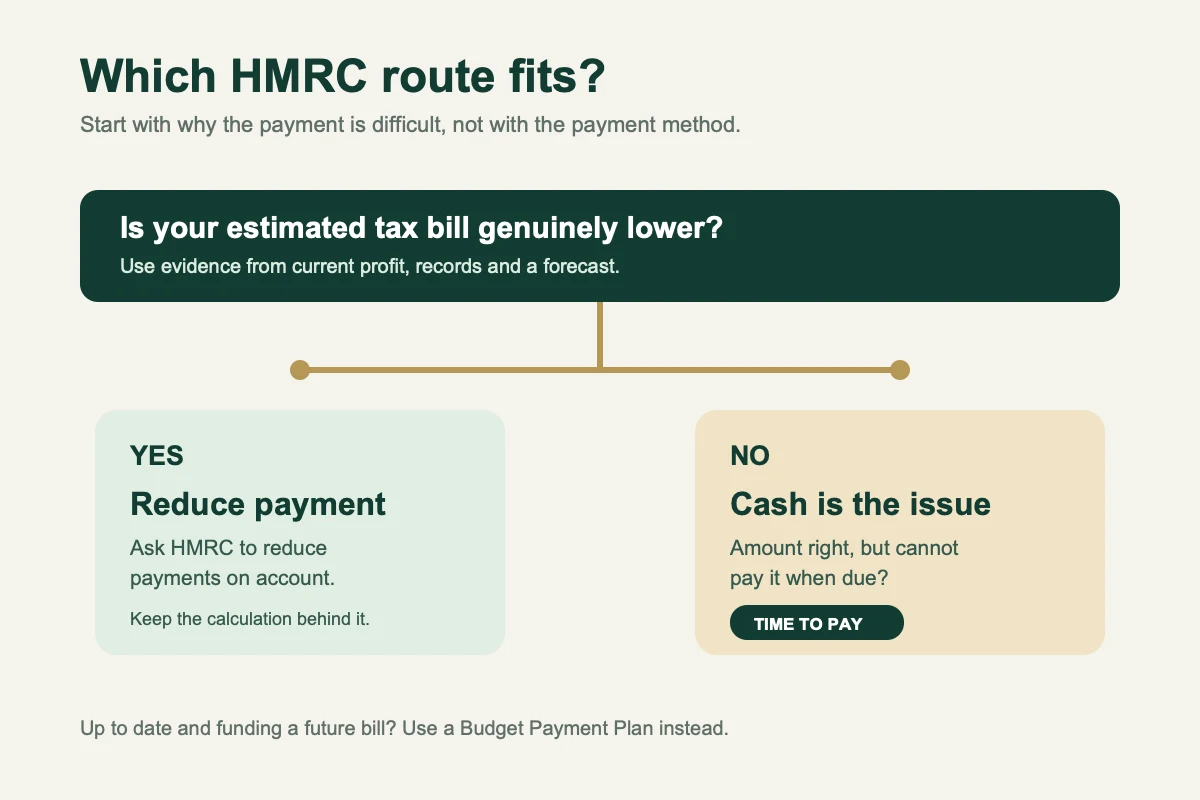
Reduce the payment, arrange a plan, or prepay?
The same £3,000 statement can lead to three different actions. The right choice depends on why the cash is short, not how frustrating the number feels.
| Your position | Better starting point | Why it fits |
|---|---|---|
| 2025/26 profits are genuinely lower than the prior year | Ask HMRC to reduce payments on account | The estimated tax liability may be lower |
| The amount is right but cash will not cover it on 31 July | Explore Time to Pay | You are dealing with a payment problem, not changing the tax calculation |
| You are up to date and want to build towards January 2027 | Use a Budget Payment Plan | It allows weekly or monthly Direct Debit payments against a future bill |
HMRC says you can reduce payments on account online or using form SA303. You need to give the amount you expect to make. Do not reduce a payment merely to get through a tight month. If the final bill is higher than expected, HMRC charges interest on the shortfall. You can read the official payments-on-account rules before changing the figure.
Worked example 1: a lower-profit year
Sam’s 2024/25 Self Assessment bill was £8,000, so his two 2025/26 payments on account are normally £4,000 each. He paid the first £4,000 in January 2026. By July, he has stopped one major contract and his latest records suggest a total 2025/26 bill of £5,000, rather than £8,000.
If that forecast is reasonable, total payments on account of £5,000 would cover the estimated bill. Sam has already paid £4,000, so he might ask to reduce the July payment to £1,000. He should keep the forecast, bank records and bookkeeping behind that estimate. A round number picked because £4,000 is unwelcome is not evidence.
Worked example 2: a correct bill and a late-paying client
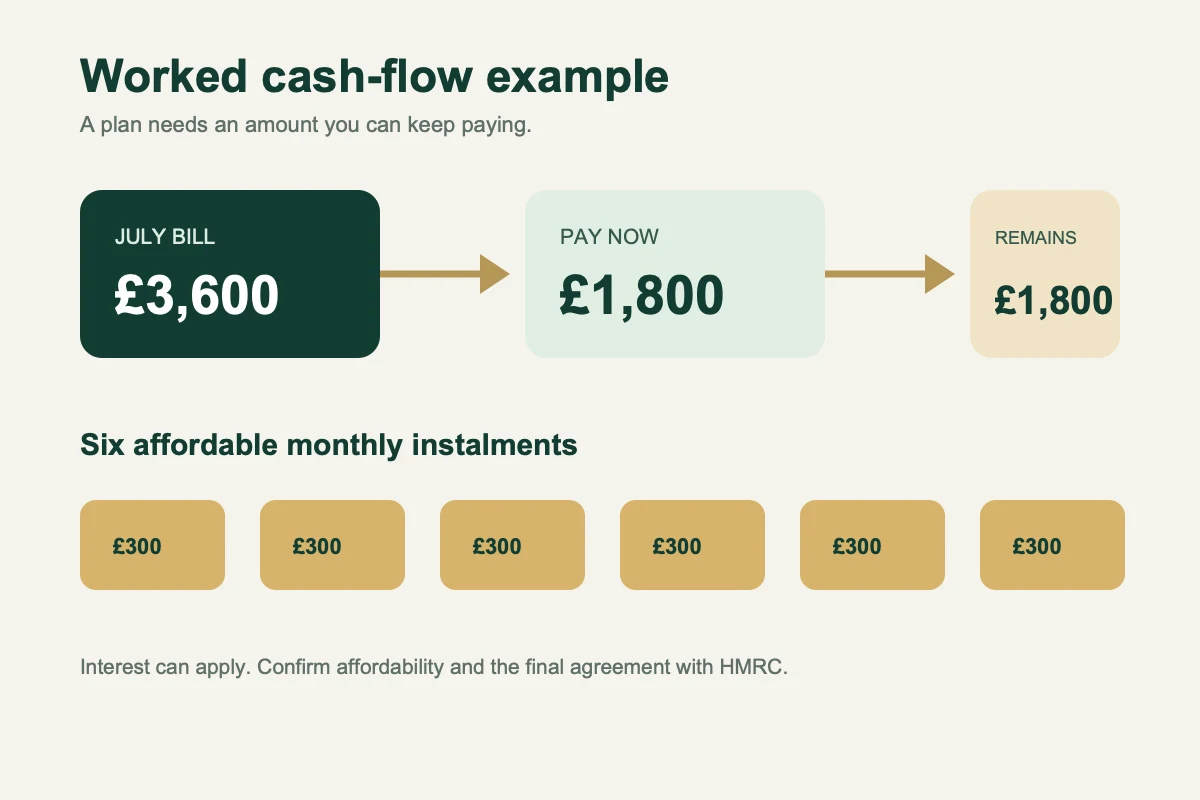
Maya’s July payment on account is £3,600. Her business has traded as expected, so there is no sound basis to reduce it. A client will pay a £2,400 invoice in late August and she has only £1,800 available after rent, payroll and essential supplier costs.
Maya can pay £1,800 now and prepare a proposal for the remaining £1,800. If she offered six equal monthly instalments, the starting calculation would be £300 per month, before allowing for interest and any other liabilities. HMRC will assess affordability using her actual circumstances. The useful preparation is a cash forecast that shows why £300 works and £600 does not.
Worked example 3: avoiding a repeat January shock
Owen is up to date with his previous Self Assessment bill and expects a £6,000 bill for 2026/27. He has six months from August to January in which he can set money aside. A £1,000 monthly Budget Payment Plan would build the full £6,000 before the deadline, assuming his estimate remains right.
That arrangement is for a future bill. It is not Time to Pay, and it does not solve a balance already due. GOV.UK says a Budget Payment Plan can be paused for up to six months, but a pause also leaves less paid towards the eventual bill. Treat it as a tax reserve on autopilot, then review the amount after a profitable or quiet quarter.
What to prepare before you apply
HMRC does not need a polished business plan. It does need a credible picture of what you owe and what you can pay. Get the basic numbers together first, especially if you may need to speak to an adviser rather than use the online route.
| Bring or calculate | What it helps establish |
|---|---|
| Self Assessment statement and UTR | The exact balance and the tax reference HMRC needs |
| Bank balances and money due from customers | What can be paid now and when cash may arrive |
| Income and essential monthly spending | An affordable instalment figure |
| Other tax dates, VAT, payroll and loan commitments | Whether the proposal creates a new missed payment next month |
| Savings, investments and available assets | HMRC’s guidance says these may need to reduce the debt |
| A 13-week cash forecast | Whether the plan works after the first instalment |
The request should be based on cleared or near-certain cash, not the best possible sales month. Add up rent, household costs, payroll, core suppliers and debt repayments. Then check what remains. GOV.UK says HMRC will usually ask for around half of the monthly amount left after living costs and fixed outgoings, although every case depends on its own facts. Paying debt faster can reduce the interest you pay in total.
Interest, missed instalments and the cost of waiting
A payment arrangement does not freeze the bill. HMRC’s published rate for late payment interest on Income Tax and National Insurance is 7.75% from 9 January 2026. The rate is linked to the Bank of England base rate and can change, so check HMRC’s current interest-rate page before relying on any illustration.
For a simple sense check, interest at 7.75% a year on an unpaid £1,800 is about £139.50 over a full year if the balance did not reduce. In a real instalment plan the balance normally falls each month, so the interest would usually be lower than that rough ceiling. It still explains why a six-month plan costs less than leaving the same debt untouched for a year.
HMRC says you should contact it if anything changes that affects the plan. If you miss a payment, it will contact you to understand why and may be able to rearrange or renegotiate the plan. Do not ignore that contact. A changed cash position is a reason to talk, not a reason to cancel the Direct Debit and hope the account goes quiet.
There is another cost to delaying a valid payment-on-account reduction. If profits really have fallen, interest can build because you have paid too much late only if the calculation is justifiably reduced. Get the distinction right. Ask for a reduction when the tax estimate is lower; ask for time when the tax estimate is right and the cash is not there.
A practical 48-hour checklist before 31 July
With the deadline this close, aim for one clear decision rather than a last-minute scramble across several accounts.
- Sign in to your Self Assessment account and check the statement, amount due and payment reference.
- Compare the July payment with your latest profit forecast. Record why any reduction would be justified.
- If the figure is right, decide how much you can pay immediately without missing wages, rent or vital operating costs.
- Use HMRC’s online payment-plan eligibility service. If it cannot offer a route, prepare the income, spending and cash-flow information for a call.
- Keep a record of the agreement, payment dates and Direct Debit amount.
- Put the next review date in the diary. A plan that was affordable in July may need changing after a client pays late or a large VAT bill appears.
Our payment-on-account guide explains how the July figure is calculated. If your records are behind, we can also help bring the bookkeeping up to date before the next tax decision. Bring the HMRC statement, your bank position and a short list of expected receipts. That is enough to start an honest conversation about the sensible next move.
FAQ: HMRC Time to Pay for Self Assessment
Can I set up an HMRC Time to Pay arrangement for Self Assessment?
You may be able to arrange monthly instalments for an overdue tax bill. Start with HMRC’s online eligibility service. If it is not suitable, HMRC will need a realistic picture of your income, spending, other taxes, savings and the amount you can repay monthly.
Does Time to Pay stop HMRC interest?
No. The arrangement can spread the debt, but interest can still apply to the unpaid amount. HMRC’s main late-payment interest rate was 7.75% from 9 January 2026, and the rate may change.
Can I reduce my July payment on account because money is tight?
Only reduce it if you reasonably expect your total tax liability to be lower than the previous year’s basis. If money is tight but the amount is correct, ask HMRC about a payment plan instead. An excessive reduction can lead to interest on the difference.
Is a Budget Payment Plan the same as Time to Pay?
No. A Budget Payment Plan is for making regular Direct Debit payments towards a future Self Assessment bill when you are up to date with the previous one. Time to Pay is for an amount you cannot pay when due.

About Golden Tree Consulting
ACCA Affiliated | MBA Qualified
Golden Tree Accounting & Business Consulting provides expert tax, bookkeeping, and advisory services to sole traders and SMEs across Croydon, London, Surrey, and Kent. With multilingual support and decades of combined experience, we help businesses stay compliant and grow.
Offices in Croydon and London Bridge.
Related guides
Self Assessment Payment on Account 31 July 2026: What to Pay and When
Self Assessment payment on account 31 July 2026 explained, with calculations, reduction rules, late interest, and cash-flow planning.

How to Get Your UTR Number: Online in 72 Hours or by Post
How to get a Unique Taxpayer Reference (UTR) in the UK: register for Self Assessment online and get it within 72 hours, where to find a UTR you already have, company UTRs and what to do if it has not arrived.

Crypto Tax UK 2026: Capital Gains, Staking Income and HMRC Records
Crypto tax UK 2026 explained with Capital Gains Tax rates, staking and mining income, exchange records, reporting routes and worked examples.