

VAT Return Deadline 7 May 2026: How to Submit Your UK VAT Return
VAT return deadline 7 May 2026 explained, with a step-by-step guide to submit your UK VAT return, avoid penalties, and fix common errors.
VAT Return Deadline 7 May 2026: How to Submit Your UK VAT Return
The VAT return deadline for the quarter ended 31 March 2026 falls on 7 May 2026, which gives small business owners a fairly short run-up after the tax year crossover. If your records are still untidy from March, or you are trying to piece the numbers together from bank entries and memory, this is the point where a routine VAT job turns into an annoying one.
For most VAT-registered businesses, the rule is straightforward. Your VAT Return and any payment are usually due one calendar month and 7 days after the end of the accounting period. If your quarter ended on 31 March 2026, HMRC expects the return to be submitted and the payment to clear by 7 May 2026.
Quick summary: if your VAT quarter ended on 31 March 2026, you usually need to file and pay by 7 May 2026. You must submit through Making Tax Digital compatible software, even if the return is nil. If you file late, quarterly filers can pick up penalty points, and once you reach the threshold the charge is £200 for that late return, then £200 again for later late submissions while you stay at the threshold.
If you want us to review the figures before you file, we can help through our VAT returns service, bookkeeping service, and contact page.
VAT return deadline 7 May 2026: who this applies to
The guide is aimed at businesses on a normal quarterly VAT cycle where the accounting period ended on 31 March 2026. For that group, the filing deadline is usually 7 May 2026.
HMRC says most VAT-registered businesses submit returns every 3 months. It also says you must submit a VAT Return even if you have no VAT to pay or reclaim. That catches people out more often than it should. A quiet quarter is still a quarter that needs a return.
You should also keep one practical distinction in mind:
- the quarter end is 31 March 2026
- the filing deadline is 7 May 2026
- the payment deadline is also usually 7 May 2026
- the payment needs time to reach HMRC’s account, so leaving it until the final evening is not a clever plan
If your business uses the Annual Accounting Scheme, has a special stagger, has cancelled VAT registration, or has an exemption from Making Tax Digital for VAT, the process can differ. For most ordinary quarterly filers, though, 7 May 2026 is the date that matters.
Official HMRC guidance is clear on two points. The deadline is normally one calendar month and 7 days after the accounting period ends, and VAT-registered businesses must usually file even if the return is nil.
Useful HMRC pages:
- Sending a VAT Return: what to include
- Sending a VAT Return: how to send your return
- Late returns and payment for VAT
- Correct errors in your VAT Return
Why this May deadline catches people after the tax-year rush
The awkward thing about a 7 May VAT return deadline is timing. You have just been through the end of the tax year on 5 April, the new tax year started on 6 April, and many employers are also dealing with April payroll updates, final FPS or EPS work, and wage-rate changes.
That is why VAT returns for the quarter ending 31 March often get treated as a side task. They are not really a side task. If March bookkeeping is incomplete, the VAT return is incomplete too.
Good monthly processes pay for themselves here. If your bank is reconciled, purchase invoices are posted, and sales are already in the software, filing the return is mostly a checking exercise. If receipts are still in a drawer and two supplier bills are sitting in somebody’s inbox, filing becomes guesswork. HMRC does allow estimated figures only if you ask permission and have a good reason. That is not the same as deciding to hope for the best.
If your records still feel messy after the April crossover, it is worth reading our new tax year checklist for small business owners alongside this guide. The two jobs are linked more closely than many businesses think.
What needs to go into a VAT Return
HMRC says your return needs to include:
- your total sales and purchases
- the amount of VAT you owe
- the amount of VAT you can reclaim
- the amount HMRC owes you, if you are reclaiming VAT on business expenses
For day-to-day filing, most owners think in terms of the VAT boxes rather than the wording above. That is sensible, because the box layout gives you a cleaner sense-check before you click submit.
| VAT Return box | What usually goes in it | Quick sense-check |
|---|---|---|
| Box 1 | VAT due on sales and other outputs | If all sales are standard-rated, this is often 20% of box 6 |
| Box 4 | VAT reclaimed on purchases and inputs | Check large claims against invoices and import entries |
| Box 5 | Net VAT to pay to HMRC or reclaim | Usually box 3 minus box 4, often calculated by software |
| Box 6 | Total sales excluding VAT | Should match turnover for the VAT period, not cash received outside the scheme rules |
| Box 7 | Total purchases excluding VAT | Do not confuse net and gross figures |
If you are registered in Northern Ireland and have relevant EU sales, there can be extra reporting on top. If you are a straightforward UK services or goods business, boxes 1, 4, 5, 6, and 7 are usually where most of the checking time goes.
One small but useful HMRC check is worth keeping in your notes. VAT Notice 700/12 says that if all your outputs are standard-rated, box 1 should be 20% of box 6. That is not a magic formula for every business, but it is a handy red-flag test.

How to submit your VAT Return without last-minute panic
Right, so let us treat this like we are sitting with you at the desk the week before filing.
1. Reconcile the bookkeeping first
Before you even look at the VAT screen, make sure:
- bank accounts for the quarter are reconciled
- all sales invoices for January to March are posted
- supplier bills and receipts for the same period are posted
- any credit notes are entered
- VAT rates and VAT codes are correct
It sounds obvious. It is still the step that gets skipped.
2. Check whether any March transactions belong in a different VAT period
Timing errors are common around quarter end. The right VAT period depends on your VAT accounting method and tax point rules. A sale raised on 31 March 2026 is not the same thing as cash received on 4 April 2026 if you are not on cash accounting.
If you are unsure whether your scheme affects the timing, stop and check before filing. It is easier to pause for twenty minutes than to correct a return afterwards.
3. Review the draft return box by box
Do not just look at the final number. Check the components.
- Does box 6 look broadly right against turnover for the quarter?
- Does box 7 include genuine business purchases only?
- Does box 4 include input VAT you are entitled to reclaim?
- Does box 1 make sense when compared with your sales mix?
If one box is oddly high or low, there is usually a reason. Sometimes the reason is perfectly legitimate. Sometimes someone coded zero-rated income as standard-rated, or posted a supplier bill gross instead of net.
4. Check import VAT and unusual items separately
If you imported goods and are using postponed VAT accounting, make sure the figures tie back to the import paperwork and statements. HMRC allows you to declare import VAT and reclaim it on the same VAT Return through postponed VAT accounting, but only if the records are there.
Unusual adjustments deserve the same care. Partial exemption adjustments, reverse charge transactions, or one-off asset purchases are exactly the sort of entries that should be checked twice.
5. Submit through Making Tax Digital compatible software
HMRC says you must submit your VAT Return using accounting software that is compatible with Making Tax Digital. If you use spreadsheets, the route is usually a spreadsheet plus bridging software, not manual retyping into an old online form.
Paper filing is only available in limited situations, such as an approved exemption from Making Tax Digital for VAT, cancellation of VAT registration, or some insolvency cases.
6. Pay in time for the funds to clear
Do not treat submission and payment as separate jobs with separate urgency. For most businesses they share the same date, and HMRC says you need to allow time for the payment to reach its account. That means the real working deadline for payment can be earlier than the date printed on the return.
Worked example 1: how the VAT payable figure is built
Assume a small marketing agency has the following figures for the quarter ended 31 March 2026:
- standard-rated sales excluding VAT: £18,000
- VAT charged on those sales: £3,600
- standard-rated purchases excluding VAT: £5,500
- VAT on those purchases: £1,100
The return would broadly look like this:
- Box 1: £3,600
- Box 4: £1,100
- Box 5: £2,500 payable to HMRC
- Box 6: £18,000
- Box 7: £5,500
The calculation is simple enough:
- output VAT due: £3,600
- less input VAT reclaimed: £1,100
- net VAT payable: £2,500
That is the number many owners jump straight to. The better habit is to look at the sales and purchase figures underneath it first. If box 6 suddenly shows £24,000 when turnover for the quarter should be about £18,000, the problem is not the final net figure. The problem is that something was posted wrongly before you ever reached box 5.
Worked example 2: why a nil return still matters
Assume a consultant remained VAT-registered during the quarter but had:
- £0 standard-rated sales
- £0 VAT charged
- £0 purchases with reclaimable VAT
That still does not mean “nothing to do”.
HMRC says VAT-registered businesses must submit a VAT Return even if there is no VAT to pay or reclaim. So the consultant still needs to file on time. If they miss the deadline because they assumed a nil quarter could be ignored, they can still receive a penalty point for a late return.
For quarterly filers, the penalty point threshold is 4 points. Once that threshold is reached, the next late submission triggers a £200 penalty, and later late submissions while still at the threshold can trigger another £200 each time.
There is nothing dramatic about a nil return. That is exactly why people forget it.
Common VAT return mistakes we see before the May deadline
Most VAT problems at this stage are not exotic. They are ordinary admin errors with annoying consequences.
Mixing up gross and net amounts
That is one of the oldest mistakes in the book. A supplier invoice for £1,200 including VAT is not a £1,200 net purchase with £240 extra VAT on top. If the gross figure is £1,200, the VAT element at the standard rate is £200 and the net amount is £1,000.
Get that wrong across a batch of bills and the return starts drifting quickly.
Claiming input VAT without the right evidence
If the invoice is missing, or it is not a valid VAT invoice where one is required, input tax recovery can become shaky. This is one of those areas where the practical answer is dull but dependable: keep the paperwork tidy and close to the transaction.
Posting personal spending through the business
A director buying groceries on the company card does not magically turn them into business costs. It does, however, make the VAT review longer and more irritating than it needed to be.
Using estimates because the books are late
HMRC says you should ask permission if you need to use estimated figures and you must have a good reason. Filing a guessed return because the books are not ready is not a process; it is just risk with extra steps.
Forgetting that all VAT-registered businesses usually need MTD-compatible filing
The old VAT online account route is not the default filing method anymore for ordinary VAT-registered businesses. HMRC says all VAT-registered businesses should now be signed up for Making Tax Digital for VAT and must use compatible software to keep records and file returns.
If you are still building a process around spreadsheets, it is worth checking whether your setup uses proper bridging software and digital links. We covered the registration side separately in our VAT registration threshold guide. Once you are registered, the filing workflow matters just as much.

Worked example 3: spotting an error after submission
Say you submit your return on 5 May 2026 and then discover on 20 May 2026 that one purchase invoice was missed. The missing reclaimable input VAT is £2,400.
HMRC says you can correct errors in returns for the previous 4 years in your next VAT Return if the net value of the errors is:
- £10,000 or less, or
- between £10,000 and £50,000 but less than 1% of the total value of your sales
In this example, £2,400 is below £10,000, so the business would usually correct it on the next return rather than making a separate report to HMRC.
Now change the facts. Suppose the net error is £18,000, and total sales are £3,000,000. One per cent of sales is £30,000, so an £18,000 net error is still below the 1% test. That sort of error can also usually go through the next return.
If the net error is over £50,000, or over £10,000 and more than 1% of sales, HMRC says you must tell it separately. Deliberate errors must also be reported separately. This is one of those areas where the rules get a bit fiddly, so if the numbers are large, get somebody to review them before you decide how to correct them.
What happens if you miss the VAT return deadline
Since 1 January 2023, VAT late submission penalties have run on a points-based system for accounting periods starting on or after that date.
For quarterly VAT returns:
- each late return gives you 1 penalty point
- the threshold is 4 points
- once you hit the threshold, a late return triggers a £200 penalty
- while you remain at the threshold, each further late submission can trigger another £200
Late payment is treated separately. HMRC says the penalty amount increases after 16 days and again after 31 days, and late payment interest runs from the first day the payment is overdue until it is paid in full.
That separation matters. You can file on time and still face charges if the payment arrives late. Or you can owe nothing, file late, and still build penalty points because the return itself was late.
If cash flow is the issue, act early rather than waiting for letters. HMRC explicitly says you should contact it as soon as possible if you are having difficulty paying by the deadline.
A simple checklist for the week before 7 May 2026
Use this as a short working list, not a heroic personal challenge:
- Reconcile the bank and check all January to March transactions are posted.
- Review sales invoices, credit notes, and purchase bills for missing items.
- Check VAT codes, especially for unusual or one-off transactions.
- Review boxes 1, 4, 5, 6, and 7 for anything that looks odd.
- Confirm import VAT or postponed VAT accounting entries if relevant.
- Submit through MTD-compatible software.
- Schedule payment early enough to clear HMRC’s account by 7 May 2026.
- Save the submission receipt and payment confirmation.
If that list feels longer than it should, the real fix is often not “try harder in May”. It is better monthly bookkeeping. Our bookkeeping service and VAT returns service are designed to make this a routine filing job rather than a quarterly scramble.
FAQ: VAT return deadline and filing
What is the VAT return deadline for the quarter ending 31 March 2026?
For most quarterly VAT-registered businesses, the return and payment are due by 7 May 2026.
Do I need to submit a VAT Return if I have nothing to pay?
Yes. HMRC says VAT-registered businesses must submit a VAT Return even if there is no VAT to pay or reclaim.
Do I have to use software to submit my VAT Return?
Usually, yes. HMRC says you must submit using Making Tax Digital compatible software, unless you are in a limited exception such as an approved exemption, VAT deregistration, or some insolvency cases.
What happens if I submit a quarterly VAT Return late?
You normally receive a penalty point for each late quarterly return. The threshold for quarterly filers is 4 points. Once you reach the threshold, a late return can trigger a £200 penalty, with further £200 penalties for later late submissions while you remain at the threshold.
Can I correct a VAT mistake on my next return?
Often, yes. HMRC says you can usually correct errors from the previous 4 years on the next return if the net value is £10,000 or less, or up to £50,000 if it is less than 1% of total sales. Larger or deliberate errors must be reported separately.
What is the most useful thing to do this week?
Finish the March bookkeeping before you open the VAT screen. That one step prevents most deadline-week mistakes.
The practical next move is simple: block out time this week to review the March quarter properly, file before the deadline crowd arrives, and make sure payment is set up to clear by 7 May 2026. If the numbers do not look clean, get in touch before you submit rather than after.

About Golden Tree Consulting
AAT Licensed | ACCA Affiliated
Golden Tree Accounting & Business Consulting provides expert tax, bookkeeping, and advisory services to sole traders and SMEs across Croydon, London, Surrey, and Kent. With multilingual support and decades of combined experience, we help businesses stay compliant and grow.
More Articles You Might Like
Continue exploring our financial insights
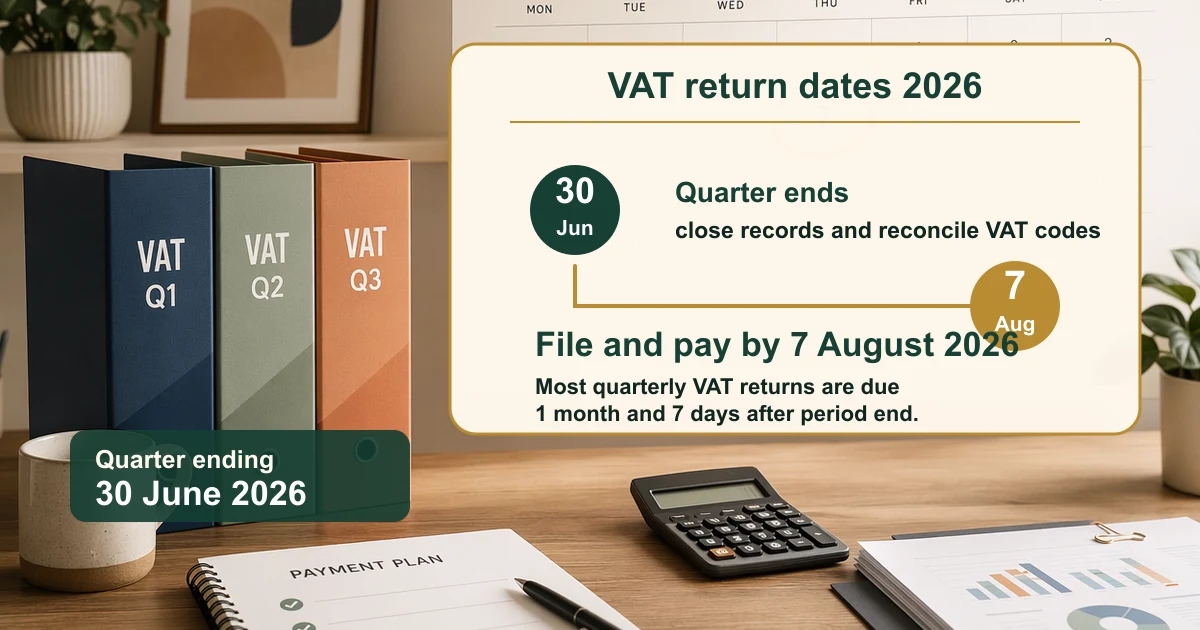
VAT Return Dates 2026: UK Deadline Guide for Small Businesses
VAT return dates 2026 explained for UK small businesses, with quarterly deadlines, payment dates, penalties, and examples.
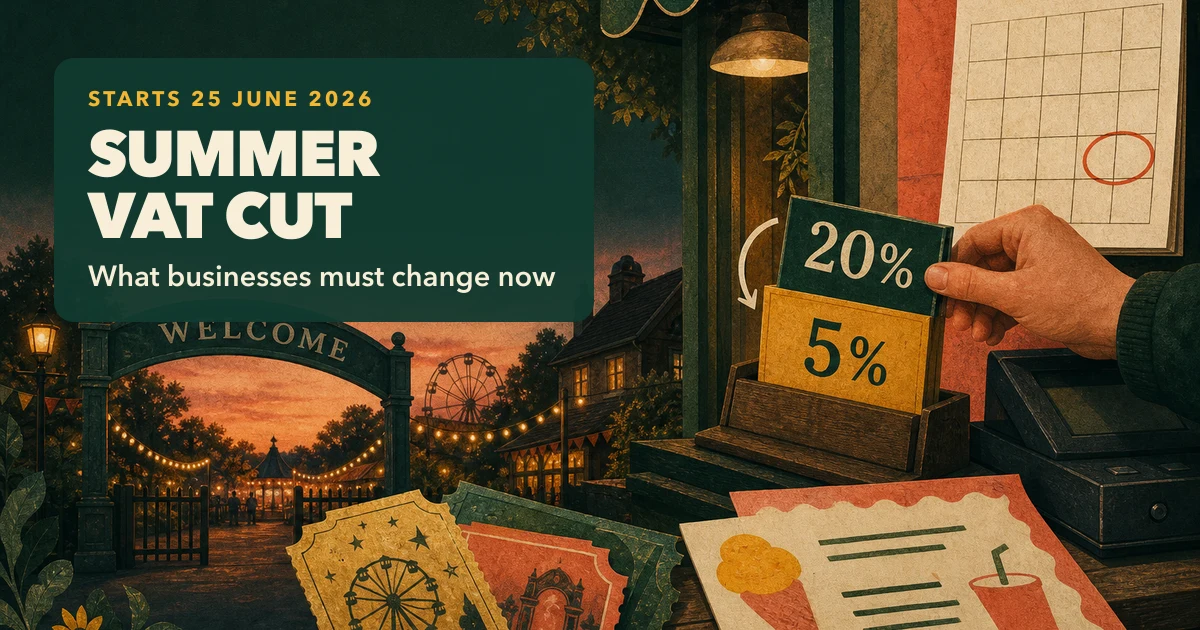
Summer VAT Cut 2026: 5% Rate Guide for Meals and Family Attractions
Summer VAT cut 2026 rules for children's meals and family attractions, with dates, eligibility, pricing examples, and setup checks.
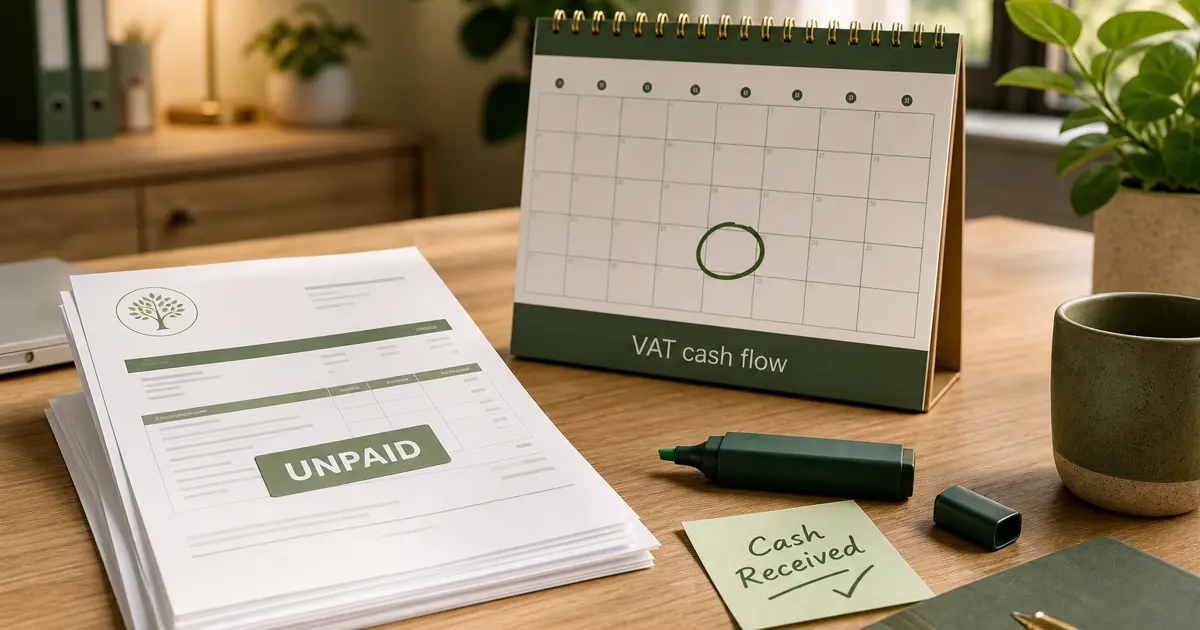
VAT Cash Accounting Scheme UK: 2026 Guide for Small Businesses
VAT Cash Accounting Scheme UK rules for 2026, with thresholds, cash-flow examples, eligibility checks, and record-keeping tips.