Corporation Tax Payment Deadline: 9 Months and 1 Day After Your Year End
When UK companies must pay Corporation Tax: 9 months and 1 day after the accounting period ends, with a year-end table, the CT600 deadline, rates, payment methods and what to do if you cannot pay.
 Golden Tree Accounting Updated 27 September 2026 18 min read
 On this page Show
- Corporation Tax payment deadline: the date follows your accounting period
- The Corporation Tax payment date is not the CT600 deadline
- How Corporation Tax is calculated in 2026
- A payment checklist before you send money
- What happens if you cannot pay by the deadline?
- Large-company instalments and other exceptions
- A simple Corporation Tax reserve routine
- Common Corporation Tax payment mistakes
- FAQ: Corporation Tax payment deadline UK 2026
- The practical next step
Most UK limited companies must pay Corporation Tax nine months and one day after the end of their accounting period. For a year end on the last day of a month, that is the 1st of the tenth month: a 31 March 2026 year end pays by 1 January 2027, and a 31 December 2025 year end paid by 1 October 2026. The CT600 return is not due until 12 months after the year end, which gives you extra time to file but not extra time to pay.
The Corporation Tax payment deadline rules are easier to manage when you split the job into three parts: identify the right accounting period, estimate the tax due, then send the payment with the correct reference. Many late payments start with a director looking at the Companies House filing date and assuming it covers HMRC as well. It does not.
Quick answer: most companies with taxable profits up to £1.5 million pay Corporation Tax nine months and one day after the end of their accounting period. Check the date in your HMRC business tax account, reserve the cash from the draft tax calculation, and pay through an approved electronic method early enough for it to clear.
Our annual accounts service can prepare the accounts and Corporation Tax computations together. If the day-to-day records are not ready, our bookkeeping service can help reconcile the figures before the payment date becomes a crisis.
Corporation Tax payment deadline: the date follows your accounting period
The due date is not the same for every company. HMRC works from the Corporation Tax accounting period, which is normally the same as the company’s financial year but can differ in the first year or after a change of year end. For most companies with taxable profits up to £1.5 million, the normal rule is nine months and one day after the accounting period ends.
Here are the normal dates for year ends on the last day of each month:
| Accounting period ends | Normal Corporation Tax payment deadline | Normal CT600 deadline |
|---|---|---|
| 31 December 2025 | 1 October 2026 | 31 December 2026 |
| 31 January 2026 | 1 November 2026 | 31 January 2027 |
| 28 February 2026 | 1 December 2026 | 28 February 2027 |
| 31 March 2026 | 1 January 2027 | 31 March 2027 |
| 30 April 2026 | 1 February 2027 | 30 April 2027 |
| 31 May 2026 | 1 March 2027 | 31 May 2027 |
| 30 June 2026 | 1 April 2027 | 30 June 2027 |
| 31 July 2026 | 1 May 2027 | 31 July 2027 |
| 31 August 2026 | 1 June 2027 | 31 August 2027 |
| 30 September 2026 | 1 July 2027 | 30 September 2027 |
| 31 October 2026 | 1 August 2027 | 31 October 2027 |
| 30 November 2026 | 1 September 2027 | 30 November 2027 |
| 31 December 2026 | 1 October 2027 | 31 December 2027 |
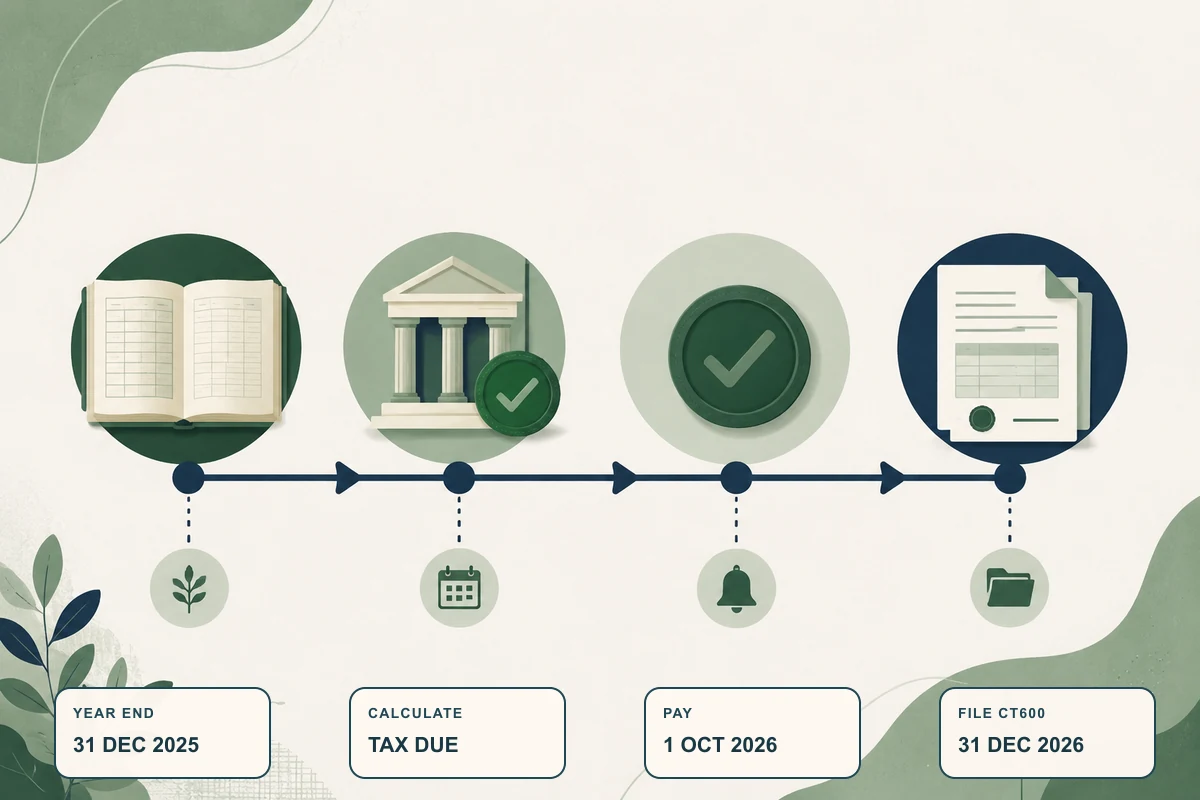
The first row shows how the dates fit together. A company with a 31 December 2025 year end normally has its Companies House annual accounts due on 30 September 2026 if its financial year matches the Corporation Tax period. The Corporation Tax payment follows on 1 October. Its Company Tax Return comes later, by 31 December.
The HMRC payment guide is the best place to check the rule and the payment routes. Your own HMRC notice and business tax account take priority if the company has an unusual first period, more than one accounting period or a changed year end.
Worked example: a 31 December year end
North Pine Ltd prepares accounts to 31 December 2025. Its draft tax computation suggests a Corporation Tax liability of £18,000. The director does not need to wait until the CT600 deadline to pay it. The practical timetable is:
- Keep enough cash available for the £18,000 estimate and any final adjustment.
- Confirm the accounting period in the HMRC business tax account.
- Make the payment by 1 October 2026 using the reference for that period.
- File the CT600, accounts and tax computations by 31 December 2026.
If the final computation rises to £18,600 after the accounts review, the extra £600 is still part of the company’s Corporation Tax liability. Paying an early estimate is sensible when cash is available, but it is not a substitute for finalising the figures.
The Corporation Tax payment date is not the CT600 deadline
A Company Tax Return usually contains the CT600, company accounts and tax computations. It tells HMRC how the taxable profit and tax liability were calculated. The payment date is earlier because HMRC expects the company to pay the self-assessed tax before the return filing deadline.
The separation matters in a few common situations:
- Filing the annual accounts with Companies House does not pay HMRC.
- Paying Corporation Tax does not file the CT600.
- A company can have no Corporation Tax to pay and still have to file a return if HMRC issued a notice to deliver one.
- Companies House has its own annual accounts deadline and a separate confirmation statement timetable.
- A first year can contain more than one Corporation Tax accounting period, which can create more than one payment or return date.
A company that made a loss is not automatically free from filing. The return still records the loss and gives HMRC the information needed for future claims or set-offs. If the company genuinely has no payment due, it should tell HMRC through the relevant nil-to-pay process so payment reminders do not continue.
That is why we recommend keeping a short deadline sheet with the accounting period end, Corporation Tax payment date, CT600 deadline and Companies House accounts date. One line for each period is enough. It prevents a director from treating “accounts done” as proof that every tax obligation has been handled.
How Corporation Tax is calculated in 2026
The amount due is based on taxable profit, not simply the balance in the business bank account or the profit shown on the first draft of the accounts. Taxable profit starts with the accounting result, then changes for items such as disallowable costs, capital allowances, losses, chargeable gains and other tax adjustments.
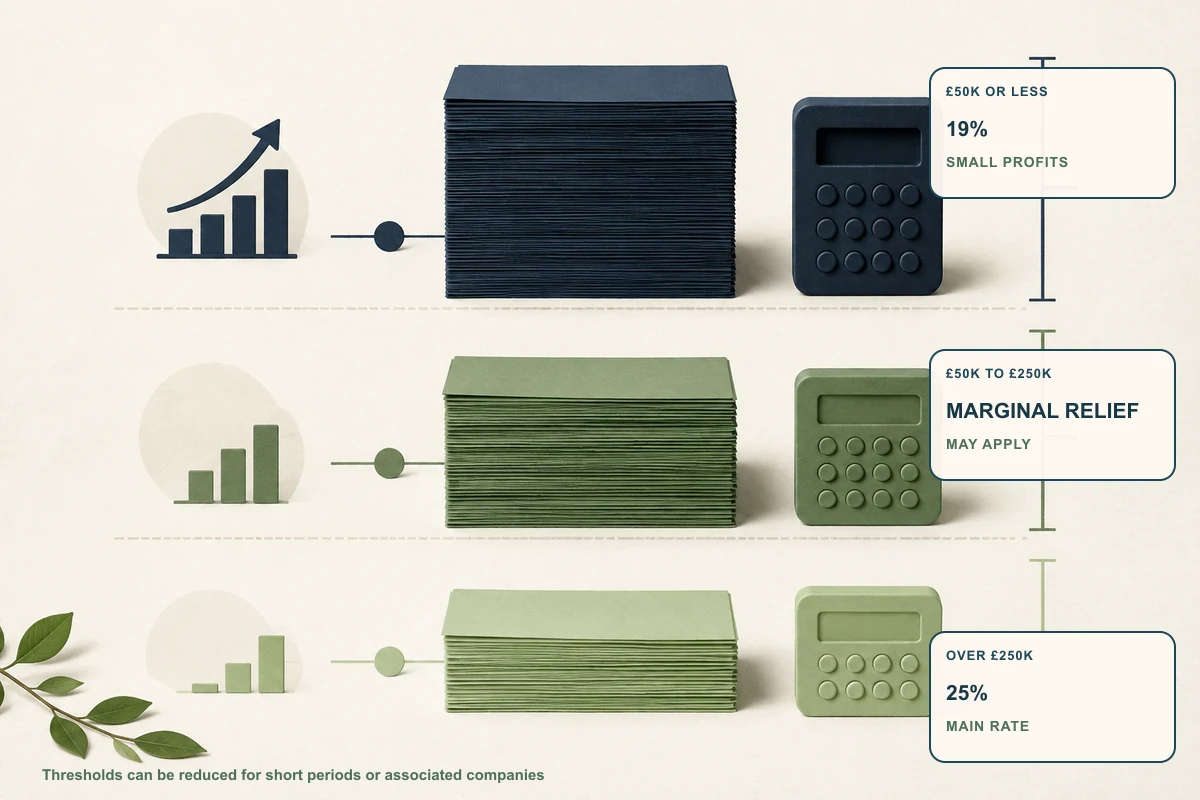
For the current headline rates, GOV.UK lists the following structure:
| Taxable profit position | Headline treatment |
|---|---|
| £50,000 or less | 19% small profits rate |
| More than £50,000 and less than £250,000 | 25% main rate less marginal relief may apply |
| More than £250,000 | 25% main rate |
The £50,000 and £250,000 thresholds are not guaranteed fixed bands for every company. They can be reduced for a short accounting period and by the number of associated companies. A group structure, exempt distributions or a company with more than one trade can also affect the computation. The current Corporation Tax rates guidance should be checked alongside the company’s own tax computation.
Worked example: £40,000 of taxable profit
Suppose a company has £40,000 of taxable profit, no associated companies and no further reliefs or adjustments. At the 19% small profits rate:
£40,000 × 19% = £7,600 Corporation Tax
That £7,600 is the tax estimate for this simplified example. It is not the same as saying that every £40,000 bank balance should produce a £7,600 payment. The bank may include a loan, a director’s funds, unpaid customer invoices or money already spent on assets. The tax computation needs the underlying records.
Worked example: £100,000 of taxable profit
Marginal relief makes the middle band less tidy. Using a simplified illustration with £100,000 of taxable profit, no associated companies and no other adjustments:
- Main-rate calculation: £100,000 × 25% = £25,000.
- Illustrative marginal relief: 3/200 × (£250,000 - £100,000) = £2,250.
- Estimated Corporation Tax: £25,000 - £2,250 = £22,750.
The effective rate in this illustration is 22.75%, not 19% and not 25%. The precise computation can change when the company has associated companies, a short period, augmented profits or other adjustments, so treat the figure as a worked explanation rather than a final bill.
Worked example: £300,000 of taxable profit
If a company has £300,000 of taxable profit, no associated companies and no other adjustments, the main-rate illustration is:
£300,000 × 25% = £75,000 Corporation Tax
At this size, directors should check whether the company is in the quarterly instalment regime rather than assuming one payment nine months and one day after the year end. The cash planning needs to start much earlier.
A payment checklist before you send money
The final payment is a short task when the records and reference are ready. Use this sequence for the company with a 1 October 2026 deadline, then adapt it to the dates shown in HMRC’s account.
1. Confirm the period you are paying for
Open the company’s HMRC business tax account and check the start and end dates of the accounting period. Do not copy the reference from last year’s payment without checking it. The first year, a shortened year or a change of accounting reference date can produce a different period from the one shown in the bookkeeping software.
2. Reconcile the draft tax calculation
Start with the draft accounts, then check the adjustments that move accounting profit to taxable profit. Review fixed assets, business entertaining, penalties, director transactions, losses, capital allowances and any costs that are partly private or not wholly for the trade. You do not need to recreate the whole CT600 on the payment day, but you do need a sensible estimate.
3. Reserve the cash separately
Tax money is not spare working capital. If the estimate is £18,000 and six months remain before the payment date, setting aside £3,000 a month would build the reserve in time. If the company has seasonal receipts, plan around the lowest cash point rather than assuming every month will look like the last one.
Keep the tax reserve visible in the cash-flow forecast. A company can be profitable and still be short of cash on the due date if customers pay late, stock is purchased early or a large VAT or PAYE payment lands in the same week.
4. Find the 17-character payment reference
HMRC uses a 17-character Corporation Tax payment reference for the accounting period. The reference changes with each period. You will normally find it on the notice to deliver the return, a payment reminder or in the company’s HMRC online account.
Using last year’s reference can delay the payment being matched to the correct period. Save the confirmation after paying, but do not treat a bank screenshot as proof that the amount has cleared in HMRC’s account.
5. Allow time for the payment to clear
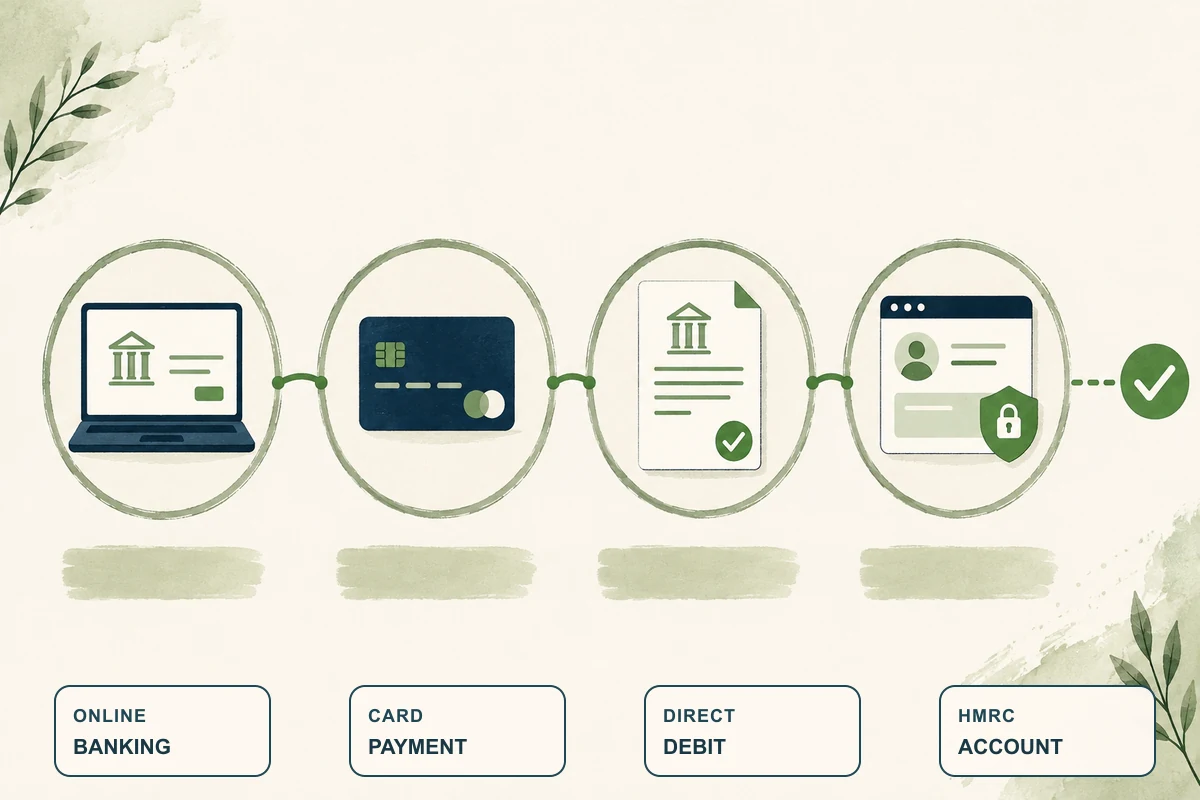
HMRC lists several routes with different timing:
| Payment route | Time to allow |
|---|---|
| Approve a payment through online banking, Faster Payments, CHAPS, debit or corporate card | Same day or next day, depending on the route |
| Direct Debit already set up, or Bacs | 3 working days |
| A new Direct Debit instruction | 5 working days |
Paying by personal credit card is not allowed. Corporate card payments can carry a fee, while a personal debit card does not have a fee under HMRC’s payment guidance. If the deadline falls on a weekend or bank holiday, the payment normally needs to reach HMRC on the last working day before it. Faster Payments made through online or telephone banking are treated differently, so check the current payment instructions rather than relying on an old diary note.
What happens if you cannot pay by the deadline?
Do not wait for the first late-payment notice if the cash is not going to be there. Contact HMRC as soon as you can, explain the position clearly and prepare a realistic proposal. HMRC may agree a payment plan, but it will want to understand the company’s income, spending, assets, other tax liabilities and how quickly the debt can be reduced.
A payment plan is not a cancellation of the tax. Late-payment interest normally runs from the day after the due date until the amount is paid, and HMRC charges it automatically. A plan can make the cash pressure manageable, but it does not turn an unpaid liability into an allowable business cost or remove the need to file the CT600.
If you can pay part of the bill, record exactly how much has been sent and which period it covers, then contact HMRC about the balance. Keep the director’s cash-flow forecast, bank statements and a list of other imminent obligations ready. A vague promise to “pay soon” is less useful than a short schedule showing what the company can afford and why.
Directors should also avoid quietly paying a company tax bill from a personal account without recording it. A personal payment may create an amount owed to the director or another accounting entry. Tell the bookkeeper or accountant so the payment is recorded in the correct period and the company records still reconcile.
Large-company instalments and other exceptions
The simple nine-month-and-one-day rule covers most smaller companies. A company with taxable profits above £1.5 million will normally need to pay Corporation Tax by quarterly instalments, with different dates before and after the end of the accounting period. Companies with profits above £20 million have another instalment timetable.
Those thresholds can be reduced where there are associated companies, and exceptions can apply to a new company or a company with a low total liability. A company that is close to the threshold should not wait for the final CT600 to decide how much cash is needed. Check the instalment rules early and use the company’s full group facts.
Short accounting periods need care too. The nine-month-and-one-day calculation follows the actual period end, not a generic “year end” in a spreadsheet. A company can also have two Corporation Tax returns when its accounts cover more than 12 months, because one accounting period cannot exceed 12 months.
A simple Corporation Tax reserve routine
The easiest payment deadline to meet is the one that appears in the cash plan months before HMRC sends a reminder. A small company can add the following to its month-end routine:
- Check the current accounting period and deadline once a month.
- Update the year-to-date taxable-profit estimate after reconciling the bank and card accounts.
- Record one-off items, such as an asset purchase, loan, grant, insurance settlement or director transaction.
- Compare the tax reserve with the latest estimate, not last year’s bill.
- Put the payment reference and a planned payment date in the task list.
- Keep the draft accounts, computation and payment confirmation together.
Say the draft computation currently points to £12,000 of Corporation Tax, but the company expects a large customer receipt in September and a £4,000 equipment purchase before the year end. The director should not automatically subtract £4,000 from the tax estimate. The equipment may be dealt with through capital allowances, and the tax result depends on the asset and the date it is brought into use. Flag it for the computation instead.
That small note is often enough to stop a future handover from becoming a hunt through bank transactions. Good bookkeeping is not only about tidy ledgers. It gives the person preparing the tax calculation a reason for the unusual numbers.
Common Corporation Tax payment mistakes
Waiting for a bill from HMRC
Companies generally work out their own Corporation Tax liability. HMRC does not normally send a bill telling you the final amount to pay. The absence of a letter is not evidence that no payment is due.
Using the Companies House date
The annual accounts deadline and the Corporation Tax payment deadline are related but separate. For a 31 December 2025 year end, annual accounts are normally due by 30 September 2026, while Corporation Tax is due on 1 October 2026.
Paying with the wrong reference
Each accounting period has its own 17-character reference. A payment can be delayed or matched incorrectly when a director reuses last year’s details.
Treating accounting profit as the tax bill
The accounts profit is the starting point. Tax adjustments, capital allowances, losses and reliefs can move the taxable profit up or down. A round percentage applied to the bank balance is not a Corporation Tax computation.
Forgetting a nil return
No tax to pay does not always mean no CT600. If HMRC issued a notice to deliver a return, file it by the deadline and tell HMRC when no payment is due.
FAQ: Corporation Tax payment deadline UK 2026
When is the Corporation Tax payment deadline in the UK?
For most companies with taxable profits up to £1.5 million, Corporation Tax is normally due nine months and one day after the end of the accounting period. A company whose period ended on 31 December 2025 would normally pay by 1 October 2026. Check the company’s actual dates because short periods and associated companies can change the position.
Is the Corporation Tax payment date the same as the CT600 deadline?
No. The payment normally comes first, nine months and one day after the accounting period ends. The Company Tax Return, usually the CT600 with accounts and computations, is normally due 12 months after the end of that period. Filing accounts with Companies House does not complete the HMRC return.
How much Corporation Tax will a small company pay in 2026?
The headline small profits rate is 19% for profits of £50,000 or less. The main rate is 25% for profits over £250,000, with marginal relief potentially applying between the two limits. The thresholds can be reduced for short accounting periods and associated companies, so use a proper tax computation for the company’s own figure.
How do I pay Corporation Tax to HMRC?
Use HMRC’s Corporation Tax payment service, online or telephone banking, Direct Debit, debit card, corporate card or another approved electronic route. Check the 17-character reference for the relevant accounting period and allow enough time for the payment to clear. Save the confirmation with the tax records.
What happens if a company cannot pay Corporation Tax on time?
Contact HMRC as soon as you know there is a problem. HMRC may agree a payment plan after reviewing the company’s finances, but interest normally continues until the debt is paid. Keep the company tax return and any payment proposal moving even when the cash position is difficult.
Do I still need to file a CT600 if the company has no tax to pay?
Yes, if HMRC has issued a notice to deliver a Company Tax Return. A company must still file when it made a loss or has no Corporation Tax to pay. Tell HMRC that no payment is due through the nil-to-pay route so it does not keep sending payment reminders.
Does every limited company pay Corporation Tax in one lump sum?
No. Companies with taxable profits above the large-company threshold may need to pay quarterly instalments, and the threshold can be reduced when there are associated companies. New companies and companies with an unusually short period can have different rules too.
The practical next step
If your company’s accounting period ended on 31 December 2025, check the £1 October 2026 deadline this week. Match the HMRC period to the draft computation, compare the reserve with the expected liability, and prepare the correct payment reference before the last few working days. If the calculation or cash plan does not make sense, use our contact page to arrange a focused review of the records and Corporation Tax timetable.

About Golden Tree Consulting
ACCA Affiliated | MBA Qualified
Golden Tree Accounting & Business Consulting provides expert tax, bookkeeping, and advisory services to sole traders and SMEs across Croydon, London, Surrey, and Kent. With multilingual support and decades of combined experience, we help businesses stay compliant and grow.
Offices in Croydon and London Bridge.
Related guides
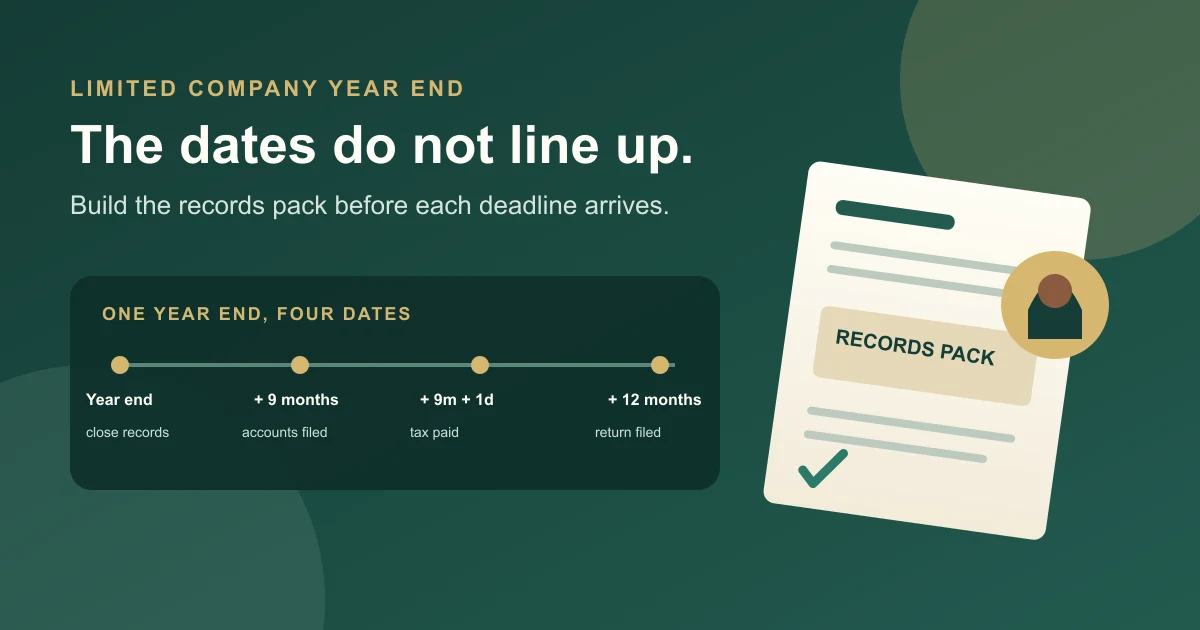
Limited Company Annual Accounts: 2026 Records and Deadline Checklist
Limited company annual accounts checklist for 2026: records to prepare, Companies House and HMRC deadlines, examples and filing changes.
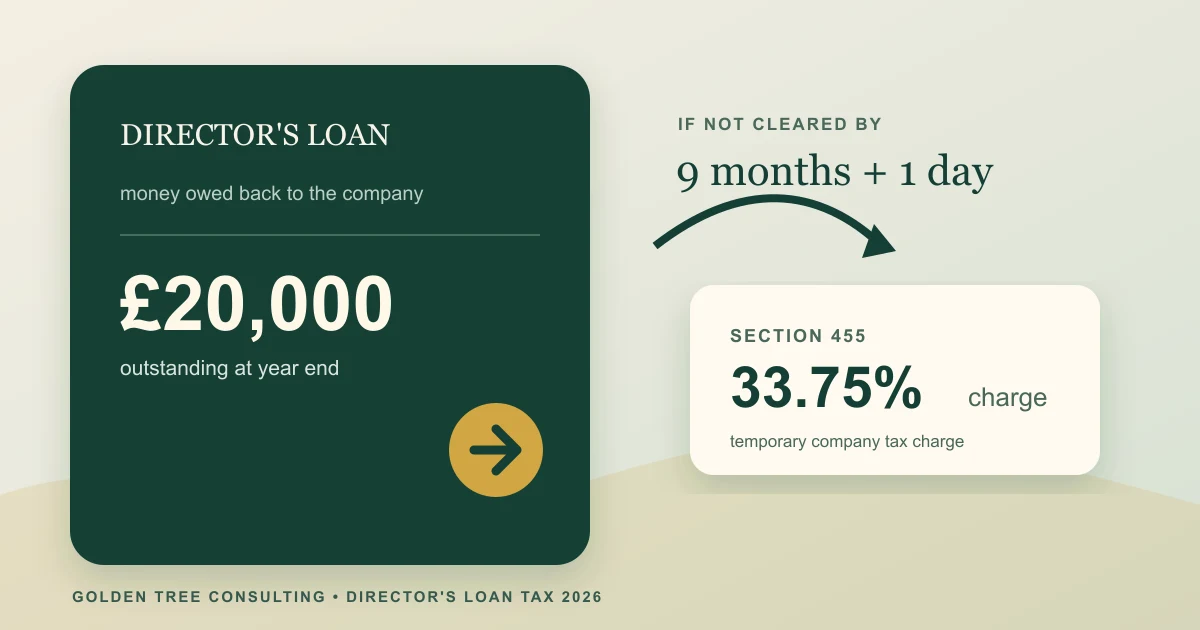
Director's Loan Tax 2026: Section 455, the £10,000 Rule and 9-Month Deadline
Director's loan tax 2026 explained: Section 455 at 33.75%, the £10,000 benefit rule, repayment timing and worked examples.

HMRC Company Tax Return Service Has Closed: How to File Your CT600 Now
HMRC and Companies House closed their joint online service for company accounts and Company Tax Returns on 31 March 2026. How to file now, which software to use and the deadlines that still apply.