Limited Company Annual Accounts: 2026 Records and Deadline Checklist
Limited company annual accounts checklist for 2026: records to prepare, Companies House and HMRC deadlines, examples and filing changes.
 Golden Tree Accounting 5 August 2026 11 min read
 On this page Show
- Limited company annual accounts: know the three dates
- What goes into an annual accounts records pack?
- Are you a micro-entity or a small company?
- Do not confuse annual accounts with the confirmation statement
- What is changing for annual accounts filing?
- A practical monthly routine before the year end
- FAQ: limited company annual accounts
Limited company annual accounts are not one job with one deadline. They are a set of records, director decisions and filings that move on different clocks. That distinction catches out plenty of otherwise organised directors: the Corporation Tax payment date can arrive before the deadline for the Company Tax Return, while Companies House has its own annual accounts date.
For a small company, the calmest way through is to make the records pack before the year end becomes urgent. You should be able to explain the money in the bank, the sales behind it, the bills still unpaid, and any money moving between you and the company. If those pieces are scattered across email, a personal card and a box of receipts, the accounts process becomes slower and more expensive for no good reason.
Quick summary: private limited companies normally file annual accounts with Companies House nine months after the financial year ends. Corporation Tax is usually due nine months and one day after the Corporation Tax accounting period ends, and the Company Tax Return is normally due 12 months after that period ends. First accounts have a different deadline, normally 21 months after incorporation.
Our company accounts service can prepare the statutory accounts and help you understand what needs signing off. If the day-to-day record keeping is the weak spot, our bookkeeping service can put the monthly routine in place before the next year end arrives.
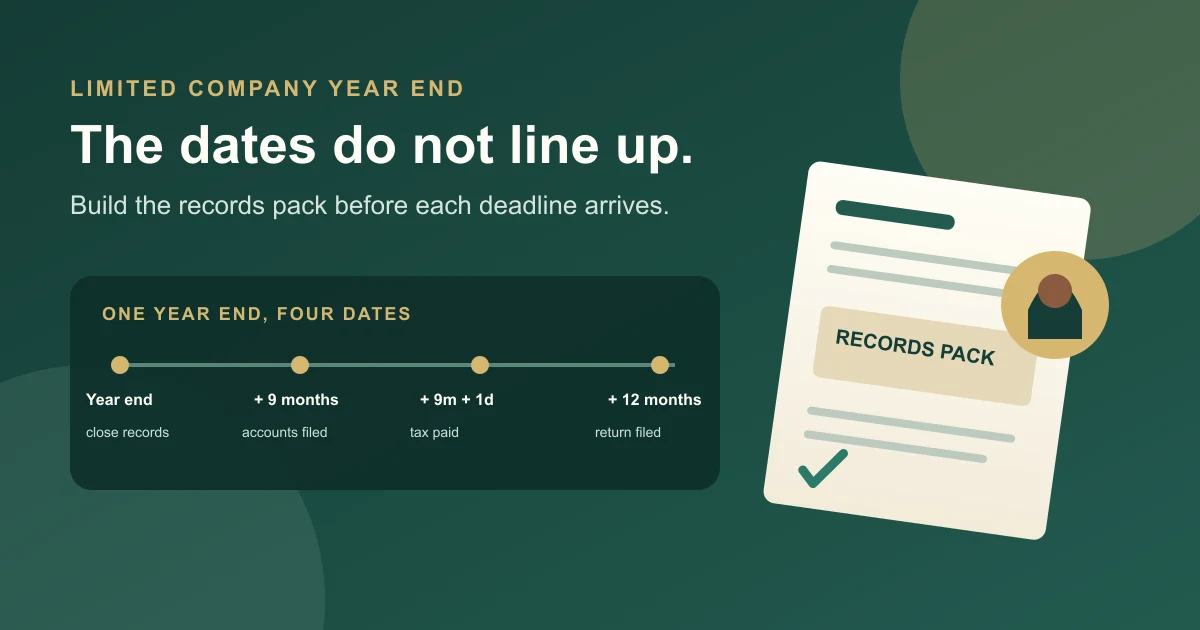
Limited company annual accounts: know the three dates
The year-end date in your accounting software is not a reminder to file everything on the same day. It is the starting point. GOV.UK’s accounts and tax returns overview sets out the usual timetable for a private limited company.
| Job | Usual deadline | Where it goes |
|---|---|---|
| Annual accounts | 9 months after the financial year ends | Companies House |
| Corporation Tax payment | 9 months and 1 day after the Corporation Tax accounting period ends | HMRC |
| Company Tax Return, usually CT600 with accounts and computations | 12 months after the Corporation Tax accounting period ends | HMRC |
| First annual accounts | 21 months after incorporation | Companies House |
The accounting period for Corporation Tax is often the same 12 months as the financial year, but not always. A first set of company accounts can cover more than 12 months, for example. HMRC may then need more than one Corporation Tax return period. That is a good point to get advice early instead of assuming one long set of accounts equals one tax return.
Worked example 1: a 31 August year end
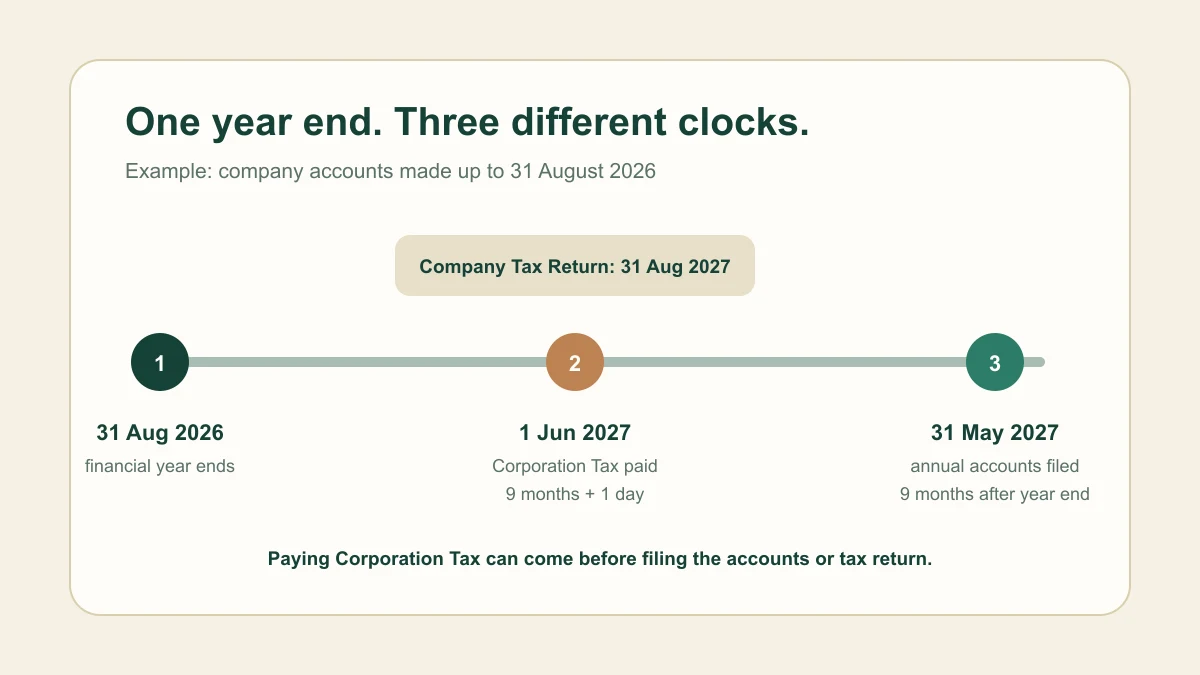
Bright Oak Ltd prepares accounts to 31 August 2026. Assume its Corporation Tax accounting period ends on the same date. Its ordinary timetable looks like this:
| Date | Action |
|---|---|
| 31 August 2026 | Financial year and Corporation Tax accounting period end |
| 1 June 2027 | Corporation Tax normally paid, nine months and one day later |
| 31 May 2027 | Annual accounts normally filed at Companies House |
| 31 August 2027 | Company Tax Return normally filed with HMRC |
The payment date is easy to miss because it sits one day after the nine-month anniversary, yet before the annual-accounts and tax-return filing dates. You do not need to wait for the tax return deadline to work out that cash needs reserving. HMRC’s Company Tax Return guidance confirms that the payment deadline normally comes first.
What goes into an annual accounts records pack?
Annual accounts turn the company’s activity into a profit and loss account, balance sheet and supporting notes. The statutory version is not just a spreadsheet of sales minus expenses. It needs records that support the figures, and directors still need to approve the accounts before filing.
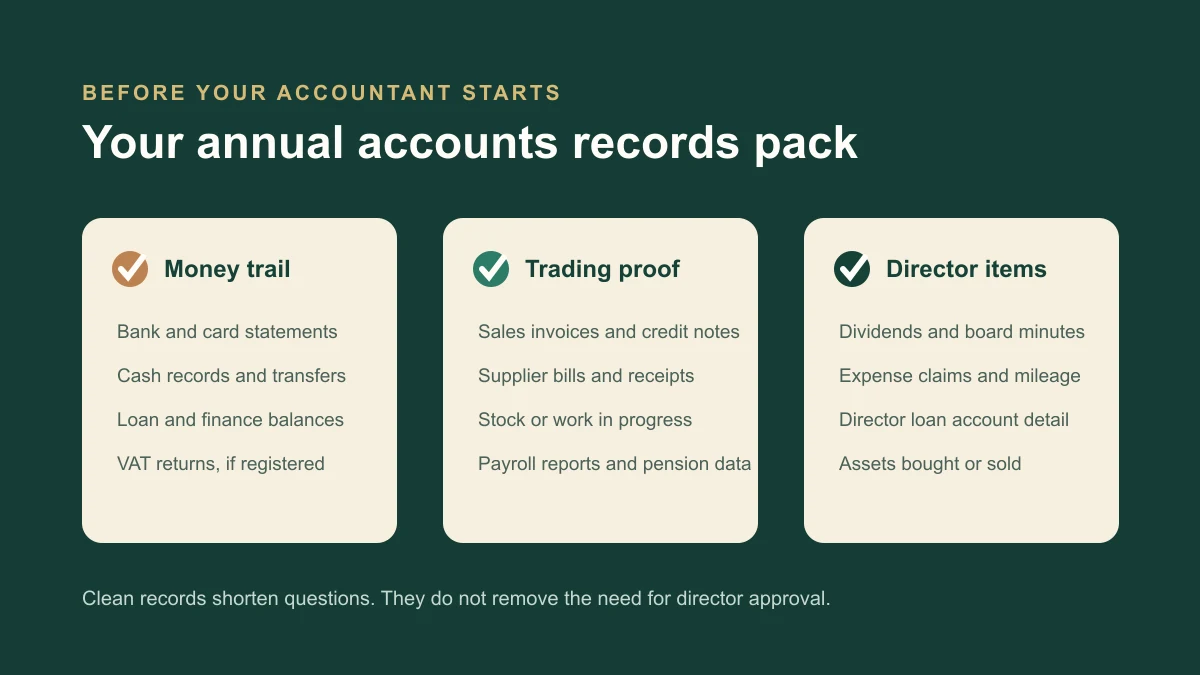
Start with the money trail. Gather every business bank and card statement for the period, including savings accounts, payment processors, loans and finance accounts. Reconcile them, which means matching the balance in your bookkeeping records to the statement and identifying genuine timing differences. A receipt is useful, but it does not explain an unreconciled bank transfer on its own.
Then collect the trading proof: sales invoices, credit notes, supplier bills, expense receipts, stock information if relevant, and payroll and pension reports. If you are VAT registered, include VAT return workings and confirmations. These records help separate a genuine business cost from a payment that needs a different treatment.
Director items deserve their own folder. Keep dividend vouchers and board minutes, personal expenses paid by the company, company expenses paid personally, mileage claims, assets bought or sold, and a clear director’s loan account schedule. We have a separate guide to director’s loan tax and Section 455 if the company has advanced money to a director or shareholder.
Worked example 2: why the bank balance is not the profit
Nia runs a design company. At the year end, the business bank account has £38,000. During the year it received £96,000 from clients. She paid £29,000 of supplier bills and overheads, £18,000 of payroll costs, and bought a laptop for £2,400. She also received a £10,000 bank loan, paid £6,000 of dividend transfers, and has £7,500 of client invoices still unpaid.
It would be wrong to treat the £38,000 bank balance as profit. The loan is not sales income, the dividend is not an ordinary operating expense, and unpaid invoices may still be income for the accounts, depending on the accounting basis and timing. The laptop may be a fixed asset rather than a cost taken in full in the profit and loss account. That is why a year-end pack needs documents and explanations, not just a closing bank figure.
Worked example 3: a director expense paid personally
Say Nia pays £480 for company software on her own card, then forgets to claim it back. The company has a genuine software cost and also owes her £480, assuming the cost is wholly and exclusively for the company and supported by the invoice. If it is not recorded, both the expense and the amount due to the director can be wrong. The fix is not to throw the receipt into the next year. Record the item to the right period and keep the evidence.
Your own facts can be more complicated if you have stock, grants, foreign currency, property, multiple directors or money borrowed from the company. The example is a prompt to gather the right papers, not individual tax advice.
Are you a micro-entity or a small company?
Many owner-managed businesses qualify as a small company or micro-entity, which can change the accounts available for filing and the audit position. It does not mean there are no accounts to prepare.
Under the current GOV.UK guidance, a company is small if it meets any two of these three conditions: turnover of £15 million or less, a balance sheet total of £7.5 million or less, and 50 employees or fewer. A micro-entity meets any two of: turnover of £1 million or less, a balance sheet total of £500,000 or less, and 10 employees or fewer. Check the full small-company and micro-entity rules before choosing a format.
Qualifying smaller companies may have audit exemptions and may be able to file simpler accounts. They still need statutory accounts for members and HMRC as part of the Company Tax Return. A dormant company has its own rules too. “No sales this year” is not always the same as dormant, particularly if there have been transactions beyond the limited exceptions.
Do not confuse annual accounts with the confirmation statement
The confirmation statement is another Companies House filing, but it is not annual accounts and it does not tell HMRC your profit. It confirms that the company information held at Companies House is correct, such as directors, registered office and share details. Keep its review period and filing date in your diary separately.
Companies House identity verification is another nearby obligation for directors and people with significant control. It is not part of the accounts calculation. Our Companies House identity verification guide explains the transition and what to expect. Keeping these tasks distinct makes it much less likely that a director assumes one filing has covered all of them.
What is changing for annual accounts filing?
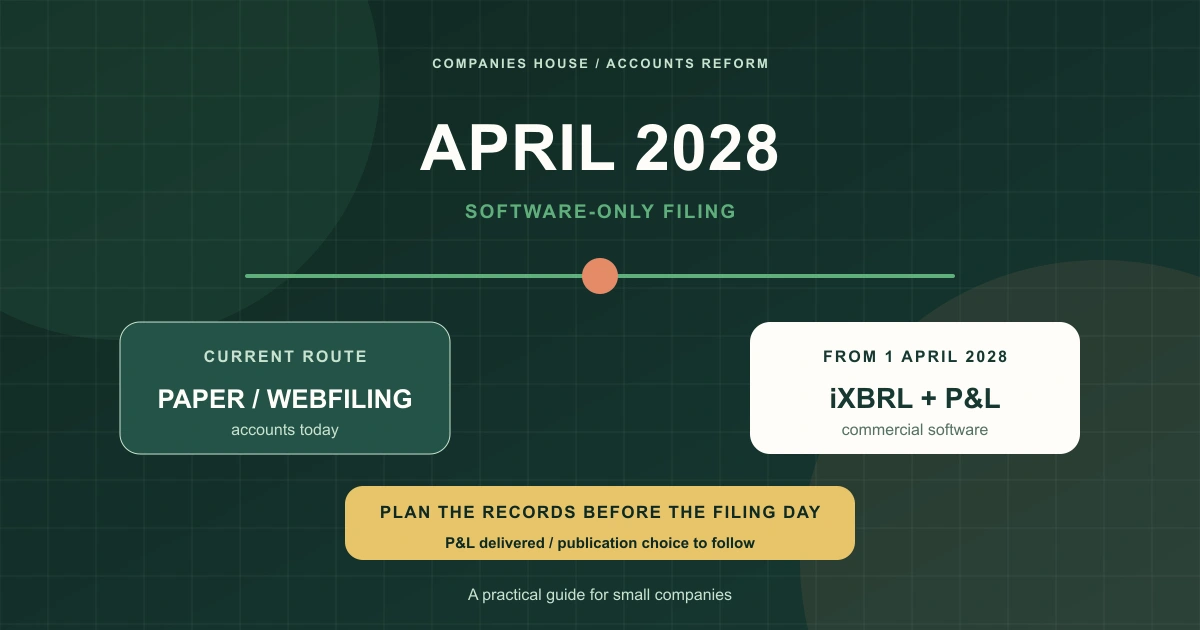
There is a useful future date to add to the longer-term plan. Companies House announced in June 2026 that accounts reforms will apply from April 2028, rather than April 2027. The announced changes include software-only annual-accounts filing in iXBRL format, removal of the abridged-accounts option, and a requirement for small companies and micro-entities to file a profit and loss account, with an option not to publish it on the public register. The Companies House announcement says companies will have one full accounting year plus nine months to prepare.
That does not change your current 2026 or 2027 deadline. It is a reason to keep records digitally and make sure your accounting process can produce an orderly year-end file. A last-minute spreadsheet and a photo folder with no naming convention are unlikely to become more comfortable under a software-only filing process.
A practical monthly routine before the year end
You do not need to build the final accounts every month. You do need to avoid discovering twelve months of unanswered questions at once. A simple monthly routine is enough for many small companies:
- Reconcile business bank, card and payment-processor accounts.
- Attach receipts and supplier bills to the matching transactions.
- Raise sales invoices promptly and review unpaid invoices.
- Record payroll, pension payments, VAT activity and finance payments.
- Review director withdrawals, reimbursements and dividend paperwork separately.
- Save a short note for unusual transactions, such as an asset purchase, loan, grant or refund.
That last note can save a surprising amount of detective work. A payment labelled only “transfer” rarely becomes more meaningful ten months later.
When the accounts are due, directors must approve them before filing. GOV.UK’s annual accounts filing service also makes clear that you need the Companies House authentication details to file. Get those details checked well before the deadline, particularly after a director or registered-office change.
If you want an accountant to prepare the accounts, send the records pack while there is still room to ask questions and plan the Corporation Tax payment. Use our contact page to arrange a review of the company’s year-end records and filing timetable. The most useful first step is simple: choose the next month-end, reconcile every account, and list every transaction you cannot explain.
FAQ: limited company annual accounts
When are limited company annual accounts due?
Annual accounts are normally due at Companies House nine months after the company’s financial year ends. First accounts are normally due 21 months after incorporation. Check the specific deadline shown on the company’s Companies House record, because a changed accounting reference date can alter it.
Is the Corporation Tax payment date the same as the annual accounts filing date?
No. Corporation Tax is usually due nine months and one day after the Corporation Tax accounting period ends. Annual accounts are normally due nine months after the financial year ends, and the Company Tax Return is normally due 12 months after the accounting period ends.
What records should I give my accountant for annual accounts?
Give bank and card statements, sales and purchase evidence, payroll and pension reports, VAT information where relevant, finance balances, asset records, dividends, director expense claims and director loan account detail. Ask for a tailored list if the company trades in stock, holds property, uses several currencies or has more than one director.
Can a small company file simpler annual accounts?
Possibly. A company that meets the current small-company or micro-entity conditions may have filing and audit exemptions. It still needs statutory accounts for its members and HMRC. Check eligibility before selecting a filing option.

About Golden Tree Consulting
ACCA Affiliated | MBA Qualified
Golden Tree Accounting & Business Consulting provides expert tax, bookkeeping, and advisory services to sole traders and SMEs across Croydon, London, Surrey, and Kent. With multilingual support and decades of combined experience, we help businesses stay compliant and grow.
Offices in Croydon and London Bridge.
Related guides
Companies House Accounts Changes 2028: What Small Companies Need to Prepare
Companies House accounts changes 2028 explained for UK small companies: software-only filing, P&L, abridged accounts and a practical preparation checklist.
Corporation Tax Payment Deadline: 9 Months and 1 Day After Your Year End
When UK companies must pay Corporation Tax: 9 months and 1 day after the accounting period ends, with a year-end table, the CT600 deadline, rates, payment methods and what to do if you cannot pay.
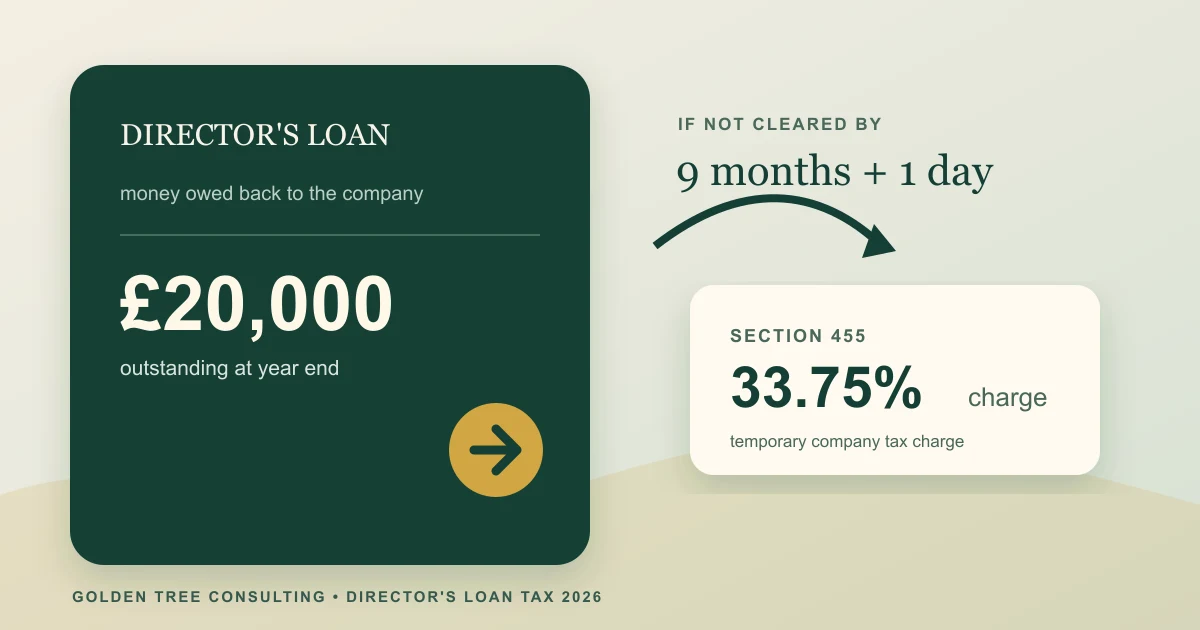
Director's Loan Tax 2026: Section 455, the £10,000 Rule and 9-Month Deadline
Director's loan tax 2026 explained: Section 455 at 33.75%, the £10,000 benefit rule, repayment timing and worked examples.