HMRC Company Tax Return Service Has Closed: How to File Your CT600 Now
HMRC and Companies House closed their joint online service for company accounts and Company Tax Returns on 31 March 2026. How to file now, which software to use and the deadlines that still apply.
 Golden Tree Accounting Updated 27 September 2026 12 min read
 On this page Show
- What closed, and what it means for your next filing
- What changed on 1 April 2026 and what stayed the same
- Dates you need in your diary now
- How to choose filing software without wasting money
- If you did not save your historical submissions
- Penalties: what late filing can cost in pounds, not just stress
- A practical plan for switching to software
- Common mistakes since the switch
- How this links to wider Companies House reforms
- Internal links to help you implement this
- Authoritative sources for this guide
- FAQ: online accounts and Company Tax Return service closing
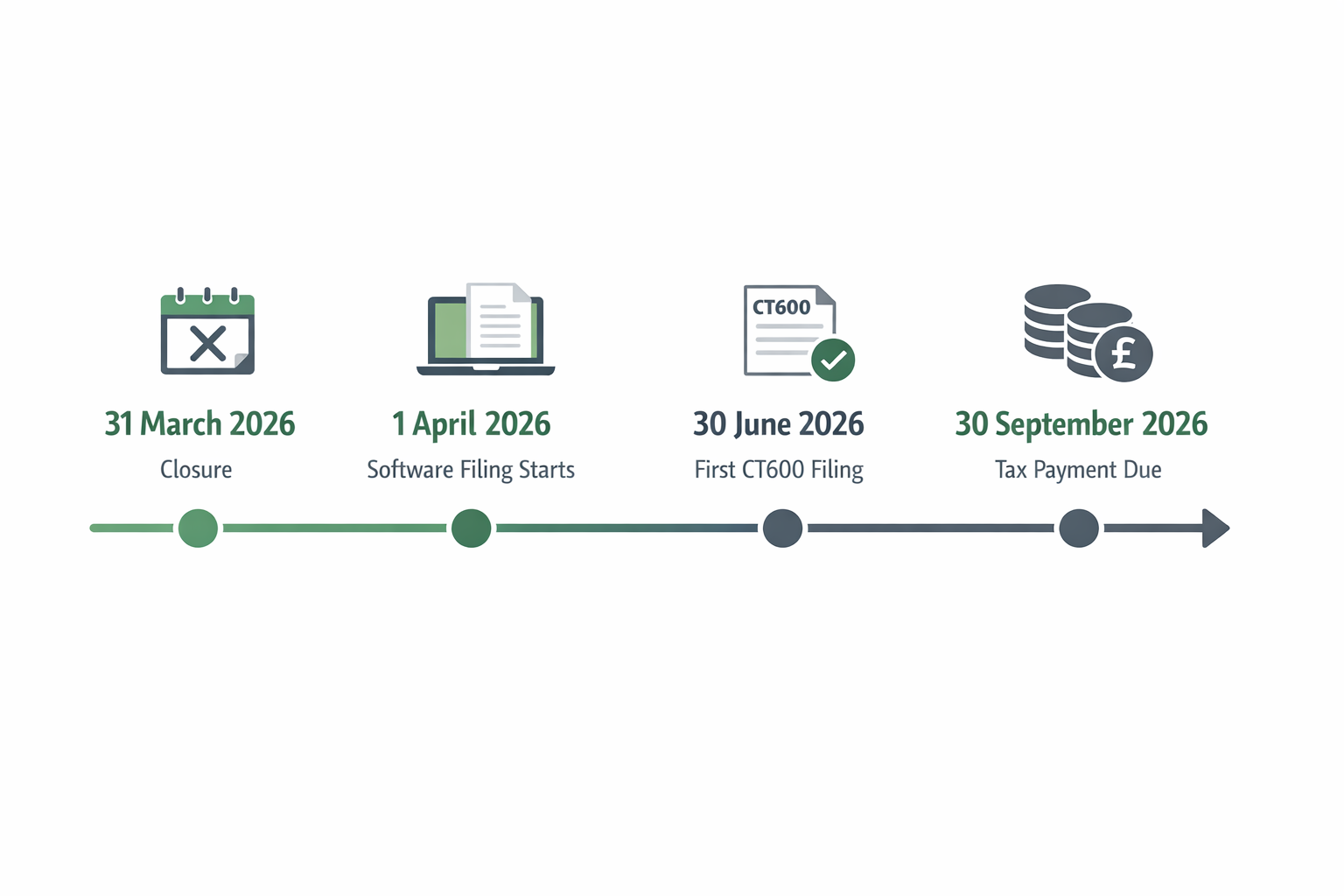
HMRC and Companies House closed their joint online accounts and Company Tax Return service on 31 March 2026. Since 1 April 2026, every limited company has had to file its CT600 with HMRC using commercial software, and previous returns can no longer be viewed in the old service. If your company used it last year, your next return needs a new route.
Many directors only find out when they log in to file. The filing deadlines and penalties have not changed, so the switch needs sorting well before your next CT600 is due, not in its final week.
Quick summary: the joint service closed on 31 March 2026 and will not reopen. Choose CT600 filing software or an agent, gather your own copies of past returns, test the filing route before your deadline, and put every filing date in one calendar owned by one named person.
If you want the filing handled for you, we can help through our annual accounts service, bookkeeping support, and contact page.

What closed, and what it means for your next filing
HMRC and Companies House closed the joint filing service on 31 March 2026. Since 1 April 2026 you must file Company Tax Returns with HMRC using software.
That change sounds simple until you list what has to happen in real life:
- someone has to choose suitable software
- your company data has to be checked and migrated properly
- prior submissions may need to be saved for future reference
- directors and staff need to know the new filing routine
- deadlines still apply while you are changing process
Companies with a year end in the first half of 2026 are meeting this for the first time now, as their CT600 deadlines come round.
What changed on 1 April 2026 and what stayed the same
The filing route changes. Your legal obligations do not.
| Area | Before 1 April 2026 | From 1 April 2026 |
|---|---|---|
| Company Tax Return (CT600) filing | Can use HMRC online joint service (if eligible) | Must use commercial software for HMRC filing |
| Accounts filing to Companies House | Joint service available | Alternative filing routes remain, with software strongly expected as reforms progress |
| Access to previous returns in old joint service | Available until closure date | No access since the closure: rely on your own saved copies, your accountant’s records or your software |
| Filing deadlines and penalties | Normal rules apply | Same deadlines and penalties still apply |
So if you were hoping deadlines might pause while you move systems, they do not.
That is why we are advising clients to treat this as a project with an owner and a short timeline, not as an admin task that can float around the to-do list.
Dates you need in your diary now
Here are the key dates most small limited companies should put in writing now.
| Date | What it means | Practical action |
|---|---|---|
| Since 1 April 2026 | Joint online filing service closed | Use software or an agent for every Company Tax Return |
| 9 months after financial year-end | Companies House accounts deadline for many private companies | Plan accounts preparation and sign-off timetable |
| 12 months after accounting period end | CT600 filing deadline | Build software workflow to file well before deadline |
| 9 months and 1 day after accounting period end | Corporation Tax payment deadline | Keep payment reserve and calendar reminder in place |
If your next CT600 is due in the coming months, choose the software now. The old service will not reopen for late filers.
How to choose filing software without wasting money
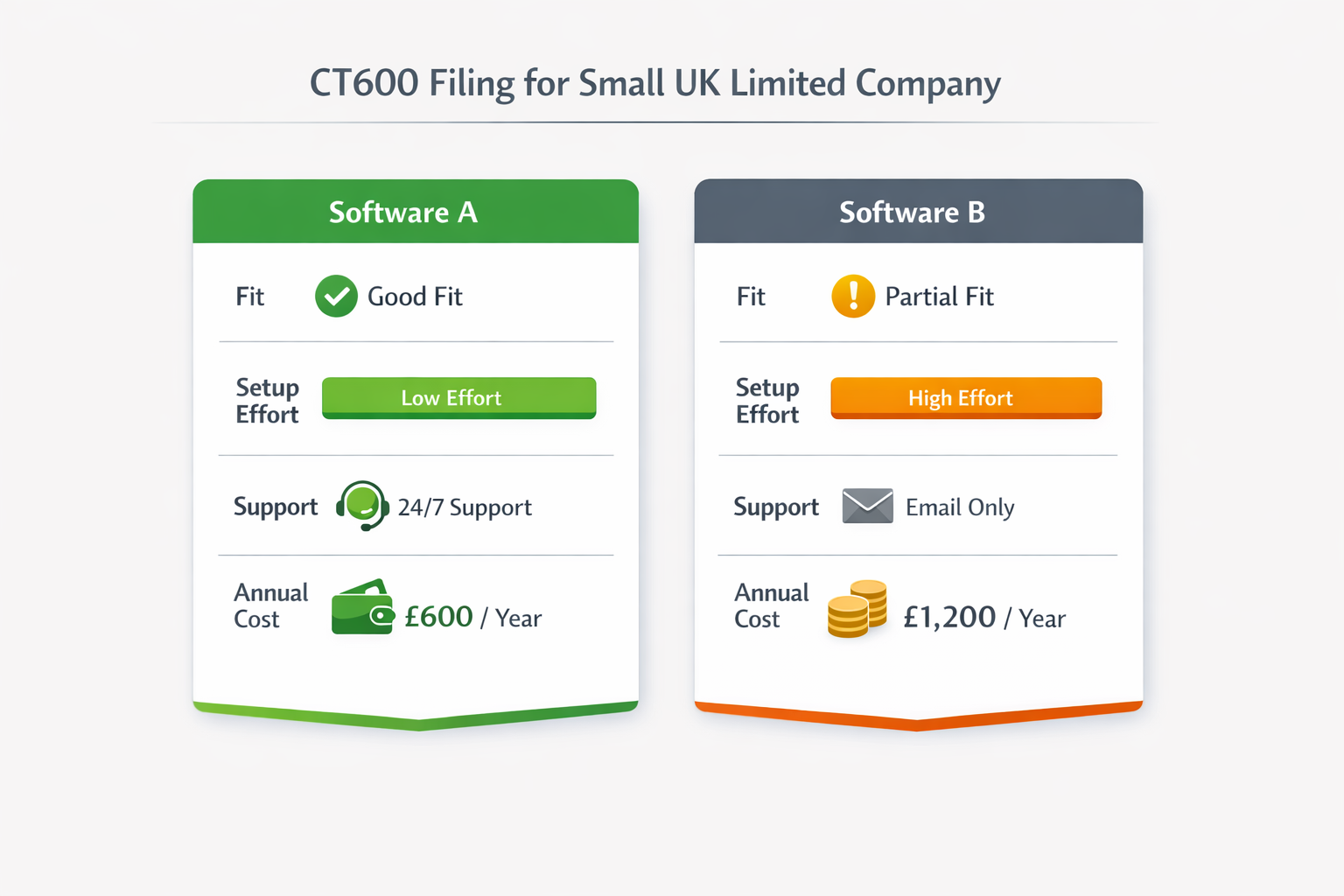
There is no single “best” product for every company. What matters is fit.
Use these criteria:
- supports your company size and account type
- supports CT600 submission and Companies House needs you actually have
- gives clear audit trail and filing confirmation
- has support you can reach in busy periods
- price is sensible for your filing complexity
Start with the official GOV.UK tool for Companies House filing software, then narrow quickly.
The common error is spending weeks comparing every feature. Most small companies need a practical short list, a quick trial, and a decision. Over-analysis is expensive when a hard deadline is this close.
A quick software decision framework
Use a simple scorecard out of 5 on each item:
- filing coverage for your obligations
- ease of use for non-specialists
- support responsiveness
- migration effort from your current records
- annual total cost
Any product scoring low on filing coverage should be eliminated immediately, however cheap it looks.
Worked example 1: software decision for a micro company
Assume your company has:
- annual turnover of £180,000
- one director-shareholder
- straightforward trading activity
- no group structures or complex disclosures
You compare three options.
| Option | Annual cost | Estimated setup time | Filing fit | Outcome |
|---|---|---|---|---|
| Option A | £180 | 8 hours | Full CT600 and small company accounts support | Strong candidate |
| Option B | £95 | 15 hours with manual workarounds | Partial fit only | False economy |
| Option C | £320 | 6 hours | Full fit plus accountant portal | Best if you need adviser collaboration |
If Option B saves £85 but costs an extra 7 hours of director time, it is usually not a saving. If your time is worth £75 per hour, that extra time is £525.
When tax deadlines are involved, cheap software that creates manual patchwork often costs more overall.
If you did not save your historical submissions
HMRC’s guidance was to save prior returns from the old service by 31 March 2026. If you did not, ask your previous accountant for copies, and keep your own submission receipts from now on.
Why does this matter?
- you may need them if HMRC asks questions later
- your future accountant may ask for earlier returns and accounts
- you may need prior figures to explain adjustments or resubmissions
From now on, keep a copy of every submission yourself.
We suggest saving at least the last three years in a structured folder with clear file names:
2023-03-31-ct600-submission.html2024-03-31-accounts-submission.html2025-03-31-filing-summary.html
Also keep backup copies in cloud storage with restricted access. One copy on one laptop is not a record-keeping policy.
Penalties: what late filing can cost in pounds, not just stress
Let us turn penalties into plain numbers. These are often the wake-up call.
Company Tax Return late filing penalties (HMRC)
Current HMRC rules include:
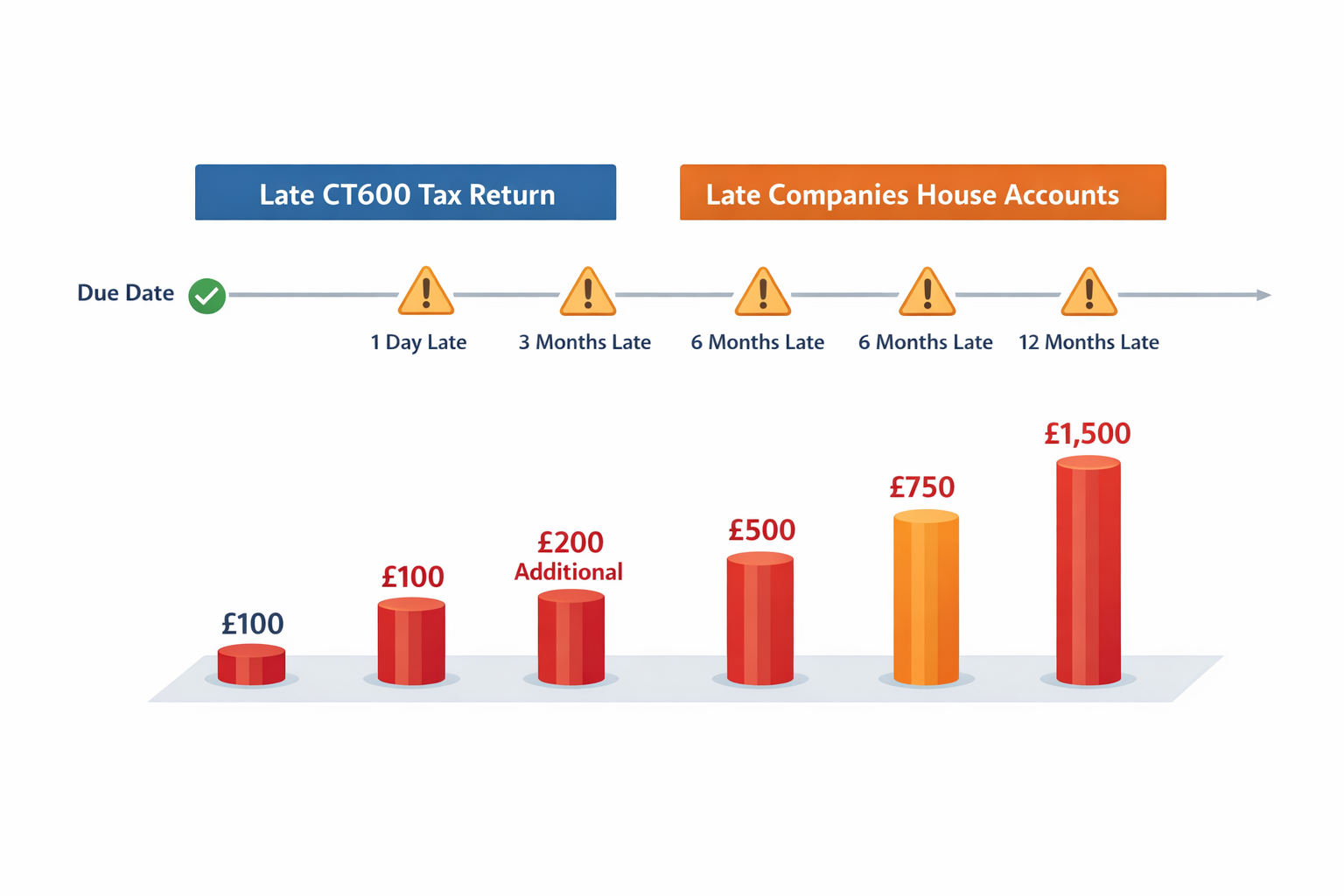
- £100 immediately after deadline
- another £100 after 3 months
- tax-geared penalties after 6 and 12 months for unpaid tax
- higher fixed penalties if returns are late repeatedly
Companies House accounts late filing penalties (private companies)
Current Companies House penalties are:
- up to 1 month late: £150
- 1 to 3 months late: £375
- 3 to 6 months late: £750
- over 6 months late: £1,500
The penalty is doubled if accounts are late two years in a row.
These numbers are current at the time of writing and should be rechecked against GOV.UK before filing if rates are updated.
Worked example 2: one late cycle can get expensive quickly
Assume a private limited company:
- files CT600 4 months late
- files Companies House accounts 2 months late
- has unpaid Corporation Tax of £18,000 at the 6-month HMRC point
Estimated penalty exposure:
- HMRC fixed late filing penalties: £200
- HMRC 6-month tax-geared penalty: 10% of £18,000 = £1,800
- Companies House 1 to 3 months late accounts penalty: £375
Total estimated penalties: £2,375, before interest and before internal time cost.
That is money that produces no value for your business.
Worked example 3: repeat lateness doubles Companies House pain
Assume your company files accounts 20 days late in year one and 20 days late again in year two.
- Year one penalty (up to 1 month): £150
- Year two penalty doubled: £300
Two years of “just slightly late” becomes £450. The pattern is what hurts.
A practical plan for switching to software
If you need a plan that works in real businesses, use this.
Week 1: pick and configure software
- confirm who owns filings internally
- choose software and create secure user access
- set up company profile, accounting period dates, and filing credentials
- run a test import or trial data entry
Week 2: export old records and document the process
- download previous returns from the old service
- store files in a clear, backed-up folder structure
- write a one-page process note: who does what, when, and where evidence is stored
Week 3: run a dry-run filing workflow
- produce draft accounts from your records
- prepare CT figures in software
- check required disclosures and attachments
- run internal review and sign-off
Week 4: final checks before closure
- confirm every required historical file is saved
- confirm software login and permissions work for all relevant staff
- confirm your deadline calendar is active with reminders
- confirm who will handle questions if submission errors appear
One sentence that saves time: assign one owner. Shared ownership often becomes no ownership.
Common mistakes since the switch
”We only file once a year, so we can sort this later”
Filing once a year is exactly why this catches people out. Annual tasks drift until they become urgent.
Choosing software without checking filing scope
Some tools are great for bookkeeping and weak on statutory filing. Always check your legal filing needs first.
Ignoring historic return downloads
Once the service closes, access is gone. Directors are often surprised by this.
No internal handover notes
If one staff member knows the whole process and they are on leave, filing week becomes fragile.
Leaving payments planning out of the filing plan
A return can be technically on time and still cause cash stress if the tax payment reserve is thin. Keep payment dates alongside filing dates in the same calendar.
How this links to wider Companies House reforms
The closure is part of a broader move toward stronger digital filing under UK company law reforms. Many companies will eventually be filing through software as standard.
The practical takeaway is simple. If you modernise your process now, you are not only handling the 31 March closure, you are reducing friction for future compliance changes too.
That does not mean you need an expensive finance transformation project.
It usually means:
- cleaner monthly bookkeeping
- clear month-end close checklist
- better year-end file organisation
- one reliable filing workflow with named owners
For smaller companies, that level of process is enough to cut most avoidable mistakes.
Internal links to help you implement this
If you want support before the deadline, these pages are the most relevant:
- Annual accounts service
- Bookkeeping service
- Self Assessment support for directors
- Payroll services if you need year-end coordination
- Contact Golden Tree Consulting
Authoritative sources for this guide
- Closure of the service to file your company accounts and tax return (GOV.UK)
- File your accounts and Company Tax Return (GOV.UK)
- Company Tax Returns penalties for late filing (GOV.UK)
- Prepare annual accounts for a private limited company penalties (GOV.UK)
- Find software for filing company accounts (GOV.UK)
- The online accounts and Company Tax Return service is closing (GOV.UK news)
FAQ: online accounts and Company Tax Return service closing
What closed on 31 March 2026?
The joint HMRC and Companies House online service for filing company accounts and Company Tax Returns closed on 31 March 2026.
Can I still file a CT600 after 1 April 2026?
Yes, but you need commercial software, or an agent using it, to file with HMRC now that the joint service has closed.
Did my filing deadlines change when the service closed?
No. Your legal deadlines for accounts, CT600 filing and Corporation Tax payment stayed the same.
Can I still get my old submissions?
Not from the old service. HMRC advised saving them before 31 March 2026. If you did not, ask your previous accountant for copies, or ask HMRC if you need specific figures.
Are penalties really that significant for a small company?
They can be. Fixed penalties add up quickly, and tax-geared penalties can become expensive if returns and payments are both late.
Is this article personal tax advice for my company?
No. This is general guidance. Your filing setup and tax position depend on your exact accounts, deadlines, and company structure, so tailored advice is sensible before key filings.
Your next practical step
Check when your next CT600 and Companies House accounts are due, choose your filing software or agent, and assign one person to own the filings. If you do those three things a month before the deadline, the switch is straightforward.

About Golden Tree Consulting
ACCA Affiliated | MBA Qualified
Golden Tree Accounting & Business Consulting provides expert tax, bookkeeping, and advisory services to sole traders and SMEs across Croydon, London, Surrey, and Kent. With multilingual support and decades of combined experience, we help businesses stay compliant and grow.
Offices in Croydon and London Bridge.
Related guides
Corporation Tax Payment Deadline: 9 Months and 1 Day After Your Year End
When UK companies must pay Corporation Tax: 9 months and 1 day after the accounting period ends, with a year-end table, the CT600 deadline, rates, payment methods and what to do if you cannot pay.
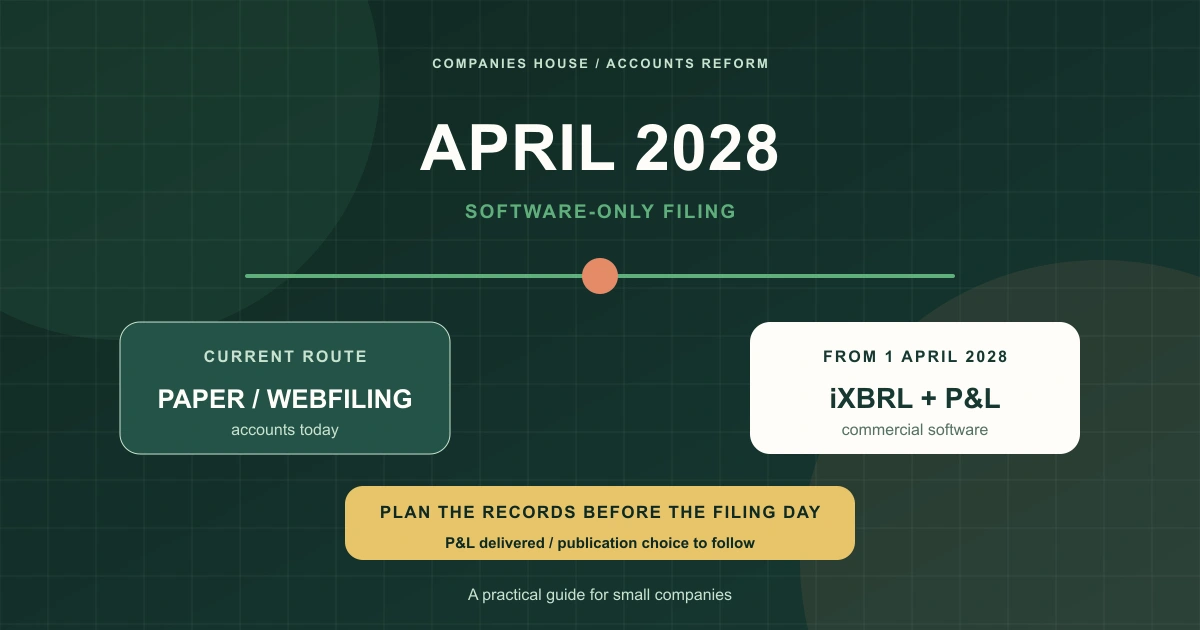
Companies House Accounts Changes 2028: What Small Companies Need to Prepare
Companies House accounts changes 2028 explained for UK small companies: software-only filing, P&L, abridged accounts and a practical preparation checklist.
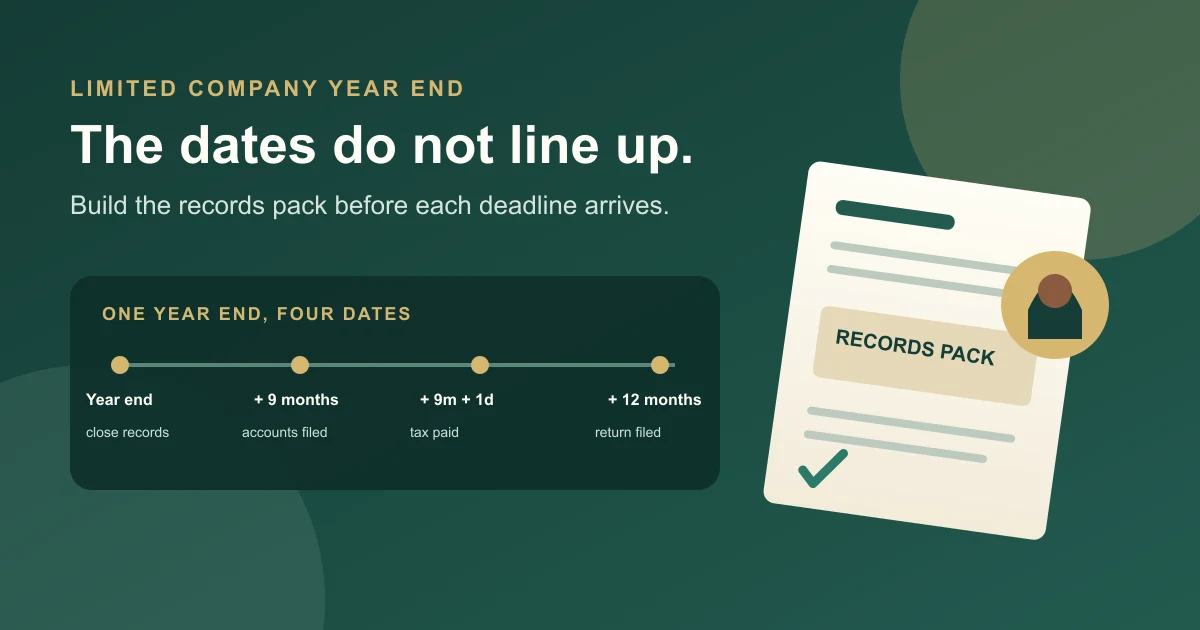
Limited Company Annual Accounts: 2026 Records and Deadline Checklist
Limited company annual accounts checklist for 2026: records to prepare, Companies House and HMRC deadlines, examples and filing changes.