Self Assessment Registration Deadline 2026: How to Register by 5 October
Self Assessment registration deadline 2026 explained for new sole traders, freelancers and side hustles, with HMRC steps, dates and record tips.
 Golden Tree Accounting Updated 27 September 2026 16 min read
 On this page Show
- Self Assessment registration deadline 2026: the dates in one view
- Who needs to register for Self Assessment?
- How to register as a sole trader for Self Assessment
- What to do after registration
- What your first filing and payment may look like
- Common registration mistakes to avoid
- What if you miss 5 October 2026?
- FAQ: Self Assessment registration deadline 2026
The Self Assessment registration deadline 2026 is 5 October 2026 if you need to file for the 2025/26 tax year and have not sent a return before. It is not the same date as the tax return deadline. You can have months between telling HMRC that you need to file and submitting the return itself, but leaving registration until January is an avoidable squeeze.
The deadline is relevant to new sole traders, freelancers, consultants, online sellers, landlords and people with other income that is not taxed through PAYE. HMRC’s recent side-hustle reminder also makes the point that several small income streams are added together when you test the £1,000 trading allowance.
Quick summary: check whether you need to register, tell HMRC by 5 October 2026, keep your 2025/26 records together, and plan for the 31 January 2027 online filing and payment deadline. Registering is the notification step. It is not the tax return.
If you want us to check the registration position and prepare the records behind your first return, our Self Assessment service, self-employment support, and contact page are good places to start.

Self Assessment registration deadline 2026: the dates in one view
The dates make more sense when you place them in order. The 2025/26 tax year ran from 6 April 2025 to 5 April 2026. If you earned enough untaxed income during that period, the registration date comes before the filing date in the following calendar year.
| Date | What it means | What to do |
|---|---|---|
| 6 April 2025 | 2025/26 tax year began | Keep records from the day you started trading or receiving the income |
| 5 April 2026 | 2025/26 tax year ended | Close the period and total your gross income and allowable costs |
| 5 October 2026 | Registration deadline for a new 2025/26 filer | Tell HMRC if you need to complete a return and have not filed before |
| 31 October 2026 | Paper return deadline | Use this only if you are filing on paper and the route applies to you |
| 30 December 2026 | Optional PAYE coding deadline | File online by this date if you want HMRC to try to collect a bill of under £3,000 through your tax code |
| 31 January 2027 | Online return and payment deadline | Submit the 2025/26 return and pay the tax due by 11:59pm |
| 31 July 2027 | Second payment on account deadline | Pay this only if payments on account apply to your account |
If you plan to file on paper, our paper tax return deadline guide covers what to post, where to send it and how the 31 October date works.
The visual below is useful because it separates the five dates that are most often mixed up. The registration deadline does not move to 31 January just because the online return is not ready yet.
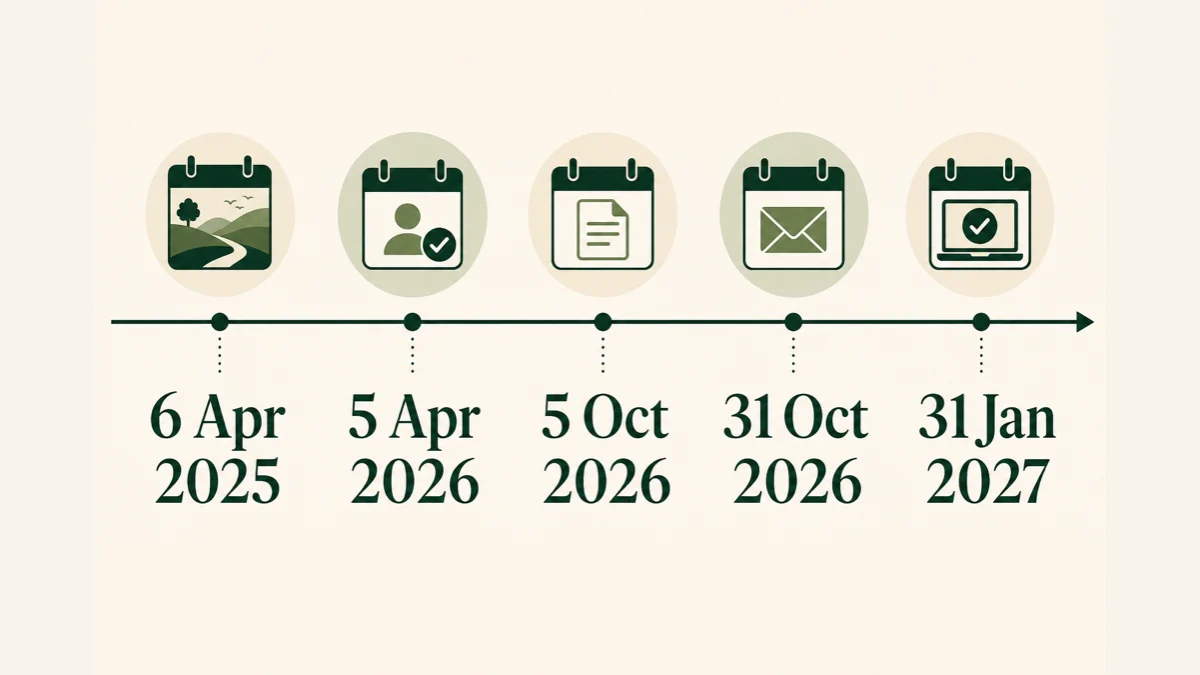
HMRC’s Self Assessment deadlines guidance confirms that the 2025/26 tax year ended on 5 April 2026, new taxpayers should tell HMRC by 5 October 2026, and online returns and payments are due by 31 January 2027.
Who needs to register for Self Assessment?
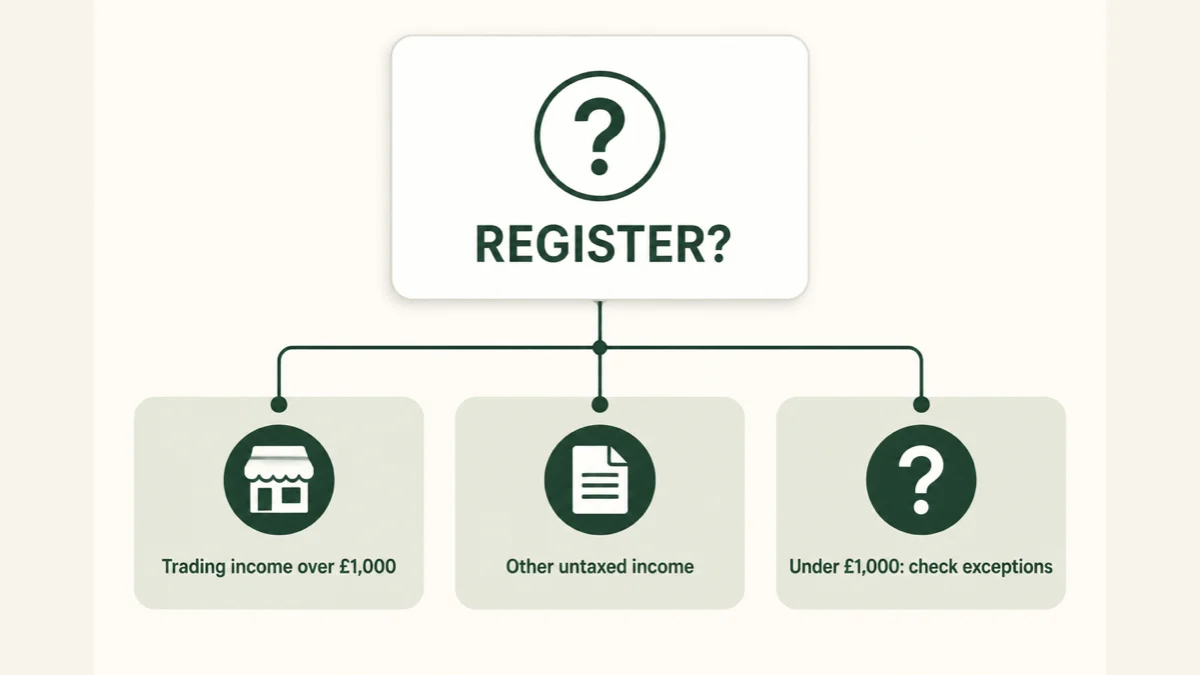
The most common reason is self-employment. You usually need to register as a sole trader if your gross trading income is more than £1,000 in a tax year. Gross means the money received or invoiced before expenses are deducted. It does not mean profit.
Other situations can also require a tax return. You may need to register if you have untaxed property income, dividends or savings income that needs reporting, foreign income, certain capital gains, a High Income Child Benefit Charge, or a request from HMRC. Company directors and partners can have their own Self Assessment obligations as well, even when they do not operate as sole traders.
The safest first step is HMRC’s own checker. The GOV.UK registration service asks why you need to file and sends you through the relevant route. A sole trader registration is not the same thing as forming a limited company. You can trade in your own name, or use a business name, while reporting the business through your personal return.
The £1,000 test uses gross income
Suppose Aisha earns £720 from freelance proofreading and £460 from weekend photography during 2025/26. Her total gross trading income is £1,180, even though each activity is below £1,000 on its own. She should treat the combined figure as the starting point and register for Self Assessment.
Now change the numbers. Ben earns £950 from occasional gardening work and has no other reason to file. Based on that trade alone, he may not need to register. He should still keep records, because a second job or a later payment can change the position. Voluntary registration can also make sense if he needs to prove self-employed status, wants to make voluntary Class 2 National Insurance payments, or needs to claim a benefit linked to self-employment.
The £1,000 allowance is not a licence to ignore income. It is a threshold with specific relief rules. If gross trading income is £1,000 or less, you may be able to use full relief, but other reasons for filing can still override that result.
Worked example: gross income versus profit
Carlos receives £1,240 from a small design business and has £440 of genuine allowable expenses. He has crossed the gross-income test, so the registration question is yes. His starting profit using actual costs is:
- gross trading income: £1,240
- allowable expenses: £440
- profit to consider: £800
Because his gross income is above £1,000, he can usually compare actual expenses with the £1,000 trading allowance when preparing the return. The trading allowance would leave £240 of taxable profit, while actual expenses leave £800. In this example the trading allowance is better, but the choice depends on his full records and wider tax position. He cannot claim the £1,000 trading allowance and the same actual expenses for that trade.
How to register as a sole trader for Self Assessment
Registration is an online HMRC process, but the details matter. A rushed application can create a duplicate record or make the first return harder to match to the business.
1. Check the reason and tax year
Confirm which tax year contains the income. If you started trading on 13 May 2025, that income falls in 2025/26 and the usual registration date is 5 October 2026. If you started on 13 May 2026, the income falls in 2026/27, so the usual registration deadline is 5 October 2027 instead.
The date you started trading is not necessarily the date you sent your first invoice. Buying stock, paying setup costs or advertising can be part of getting ready and do not, on their own, prove that the trade had begun. HMRC’s commencement guidance says the test is fact-specific: consider when you were in a position to provide the goods or services and had begun operational activity or offered them for sale. If the facts are unclear, keep a short note of the date you used and why.
2. Gather the information HMRC asks for
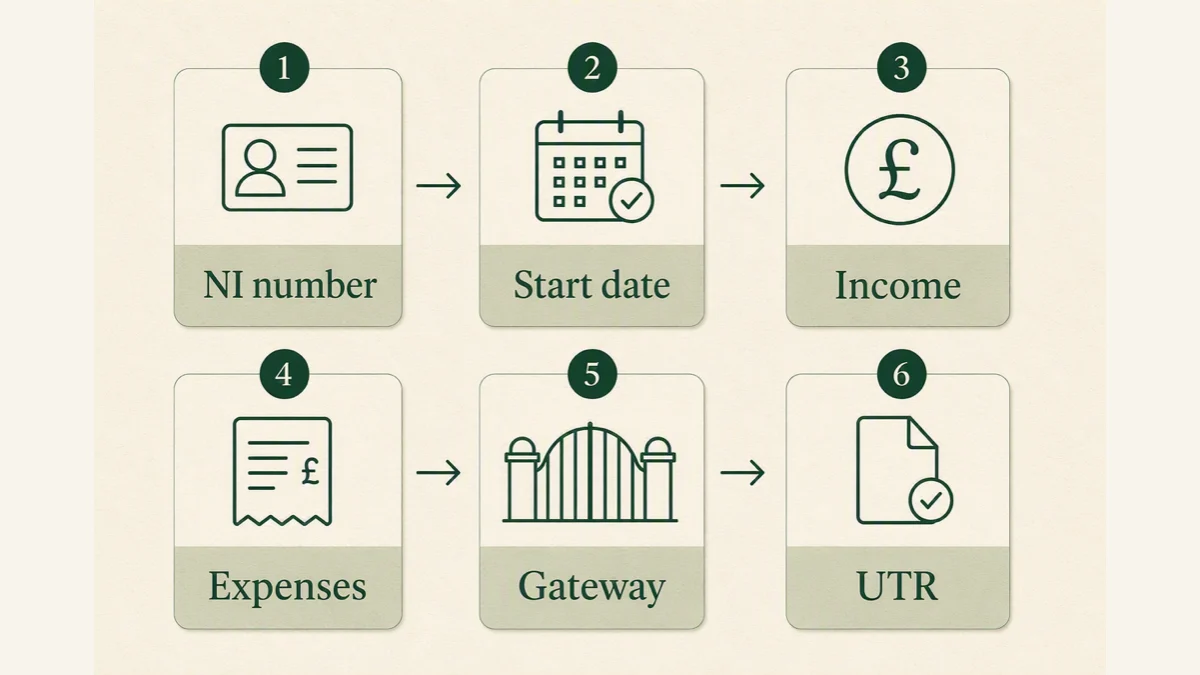
Have these details ready before opening the form:
- your National Insurance number
- your legal name, address and contact details
- the date your self-employment began
- a plain description of the work or trade
- a rough view of your income and expenses so far
- details of any existing Self Assessment registration
You do not need to wait until your final profit is calculated. That is one of the reasons the 5 October date exists. HMRC needs to know that a return is due; the return itself is where you report the finished numbers.
3. Use the correct HMRC route
Sign in through GOV.UK and choose the registration route that matches your situation. A person registering as a sole trader tells HMRC about self-employment and the associated National Insurance record. Someone who needs to report dividends, property income or another source may need the non-self-employed route instead.
If you are already registered for Self Assessment for another reason, do not assume the job is complete. HMRC says someone who was already registered may need to register again as a sole trader so the self-employed record and National Insurance position are set up correctly. Read the question on the service carefully rather than opening a second Government Gateway account.
4. Save the confirmation
Take a copy of the confirmation screen or reference, then keep an eye on your HMRC messages and post. HMRC will issue your Unique Taxpayer Reference, usually called a UTR, once the record is created. The UTR is the identifier you will use for future Self Assessment returns and conversations with HMRC.
If you register online through your Personal Tax Account, HMRC says the UTR now appears in your online account within 72 hours, instead of taking up to 15 days to arrive by post (HMRC announcement, 9 September 2026). That makes a last-week registration more manageable, but it is still better not to leave it until 4 October. Our guide to getting your UTR number covers the steps and where to find a UTR you already have.
Do not send your National Insurance number or UTR in a public post or to an unexpected email address. Use your GOV.UK account or an authorised accountant when sharing tax details. A simple security habit is to type GOV.UK into your browser rather than following a link from an unsolicited message.
What to do after registration
Registration is the start of the admin, not the finish line. Put the following into one folder or bookkeeping system while the transactions are still easy to identify:
- sales invoices, platform statements and payment records
- bank and card statements for the business activity
- receipts and supplier invoices for costs
- mileage logs and notes for mixed-use expenses
- pension, gift aid, interest and dividend information where relevant
- your P60 or P45 if you also have employment income
- payments on account and HMRC account statements
Keep your records even if the return is simple. HMRC does not normally ask you to upload every receipt with the return, but you need evidence for the figures if the department asks questions. For a return due by 31 January 2027, the usual five-year record-keeping period runs to at least 31 January 2032.
Our bookkeeping service can help build a monthly routine before the first filing deadline. If you are deciding between cash basis and traditional accounting, our cash basis versus traditional accounting guide explains the timing differences without trying to make one method right for everybody.
Worked example: building a first tax reserve
Imagine Dan has 2025/26 self-employed profit of £24,000, no other taxable income and no special reliefs. Using a simplified England, Wales or Northern Ireland calculation:
- personal allowance: £12,570
- taxable income: £24,000 minus £12,570 = £11,430
- Income Tax at 20%: £2,286
- Class 4 National Insurance at 6% on £11,430: £685.80
- illustrative total for Income Tax and Class 4 NIC: £2,971.80
That is not a personal tax calculation. Scotland has different Income Tax bands, and employment income, pension contributions, student loans, benefits, losses and other details can change the result. It is a useful planning example, though. Dan might set aside around £250 a month while he waits for the final return calculation, then adjust the reserve when his bookkeeping is complete.
Class 2 National Insurance rules have changed, and voluntary payments can be relevant in some cases. Check your own record before assuming that no payment is possible or that a weekly charge will automatically appear.
What your first filing and payment may look like
For someone who started trading in 2025/26, the first return covers the period from the start date up to 5 April 2026. It can include other income too. A PAYE job does not count towards the £1,000 gross trading-income test, but its pay and tax deducted may need to be included in the employment section of the return.
If you register after 5 October 2026, HMRC says it may give you a different filing date, normally three months from the date on its letter or email. That does not postpone the tax payment. Any 2025/26 tax due still needs to be paid by 11:59pm on 31 January 2027.
Worked example: why January can be bigger than expected
Suppose Elena’s final 2025/26 Self Assessment bill is £2,400 and payments on account apply. Her January 2027 statement could show:
- balancing payment for 2025/26: £2,400
- first payment on account for 2026/27: £1,200
- total due by 31 January 2027: £3,600
Her second payment on account would then be £1,200 by 31 July 2027. The exact calculation depends on what is included in the bill and whether the payments-on-account conditions are met. HMRC generally does not require payments on account where the previous bill was under £1,000 or where at least 80% of the tax was collected outside Self Assessment, but check the statement rather than relying on a rule of thumb.
This is why registering early helps. You can see the tax calculation, check the records and build a reserve before a January statement combines the old bill with an advance payment for the new year.
Common registration mistakes to avoid
Treating 5 October as the tax return deadline
It is the date for telling HMRC that a return is needed. The online return and payment deadline for 2025/26 is 31 January 2027. Confusing the two creates either unnecessary panic in October or a very late registration in January.
Testing the £1,000 limit against profit
Someone with £1,300 of sales and £500 of costs has £1,300 of gross trading income, not £800 for the registration test. Work from the money coming in before expenses.
Registering each side income separately
Two small trades can be added together for the £1,000 test. Keep separate records for each activity if that makes the bookkeeping clearer, but do not assume each stream gets its own threshold.
Waiting for a UTR before keeping records
The UTR identifies your HMRC record. It does not create the transactions and it does not replace invoices, bank statements or receipts. Start the evidence pack as soon as the work starts.
Opening a duplicate Government Gateway account
A new account can make it harder to find the correct tax record. Use the existing sign-in if you already have one, and check whether you need to add self-employment to an existing Self Assessment record.
Assuming income under £1,000 always ends the conversation
The trading allowance is only one part of the rules. A loss claim, voluntary National Insurance, Tax-Free Childcare, Maternity Allowance, CIS deductions or another source of income can change what you need to do.
What if you miss 5 October 2026?
Register as soon as you realise. Do not wait until the return is perfect. You can then work through the figures and submit the return by the deadline that HMRC gives you, while still paying any tax due by 31 January 2027.
Late registration can lead to a failure to notify penalty if tax remains unpaid after 31 January. Late filing and late payment penalties are separate issues. HMRC’s Self Assessment penalty guidance explains the initial £100 late filing penalty, the possible daily penalties after three months, and the 5% charges that can apply when tax remains unpaid.
If there was a genuine reasonable excuse, keep the evidence and consider the formal appeal route. A vague feeling that the rules were confusing is not the same as a documented event that prevented you acting. We can help separate a late registration problem from a calculation problem through our Self Assessment service, but HMRC decides whether a penalty appeal is accepted.
FAQ: Self Assessment registration deadline 2026
What is the Self Assessment registration deadline 2026?
For someone who needs to file for the 2025/26 tax year and has not filed before, the usual deadline is 5 October 2026. The 2025/26 tax year ran from 6 April 2025 to 5 April 2026.
Is the £1,000 threshold based on profit?
No. For a sole trader, the common test starts with gross trading income before expenses. Add the gross income from relevant trades together. If the total is above £1,000, you usually need to register, even if allowable expenses later reduce the taxable profit.
Do I need to register if my trading income is £1,000 or less?
Not always. If that is your only reason for filing, you may qualify for trading allowance relief. You may still need to register for another reason, or choose to register to preserve a self-employed record or claim a benefit linked to self-employment.
What if I started trading after 5 April 2026?
Income from the 2026/27 tax year is normally reported after 5 April 2027. If you need to file for that year, the usual registration deadline is 5 October 2027 and the online return and payment deadline is 31 January 2028.
Can I register now and file later?
Yes. Registering tells HMRC that you need to complete a return. You can prepare your records during the year and submit the online return from 6 April 2026 up to 31 January 2027 for the 2025/26 tax year.
Does registering for Self Assessment make me a limited company?
No. A sole trader registers with HMRC for Self Assessment and remains personally responsible for the business. Forming a limited company is a separate Companies House and Corporation Tax decision.
What if I have a PAYE job as well?
You can be employed and self-employed at the same time. Your PAYE salary and tax already deducted may need to go on the return, but your employment income does not count as trading income when checking the £1,000 sole trader threshold.
Open HMRC’s checker, total the gross income from every relevant trade, and save the evidence pack before you register. If the answer is yes, do not wait for January. The cleanest next step is to register by 5 October 2026, then use the time before 31 January to check the return properly.

About Golden Tree Consulting
ACCA Affiliated | MBA Qualified
Golden Tree Accounting & Business Consulting provides expert tax, bookkeeping, and advisory services to sole traders and SMEs across Croydon, London, Surrey, and Kent. With multilingual support and decades of combined experience, we help businesses stay compliant and grow.
Offices in Croydon and London Bridge.
Related guides
How to Get Your UTR Number: Online in 72 Hours or by Post
How to get a Unique Taxpayer Reference (UTR) in the UK: register for Self Assessment online and get it within 72 hours, where to find a UTR you already have, company UTRs and what to do if it has not arrived.

Side Hustle Tax UK: 5 April 2026 Checklist to Avoid Costly Mistakes
Side hustle tax UK rules are easy to get wrong. Use this 5 April 2026 checklist to track income, claim expenses correctly, and avoid HMRC penalties.
HMRC MTD Letter 2026: What to Check If You've Been Signed Up
Received an HMRC MTD letter? Check the £50,000 qualifying-income test, correct changed income sources and catch up with the 2026/27 steps.