Self Assessment Paper Tax Return Deadline 2026: 31 October UK Guide
Self Assessment paper tax return deadline 2026 explained: what to post, where to send SA100, penalties, payment dates and a 31 October checklist.
 Golden Tree Accounting 9 September 2026 20 min read
 On this page Show
- Self Assessment paper tax return deadline 2026 at a glance
- Who should use the paper route?
- Build the right paper return pack
- Complete the SA100 without losing the useful details
- Where to post a paper Self Assessment return
- Filing the return and paying the bill are separate dates
- What to do if you cannot finish by 31 October
- Paper return penalties if you miss the date
- Common paper-filing mistakes to catch before posting
- A practical checklist for 31 October 2026
- FAQs about the 2026 paper tax return deadline
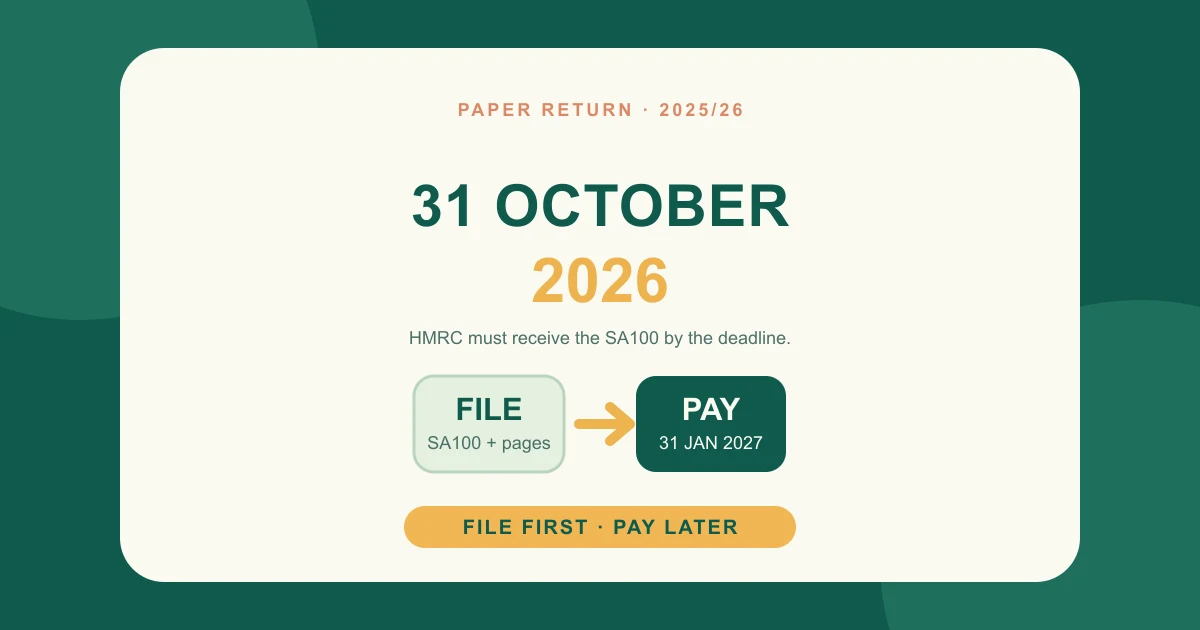
The Self Assessment paper tax return deadline 2026 is 11:59pm on 31 October 2026 for most people filing a return for the 2025/26 tax year. That is the date HMRC must receive the paper return, not simply the date you put it in the post. Tax owed for that return is normally due later, by 31 January 2027.
That gap between filing and paying causes a fair amount of confusion. You can file a paper return in October, wait for HMRC to calculate it, then pay in January. You still need to get the figures and supplementary pages right the first time, though. A form that arrives without a signature, a required page or a clear business calculation can create a second deadline problem.
There is a practical wrinkle this year. 31 October 2026 falls on a Saturday. HMRC’s rule is that the return must arrive by the deadline. Leaving the envelope until the last weekday before it is due gives the postal service very little room. If you are using paper, start the pack now and build in time for delivery.
Quick answer: the 2025/26 paper return must reach HMRC by 11:59pm on 31 October 2026, unless your notice to file gives a later date. The payment deadline remains 31 January 2027. Check the right forms, complete the SA100 in whole pounds, sign the declaration, send it to the correct address and keep proof of delivery.
If you want another pair of eyes on a self-employed return, our Self Assessment service can help you check the figures and forms before they go in the envelope. Do not wait for the payment date to discover that an income source or supplementary page was missed.
Self Assessment paper tax return deadline 2026 at a glance
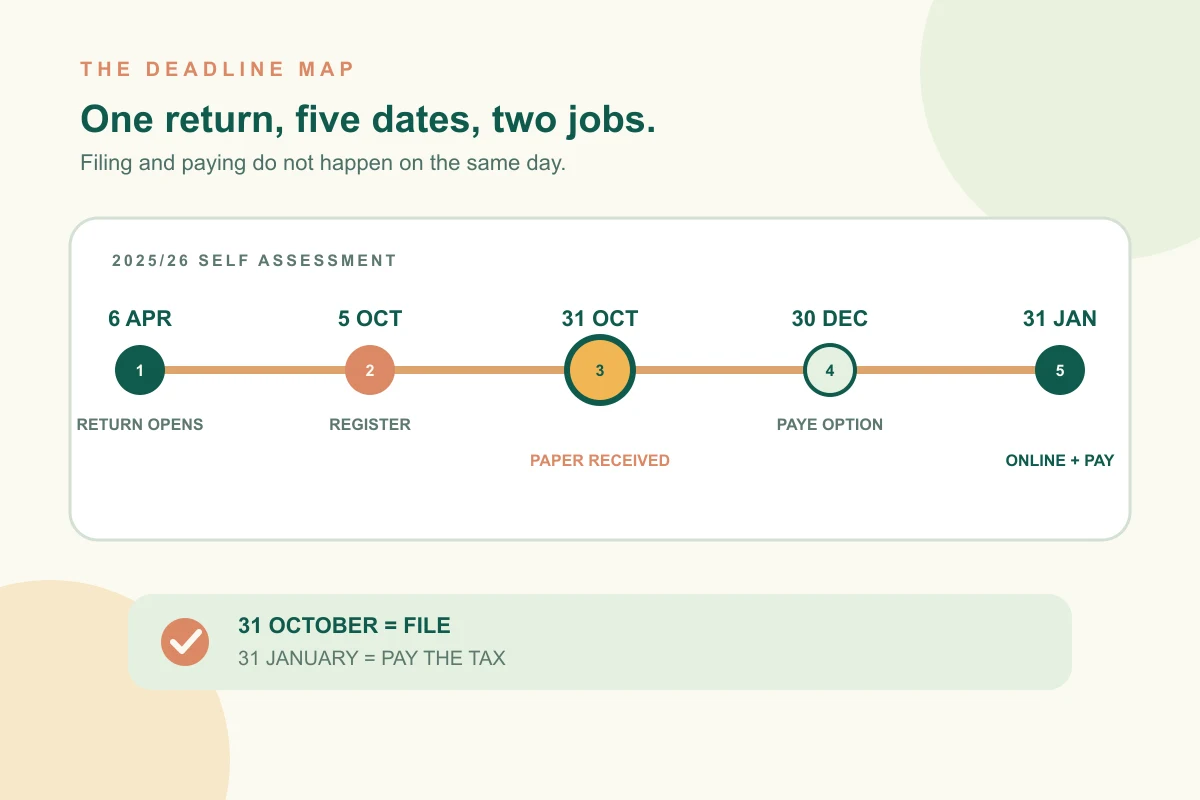
The return covers income, gains and claims for the tax year from 6 April 2025 to 5 April 2026. The dates below are the normal timetable for an individual who has received a notice to file.
| Date | What it means | Who needs to act |
|---|---|---|
| 6 April 2026 | The 2025/26 tax year return can be filed | Anyone ready to report the year just ended |
| 5 October 2026 | Tell HMRC if you newly need to file for 2025/26 | First-time filers and some people who did not file for 2024/25 |
| 31 October 2026 | Paper return must reach HMRC by 11:59pm | People using the paper route, unless their notice says otherwise |
| 30 December 2026 | Online return deadline if you want eligible tax collected through PAYE | People who meet HMRC’s tax-code collection conditions |
| 31 January 2027 | Online filing deadline and tax payment deadline | Online filers and anyone with tax to pay |
| 31 July 2027 | Second payment on account, where applicable | Taxpayers who are required to make payments on account |
The GOV.UK Self Assessment deadlines guidance confirms the key distinction: HMRC must receive a paper return by 31 October 2026, but an online return can be filed by 31 January 2027. The same page says tax owed for 2025/26 is due by 31 January 2027.
The 5 October date is important, but it is not the paper filing date. If you are filing for the first time, registering with HMRC and submitting a return are separate jobs. The existing registration guide on this site covers that process. This guide is about getting the 2025/26 paper return completed, posted and received on time.
Who should use the paper route?
Most people now file online. HMRC’s 2026 return notes say 97% of people already use the online service, which is available at any time of day and saves work as you go. Online filing also gives you an extra three months and does the basic calculations for you.
Paper filing can still be sensible if you prefer a printed form, your agent is submitting it on your behalf or your circumstances fit a form that is not available through the ordinary online service. Some taxpayers, including trustees of registered pension schemes and non-resident companies, have special rules and cannot file online. Their paper deadline may be 31 January 2027 rather than 31 October, so they should follow the notice and the relevant HMRC form instructions.
Do not assume that living outside the UK automatically gives you the later date. A UK resident using the paper SA100 generally has the 31 October deadline. A non-resident individual may still be able to file online, while a non-resident company has a different form and process. The category on your notice matters more than a general rule found in a forum.
If you start with paper and then realise that online filing would be safer, check the online service before the paper deadline. Online filing is usually easier to amend and lets you save the return while you gather information. It is not a reason to delay the underlying work. The income and expenses still need to be identified and supported.
Build the right paper return pack
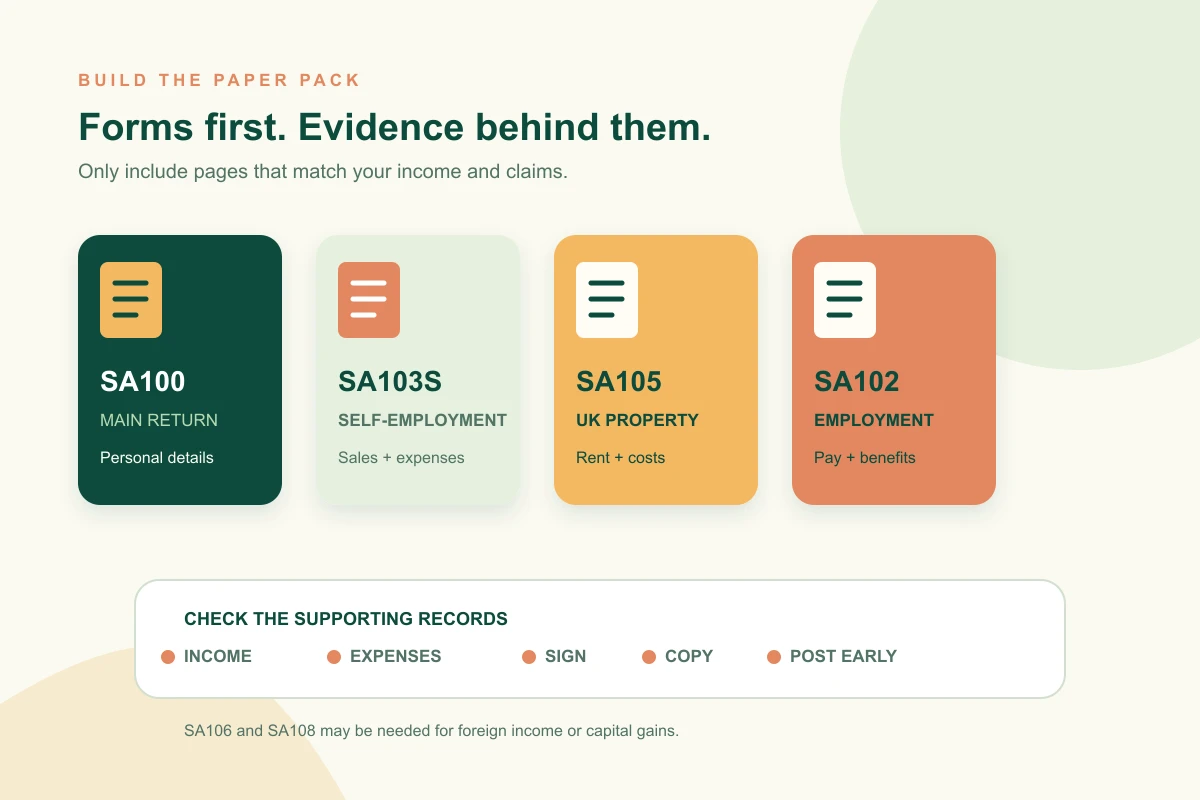
The main form is the SA100 Tax Return 2026. It covers the year from 6 April 2025 to 5 April 2026. You may need supplementary pages, depending on what happened during that year.
| Your circumstances | Page you may need | Typical information |
|---|---|---|
| Employment or a directorship | SA102 | Pay, tax deducted, benefits and employment expenses |
| Self-employment | SA103S or SA103F | Turnover, allowable expenses, capital allowances and profit |
| UK property income | SA105 | Rent, allowable property costs and finance-cost information |
| Partnership income | SA104S or SA104F | Your share of partnership income and relevant details |
| Foreign income or gains | SA106 | Overseas income, foreign tax and related claims |
| Capital gains | SA108 | Disposals, gains, losses and relief claims |
| Additional information | SA101 | Less common income, deductions or reliefs |
Do not attach every page you can find. Read the questions on the SA100 and the current notes, then include the pages that match your sources of income and claims. A self-employed director with a salary, dividends and a separate trade may need more than one set of pages. Someone with only PAYE income and a small additional item may need a much shorter pack.
Alongside the forms, collect the records behind the boxes:
- P60s, P45s and payslips for employment income
- dividend vouchers and company records for dividends
- sales invoices, bank statements and payment-platform reports for a trade
- receipts and a list of allowable business expenses
- rent schedules, agent statements and repair invoices for property income
- pension contribution statements and Gift Aid records where relief is claimed
- interest statements, foreign tax details and exchange-rate workings where relevant
- contracts, purchase records and disposal proceeds for capital gains
- details of student loans or High Income Child Benefit Charge information if HMRC asks for it
The evidence does not all go in the envelope. Keep it in a labelled folder or digital archive so each figure can be traced back to a record. HMRC may ask to see it later. Our bookkeeping service can help rebuild a missing income and expense schedule when the bank feed, invoices and paper receipts do not agree.
Complete the SA100 without losing the useful details
The 2026 paper form has a few instructions that are easy to overlook when you are copying figures from a spreadsheet.
Use whole pounds in the paper boxes
The SA100 notes say to enter figures in whole pounds and ignore pence. They also say to round down income and round up expenses and tax paid, which is intended to benefit the taxpayer. Do not round every line to the nearest pound using a spreadsheet default.
Here is a simple example:
- sales received and invoiced: £42,786.40, entered as £42,786
- allowable expenses: £9,214.88, entered as £9,215
- reported profit before any other adjustment: £42,786 - £9,215 = £33,571
That is a form-entry convention, not permission to invent a larger expense. Keep the original pounds-and-pence records in your working papers so the rounding can be checked.
Check personal details and the tax year
Check your name, address, National Insurance number and Unique Taxpayer Reference. Make sure the form says 6 April 2025 to 5 April 2026. A correct calculation on the wrong year’s form is still a filing problem.
If the return was issued after the normal timetable, read the notice carefully. The SA100 notes say the relevant date may be 3 months after the notice if that is later than 31 October 2026. Do not overwrite the deadline on the notice with a date copied from a general calendar.
Leave irrelevant boxes blank
The form instructions say to leave a box blank when it does not apply. Do not put zeroes, ticks or notes in every empty box. Answer the questions at the start first, then use the relevant supplementary page. This makes it easier to see whether a missing page is a genuine omission or a section that does not apply.
Sign and date the declaration
An unsigned paper return is not a finished return. Check the declaration on the final page, sign and date it, then scan or copy the completed pack before posting. An agent can complete much of the form, but the declaration and authority still need to follow the instructions that apply to the return.
If a final figure is not available, do not simply leave the whole return until January. HMRC’s form instructions allow provisional figures when needed, provided you mark the return and explain what is provisional, why it is being used and when the final figure is expected. Use this only when the estimate is based on the best information you have, not as a convenient way to avoid checking the books.
Where to post a paper Self Assessment return
The GOV.UK guidance on completing the 2026 return says you need to post the return to HMRC. If you live in the UK, the address is:
Self Assessment
HM Revenue and Customs
BX9 1AS
United Kingdom
If you live outside the UK, the guidance gives this address:
HM Revenue and Customs
Benton Park View
Newcastle Upon Tyne
NE98 1ZZ
United Kingdom
Check your latest HMRC correspondence before using a general address. The 2026 SA100 information sheet also says to look at recent HMRC correspondence for the office address and to use BX9 1AS if you do not have recent correspondence. Keep a copy of the envelope details as well as the return itself.
The legal test is receipt. A postmark or a photograph of an envelope does not prove that HMRC had the return by 11:59pm on 31 October. Post early, use a trackable service where practical and save the receipt, tracking result and a complete copy of everything sent. If you are using an accountant or tax agent, agree who is posting it and ask for confirmation of the date and delivery evidence.
Because the 2026 deadline is a Saturday, treat the final week as the risk window rather than the final day as a target. A missing page can be corrected. A late envelope may create a penalty before anyone has reviewed the figures.
Filing the return and paying the bill are separate dates
Filing early does not make the tax payable immediately. If HMRC receives the paper return by 31 October, the 2026 form notes say HMRC will calculate the tax and tell you how much to pay before 31 January 2027. You can still budget before the calculation arrives by making a sensible estimate from your records.
Payments on account can make the January figure larger than expected. They are advance payments towards the next Self Assessment bill, usually based on the relevant tax from the previous year. Each instalment is normally half of that amount. They generally do not apply if the relevant tax was less than £1,000, or if more than 80% of the tax was already collected outside Self Assessment, such as through PAYE.
Worked example: the January payment can contain two parts
Imagine that Maya’s 2025/26 calculation shows £4,800 of relevant Self Assessment tax and she has no previous payments on account to set against it. If the normal payments-on-account rules apply:
| January 2027 item | Calculation | Amount |
|---|---|---|
| Balancing payment for 2025/26 | Tax shown by the return | £4,800 |
| First payment on account for 2026/27 | 50% of £4,800 | £2,400 |
| Total due by 31 January 2027 | £4,800 + £2,400 | £7,200 |
| Second payment on account for 2026/27 | 50% of £4,800, due 31 July 2027 | £2,400 |
This is an illustration, not a prediction of Maya’s final bill. The relevant amount can be affected by tax deducted at source, Class 4 National Insurance, claims and other details. Her HMRC statement is the figure to pay. If the next year’s income is likely to be lower, she may be able to ask HMRC to reduce the payments on account, but reducing them too far can lead to interest.
If the return shows a smaller bill than the previous year, do not assume the paper filing date has moved. The return is still due on the applicable filing date. Only the calculation and payment position changes.
What to do if you cannot finish by 31 October
The safest option is to make a decision before the paper deadline, not after it.
Switch to online filing if you are eligible
Online filing gives most people until 31 January 2027. It also checks more of the arithmetic and shows the tax calculation as you work. If you have not used the online service before, allow time to deal with sign-in, identity checks, registration and any missing supplementary information.
Do not post an incomplete paper return and assume you can replace it online later without a problem. If you know the envelope will not arrive on time, finish and submit online instead where the service accepts your circumstances. Keep a note of what was submitted and the submission confirmation.
If the date has already passed
File as soon as possible and check the penalty position. GOV.UK tells people who miss the paper filing deadline to send the return online instead, but filing online is not a magic reset for a paper return that was already late. HMRC’s internal guidance says a late paper return cannot be made penalty-free simply by sending another return online before 31 January.
If you could not file on time because of an event outside your control, gather evidence and consider a reasonable-excuse appeal. Do not wait for the appeal decision before submitting the return or paying what you can. If you cannot pay the tax, contact HMRC about payment help and keep the filing job moving.
If HMRC says you cannot file online
Some returns have a different route or later deadline. Read the notice and the form notes, then contact HMRC if the instructions do not match your circumstances. A general online deadline is not a substitute for the special rule that applies to your form.
Paper return penalties if you miss the date
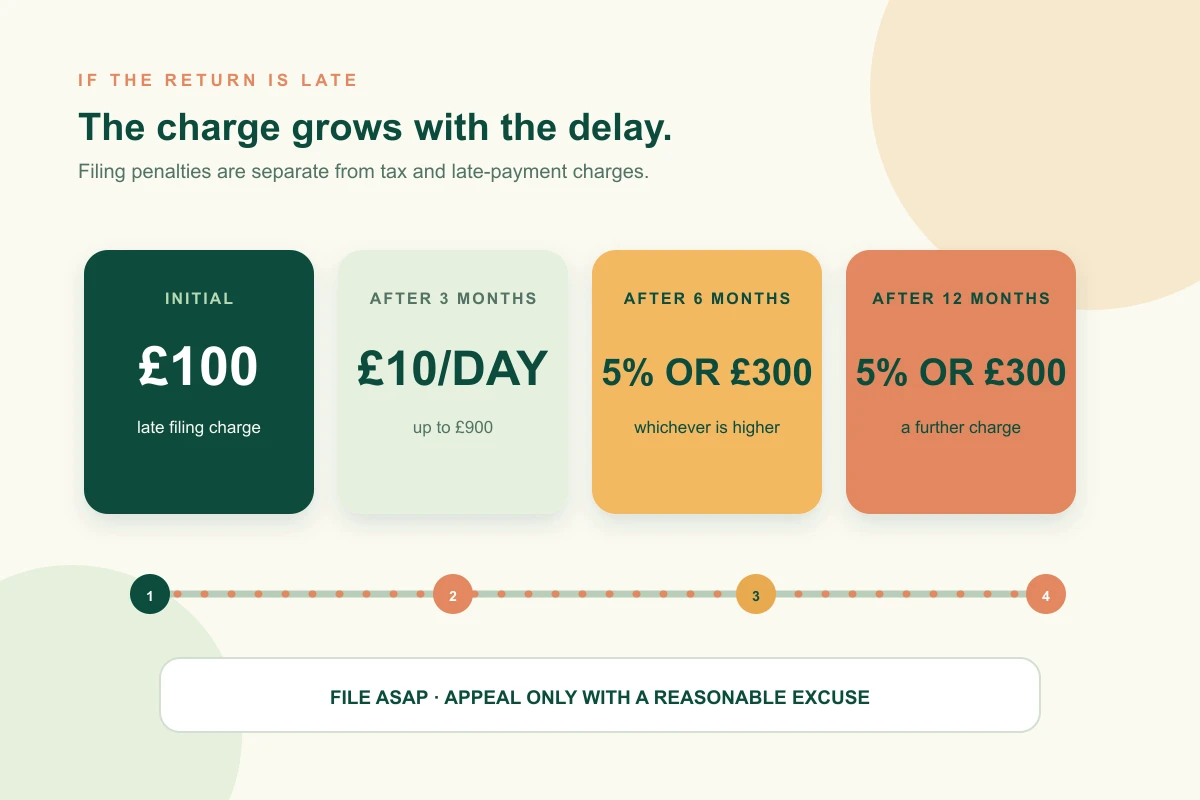
The late-filing penalty is separate from the tax bill. HMRC’s current penalty guidance says the usual sequence is:
| How late the return is | Possible late-filing charge |
|---|---|
| Immediately after the deadline | £100 initial penalty |
| More than 3 months late | £10 per day, up to £900 |
| More than 6 months late | 5% of tax due or £300, whichever is greater |
| More than 12 months late | A further 5% of tax due or £300, whichever is greater |
Worked example: a seven-month delay
Suppose a taxpayer owes £2,400 and the return is seven months late. The illustrative filing penalties could be:
- £100 initial penalty
- £900 of daily penalties, if the full 90-day maximum is charged
- £300 at the six-month point, because 5% of £2,400 is £120 and £300 is higher
- £1,300 total late-filing penalties, before any late-payment interest or late-payment penalties
The actual account and penalty notices decide what HMRC charges. The example shows why filing is worth prioritising even when the tax calculation is not ready. A return with no tax to pay can still attract late-filing penalties.
If you have a reasonable excuse, you can appeal. A reasonable excuse is fact-specific. Keep evidence of the event, when it happened, what you did to deal with it and when you filed. “I forgot” or “I did not know” is unlikely to be enough on its own.
Common paper-filing mistakes to catch before posting
Using the 31 January date for a paper return
The online deadline is later. A paper return received after 31 October can be late even though an online return would still be within time. Decide which route you are using and put that route’s deadline on the front of your checklist.
Sending the main form without a supplementary page
The SA100 may ask questions that point to SA103, SA105, SA102, SA106 or SA108. Read the form before printing the final pack. A self-employed person who reports only the SA100 may leave the main business figures out entirely.
Copying gross turnover into a profit box
Turnover is not the same as taxable profit. If a sole trader has £36,000 of sales and £8,500 of allowable expenses, the starting profit calculation is £36,000 - £8,500 = £27,500, before any other adjustments or reliefs. The actual return may require capital allowances, private-use adjustments or a different accounting basis.
Forgetting employment and dividend income
A director who also runs a trade may need to report salary, benefits, dividends and self-employment separately. A bank transfer labelled “director pay” is not enough evidence on its own. Match the figure to payroll, dividend paperwork and the correct return page.
Posting to an old address
HMRC addresses and processing arrangements can change. Use the current form and your latest correspondence, then keep the proof of posting. Do not rely on a saved address from a previous year’s envelope.
Sending the only copy
Scan or photocopy the signed return and supplementary pages. Save the records and the posting evidence together. If HMRC asks a question, you should be able to see exactly what was submitted rather than reconstructing it from memory.
A practical checklist for 31 October 2026
Use this checklist in the week before posting:
- Confirm the return covers 6 April 2025 to 5 April 2026.
- Read the notice to file and confirm whether it gives a later date.
- Check whether you need SA100 only or supplementary pages as well.
- Reconcile trade income to invoices, bank statements and payment platforms.
- Separate turnover, allowable expenses, private costs and capital purchases.
- Check PAYE, dividends, property income, interest, pensions and gains.
- Enter paper figures in whole pounds, rounding down income and up expenses and tax paid as instructed.
- Mark and explain any provisional figures.
- Check every required page is present, then sign and date the declaration.
- Copy or scan the full pack.
- Use the current HMRC address and post early enough for receipt.
- Keep the delivery receipt, tracking result and a note of the date sent.
- Estimate the January payment, including any possible payment on account.
The final check should be boring. Boring is good here. It means the number on the tax calculation can be traced to a page, the page can be traced to a working paper and the envelope can be traced to a delivery record.
FAQs about the 2026 paper tax return deadline
When is the Self Assessment paper tax return deadline in 2026?
HMRC must receive most paper returns for the 2025/26 tax year by 11:59pm on 31 October 2026. If your notice to file gives a later date, follow the notice. The normal tax payment date remains 31 January 2027.
Can I file my Self Assessment return online instead of on paper?
Usually. Online filing gives most people until 31 January 2027 and makes it easier to save, calculate and amend the return. If you are switching from paper, check that your circumstances are accepted by the online service and submit before the relevant deadline.
Where do I send a paper Self Assessment tax return?
UK residents should normally use Self Assessment, HM Revenue and Customs, BX9 1AS, United Kingdom. People living outside the UK should check the current form guidance, which gives HM Revenue and Customs, Benton Park View, Newcastle Upon Tyne, NE98 1ZZ, United Kingdom. Your latest HMRC correspondence takes priority if it gives a different office.
What forms go with the SA100 paper tax return?
The pages depend on your income. Self-employment usually uses SA103S or SA103F, UK property uses SA105, employment or directorships use SA102, foreign income uses SA106 and capital gains use SA108. Do not include a page that does not apply, but do not leave out one that the SA100 questions require.
Will HMRC calculate my tax if I file by 31 October?
HMRC’s 2026 form notes say it will calculate the tax and tell you what to pay before 31 January 2027 when it receives the paper return by 31 October. Keep your own working papers and do not treat HMRC’s calculation service as a replacement for checking the return.
What happens if my paper return is late?
The initial penalty is £100, followed after three months by possible daily penalties of £10 a day up to £900. Further penalties can apply after six and twelve months. File as soon as possible and appeal only where you have a fact-based reasonable excuse.
When do I pay tax if I send a paper return?
The paper filing date is not the payment date. Tax for 2025/26 is normally due by 31 January 2027. If payments on account apply, the first 2026/27 instalment can be due on that date as well, with the second normally due on 31 July 2027.
The useful next step is to put the SA100, the required supplementary pages and the delivery receipt beside your records today. If one box still depends on a guess, send the draft pack to our contact page before you post it, so there is time to resolve the missing evidence before Saturday 31 October.

About Golden Tree Consulting
ACCA Affiliated | MBA Qualified
Golden Tree Accounting & Business Consulting provides expert tax, bookkeeping, and advisory services to sole traders and SMEs across Croydon, London, Surrey, and Kent. With multilingual support and decades of combined experience, we help businesses stay compliant and grow.
Offices in Croydon and London Bridge.
Related guides
HMRC MTD Letter 2026: What to Check If You've Been Signed Up
Received an HMRC MTD letter? Check the £50,000 qualifying-income test, correct changed income sources and catch up with the 2026/27 steps.

HMRC Tax Investigation Letter: What to Do During a Compliance Check in 2026
Received an HMRC tax investigation letter? Learn what a compliance check means, what records to prepare, how penalties work and when to get help in 2026.

Self Assessment Registration Deadline 2026: How to Register by 5 October
Self Assessment registration deadline 2026 explained for new sole traders, freelancers and side hustles, with HMRC steps, dates and record tips.