Tips Tax UK 2026: PAYE, National Insurance and Fair Distribution for Employers
Tips tax UK 2026 explained for employers, including PAYE, National Insurance, tronc schemes, payment deadlines, records and fair distribution.
 Golden Tree Accounting 2 September 2026 21 min read
 On this page Show
- Tips tax UK 2026: separate the legal and tax questions
- Classify the payment before it reaches the payroll file
- Direct tips and employer-controlled tips need different payroll treatment
- Tronc schemes are a separate arrangement, not a tax-free shortcut
- The fair-distribution checklist for employers
- Payment dates, records and worker requests
- What changed, and what has not changed, in 2026
- VAT and National Minimum Wage traps
- A payroll and bookkeeping process that can be checked
- FAQ: tips tax UK 2026
- The next practical check
A restaurant that collects £1,000 in card tips cannot quietly remove a £20 card fee and pass the balance on as if nothing happened. It needs to identify who controls the money, use the right payroll route, pay the qualifying tips on time and keep a record of the allocation. That is the practical side of tips tax UK 2026 for employers.
The tax answer is not the same for every tip. Cash handed straight to a worker and kept by that worker has one route. A card tip that reaches the employer, a service charge added to the bill or a payment distributed through a tronc has another. The amount may look similar on the till report, but the PAYE and National Insurance work can be quite different.
There is a second set of rules to keep in view. Since 1 October 2024, the Employment (Allocation of Tips) Act 2023 has required qualifying tips to be passed to workers without deductions other than usual tax and National Insurance deductions, allocated fairly and transparently. The Act did not rewrite the tax rules. HMRC still looks at the way money is received, paid and allocated when deciding the payroll treatment.
Quick answer: classify the payment before you post it. Direct tips retained by a worker normally sit outside the employer’s PAYE payroll. Tips paid by an employer must go through the appropriate PAYE arrangement, and National Insurance depends on the facts. A mandatory service charge paid to staff always attracts National Insurance. Keep the tipping policy, allocation formula, payment date and supporting records together.
If your till reports, payroll and bookkeeping do not agree, our payroll services can help you map the tip route before the next pay run. It is much easier to correct the process while the payment report and staff rota are still available.

Tips tax UK 2026: separate the legal and tax questions
Employers often ask one short question, “Are tips taxable?” That question has two parts. The employment-law rules ask what must happen to the money once the employer controls or significantly influences its distribution. The tax rules ask whether PAYE and National Insurance apply to the payment and who is responsible for operating them.
The same card tip can sit inside both rulebooks. A genuinely direct cash tip may be taxable to the employee but outside the employer’s tipping policy and payroll. A card tip paid into the business account can be a qualifying tip under the Tipping Act, taxable pay through the relevant payroll, and part of the records the staff can ask to see.
| Payment route | Who controls the money? | PAYE position | National Insurance position | Employer action |
|---|---|---|---|---|
| Cash tip handed to and kept by the worker | No employer involvement | Not through the employer’s PAYE | No employer Class 1 NIC on the tip | Tell the worker to report the taxable amount to HMRC and explain the workplace policy |
| Card tip or cash pool received and shared by the employer | The employer, directly or indirectly | Include each worker’s payment in gross pay and deduct PAYE | Usually due where the employer passes on or allocates the money | Reconcile the pool, allocate it, run payroll and retain evidence |
| Separate tronc arrangement | Troncmaster, subject to the facts | Troncmaster normally operates PAYE for tronc payments | Depends on who receives and allocates the money; employer remains responsible where due | Tell HMRC about the tronc, record payment dates and check the NIC treatment |
| Compulsory service charge paid to workers | Employer receives an amount the customer must pay | Treat the payment made to staff as earnings | Due on the payment regardless of the sharing method | Include it in payroll and account for VAT on the underlying supply |
That last column is the bit that prevents a tidy-looking spreadsheet from becoming a payroll problem. Keep the sales record, the tip policy, the allocation calculation and the payroll report close enough that another person can follow the route.
Classify the payment before it reaches the payroll file
The wording on a menu, invoice or card machine matters. HMRC distinguishes a tip or gratuity, a voluntary service charge and a compulsory service charge. A business can call all three “service charge” in ordinary conversation, but the label does not decide the tax result.
A tip or gratuity
A tip is an uncalled-for, spontaneous payment offered by a customer. It can be cash, part of a cheque, a specific amount on a debit or credit card payment, or a payment made through a digital app. The important practical question is where it goes next.
If the customer pays the worker directly and the worker keeps the money without employer involvement, the employer does not run PAYE on it. The employee still has taxable income and must tell HMRC about the amount, usually through a tax-code adjustment or Self Assessment where relevant.
The position changes if staff hand cash to the employer so it can be pooled and divided, or if card tips go into the business’s payment account. The employer is then involved in the payment or allocation. That is the point at which payroll records need to start, even if the tip originated with a customer’s generosity rather than the business’s own funds.
A voluntary service charge
A voluntary service charge is an amount added to the bill where the customer has a genuine choice not to pay it. The wording should make that choice clear, and staff should describe it consistently. An open amount entered by a customer on a card slip is more likely to be a gratuity than a pre-set charge.
For VAT, a genuinely optional service charge is outside the scope of VAT. For Income Tax and National Insurance, the payment is treated along the same lines as tips, so the employer must still examine the arrangement under the payroll rules.
A compulsory service charge
A compulsory service charge is not optional. It is part of the amount the customer has agreed to pay. If the money is paid out to employees, National Insurance is always due, regardless of how the business shares it. For VAT, a compulsory restaurant service charge is part of the consideration for the meal or service and is normally standard-rated.
That distinction can affect the customer’s bill and the staff payroll at the same time. If a standard-rated meal has a net value of £800 and the business adds a compulsory £100 service charge, the VAT base is £900. At 20%, the VAT is £180, making the customer total £1,080 before any other items. The £100 paid to staff is also a payroll amount, not a VAT-free tip simply because the business intends to pass it on.
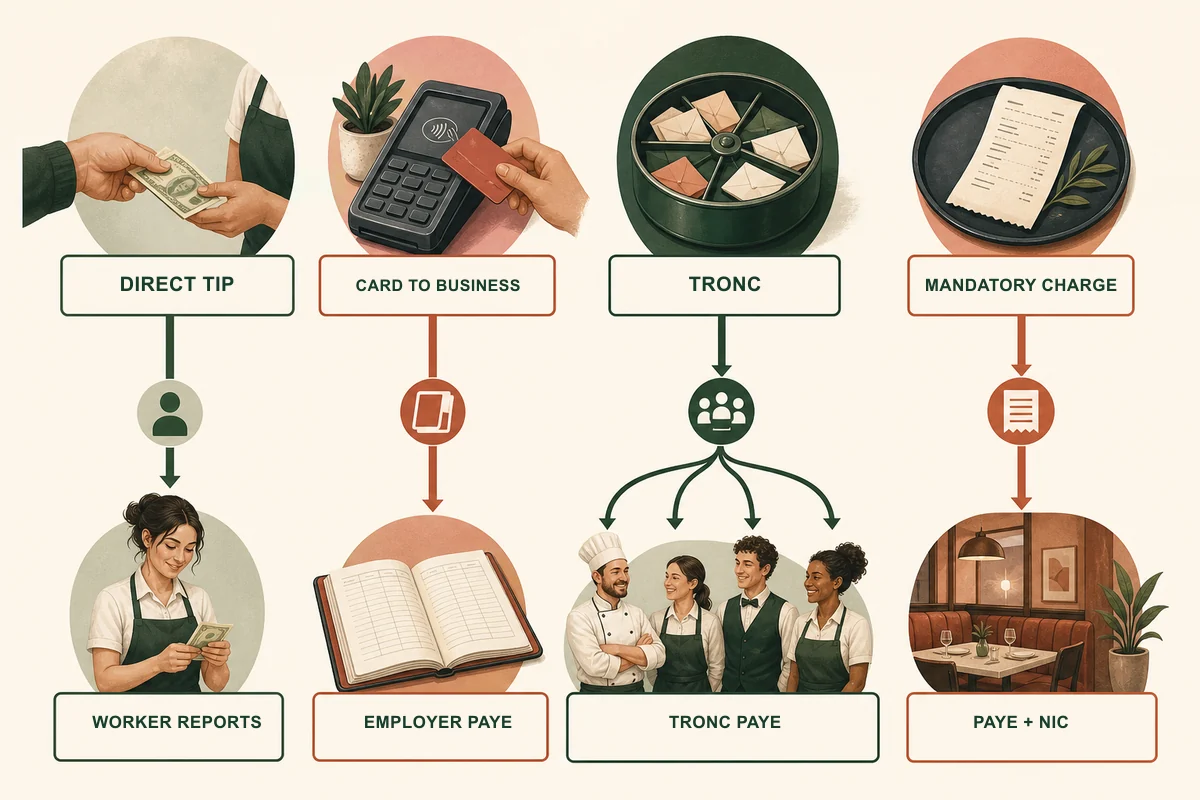
Direct tips and employer-controlled tips need different payroll treatment
The cleanest way to explain the difference is to follow the money rather than the label on the till report.
When a worker keeps a direct cash tip
Suppose a hairdresser receives £90 in cash from customers each Saturday and keeps it. Over four Saturdays, that is £360. If the employer has not collected the money, told workers how to share it or promised to pay a set amount from it, the £360 does not go through the employer’s payroll.
It is still taxable income for the worker. If all £360 falls within a basic-rate slice of the worker’s taxable income, a simple illustration would be £360 x 20% = £72 of Income Tax. That is not a final tax calculation. The employee’s wider income, tax code, Scottish or Welsh rates, Self Assessment position and other circumstances can change the result. There is no employer Class 1 National Insurance on a genuinely direct tip.
The employer should not pretend the money does not exist. A short policy note can explain that workers may keep direct tips, that the business does not control their allocation and that workers must report their own taxable amounts. That gives staff a clear answer without pulling a direct payment into the wrong payroll route.
When the employer shares a tip pool
Now take £3,000 of card tips received into the business account during August. The employer agrees a published allocation formula based on hours worked, role and the location where the tips were earned. The formula produces these shares:
| Worker group | Number of workers | Share per worker | Group total |
|---|---|---|---|
| Front-of-house team | 3 | £500 | £1,500 |
| Kitchen team | 3 | £300 | £900 |
| Bar and support team | 3 | £200 | £600 |
| Total | 9 | £3,000 |
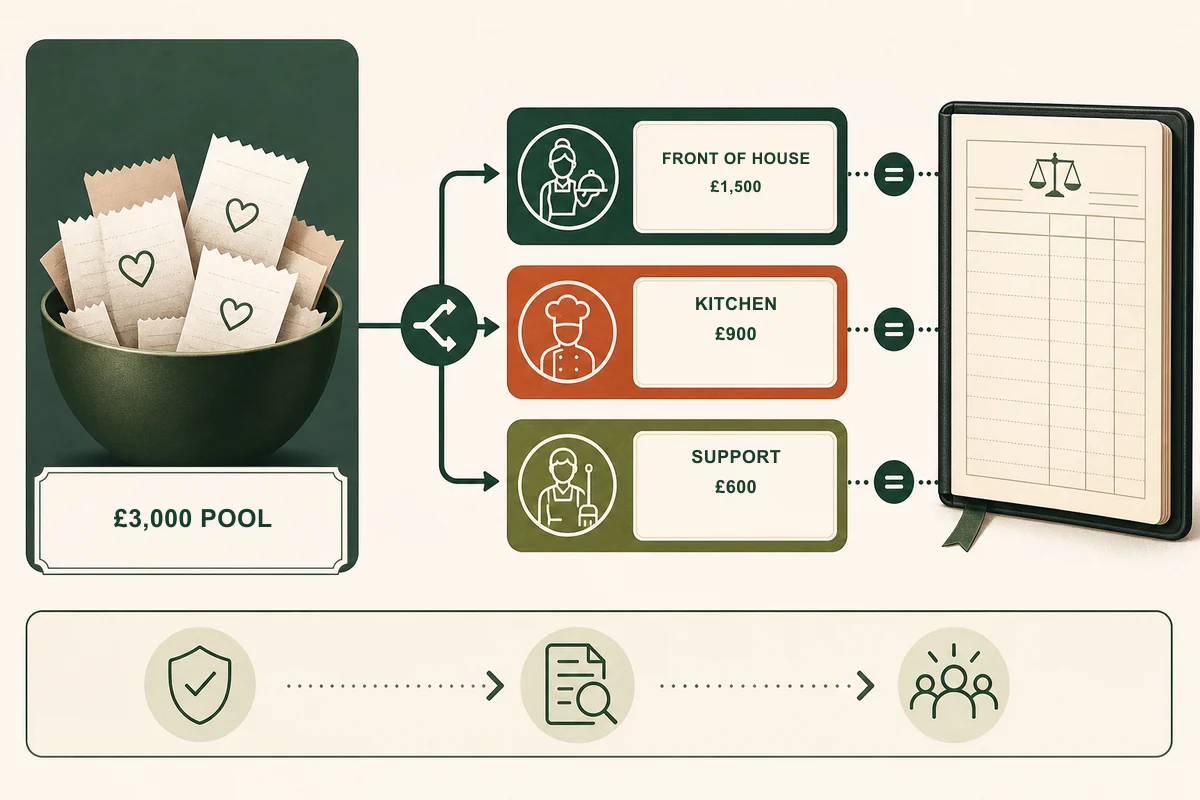
The business has allocated the tips. Each employee’s share belongs in the appropriate gross-pay record, with PAYE deducted through the employer’s normal payroll arrangement. National Insurance must be assessed using the actual facts and pay periods. The business cannot subtract a 2% card fee, which would be £60, as an ordinary administration charge and call the remaining £2,940 the staff pool. Usual tax and National Insurance deductions are different from an employer keeping a slice for processing costs.
The allocation formula does not have to give every worker an identical amount. It does need clear, objective reasons and a fair outcome. Staff should be able to understand the factors, check the money received and see how their own share was calculated.
If tips are entered into payroll as a single unexplained total, the reconciliation will be difficult later. Keep the underlying tip report, the worker-level allocation and the payroll journal together. Our bookkeeping support can help if the payment processor, till and payroll are producing different totals.
Tronc schemes are a separate arrangement, not a tax-free shortcut
A tronc is an organised system for bringing together tips, gratuities and service charges and sharing them among workers. The person responsible is the troncmaster. It may be a worker, an accountant or an independent company. The employer can use a tronc to separate the allocation decision from the ordinary payroll process, but it does not make the payments tax-free.
When an employer becomes aware of a tronc, it must normally tell HMRC the troncmaster’s name and explain the arrangement. HMRC’s guidance notes a limited exception for arrangements that came into existence before 6 April 2004. If HMRC is satisfied that the tronc exists, it can set up a PAYE scheme in the troncmaster’s name. The troncmaster then operates PAYE on payments from the tronc and reports them when or before they are paid.
National Insurance needs its own check. If the troncmaster allocates money that was not paid to the employer and the employer does not pay or allocate it, the conditions for no Class 1 NIC may be met. If the employer receives, passes on or allocates the money, NIC may be due. When it is due, the employer remains responsible for calculating and recording it, even if a troncmaster handles the cash distribution.
Imagine a recognised tronc pays £2,400 to six workers at the end of August. The troncmaster’s payroll needs the allocation and payment date for each worker. The employer should be able to match the total to the card and cash records, confirm that the tip policy and allocation process were followed, and check whether any part of the payment creates employer or employee NIC. A spreadsheet saying “tronc, £2,400” is not enough evidence on its own.
Do not promise staff that a tronc removes all National Insurance. The result turns on who received the money and who decided the allocation. If the arrangement is new, material or unclear, ask HMRC or a payroll adviser before the first payment.
The fair-distribution checklist for employers
The Employment (Allocation of Tips) Act 2023 applies to tips, gratuities and service charges that the employer receives or has control or significant influence over, including card payments made indirectly through a payment scheme. It does not apply to a worker who receives and keeps a cash tip with no employer involvement, or to an app that pays a worker directly without passing through the employer.
For a business that receives tips more than occasionally or exceptionally and has control or significant influence over how they are divided, the working checklist is clear:
- Put a written tipping policy in place and make it available to every worker, including agency workers.
- Explain whether the business encourages tips or service charges and how the money will be dealt with.
- Use clear, objective allocation factors such as role, hours, responsibility, service area and customer intention.
- Include the people who contribute to the service, not just the person who takes the payment.
- Check the formula for direct or indirect discrimination, especially where casual, agency or part-time staff are treated differently.
- Pass qualifying tips to workers without deductions other than usual tax and National Insurance deductions.
- Pay the money no later than the end of the month after the month in which it was received.
- Keep the tip records and the evidence supporting each allocation.
Fair does not mean every worker must receive the same proportion. A restaurant may reasonably give different weights to front-of-house, kitchen and supervisory work. The reason for the difference must be clear, applied consistently and capable of being explained to the people affected.
The policy should not be a document that sits in a manager’s drawer. Give it to new starters, agency workers and existing staff, and make sure the wording matches what the till, tronc and payroll actually do. A promise in a contract can also affect the National Insurance treatment, so avoid copying a formula into employment terms without checking the wider consequences.
Payment dates, records and worker requests
The payment timing rule is easy to put into a calendar and easy to lose in a monthly bookkeeping close. Qualifying tips received in one month must normally be paid by the end of the next month.
| Tips received | Latest normal payment date | Record to retain |
|---|---|---|
| July 2026 | 31 August 2026 | Till or payment report, policy, allocation and payroll or tronc record |
| August 2026 | 30 September 2026 | Same records, including agency-worker amounts where relevant |
| September 2026 | 31 October 2026 | Same records plus the payment date and any correction note |
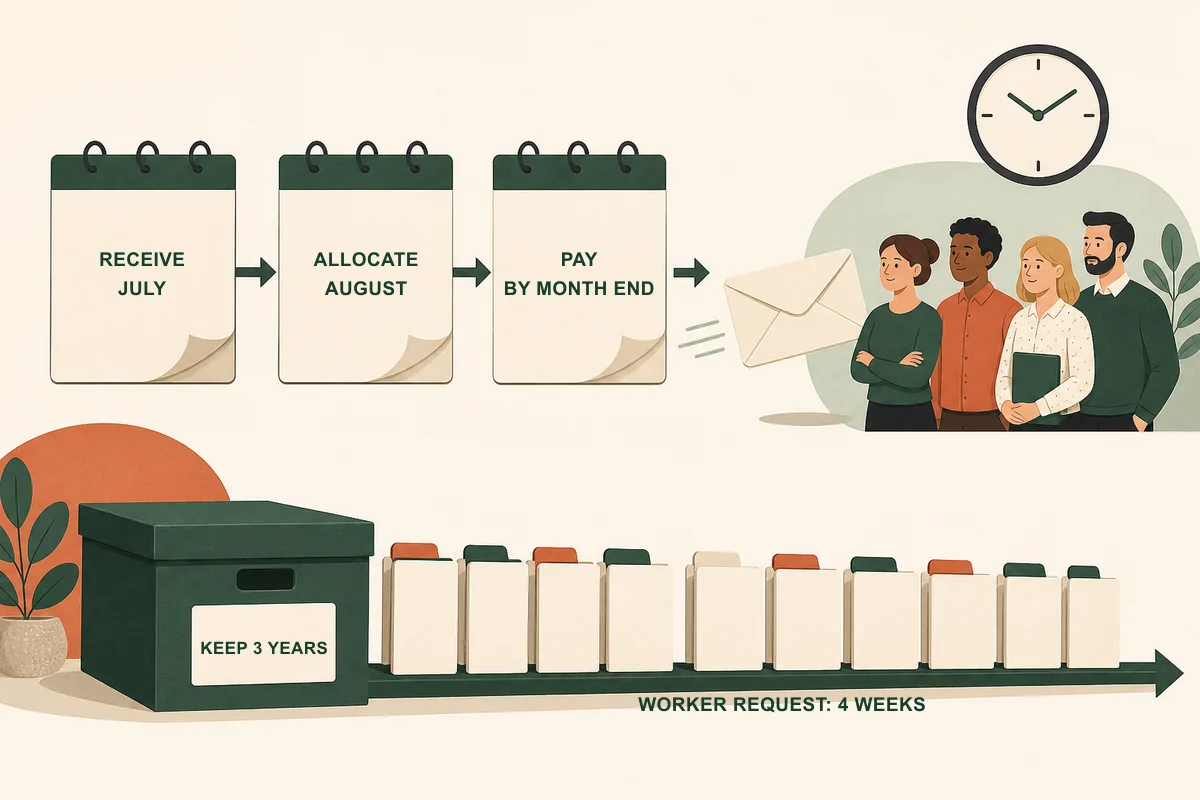
Employers must keep tip records for 3 years from when the tips were paid. The records need to show at least the money received, the amount paid to each worker and the amount arranged for a troncmaster to allocate. Keep enough detail to explain the formula, the people included and any correction.
Workers can normally ask to see tip records once every 3 months. A request can cover one month or two or more consecutive months, and can reach back up to three years for the period the worker worked for the employer. The employer must provide the records within 4 weeks. The records should protect personal information that does not need to be shared, but a refusal to keep or provide the underlying tip evidence is not a sensible payroll policy.
If a worker raises a concern, start with the numbers. Show the money received, the relevant policy, the factors used, the person’s hours or role where relevant, the amount allocated and the date paid. A calm reconciliation often finds a till mapping error or a missed starter before it becomes a formal dispute.
What changed, and what has not changed, in 2026
The rules are easy to misstate because there have been several announcements. The existing Tipping Act and Code of Practice remain the baseline for employers.
The Government published a revised statutory code in June 2026, then withdrew it on 29 July 2026 so that a new public consultation could take place. Employers should continue to follow the existing code while that work happens. The withdrawal does not switch off the current duties to pass on qualifying tips, use a fair process, keep records or make a policy available.
There are also expected changes connected to the Employment Rights Act 2025. As at 2 September 2026, Acas says those changes have not happened yet and are due to come into effect by the end of 2026. They are expected to require consultation with workers before creating or changing a tipping policy, an anonymised summary of consultation feedback, and a policy review at least every three years. Do not write those future steps as if they are already in force, but do leave enough space in the process to adopt them when the commencement date is confirmed.
The tax position is separate. HMRC’s current employer guidance says the October 2024 tipping legislation did not change how tips, gratuities and service charges are assessed for Income Tax and National Insurance. That is why a business needs both a fair-distribution policy and an accurate payroll decision.
VAT and National Minimum Wage traps
Tips are not a way to reduce a wage bill. Amounts paid by customers as tips, gratuities or service charges do not count towards National Minimum Wage pay. An employer must pay the statutory minimum separately and cannot tell staff that tips make up the difference.
VAT follows a different distinction from Income Tax. A tip genuinely given freely is outside the scope of VAT, including when it is paid by card and later passed to workers. A compulsory service charge is part of the consideration for the underlying supply and is normally standard-rated. A voluntary service charge is outside the scope when the customer has a genuine option not to pay it.
That makes the till configuration important. If a card screen presents a compulsory charge as a tip, the customer may not have the choice the business thinks it has given them. If a menu says a service charge is optional but staff tell customers it must be paid, the records and customer communication do not line up. Ask someone outside the day-to-day operation to read the menu, the receipt and the card prompt together.
A payroll and bookkeeping process that can be checked
The process does not need to be elaborate. It needs to make the payment route visible from the sale to the worker’s payslip or tronc record.
| Control point | What to capture | Owner or evidence |
|---|---|---|
| Payment source | Cash, card, app, voluntary charge or compulsory charge | Till report, payment processor statement and menu or receipt wording |
| Scope decision | Whether the employer receives, controls or significantly influences the allocation | Written policy and a short decision note |
| Allocation | Workers included, objective factors, hours or role data and each share | Allocation worksheet or tronc report |
| Tax route | Employer PAYE, tronc PAYE or direct-worker reporting | Payroll journal, troncmaster record or worker guidance |
| Payment date | Date money reached workers and any agency | Bank payment, payslip or tronc payment record |
| Ongoing review | Reconciliation, worker questions and policy changes | Monthly close checklist and retained correspondence |
At month end, compare the total in the point-of-sale report with the amount paid to workers and the amount entered into payroll or sent to the troncmaster. Investigate differences before rolling them into the next month. A missing £100 may be a till error, an unpaid tip obligation, a VAT classification problem or an innocent timing difference. The ledger will not tell you which one without the source record.
Keep the process proportionate to the business. A small café with occasional tips may only need a clear note and a monthly check. A restaurant with multiple sites, agency workers and a tronc needs location-level reporting and a named person who can answer a worker’s record request. The legal test is about the facts, not the size of the spreadsheet.
FAQ: tips tax UK 2026
Are tips taxable in the UK in 2026?
Yes. Tips are taxable income. A worker who receives and keeps a direct cash tip without employer involvement normally reports it to HMRC. A tip paid through an employer scheme or a tronc is dealt with through the relevant payroll arrangement. The route changes who operates PAYE, not the basic fact that the tip can be taxable.
Do employers deduct PAYE and National Insurance from tips?
PAYE must be operated on tips paid by an employer to an employee. National Insurance depends on who received the money, who allocated it and how the arrangement works. A compulsory service charge paid to employees always attracts National Insurance. A genuinely direct cash tip retained by a worker does not go through the employer’s PAYE payroll or attract employer Class 1 NIC on that tip.
Is a service charge the same as a tip?
No. A voluntary service charge must be genuinely optional and clearly presented that way. A compulsory service charge is an amount the customer has to pay and is treated differently for VAT and National Insurance. The words on the menu, receipt and card machine should match the actual customer choice.
What is a tronc scheme?
A tronc is a separate arrangement for collecting and sharing tips, gratuities and service charges. The troncmaster normally operates PAYE for payments from the tronc. The employer must normally tell HMRC about the arrangement and check National Insurance, because an independent tronc does not automatically remove the employer’s responsibilities. HMRC notes a limited exception for arrangements that came into existence before 6 April 2004.
When must employers pay tips to workers?
Qualifying tips must normally be paid no later than the end of the month after the month they were received. If a business receives £1,000 of qualifying tips during July, the normal payment deadline is 31 August. The payment date should be recorded alongside the allocation and payroll or tronc record.
How long must an employer keep tip records?
Keep them for 3 years from the date the tips were paid. A worker can usually request consecutive-month records once every three months, covering up to three years of their employment history, and the employer must respond within 4 weeks.
Can an employer deduct card fees from tips?
Not as an ordinary cost of processing or administration. Qualifying tips must be passed to workers without deductions other than usual tax and National Insurance deductions. If the business wants to change the allocation method, it should review the written policy, consult as required and check the legal and payroll effect before making the change.
The next practical check
Pull one complete month of tip reports and trace the money to the worker payment. Mark the route, allocation rule, PAYE or tronc treatment, VAT position and payment date. If one number cannot be explained from the records, fix that gap before the next month closes. You can send the payroll question to our team with the report and policy to hand, so the discussion starts with the facts rather than a guess.
Official guidance used

About Golden Tree Consulting
ACCA Affiliated | MBA Qualified
Golden Tree Accounting & Business Consulting provides expert tax, bookkeeping, and advisory services to sole traders and SMEs across Croydon, London, Surrey, and Kent. With multilingual support and decades of combined experience, we help businesses stay compliant and grow.
Offices in Croydon and London Bridge.
Related guides
IR35 for Contractors UK 2026: Inside vs Outside and What to Do Next
IR35 for contractors UK 2026 explained with inside and outside tests, CEST, client duties and practical records for your next contract.
Tax-Efficient Employee Benefits UK 2026: 7 Options for Small Employers
Tax-efficient employee benefits UK 2026 explained, from £50 trivial gifts to pensions and new work-cost reimbursements, with examples and deadlines.

Employment Allowance UK 2026/27: Who Can Claim, Who Cannot, and How to Apply
Employment Allowance UK 2026/27 explained, with who can claim, who cannot, EPS steps, and worked examples for small employers.