IR35 for Contractors UK 2026: Inside vs Outside and What to Do Next
IR35 for contractors UK 2026 explained with inside and outside tests, CEST, client duties and practical records for your next contract.
 Golden Tree Accounting 24 August 2026 20 min read
 On this page Show
- IR35 for contractors UK 2026: the short version
- Who decides your IR35 status?
- Inside IR35 versus outside IR35 in practice
- How HMRC decides whether a contract is inside or outside
- A five-step IR35 check before you sign
- What happens when a contract is inside IR35?
- If you disagree with a Status Determination Statement
- Records that support an outside-IR35 position
- When professional help is sensible
- FAQ: IR35 for contractors UK 2026
A contract can call you a contractor, consultant or supplier. HMRC will still look at the relationship behind the label. If you work through your own limited company, the question is whether you would have been an employee of the client if the company was taken out of the picture. That is the point of IR35 for contractors UK 2026 guidance.
The answer matters before the first invoice. It can affect who makes the decision, who runs PAYE, how much National Insurance is paid, what your limited company reports and which records you need to keep. It can also vary from one contract to the next. A status decision is about the particular engagement, not a permanent badge attached to you.
Quick answer: check the client’s size, read the contract alongside the real working arrangements, use HMRC’s CEST tool with accurate information, save the result, and ask for a Status Determination Statement if the client is responsible. If the facts change, check the contract again.
If you are setting up a contractor company, our UK company formation service can help with the basic structure. For an existing company, bookkeeping support and payroll support are useful once you know which tax route applies.
IR35 for contractors UK 2026: the short version
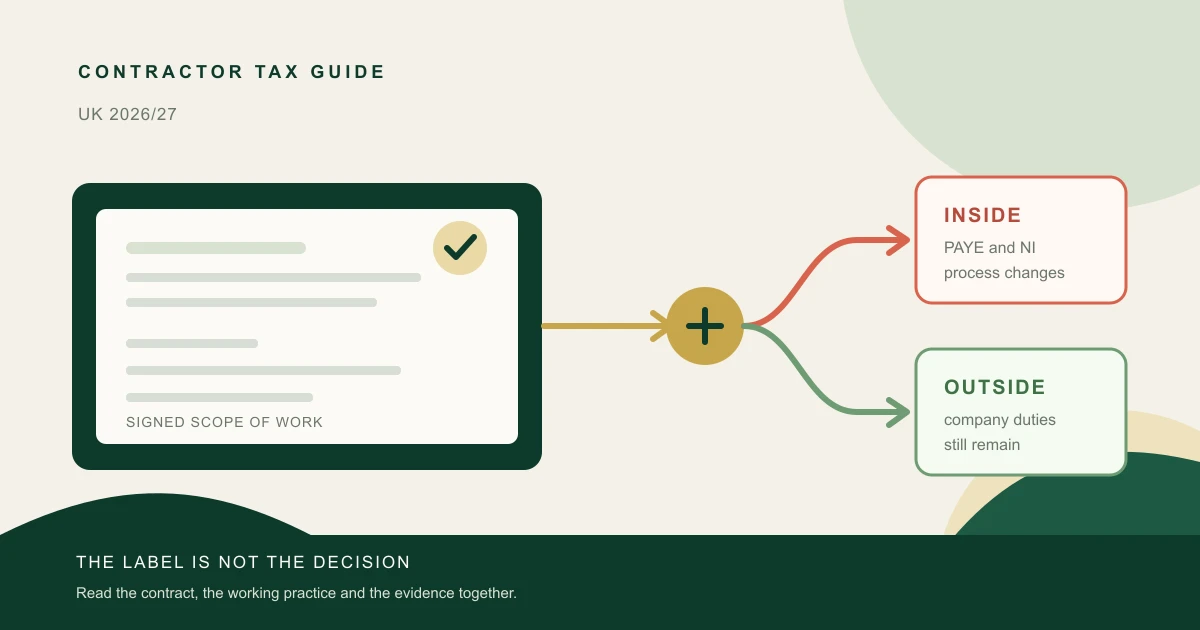
IR35 is the familiar name for the intermediaries legislation and the off-payroll working rules. Both ask a similar question: would the individual be employed for tax purposes if the intermediary, usually a personal service company, was removed? The rules are designed to make Income Tax and National Insurance broadly similar to an employee’s where the facts point to employment. HMRC’s off-payroll working guidance was updated on 26 February 2026.
The words inside IR35 mean the engagement is treated as employment for tax and National Insurance. A responsible client or fee-payer may deduct PAYE and employee National Insurance from the payment to your intermediary. Employer National Insurance is also due from the deemed employer where the rules apply.
The words outside IR35 mean the engagement is treated as genuine self-employment for tax. Your company is still a company. It may have Corporation Tax, payroll, VAT, dividend and annual accounts duties. Outside status is not a tax-free label, and it is not created by adding one sentence to a contract.
| Question | Practical answer |
|---|---|
| What is being tested? | The relationship between the worker and the client for tax purposes |
| Is status attached to the person? | No. It is normally assessed for each contract or engagement |
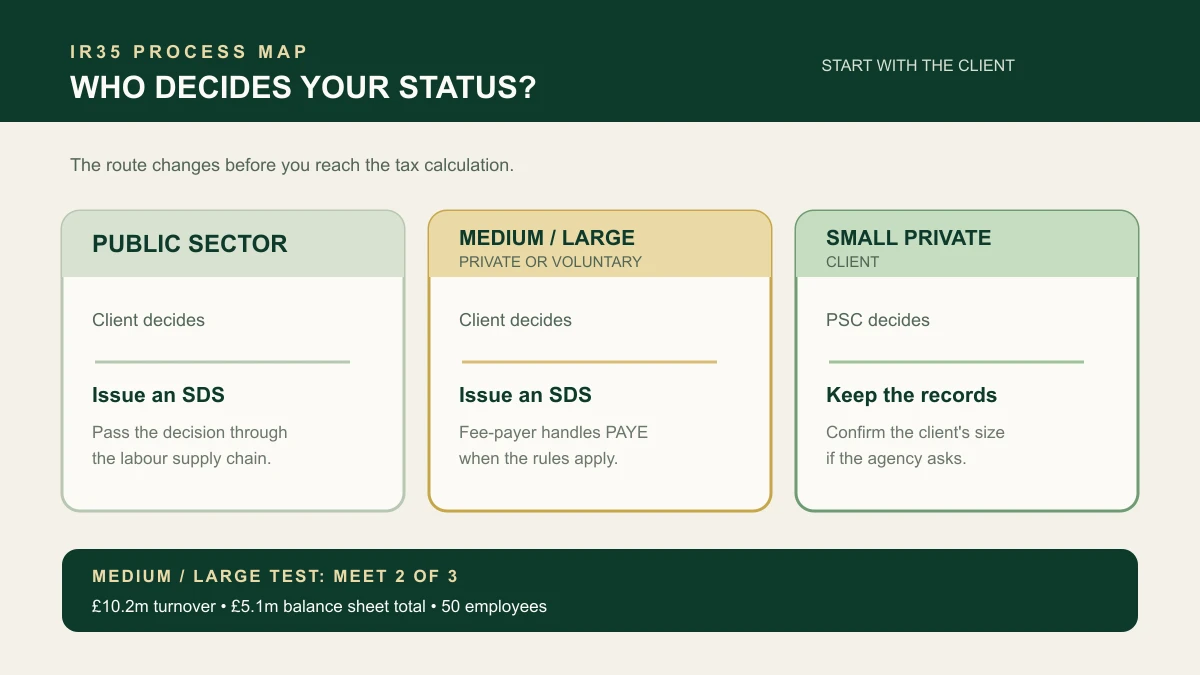
| Who decides? | The client in the public sector and for medium or large private clients; the intermediary for a small private client |
| What does inside mean? | PAYE and National Insurance treatment broadly similar to employment |
| What does outside mean? | The intermediary is taxed as a normal business, subject to its own company obligations |
| Do tax rules create employment rights? | No. Tax status and employment-law rights are separate questions |
CEST is useful, but it is not a shortcut around the facts. HMRC says the tool can be used by hirers, workers and agencies, and that it will stand by a result when the information supplied remains accurate and follows its guidance. The CEST guidance also says you need the contract details, responsibilities, control over when, where and how the work is done, payment terms and any benefits or expense arrangements before starting.
Who decides your IR35 status?
The client’s size is the first practical question. Contractors often ask whether they are personally working for a large business. The legal test is about the client, not the contractor’s own company. A small personal service company can still work for a medium-sized client.
| Client or engagement | Who normally makes the status decision? | What you should expect |
|---|---|---|
| Public authority | Client | The client determines status and passes the decision through the labour supply chain |
| Medium or large private or voluntary organisation | Client | The client issues a Status Determination Statement, usually called an SDS |
| Small private or voluntary organisation | Contractor’s intermediary | Your company assesses the engagement under the original intermediaries rules |
| Wholly overseas client with no UK connection | Contractor’s intermediary | Check the overseas and supply-chain facts before assuming the client-led rules apply |
For a private company, HMRC’s current client guidance says the organisation is medium or large when it meets at least 2 of these 3 conditions:
- annual turnover of more than £10.2 million
- balance sheet total of more than £5.1 million
- more than 50 employees
For 2026/27, the figures above are still the practical starting point for the client-size test. The Companies Act thresholds increased from 6 April 2025 to £15 million turnover and £7.5 million balance sheet total, while the 50-employee limit stayed the same. Transitional rules mean that change can affect off-payroll status from 2027/28, depending on the client’s financial year and the two-year test. If an engagement continues into a later tax year, recheck the client’s size against HMRC’s threshold-transition guidance. Group rules and special tests can affect the answer, so the table is a starting point rather than a size certificate. A small private client does not normally decide the worker’s tax status, but it must confirm its size if the contractor or agency asks. HMRC sets out the split in its guidance for clients.
Worked example: why the client’s size changes the process
Northgate Ltd has annual turnover of £11.4 million, a balance sheet total of £4.8 million and 62 employees. It meets the turnover and employee tests, so it is medium or large for this example. The client should make the decision for a contractor engaged through a personal service company and give the contractor an SDS with the conclusion and reasons.
Briar Studio has turnover of £8.7 million, a balance sheet total of £4.1 million and 31 employees. It does not meet two of the tests. If no group or special rule changes the result, it is a small client and the contractor’s intermediary normally makes the decision. The contractor should still ask the client to confirm the size in writing and keep that confirmation with the contract.
Inside IR35 versus outside IR35 in practice
Inside and outside status change the tax process, but neither label tells the whole commercial story. An inside contract may offer a higher day rate to reflect the PAYE treatment. An outside contract may offer more control but leave your company responsible for its own filings, reserves and compliance. Compare the full arrangement, not just the headline rate.
| Area | Inside IR35 | Outside IR35 |
|---|---|---|
| Tax treatment | Employment Income Tax and employee National Insurance are deducted through PAYE by the responsible fee-payer or intermediary | The intermediary accounts for its normal company and personal extraction taxes |
| Who receives the invoice payment? | The PSC may receive a payment after deductions when the client or fee-payer is responsible | The PSC generally receives the agreed business payment and manages its own tax reserves |
| Employer National Insurance | Paid by the deemed employer where the client-led rules apply | Normal employer National Insurance can still apply to the company’s own payroll |
| Company responsibilities | Keep contract records and reconcile payments, even when PAYE is operated elsewhere | Keep full accounts, payroll, VAT and Corporation Tax records as relevant |
| Employment rights | Not created by the tax decision | Not created by the tax decision either |
| Status across contracts | One engagement can be inside while another is outside | One engagement can be outside while another is inside |
The money calculation also depends on who is responsible. For a medium or large private client, the client normally gives the SDS and the fee-payer deducts Income Tax and employee National Insurance from the relevant payment. For a small private client, the intermediary, usually your personal service company (PSC), normally calculates a deemed employment payment if the rules apply.
Worked example: a small-client deemed-payment calculation
Suppose a contractor’s company receives £60,000 of income from engagements that fall within the intermediaries rules during 2026/27. Assume the company has £1,500 of qualifying engagement expenses and has already paid the worker £12,570 of salary that was taxed as employment income.
HMRC’s calculation starts like this:
| Calculation step | Amount |
|---|---|
| Off-payroll income | £60,000 |
| Less 5% flat general-expense deduction | -£3,000 |
| Balance | £57,000 |
| Less qualifying engagement expenses | -£1,500 |
| Less salary already taxed as employment income | -£12,570 |
| Amount before later employer National Insurance step | £42,930 |
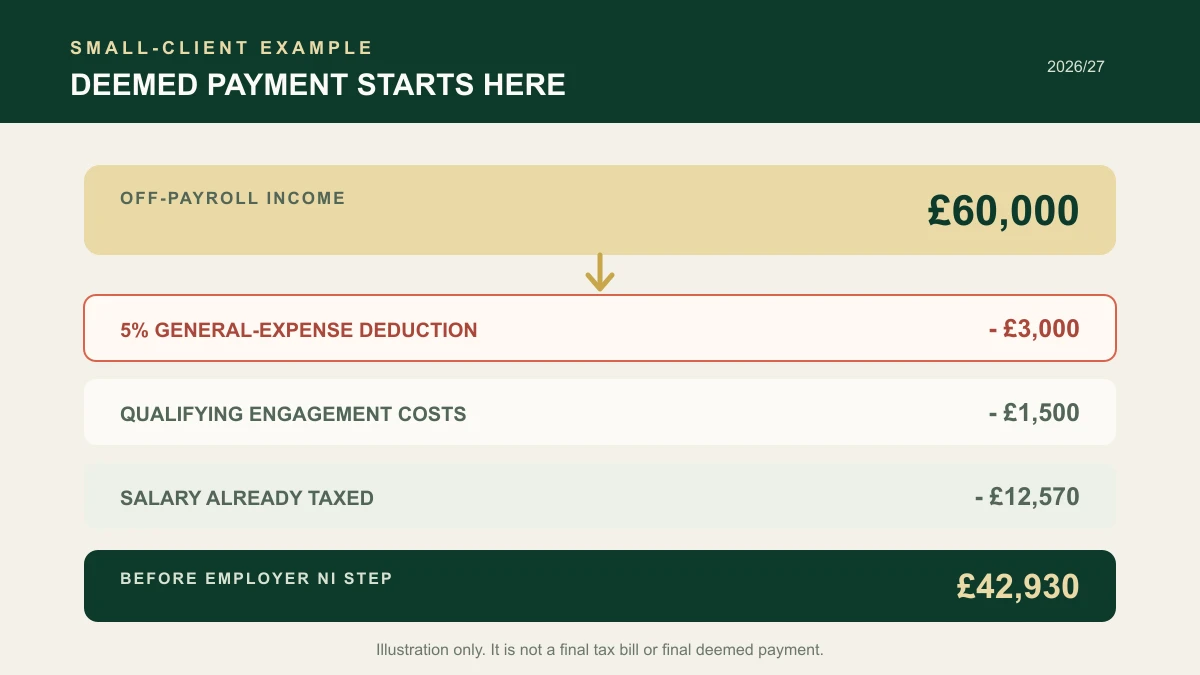
The £42,930 is not the final tax bill or necessarily the final deemed payment. HMRC’s deemed-payment calculation has further steps for pension contributions, employer National Insurance already paid and employer National Insurance on the deemed payment. The point of the example is to show why the company should not treat the whole £60,000 as ordinary dividend capacity.
For a client-led inside-IR35 contract, the payment route is different. The deemed employer or fee-payer handles PAYE and employee National Insurance before the PSC is paid. Ask who the fee-payer is and how the agreed rate is stated. A rate that looks attractive before deductions may not produce the cash you expected.
How HMRC decides whether a contract is inside or outside
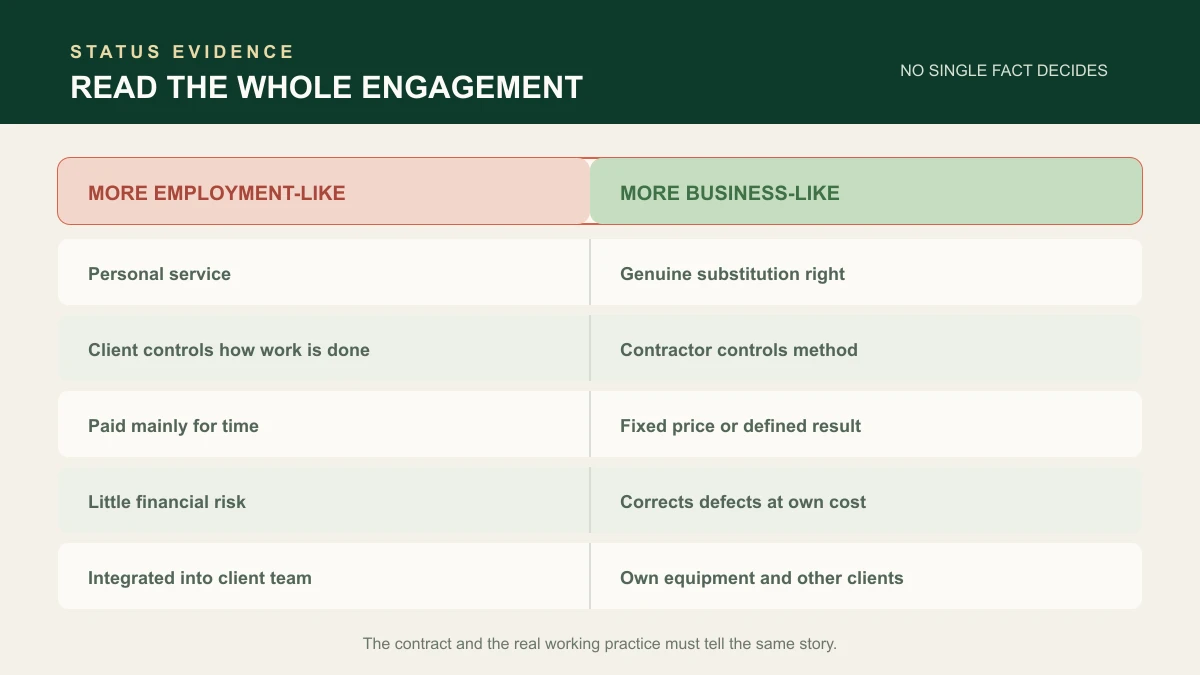
There is no reliable one-page scorecard that turns five favourable facts into an outside result. HMRC considers the contract and the actual working practices, then looks at the overall picture. The Employment Status Manual lists factors such as control, personal service, equipment, financial risk, payment method, mutual obligations, integration, length of engagement and the chance to profit from sound management.
Personal service and substitution
Ask whether the client has hired your personal skill or your company’s ability to provide a service. A genuine right to send a suitably qualified substitute can point away from employment. A clause that exists only on paper, while everyone expects you to do every hour personally, is weak evidence. HMRC’s guidance says a substitution right must be genuine before it carries weight.
The details matter. Who chooses the substitute? Can the client reject them only for reasonable skill or security reasons? Does your company pay the substitute? Have you used the clause or had a real reason to use it? Keep the emails and approvals rather than relying on a sentence buried in the contract.
Control over the work
Control is more than being told the desired outcome. Consider who decides what work is done, when it is done, where it is done and how it is done. A specialist may receive little day-to-day instruction and still be an employee if the client has the contractual right to control the work.
Working remotely does not settle the issue. A remote worker can still be integrated into the client’s team, use the client’s systems, attend fixed meetings and follow its process. An outside contractor can work on a client site when the project requires it. The location is one fact among many.
Financial risk and being in business
A business that quotes for a defined result, corrects defective work at its own cost, supplies equipment, carries relevant insurance and can make a profit or loss looks different from someone paid for time under the client’s normal management. Multiple clients can help show a business on its own account, but having one client at a particular moment does not decide the result.
Worked examples: two contracts, two different pictures
Maya accepts a nine-month UX contract at £550 a day. She must work Monday to Friday during the client’s core hours, use the client’s equipment, attend the product team’s daily meetings and perform the work personally. The product manager assigns tasks and can move her between projects. The contract calls her an independent consultant, but the actual facts point more towards employment for tax purposes. It is not a formal determination, but the mismatch needs attention before she starts.
Sam agrees a £18,000 fixed-price data project. His company controls the method and timetable, uses its own software, carries professional indemnity insurance and must correct defects at its own cost. The contract permits a suitably qualified substitute with reasonable client approval, and Sam’s company has two other clients during the same period. Those facts point more towards a business providing a service. They still do not guarantee an outside result if the day-to-day relationship turns into simply filling a staff gap.
The difference is not the job title. It is the evidence behind the engagement.
A five-step IR35 check before you sign
1. Identify the client and the fee-payer
Write down the end client, agency, umbrella company if one is involved, and the entity that will pay your intermediary. Ask the client to confirm whether it is small, medium or large for the off-payroll rules. Do not assume the agency is the decision-maker just because it sent the contract.
2. Read the contract for the important facts
Mark the clauses covering personal service, substitution, control, hours, location, deliverables, equipment, correction of defects, payment, notice and termination. A contract that says “outside IR35” but gives the client employee-style control needs a proper conversation.
3. Compare the contract with real working practices
Tell the client if the planned arrangement does not match the written terms. If the contract says you control the method but the client intends to manage every task, the practical facts may carry more weight. Update the agreement when the engagement changes.
4. Run CEST with the full facts and save the result
HMRC says CEST cannot save your progress, so gather the contract and working-practice details first. Save the answers and result as a PDF or printed record. The result is only as reliable as the information entered. Use the HMRC CEST tool as evidence, not as permission to enter answers that sound better than the arrangement.
5. Ask for the SDS before the first payment when the client decides
The SDS should state the conclusion and the reasons. HMRC says it must be passed to the worker and the person or organisation contracted with. Keep it with the contract, CEST result and your own notes. If the client changes the decision later, ask what fact changed and keep the new statement too.
What happens when a contract is inside IR35?
For a medium or large private client, the client normally determines status and passes the SDS through the supply chain. The deemed employer or fee-payer, meaning the party responsible for operating the payment process, deducts Income Tax and employee National Insurance from the relevant payment to your intermediary. Employer National Insurance and Apprenticeship Levy, where due, are paid by the deemed employer. HMRC’s overview of what happens when the rules apply explains the allocation.
If an umbrella company sits in the labour supply chain, check that route separately. HMRC’s 2026 umbrella-company PAYE guidance applies to money paid to workers from 6 April 2026. It says the agency or end client is responsible for checking that PAYE is operated correctly by the umbrella company, with some exceptions for workers employed through their own personal service company.
For 2026/27, the standard figures that often appear in payroll calculations are below. The table distinguishes the taxable-income bands from the gross-income thresholds often shown on payslips. For an England, Wales or Northern Ireland taxpayer with the full Personal Allowance, higher-rate tax starts once gross income passes £50,270, but the 20% band itself covers up to £37,700 of taxable income after the allowance.
| 2026/27 figure | Current amount or rate |
|---|---|
| Standard Personal Allowance | £12,570 |
| Basic Income Tax rate | 20% on up to £37,700 of taxable income after the standard Personal Allowance |
| Higher Income Tax rate | 40% on taxable income from £37,701 to £125,140 |
| Additional Income Tax rate | 45% above £125,140 |
| Employee National Insurance, main Category A band | 8% |
| Employee National Insurance, upper band | 2% |
| Employer National Insurance, standard Category A rate | 15% |
The figures are not a personal calculation. Scotland has different Income Tax bands, and the correct PAYE result depends on pay frequency, tax code, other income, pension contributions and the worker’s circumstances. HMRC’s current Income Tax rates and National Insurance rates from 6 April 2026 are the right places to recheck the numbers before publishing a quote or payroll instruction.
Being inside IR35 also does not make you an employee of the client for employment rights. HMRC’s CEST manual says the tool only determines employment status for tax and National Insurance. Holiday pay, sick pay, redundancy protection and other rights need a separate employment-law analysis.
If you disagree with a Status Determination Statement
Do not respond with only “I am a contractor”. Set out the facts that the client may have missed. Point to the actual substitution process, who controls the work, the agreed deliverables, financial risk, equipment, correction obligations and any change in working practices. Attach clear evidence where you have it.
The client-led disagreement process gives the client 45 calendar days to consider the representation and respond. It must either confirm the original decision with reasons or withdraw it and issue a new SDS with the date it applies from. The original treatment continues while the disagreement is being considered.
If the client does not issue a valid statement or fails to respond properly, PAYE responsibility can move to the client. That is a compliance problem for the supply chain, not a reason for you to ignore the deductions or stop keeping records. HMRC’s client-led disagreement guidance sets out the process.
Records that support an outside-IR35 position
Keep a small evidence pack for each engagement. It should include:
- the signed contract, statement of work and any change orders
- the client-size confirmation and SDS, if the client is responsible
- the CEST answers and saved result, with the date completed
- emails that show agreed deliverables rather than day-to-day staff supervision
- evidence of a genuine substitution discussion or approval, if relevant
- invoices, acceptance records and correspondence about correcting defective work
- records showing your company supplied equipment, paid costs or carried financial risk
- insurance, marketing, business website and other evidence of a real company, where relevant
- a note of other clients or work that ran alongside the engagement
- a dated review whenever the contract, manager, duties, hours or location changed
No single document proves status. Good records make it easier to explain the whole relationship if the client reviews its decision or HMRC asks questions. If your company needs help matching its bookkeeping records to contract income and payroll, that is a separate task from deciding status, but it is part of running the company properly.
When professional help is sensible
Ask for a contract-specific review when the engagement is high value, the client has issued a blanket inside decision, the written terms conflict with the proposed work, or an agency cannot explain who the fee-payer is. A review should consider both the contract and the working practices. A generic online answer cannot do that job.
Golden Tree Consulting can help with the company, bookkeeping and payroll work around a contractor business. Use our contact page to explain the arrangement, or review the payroll service if the business needs a clean process for payments and records. Your adviser may also tell you that the status question needs a specialist employment-tax or legal opinion. That is a sensible boundary, not a failure of the basic bookkeeping work.
FAQ: IR35 for contractors UK 2026
What is IR35 for contractors in the UK?
IR35 is the common name for rules that ask whether someone working through an intermediary, usually their own limited company, would have been an employee if they had contracted directly with the client. It is a tax and National Insurance question based on the particular engagement.
What is the difference between inside IR35 and outside IR35?
Inside IR35 means the engagement is treated as employment for tax and National Insurance purposes. Outside IR35 means the engagement is treated as genuine self-employment for tax. A company with an outside engagement still has its normal Corporation Tax, payroll, VAT and accounts obligations where they apply.
Who decides whether a contract is inside IR35?
For a public authority or medium or large private-sector client, the client normally decides and issues the SDS. For a small private-sector client, the contractor’s intermediary normally decides. Ask for the client’s size confirmation when the position is unclear.
Can one contract be inside IR35 and another outside IR35?
Yes. HMRC says the rules apply on a contract-by-contract basis. Different clients, contracts and working practices can produce different results for the same contractor.
Does being inside IR35 give me employee rights?
No. The tax result does not automatically give you holiday pay, sick pay, redundancy protection or other employment rights. CEST is for tax and National Insurance purposes. Take separate advice if employment rights are part of the decision.
Can I use HMRC’s CEST tool for an IR35 decision?
Yes. Hirers, workers and agencies can use CEST. HMRC says it will stand by a result when the information is accurate and in line with its guidance. Save the answers and result because the tool cannot save your progress while you are completing it.
How long does a client have to answer an IR35 disagreement?
The client must respond within 45 calendar days of receiving the representation. It must explain why it is keeping the original SDS or issue a new statement and say when the new decision applies.
Before the next assignment starts, ask for the client-size confirmation, run CEST using the real contract, and store the result with the signed statement of work. If a large client labels the role inside IR35, ask for the SDS and reasons before your first invoice. That record will be far more useful than a contract headed “outside IR35” with no evidence behind it.

About Golden Tree Consulting
ACCA Affiliated | MBA Qualified
Golden Tree Accounting & Business Consulting provides expert tax, bookkeeping, and advisory services to sole traders and SMEs across Croydon, London, Surrey, and Kent. With multilingual support and decades of combined experience, we help businesses stay compliant and grow.
Offices in Croydon and London Bridge.
Related guides

Companies House Accounts Changes 2028: What Small Companies Need to Prepare
Companies House accounts changes 2028 explained for UK small companies: software-only filing, P&L, abridged accounts and a practical preparation checklist.

Corporation Tax Payment Deadline: 9 Months and 1 Day After Your Year End
When UK companies must pay Corporation Tax: 9 months and 1 day after the accounting period ends, with a year-end table, the CT600 deadline, rates, payment methods and what to do if you cannot pay.

Tips Tax UK 2026: PAYE, National Insurance and Fair Distribution for Employers
Tips tax UK 2026 explained for employers, including PAYE, National Insurance, tronc schemes, payment deadlines, records and fair distribution.