Tax-Efficient Employee Benefits UK 2026: 7 Options for Small Employers
Tax-efficient employee benefits UK 2026 explained, from £50 trivial gifts to pensions and new work-cost reimbursements, with examples and deadlines.
 Golden Tree Accounting 17 August 2026 17 min read
 On this page Show
- Tax-efficient employee benefits UK 2026: what the phrase really means
- What changed on 6 April 2026?
- Seven tax-efficient employee benefits worth considering
- Taxable benefits can still be worthwhile
- How to choose a benefit for a small team
- Reporting dates and the records to keep
- Common mistakes to avoid
- A practical 30-day setup plan
- FAQ: tax-efficient employee benefits UK 2026
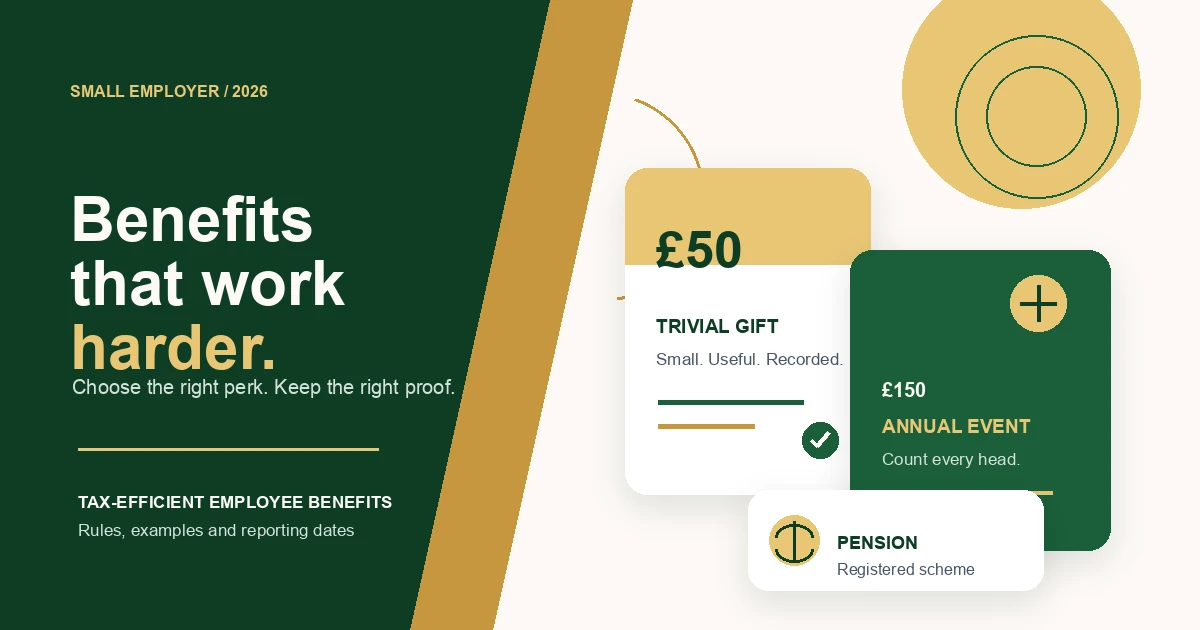
A £48 gift, a £140 staff event, or a pension contribution can be worth more to a small team than another generic perk. A £51 gift or a £160 event can create a very different tax and reporting result. Tax-efficient employee benefits UK 2026 rules reward careful design, not guesswork.
There is a useful new point for this tax year. From 6 April 2026, employers can reimburse certain work-related costs, including eligible homeworking equipment, qualifying eye tests and seasonal flu vaccinations, without creating an Income Tax or National Insurance charge when the conditions are satisfied. That is helpful for smaller employers, especially where staff work from home or across different locations.
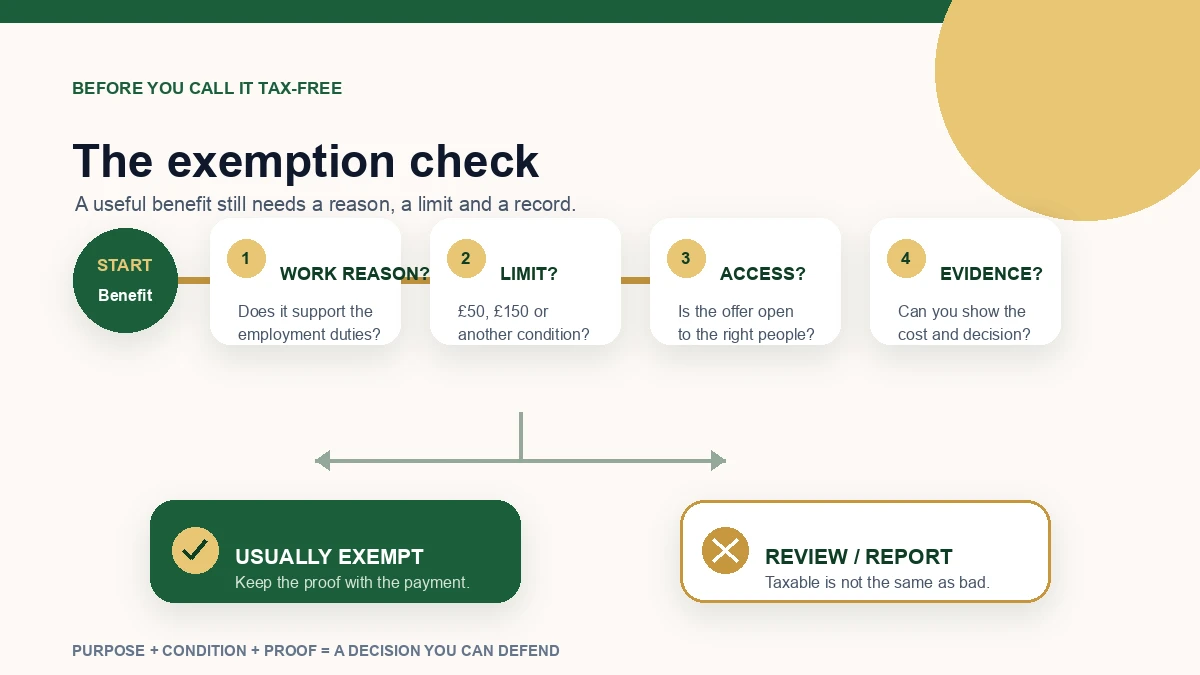
Quick answer: start with benefits that are clearly exempt, record why they qualify, and keep taxable benefits separate. The amount, purpose, contract terms, access rules and reporting route all matter. A benefit is not tax-free simply because it is small or popular.
If you are reviewing your staff package before the next payroll cycle, our payroll services and bookkeeping support can help tie the benefit choices to the right records and reports.
Tax-efficient employee benefits UK 2026: what the phrase really means
There are three separate questions behind every employee perk:
- Does the employee pay Income Tax on it?
- Does the employer pay National Insurance on it?
- Does the employer need to report it through payroll, a P11D or a P11D(b)?
Some benefits answer “no” to all three when the exemption applies. A qualifying trivial benefit is a good example. An employer pension contribution is usually not taxable as the employee’s earnings, but it still counts towards the employee’s pension annual allowance. Private medical insurance is normally taxable for the employee and creates an employer Class 1A National Insurance cost, even though it may be an attractive benefit.
That distinction matters for cash planning. The cheapest benefit on paper is not always the one employees value most, and the most valued benefit is not always tax-free. We would rather show a director the full cost before a benefit is promised than explain a P11D correction after the payroll year has closed.
For 2026/27, the tax year runs from 6 April 2026 to 5 April 2027. Keep that cycle in mind when you set limits, review benefits and plan your year-end records. Your company’s accounting year may end on a different date.
What changed on 6 April 2026?
The 2026 changes make certain reimbursements easier to handle. Before the change, an employer could often provide an item directly and preserve an exemption, while reimbursing the employee could produce a taxable benefit. From 6 April 2026, the treatment is more consistent for certain work-related costs.
The main areas are:
- Homeworking equipment: qualifying equipment, supplies or services used to perform employment duties can be reimbursed where the statutory conditions are met and private use is not significant.
- Eye tests and corrective appliances: an eye test required under display-screen rules, and glasses or contact lenses needed solely for screen use following that test, can be reimbursed where the conditions apply.
- Seasonal flu vaccinations: an employer can arrange, pay for or reimburse a vaccination for the employee. The exemption does not cover a family member’s vaccination, and it does not apply where the arrangement is made through salary sacrifice.
The phrase “homeworking equipment” does not turn every item bought for a spare room into a tax-free benefit. Ask what the employee needs to perform their duties, who owns the item, whether private use is significant, and whether you approved the purchase. Keep the receipt and a short note explaining the business purpose.
Worked example: a reimbursement that needs a paper trail
Four employees each buy an eligible monitor and keyboard package costing £150. The employer reimburses £600 in total. If the items are needed for the duties, the private-use condition is met and the employer keeps the approvals and receipts, the reimbursement can fall within the 2026 exemption.
If one employee buys a £900 home entertainment system and calls it office equipment, the label does not decide the tax treatment. The employer needs to assess the actual use and may have to treat some or all of the cost as taxable.
Seven tax-efficient employee benefits worth considering
1. Employer pension contributions
Contributions to a registered pension scheme are generally not taxed as earnings for the employee. They can be a meaningful benefit for staff and directors because the value goes towards long-term financial security rather than disappearing in a monthly subscription.
There is a limit to watch. The standard pension annual allowance is £60,000 for 2026/27, and the total includes contributions made by the employee and employer across their pensions. The allowance can be lower after flexible access or for some higher-income individuals. A large employer contribution should be checked before it is promised.
Worked example: the annual allowance check
A company contributes £200 per month for each of six employees. The annual company cost is:
- £200 × 12 months = £2,400 per employee
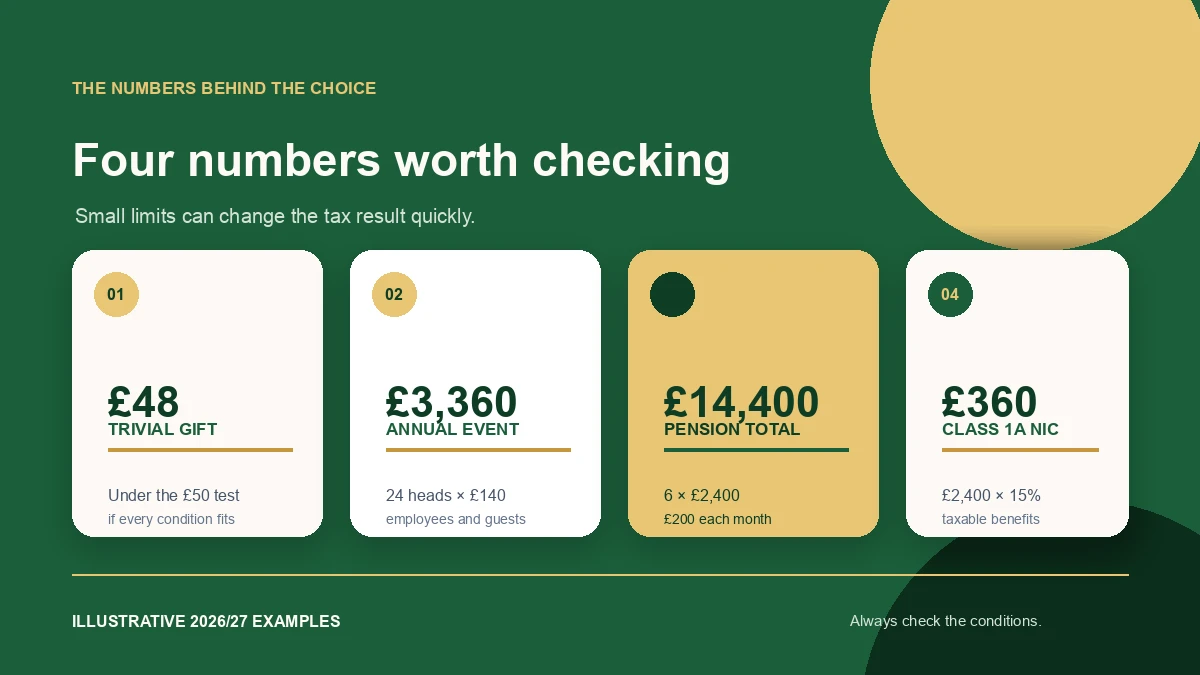
- £2,400 × 6 employees = £14,400 in total
Each employee’s £2,400 contribution counts towards their own annual allowance, alongside any personal or other employer contributions. The total does not mean every employee has used £14,400 of their allowance. Keep the calculation per person.
Employer pension contributions are not a shortcut around every pension rule. Check the registered scheme, the individual’s wider pension savings, salary sacrifice terms and the company’s normal accounting treatment. For a director with several income sources, personal advice may be sensible.
2. Trivial benefits
A trivial benefit can be exempt when it costs £50 or less to provide, is not cash or a cash voucher, is not a reward for work or performance, and is not part of the employee’s contract or a relevant salary sacrifice arrangement. The conditions all matter.
There is no general annual cap for ordinary employees, but directors and other office holders of close companies have a £300 cap in the tax year. A close company is broadly one controlled by five or fewer shareholders, or by its directors.
Worked example: why £50 is a hard edge
Eight employees receive a non-cash birthday gift costing £48 each. The employer spends £384, and each gift can be exempt if the other conditions are met. A gift costing £52 does not become a £2 taxable benefit. The full benefit needs to be reviewed under the taxable benefits rules.
For a close-company director, six qualifying gifts at £45 total £270, leaving the director within the £300 annual cap. A seventh gift would take the total to £315, so the business should pause and check the reporting treatment rather than assume the extra £15 is harmless.
Record the date, recipient, cost including VAT where relevant, description and reason. “Director gift” in a bank feed is not enough evidence on its own.
3. Annual staff functions
An annual function, such as a summer event or Christmas party, can be exempt when it is open to all employees, is an annual event and costs no more than £150 per head. The amount is not a general annual party allowance. It is an exemption limit for qualifying functions.
The cost per head includes the people covered by the event, so include guests when working out the calculation. Where there are multiple annual functions, their costs may need to be considered together. If the total exceeds the limit, do not assume that only the excess is taxable.
Worked example: the guest count matters
A business invites 12 employees and 12 guests to one annual event. The total headcount is 24. At £140 per head, the cost is:
- 24 × £140 = £3,360
That is within the £150 per-head test, subject to the other conditions. If the bill is £3,840, the cost is £160 per head, so the employer needs to review the tax treatment before paying it from the business account.
4. Cycle to Work
An employer can lend or hire cycles and safety equipment without creating a taxable benefit when the offer is generally available to employees and the cycle is mainly used for qualifying journeys, such as travel between home and work. It is not a tax-free route for buying any bicycle for personal use.
The access condition is easy to overlook in a small company. You do not need every employee to take up the offer, but the scheme should be open to the workforce rather than reserved for one director. Keep the scheme terms, equipment details and a record of the employee’s declaration about use.
5. Work equipment, mobile phones and homeworking support
Equipment provided for employment duties can be exempt when private use is insignificant. A mobile phone and SIM can also be exempt when the employer provides one phone for the employee, subject to the rules. The company should own or contract for the item where the exemption requires it, and the work purpose should be clear.
The 6 April 2026 reimbursement change helps when employees pay for eligible items themselves. It does not create a blank cheque for home-office furniture, broadband upgrades or household purchases. Approve the item, record why it is needed and check the current HMRC conditions before reimbursing it.
6. Work-related training and professional subscriptions
Training that improves or maintains skills used in the employee’s current duties can be valuable without creating a taxable benefit when the employer pays it under the relevant rules. Some professional subscriptions and fees can also be exempt where the organisation and membership meet HMRC’s conditions.
The course title is not decisive. A bookkeeping firm paying for software training used in its client work is easier to support than a personal hobby course with no connection to the role. Save the invoice, course description and a short explanation of the work connection.
7. Health screening, flu vaccinations and qualifying eye care
One health screening assessment and one medical check-up in a year can be exempt. Qualifying eye tests and screen-use corrective appliances can be exempt where the display-screen conditions apply. From 6 April 2026, qualifying reimbursements can use the same treatment as direct provision.
Seasonal flu vaccinations are also a practical low-cost option for a small team. The employer can pay the provider directly or reimburse the employee when the rules are met. Keep the arrangement focused on employees, not family members, and do not put it through a salary sacrifice arrangement if you want the specific exemption.
These benefits are useful because they solve a work problem. They are not a substitute for an employment contract, a risk assessment or a proper health and safety process.
Taxable benefits can still be worthwhile
“Tax-efficient” does not mean “never offer anything taxable”. Private medical insurance, company cars, gym memberships and beneficial loans can be valuable, but they usually need a proper tax and National Insurance calculation.
For 2026/27, the Class 1A National Insurance rate on expenses and benefits is 15%. Suppose four employees each receive private medical insurance with a taxable value of £600:
- £600 × 4 employees = £2,400 taxable benefits
- £2,400 × 15% = £360 employer Class 1A NIC
The employees’ personal Income Tax is a separate calculation. If the benefits were not payrolled, the employer generally reports them on P11D and reports the Class 1A total on P11D(b). If they were correctly payrolled, the year-end P11D position changes, but the Class 1A work does not disappear.
Our P11D deadline guide covers the reporting mechanics, while our payrolling benefits guide explains the choice of route. This article is about selecting the benefit before you get to those forms.
How to choose a benefit for a small team
Use five questions before you add anything to the handbook:
| Question | What to check |
|---|---|
| Will employees use it? | Ask staff what would help with work, health, travel or long-term saving. |
| Is it exempt or taxable? | Identify the precise HMRC condition, not just the benefit’s marketing name. |
| What is the full employer cost? | Include VAT, setup fees, employer NIC and any payroll or provider charge. |
| Can everyone access it fairly? | Check part-time staff, remote workers, new starters and employees at different locations. |
| Can we evidence it? | Decide who keeps approvals, invoices, dates, values and employee declarations. |
Imagine a five-person studio with £4,000 to spend on benefits. It could provide five £48 qualifying gifts for £240, contribute £50 a month to each employee’s pension for £3,000, and keep £760 for a work-related training budget. That may deliver more lasting value than spending the entire £4,000 on a taxable perk that nobody asked for.
The best choice depends on your team and cash flow. A pension contribution is not a replacement for a staff event, and a cycle scheme is not useful to someone who works remotely and never travels by bike. Ask first, then check the tax route.
Reporting dates and the records to keep
Benefits should have their own small register, even if your payroll software has a benefits module. For each item, record:
- employee or director name
- benefit type and date provided
- cost and VAT treatment
- whether the item was direct provision or reimbursement
- the condition that makes it exempt, if applicable
- invoice, receipt, approval and employee declaration
- payroll, P11D, P11D(b) or no-reporting decision
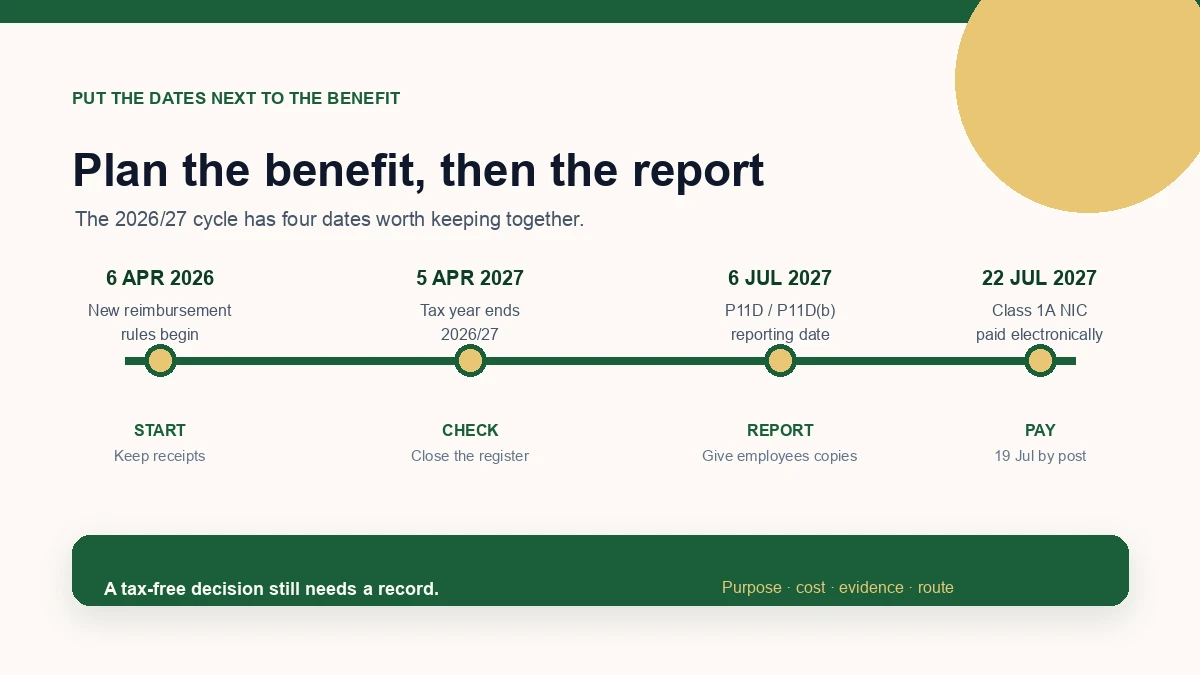
For benefits provided during 2026/27, the tax year ends on 5 April 2027. The usual employer timetable is:
| Task | Date for 2026/27 benefits |
|---|---|
| Tax year ends | 5 April 2027 |
| Report benefits and give employees their information | 6 July 2027 |
| Pay Class 1A NIC electronically | 22 July 2027 |
| Pay Class 1A NIC by post | 19 July 2027 |
| Pay PAYE Settlement Agreement tax and Class 1B NIC, if relevant | 22 October 2027 electronically |
The dates above are the normal cycle. Check HMRC’s expenses and benefits deadlines before filing because payment methods and future guidance can change.
Accurate bookkeeping makes this much easier. Ask your bookkeeper to use clear categories for staff welfare, pensions, training, professional fees, medical benefits, entertaining, cycles and director costs. A single “staff expenses” code hides the information payroll needs later.
Common mistakes to avoid
Treating the £50 trivial-benefit limit as an allowance
The limit applies to the cost of each qualifying benefit, not a pot of £50 that can be topped up. Cash and cash vouchers do not qualify, and performance-related gifts fail a key condition.
Calling every staff meal an annual function
The £150 rule is for qualifying annual functions open to all employees. A client dinner, a one-off team lunch or an event available only to directors may be treated differently.
Reimbursing home-office purchases without approval
The 2026 reimbursement rules are useful, but they are not a general personal shopping exemption. Keep the work purpose and private-use assessment with the receipt.
Forgetting the close-company director cap
The £300 trivial-benefit cap applies to directors and office holders of close companies. Track the director’s benefits across the tax year instead of checking each gift in isolation.
Assuming payrolling removes every year-end task
Payrolling changes how Income Tax is collected. It does not replace the need for Class 1A calculations, a benefit register or a review of items that were not payrolled.
Offering a benefit before checking access and contracts
A benefit that is promised in an employment contract, provided through a relevant salary sacrifice arrangement or offered only as a reward for performance may lose an exemption. The wording should be checked before the promise is made.
A practical 30-day setup plan
Use the next month to turn a list of ideas into a controlled process:
- Ask employees which benefits would make a real difference.
- Separate exempt, taxable and uncertain options.
- Check the current HMRC condition for every exempt option.
- Set an annual budget that includes employer NIC and admin time.
- Add the chosen benefits to contracts or policies only after review.
- Create the benefit register and decide who approves reimbursements.
- Add payroll and bookkeeping checks to the monthly close.
If your team already has P11D corrections, director expenses or mixed payroll records, a short review with our payroll team can prevent a small perk becoming a year-end clean-up. You can also contact Golden Tree Consulting with the benefit list, approximate values and the tax year you are planning for.
FAQ: tax-efficient employee benefits UK 2026
What are tax-efficient employee benefits in the UK?
Tax-efficient employee benefits are perks that provide useful value while qualifying for a tax and National Insurance exemption, or that have a manageable reporting cost. The exact conditions decide the result.
How much can a trivial benefit cost in 2026/27?
It must cost £50 or less, not be cash or a cash voucher, not reward work or performance, and not be contractual or provided through a relevant salary sacrifice arrangement. Directors of close companies also have a £300 annual cap.
Is the £150 staff party limit an annual allowance?
No. It is an exemption limit for a qualifying annual function that is open to all employees. Include the relevant guests when calculating the cost per head and review multiple events together.
Are employer pension contributions taxable benefits?
Employer contributions to a registered pension scheme are generally not taxed as earnings for the employee, but they count towards the employee’s annual allowance. The standard allowance is £60,000 for 2026/27, subject to possible reductions.
What changed for reimbursed employee benefits from 6 April 2026?
Qualifying reimbursements for work-related homeworking equipment, certain eye tests and VDU-specific corrective appliances, and seasonal flu vaccinations can be exempt from Income Tax and National Insurance when the statutory conditions are met.
Do tax-efficient benefits still need to be recorded?
Yes. Keep the recipient, date, cost, purpose, evidence and tax decision. Good records protect an exemption and help identify items that do belong on payroll or a P11D.
When do employers report benefits for 2026/27?
The tax year ends on 5 April 2027. The usual reporting deadline is 6 July 2027, with Class 1A NIC due by 22 July 2027 electronically or 19 July by post.
Before the next benefit is promised, write down the cost per employee, the exemption condition and the evidence you will keep. That three-line check catches most expensive misunderstandings before they reach payroll.
Sources and further reading

About Golden Tree Consulting
ACCA Affiliated | MBA Qualified
Golden Tree Accounting & Business Consulting provides expert tax, bookkeeping, and advisory services to sole traders and SMEs across Croydon, London, Surrey, and Kent. With multilingual support and decades of combined experience, we help businesses stay compliant and grow.
Offices in Croydon and London Bridge.
Related guides

Payrolling Benefits in Kind: Mandatory From April 2027 (UK Employer Guide)
From 6 April 2027 employers must payroll company cars, vans, fuel and private medical benefits instead of reporting them on P11Ds. What changes, the April 2028 second phase, registration from November 2026 and how to prepare.

Tips Tax UK 2026: PAYE, National Insurance and Fair Distribution for Employers
Tips tax UK 2026 explained for employers, including PAYE, National Insurance, tronc schemes, payment deadlines, records and fair distribution.
IR35 for Contractors UK 2026: Inside vs Outside and What to Do Next
IR35 for contractors UK 2026 explained with inside and outside tests, CEST, client duties and practical records for your next contract.