VAT Flat Rate Scheme 2026: Is the 16.5% Rule Costing Your Business Money?
VAT Flat Rate Scheme 2026 guide for small businesses, covering the 16.5% limited-cost rule, thresholds, examples and exit checks.
VAT Flat Rate Scheme 2026: Is the 16.5% Rule Costing Your Business Money?
The VAT Flat Rate Scheme can look wonderfully tidy on a busy quarter. You charge customers the normal VAT rate, apply one fixed percentage to your VAT-inclusive turnover, and send that amount to HMRC. Fewer purchase invoices need to be analysed for the VAT return. For the right small business, that can be a sensible trade.
The catch is the 16.5% limited-cost business rule. Many consultants, agencies, contractors and other service businesses have low spending on physical goods. They can join the scheme expecting a saving, then discover that the special 16.5% rate leaves little or no advantage once they have stopped reclaiming input VAT on ordinary costs. It is one of those VAT areas where the arithmetic matters more than the sales pitch.
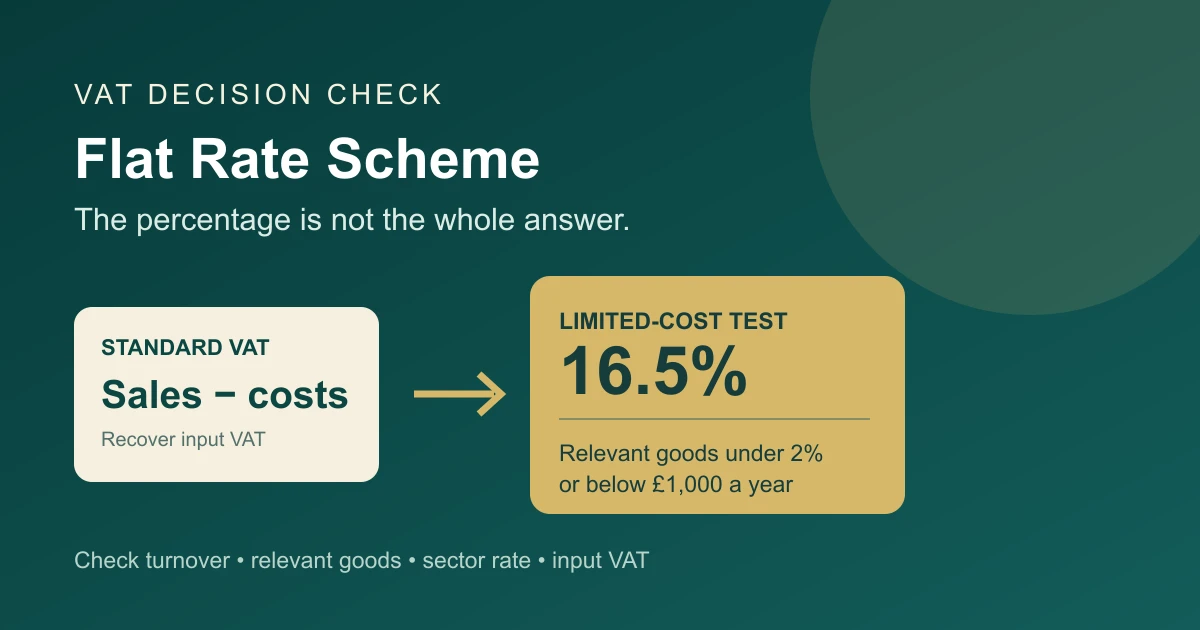
Quick summary: you may be able to join the VAT Flat Rate Scheme if VAT-exclusive taxable turnover is £150,000 or less. You usually pay a sector percentage on VAT-inclusive turnover and cannot reclaim VAT on normal purchases. If relevant goods are below 2% of turnover, or below £1,000 a year when they exceed 2%, the 16.5% limited-cost rate normally applies. Run both calculations before joining or renewing your approach.
If your VAT returns are being prepared from bank transactions, receipts and a hopeful spreadsheet, our VAT return service, bookkeeping support and contact page can help turn the choice into a calculation rather than a guess.
How the VAT Flat Rate Scheme works in 2026
Under standard VAT accounting, you normally add output VAT to taxable sales and deduct recoverable input VAT on business purchases. The difference goes to HMRC. Under the Flat Rate Scheme, you still charge customers VAT in the normal way, but you pay HMRC a fixed percentage based on the sector that best describes the main business activity. GOV.UK’s Flat Rate Scheme overview confirms that the percentage is applied to VAT-inclusive turnover.
That phrase, VAT-inclusive, is important. A photographer who invoices £10,000 plus £2,000 VAT has flat-rate turnover of £12,000, not £10,000. A photographer’s listed sector percentage is 11%, so the starting flat-rate payment would be £1,320. Under standard VAT, the payment would instead depend on the £2,000 output VAT less recoverable VAT on purchases.
You normally cannot reclaim VAT on ordinary purchases while using the scheme. There is an exception for a single purchase of qualifying capital expenditure goods costing £2,000 or more including VAT. A bought van or one qualifying computer package may qualify; services, leased items and several separate smaller purchases do not automatically become one claim. The detailed rules are in VAT Notice 733.
The scheme can reduce admin, but it does not remove the need for good records. You still need sales figures, the right sector percentage, invoices, evidence for any capital-goods claim, and a check of whether you are a limited-cost business for each relevant period.
The 16.5% limited-cost business test
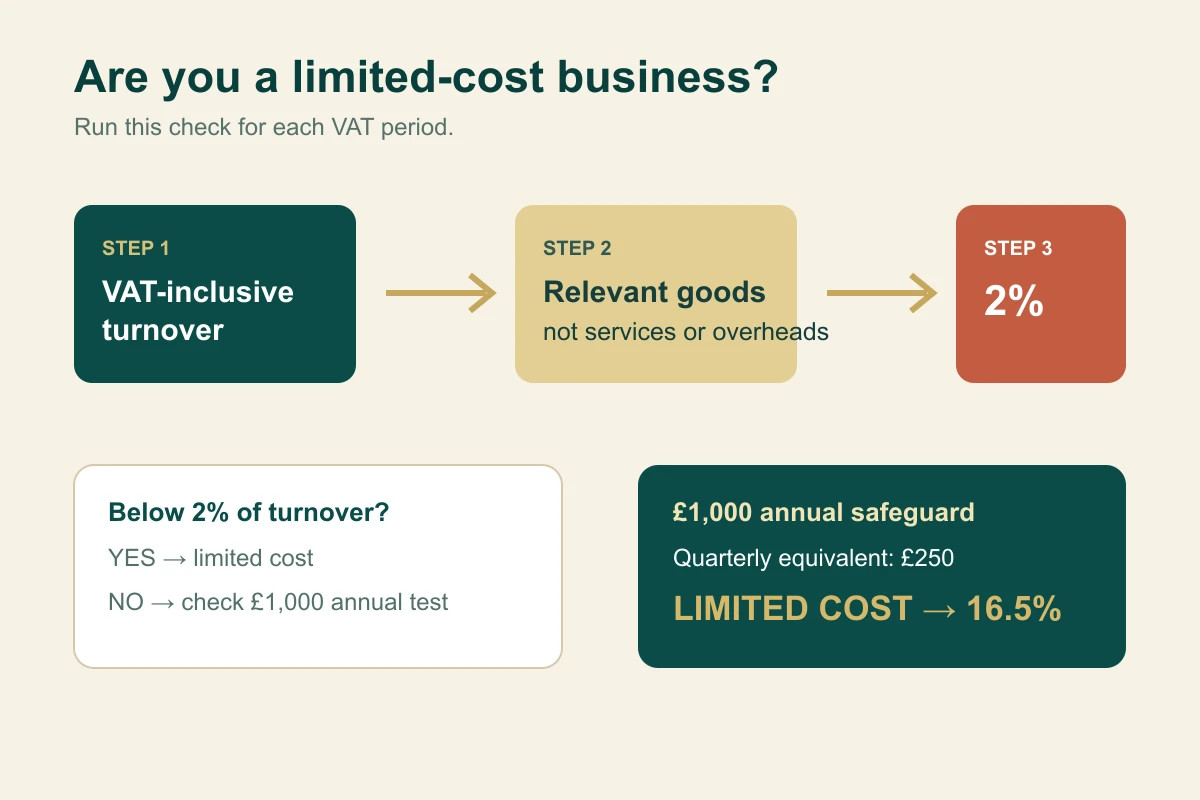
The limited-cost test is the hinge point for many service businesses. You are a limited-cost business if the cost of your relevant goods is less than either:
- 2% of VAT-inclusive turnover; or
- £1,000 a year, where the goods cost is more than 2% of turnover.
On a quarterly return, the £1,000 figure is apportioned. That makes it £250 for a normal three-month VAT period. If you meet the test, GOV.UK says you use the 16.5% rate rather than your sector rate. Relevant goods are physical items used exclusively for the business, not services. Rent, phone contracts, accountancy fees, subcontractor labour, fuel used in a vehicle and advertising can be genuine business costs without helping you pass this particular test.
This catches people because “I have plenty of expenses” and “I have enough relevant goods” are different statements. A freelance marketer may spend heavily on software subscriptions, co-working space, travel and freelance support. Those costs matter commercially, but they may not be relevant goods for the Flat Rate Scheme test.
Worked example 1: a consultant at 16.5%
Assume Maya is a VAT-registered consultant. In one quarter she invoices £30,000 plus £6,000 VAT, so her VAT-inclusive turnover is £36,000. She buys £180 of stationery and other relevant goods during the quarter. Her 2% figure is £720. Her relevant goods are below both £720 and the quarterly £250 amount.
| Calculation | Amount |
|---|---|
| VAT-inclusive turnover | £36,000 |
| Limited-cost rate | 16.5% |
| Flat Rate Scheme payment | £5,940 |
| Output VAT charged to customers | £6,000 |
| Amount left before other costs | £60 |
There may still be an admin reason to use the scheme, but this is not an automatic VAT saving. If Maya has recoverable VAT on software, equipment, travel or professional costs under standard VAT accounting, a standard calculation could be better. Her actual answer depends on the full mix of purchases and supplies.
Sector rates, the 1% discount and the comparison you should make
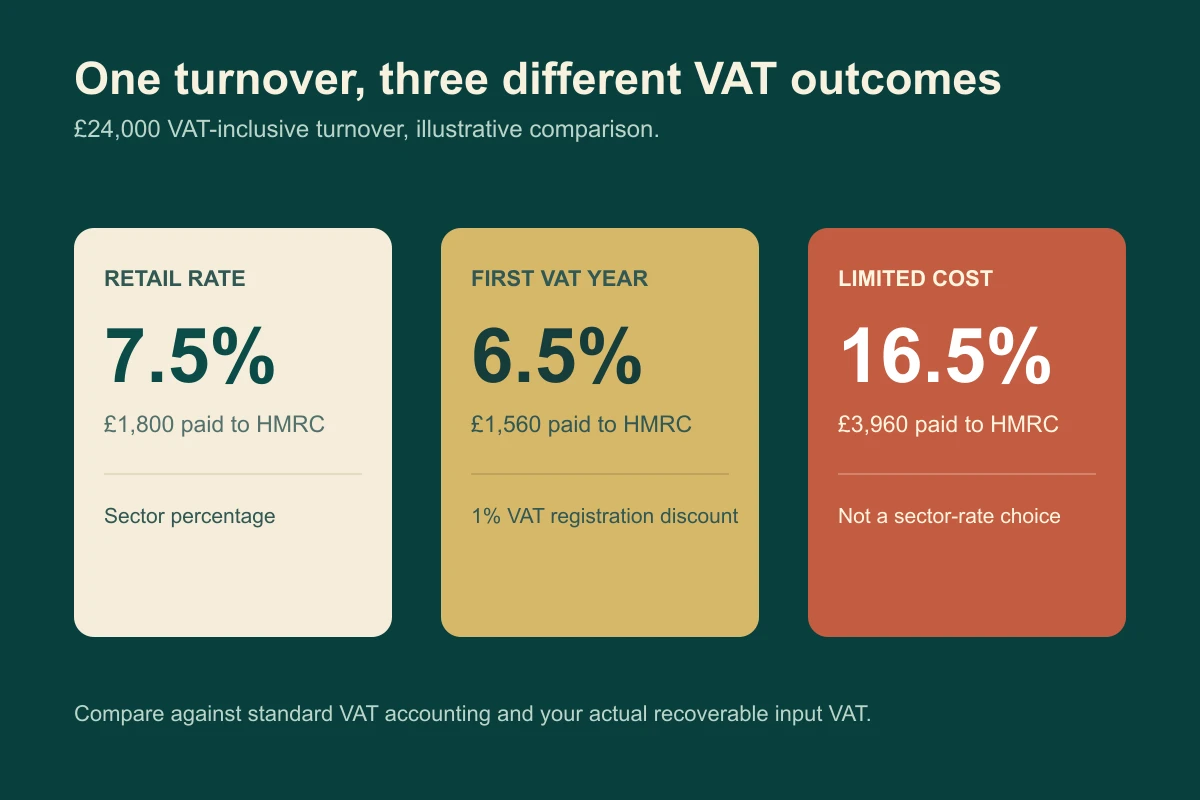
If you are not a limited-cost business, use the published percentage for your main sector. The current table includes 14.5% for accountancy or book-keeping, 11% for advertising, 10% for transport or storage, 7.5% for retailing not listed elsewhere and 12% for activity not listed elsewhere. HMRC’s rate table and limited-cost guidance is the source to check before choosing a category.
Newly VAT-registered businesses receive a 1% reduction in their first year of VAT registration. It applies to the rate, not to turnover. So a retailer using a 7.5% sector rate would use 6.5% in that first year, assuming it is not a limited-cost business.
Worked example 2: a retailer with the first-year discount
Lewis runs a small shop. His VAT-inclusive turnover for a quarter is £24,000. He buys stock, so he is not limited cost. His listed retailing rate is 7.5%, reduced to 6.5% in his first year of VAT registration.
| Calculation | Amount |
|---|---|
| VAT-inclusive turnover | £24,000 |
| First-year flat rate | 6.5% |
| Flat Rate Scheme payment | £1,560 |
| VAT charged at 20% within turnover | £4,000 |
| Difference before input-VAT comparison | £2,440 |
The £2,440 is not profit and it is not a guaranteed saving. Lewis still needs to compare it with the input VAT he would reclaim under standard accounting. Businesses that buy a lot of stock can find the normal method more attractive, particularly when their purchases rise.
Who can join, and when you need to leave
To join, your VAT-exclusive taxable turnover must be £150,000 or less. You must be VAT registered and apply to HMRC. If you are registering for VAT for the first time, you can apply at the same time. If you are already registered, the online application or form VAT600FRS is used. HMRC normally confirms the start date from the beginning of the VAT period after it receives the application, so do not just use the percentage on the next return without confirmation.
There are exclusions and special cases. The scheme is not for every business with turnover below the headline figure. VAT groups, some associated businesses, certain margin-scheme activities and businesses that have recently left the scheme need careful checking. The joining guidance is the sensible starting point.
You must normally leave if, on the anniversary of joining, VAT-inclusive turnover for the previous 12 months was more than £230,000, or you expect it to be above that amount in the next 12 months. You also have to leave if you expect total income in the next 30 days alone to exceed £230,000 including VAT. Those are not figures to leave until the annual accounts are finished.
Worked example 3: the 30-day exit check
Suppose an events business is on the scheme and normally invoices £12,000 a month including VAT. It wins a contract and expects £235,000 including VAT from one customer over the next 30 days. The 30-day test is met even though the normal monthly run rate is much lower. The business should check the leave date immediately instead of filing the next return at its old flat rate.
Four Flat Rate Scheme mistakes worth avoiding
The first mistake is treating the sector list like a menu. Pick the activity that best reflects the main business activity, usually the one producing the highest turnover. A secondary service may have a lower percentage, but that does not make it the correct category.
The second is counting every expense as a relevant good. The limited-cost rule is deliberately narrower than the ordinary Income Tax or VAT expense rules. Keep a separate working paper for goods, then retain the invoices behind it. That makes a quarterly review much easier to defend.
The third is forgetting the first-year discount has an end date. A 1% reduction feels small until it disappears from a growing turnover figure. Put the VAT registration anniversary in the diary alongside the return deadline.
Finally, do not join purely because a friend in a different trade says it worked for them. A shop with regular stock purchases, a contractor with substantial materials, and a consultant buying subscriptions can produce very different answers from the same turnover. Compare one recent completed VAT period under both methods, then repeat the comparison after a material change in costs or sales.
The 29 July 2026 capital-goods change, and why it is not a shortcut
From 29 July 2026, the Capital Goods Scheme is changing: computers and computer equipment are removed from that separate scheme, and the threshold for land, buildings and civil engineering work rises from £250,000 to £600,000 excluding VAT for qualifying expenditure incurred from that date. That is a real change for some VAT-registered businesses, set out in HMRC’s Capital Goods Scheme simplification note.
It does not make every laptop purchase recoverable under the Flat Rate Scheme. Keep the two rule sets separate. The Flat Rate Scheme’s own capital-expenditure exception still asks whether there is a single qualifying purchase of goods costing at least £2,000 including VAT. If you are planning a large asset purchase, mixed taxable and exempt supplies, or a change of VAT method, get the figures checked before signing the order.
A practical Flat Rate Scheme review before your next VAT return
Use this short review before filing:
- total VAT-inclusive turnover for the period
- sector percentage and evidence for the main activity
- relevant goods only, separately from services and overheads
- limited-cost calculation for the period
- input VAT that would be recoverable under standard accounting
- any single capital-goods purchase costing £2,000 or more including VAT
- £150,000 joining threshold and £230,000 exit checks
- whether the 1% first-year reduction has ended
Our VAT return team can review a live comparison, and our bookkeeping service can keep the source records clear enough to repeat it next quarter. The practical next move is to calculate both methods from your last completed quarter before you decide that “simple” is also “cheaper”.
FAQ: VAT Flat Rate Scheme 2026
Is the VAT Flat Rate Scheme worth it for a consultant?
Sometimes, but consultants are often limited-cost businesses because much of their spending is on services rather than relevant goods. Compare the 16.5% calculation with standard VAT accounting using real purchase invoices, not a rough percentage.
Do I use the percentage on sales before or after VAT?
The percentage is applied to VAT-inclusive turnover. If you charge £1,000 plus £200 VAT, the flat-rate turnover for that sale is £1,200.
Can a business leave the Flat Rate Scheme voluntarily?
Yes. A business can leave voluntarily, but it should check timing and the VAT consequences first. Mandatory exit rules are separate, especially the £230,000 anniversary and 30-day tests.
Does the 1% discount apply forever?
No. It is a 1% reduction for the first year that the business is VAT registered. Keep the VAT registration anniversary in the review calendar so the next return uses the correct rate.

About Golden Tree Consulting
ACCA Affiliated | MBA Qualified
Golden Tree Accounting & Business Consulting provides expert tax, bookkeeping, and advisory services to sole traders and SMEs across Croydon, London, Surrey, and Kent. With multilingual support and decades of combined experience, we help businesses stay compliant and grow.
More Articles You Might Like
Continue exploring our financial insights
VAT Bad Debt Relief UK 2026: How to Reclaim VAT on Unpaid Invoices
VAT bad debt relief UK 2026 explained: check the six-month rule, calculate the VAT on unpaid invoices, claim it on your return and keep the right records.

How to Claim VAT Back in the UK: Input Tax Guide for Small Businesses 2026
How to claim VAT back in the UK in 2026: check input tax, VAT invoices, pre-registration costs, blocked expenses and your VAT return.

Etsy Seller Tax UK: 2026 Guide to Records, VAT and Self Assessment
Etsy seller tax UK guide for 2026: the £1,000 trading allowance, Self Assessment, VAT threshold, expenses and records to keep.