VAT Bad Debt Relief UK 2026: How to Reclaim VAT on Unpaid Invoices
VAT bad debt relief UK 2026 explained: check the six-month rule, calculate the VAT on unpaid invoices, claim it on your return and keep the right records.
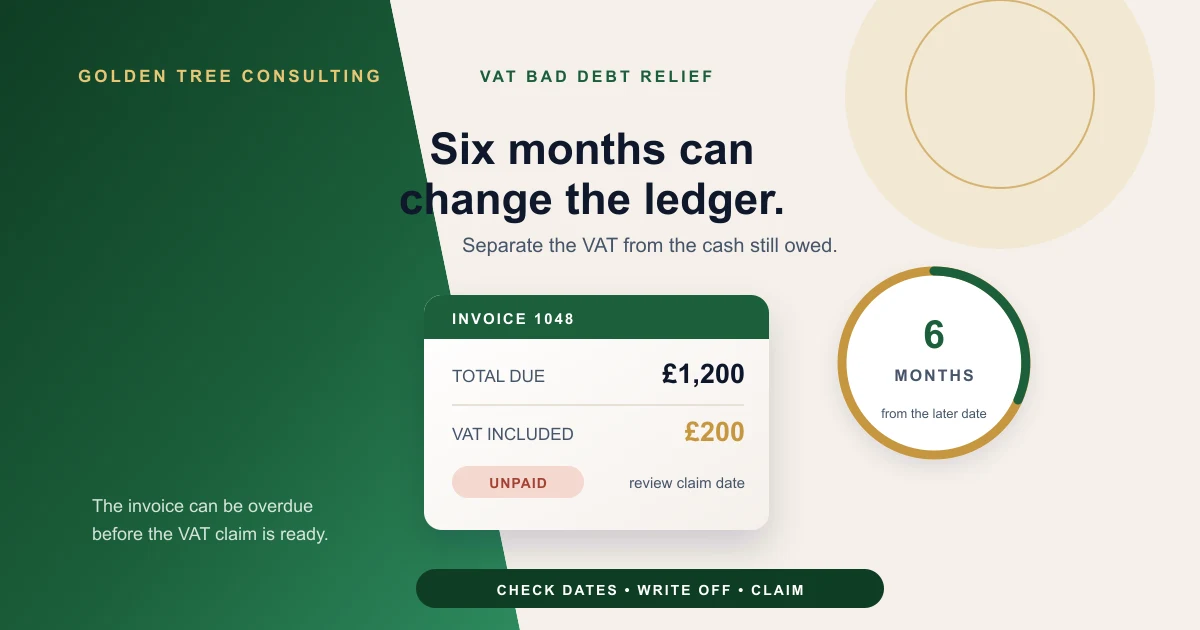
An unpaid £1,200 invoice can leave a VAT-registered business in an awkward position. You may have sent £200 of VAT to HMRC even though the customer has not sent you a penny. The invoice is still sitting in your aged-debt report, and the cash would be useful for wages, suppliers or your next tax payment.
VAT bad debt relief UK 2026 rules may let you reclaim the VAT element once the debt has stayed unpaid for long enough and you have written it off correctly. It is not an automatic refund, and it does not turn a slow payer into a good customer. It is a way to correct the VAT position when a genuine commercial debt has gone bad.
Quick answer: wait at least six months from the later of the payment due date or the date of supply, write the debt off in your day-to-day VAT accounts, move it to a separate bad debt account, calculate the VAT still unpaid, and include the claim in Box 4 of the VAT Return for the period in which you become entitled to relief. Keep the invoice, payment history and write-off evidence together.
If a missed payment is affecting your VAT records, our VAT returns service can help check the return and the supporting entries. Our bookkeeping service can also help match the sales ledger, bank receipts and bad debt account before you make the claim.
VAT bad debt relief UK 2026: the rule in plain English
HMRC’s VAT Notice 700/18 on relief from VAT on bad debts sets out the conditions. In simple terms, you may be able to claim when all of the following are true:
| Check | What it means in practice |
|---|---|
| You made a taxable supply | You supplied goods or services and charged VAT in the normal way |
| You accounted for and paid the VAT | The VAT was included in an earlier VAT Return and paid to HMRC |
| The debt has stayed unpaid | At least 6 months have passed from the later of the due date or date of supply |
| You have written it off | The debt is written off in your day-to-day VAT accounts and moved to a separate bad debt account |
| The debt is not sold or factored in a way that prevents relief | You still hold the relevant debt when you claim |
| The price was not above the normal selling price | The supply was made at a customary commercial price |
| You are within the time limit | The claim is made within 4 years and 6 months of the later relevant date |
That list is why a simple note saying “customer has not paid” is not enough. HMRC wants the claim to connect the original sale, the VAT you paid, the amount still outstanding and the accounting entry that records the write-off.
There is an important difference between late and bad. An invoice that is 60 days overdue is a credit-control problem, but it may not yet qualify for VAT bad debt relief. A customer can pay on day 181, too. You can claim only when the legal conditions are met, and you must correct the return if money arrives after the claim.
When does the six-month waiting period start?
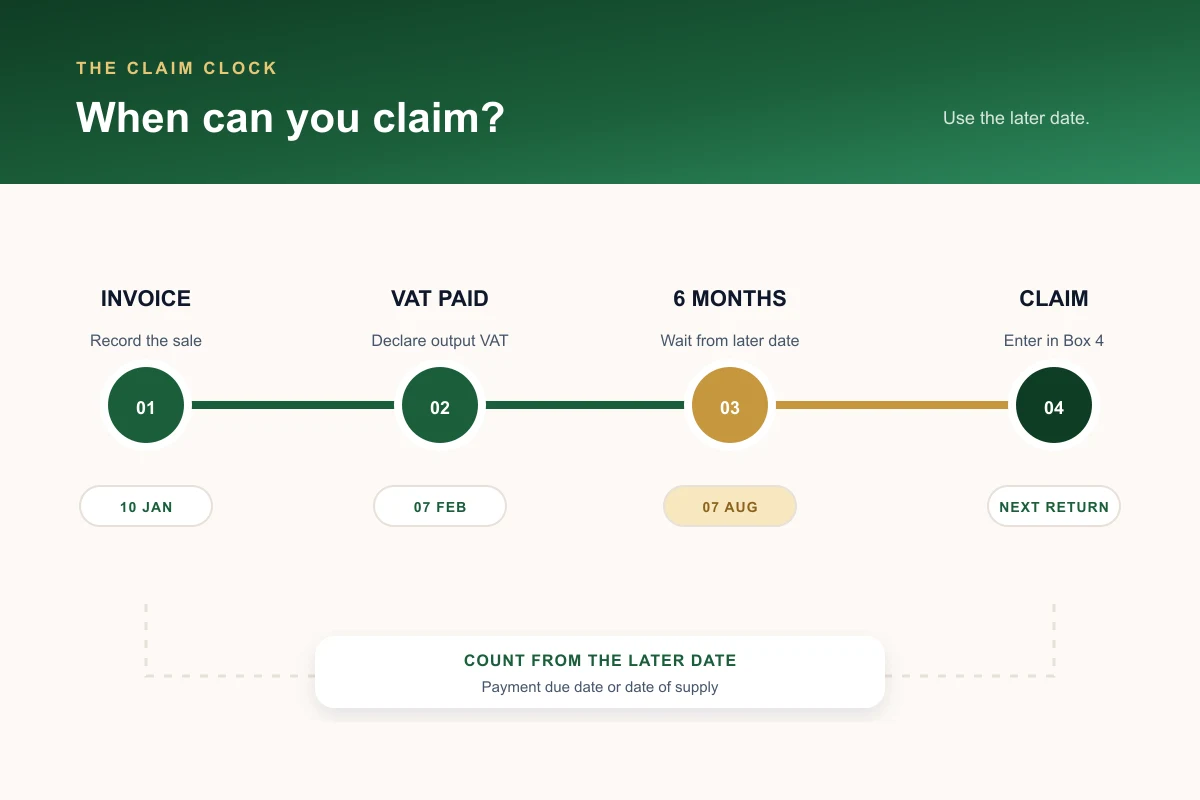
You do not always count six months from the invoice date. The relevant date is the later of:
- when payment was due and payable, based on the agreed credit terms; or
- the date of supply, sometimes called the tax point.
The later-date rule matters when an invoice is issued before the goods are delivered or the service is finished. It also matters when a customer has a longer agreed payment term. A business that checks only the invoice date can make a claim too early.
Worked example: the later date controls
Assume a consultancy issues an invoice on 10 January 2026. The work is completed on 20 January, creating the relevant date for the supply. The agreed payment date is 28 February 2026.
The later date is 28 February, so the six-month period runs from there. The business should not treat 10 July as an automatic claim date just because six months have passed since the invoice was issued. It should wait until the debt has remained unpaid for the required period from the later relevant date, then claim in the VAT Return that covers the date entitlement arises.
Now change the facts. The work is completed on 10 March 2026, but the invoice says payment is due on 28 February. The later date is now 10 March, so the claim point moves later. The records should show why the date was chosen.
If you use the VAT Cash Accounting Scheme, the timing is different. You generally account for VAT when the customer pays, so an unpaid invoice does not usually create the same VAT cash-flow problem. Check the scheme rules before trying to apply the standard bad debt process to a cash-accounting return.
How much VAT can you reclaim?
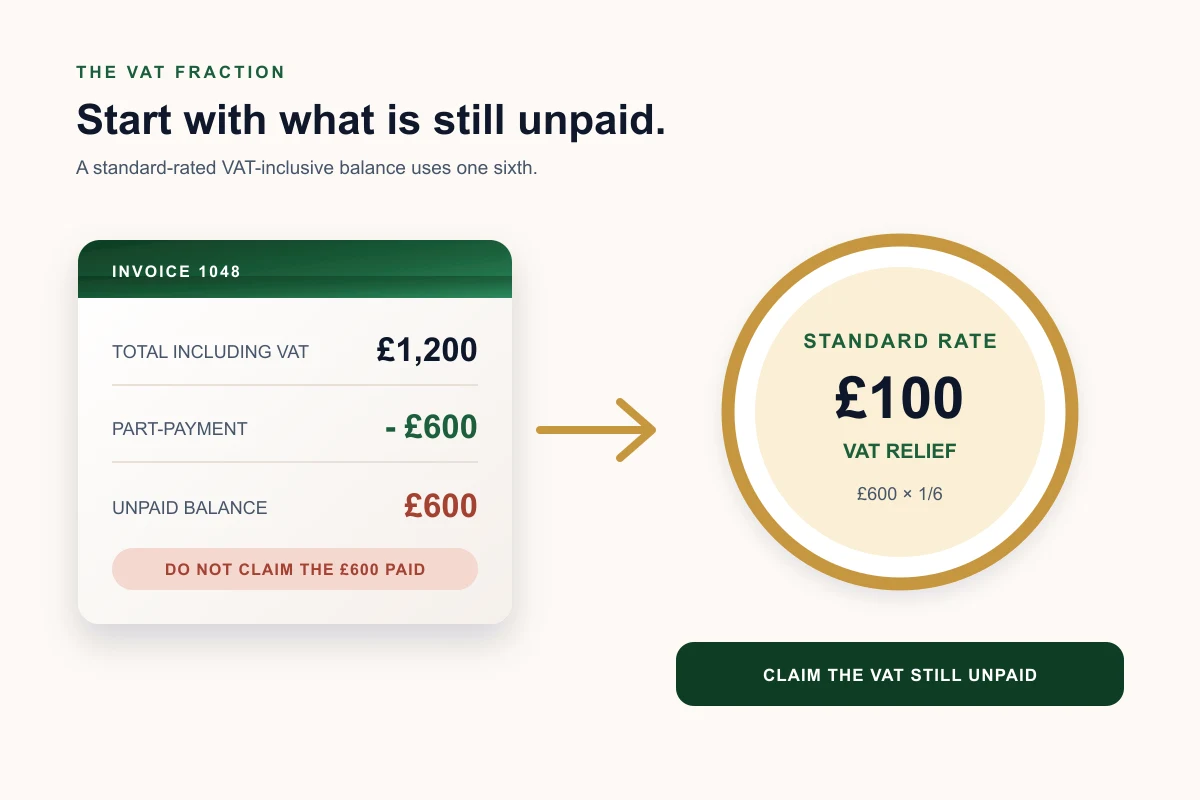
The claim is based on the VAT included in the amount that remains unpaid, not automatically on the original invoice total. For a standard-rated supply at 20%, the VAT fraction of a VAT-inclusive amount is one sixth. For a reduced-rated supply at 5%, the fraction is one twenty-first. A zero-rated supply has no output VAT to reclaim.
The calculation is easier when your invoice shows the net amount, VAT and gross total separately. If the customer has made a part-payment, start with the VAT-inclusive balance still owed and apply the correct VAT fraction. Do not claim VAT on money you have already received.
Worked example: a standard-rated invoice with no payment
Your business raises a standard-rated invoice for:
| Invoice element | Amount |
|---|---|
| Net supply | £1,000 |
| VAT at 20% | £200 |
| Total due | £1,200 |
If the customer has paid nothing when the claim becomes available, the unpaid balance is £1,200. The VAT bad debt relief is:
£1,200 × 1/6 = £200
You do not reclaim the £1,000 net sale. You reclaim the £200 of VAT that was previously accounted for and paid to HMRC, provided the other conditions are met.
Worked example: a part-payment
Suppose the same customer pays £600 after the invoice was issued. The unpaid VAT-inclusive balance is £600:
£1,200 total - £600 paid = £600 outstanding
The VAT included in that outstanding balance is:
£600 × 1/6 = £100
The relief is £100, not £200. If you later receive the remaining £600, you must account for the VAT included in that payment instead of keeping the whole relief.
How to claim bad debt relief on a VAT Return
The claim is made through the VAT Return for the accounting period in which you become entitled to relief. There is no separate general refund form for a normal claim made while the VAT registration remains open.
The GOV.UK guidance on what to include in a VAT Return confirms that a qualifying bad debt can be written off and claimed through the return. The practical sequence is:
1. Confirm the supply and the original VAT treatment
Find the original VAT invoice, the date of supply and the return in which the output VAT was declared. Check that the supply was taxable and that your business actually accounted for and paid the VAT. You cannot claim relief on VAT that was never due or never paid to HMRC.
2. Check the due date and six-month point
Read the agreed payment terms rather than relying on the date shown in your accounting software. Compare the due date with the date of supply and use whichever is later. Write the claim date into your review notes so another person can follow the calculation.
3. Write off the debt in the VAT accounts
Record the write-off in your normal accounting records and transfer the debt to a separate VAT bad debt account. The account should not be a vague “old invoices” list. It needs enough detail to connect the claim to the original supply and the VAT Return.
4. Calculate only the unpaid VAT
Subtract payments received, credits that genuinely reduce the consideration, or other amounts that affect the outstanding debt. If several supplies are involved, allocate payments carefully. HMRC’s default approach is generally to allocate an unspecified payment to the earliest supply, unless the customer specifies a supply and pays that supply in full.
5. Enter the claim in Box 4
Include the VAT amount in Box 4 of the VAT Return for the period in which you become entitled to make the claim. The entry reduces the net VAT payable or increases the repayment due on that return. Keep the workings with the VAT account rather than relying on the software’s transaction memo.
6. Watch for later payments
If the customer pays after your claim, the VAT relating to the payment goes into Box 1 of the VAT Return for the period in which the payment is received. The VAT amount to repay depends on the payment received and the outstanding consideration when the claim was made.
Do not issue a credit note merely because an invoice is unpaid. A credit note is for a genuine mistake, overcharge or agreed reduction in the value of a supply. Bad debt relief is the route for an eligible unpaid debt.
The records your VAT bad debt account needs
Good evidence is mostly ordinary bookkeeping information, kept in the right place. For each debt, keep:
- a copy of the VAT invoice, or another document containing the equivalent information;
- the customer name;
- the invoice date and invoice number;
- the date payment was due and the date of supply;
- the VAT-inclusive amount of the supply;
- the VAT originally charged and the VAT period in which you accounted for it;
- every payment received and how it was allocated;
- the amount written off as a bad debt;
- the amount of VAT claimed;
- the VAT Return period in which the claim was made; and
- the date of the write-off and the accounting entry that moved the balance to the separate account.
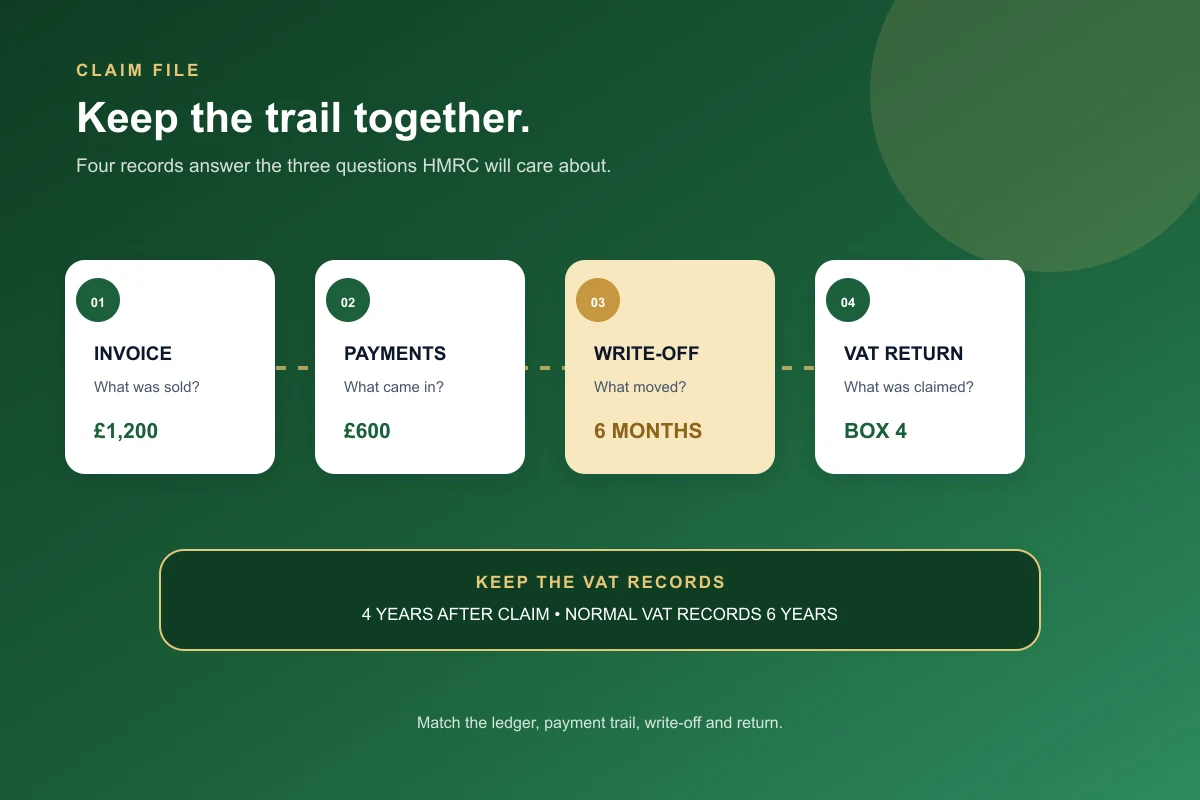
HMRC says the bad debt records listed in Notice 700/18 must be kept for 4 years from the date of the claim. That sits alongside the normal VAT record-keeping period, which is generally 6 years. Keeping the wider sales-ledger and VAT trail for the longer period is the safer routine for most businesses.
Your bookkeeping system should make it possible to answer three questions without rebuilding the file from memory:
- What did we sell, and how much VAT did we pay?
- What has the customer paid, and what remains outstanding?
- What did we claim, when did we claim it, and what happens if money arrives later?
If the answer to any of those depends on a spreadsheet saved on one person’s laptop, the process needs tightening before the return is submitted.
Part-payments and several invoices
Part-payments are where a correct basic rule can become a messy ledger exercise. Consider a customer who owes three invoices and sends one bank transfer with no reference. You cannot simply apply the whole payment to the invoice that is easiest to close.
HMRC’s approach is generally to allocate an unspecified payment to the earliest supply. If the customer clearly identifies a particular invoice and pays that invoice in full, you can follow that instruction. The allocation should be documented because it changes which invoice, if any, has been unpaid for six months and how much VAT remains in the debt.
Worked example: three invoices and an unspecified payment
Imagine these standard-rated invoices are outstanding:
| Invoice | Gross amount | VAT included |
|---|---|---|
| 101, January | £1,200 | £200 |
| 102, February | £2,400 | £400 |
| 103, March | £1,800 | £300 |
The customer sends £2,000 without saying which invoice it is for. On the usual earliest-supply approach, the first £1,200 clears invoice 101, leaving £800 to allocate against invoice 102. The unpaid part of invoice 102 is £1,600, containing £266.67 of VAT at 20%, assuming the six-month condition has been met and no other facts change.
That is not a reason to round the number until it looks tidy. Keep the calculation, the payment reference and the allocation note together. Small rounding differences can be corrected, but unexplained allocations are much harder to defend.
When bad debt relief is not available yet
A customer saying “we will pay next month” does not create entitlement to relief. You may have a serious cash-flow problem, but the debt can still be recoverable. The six-month condition and the write-off requirement are separate checks.
Relief can also be affected when:
- the debt has been sold or absolutely assigned to a factoring company;
- an insurer, guarantor or another person has paid part of the debt;
- there is enforceable security that reduces the amount at risk;
- the original price was above the customary selling price;
- the supply was under a scheme with different timing, such as VAT Cash Accounting; or
- the business is part of a VAT group and the records have not been kept separately for the relevant member.
Factoring needs particular care. A business may use invoice finance to improve cash flow, but an absolute assignment can prevent a bad debt relief claim while the debt remains assigned. Ask your finance provider or accountant how the agreement treats the debt before assuming that an unpaid customer balance can be claimed.
What if the customer pays after the claim?
VAT bad debt relief is not a permanent exemption from VAT on a sale. It is a correction based on the debt being unpaid when you claim. If money arrives later, you have to bring the VAT back into the return.
Worked example: a later payment
Your business raises a standard-rated invoice for £9,000, made up of £7,500 net value and £1,500 VAT. The customer pays £3,000 and the remaining £6,000 qualifies for relief after the six-month point.
The initial claim is:
£6,000 × 1/6 = £1,000
Two months later, the customer pays £2,400. Assuming the payment relates only to that outstanding invoice, the VAT in the payment is:
£2,400 × 1/6 = £400
The business includes £400 in Box 1 for the return covering the later payment. The remaining unpaid balance is £3,600, with £600 of VAT still represented in the debt. Keep the post-claim payment and the repayment calculation in the same bad debt account.
If the customer pays a different amount, pays several invoices, or a third party settles the account, repeat the allocation rather than applying a blanket 1/6 to whatever appears in the bank feed.
Bad debt relief is separate from chasing the invoice
The VAT claim does not cancel the commercial debt. You can still chase the customer, agree a payment plan, use a collection process or take legal advice. If you later recover the invoice, account for the VAT as described above.
Our recent late payment rules guide covers statutory interest, fixed recovery sums and the policy changes that were being discussed in 2026. Those rules are about recovering money or compensation from a qualifying commercial customer. VAT bad debt relief is about correcting VAT you already paid to HMRC. They may apply to the same invoice, but they are not the same claim.
Keep the debt-recovery file and the VAT file connected. A reminder email may prove that you chased the customer, but it does not replace the separate bad debt account. A write-off journal may support the VAT claim, but it does not prove that you followed your normal credit-control process. The strongest record shows both.
A monthly routine for spotting claims
Bad debt relief is easy to miss when it is reviewed only once a year. Add a short check to the month-end bookkeeping routine:
- run an aged-debt report for invoices older than 90, 120 and 180 days;
- mark the payment due date and date of supply for material overdue balances;
- separate genuine disputes from debts that are simply slow to pay;
- check whether VAT was accounted for under the standard scheme or another scheme;
- record all part-payments and any customer allocation instructions;
- review whether a debt has been written off, factored, insured or settled by someone else;
- flag debts approaching the six-month point for the next VAT Return; and
- keep the claim calculation with the return working papers.
This routine does not mean you should write off every invoice that is late. It gives you a controlled list of debts to review with the person responsible for credit control, bookkeeping and VAT. The decision to write off a debt is an accounting and commercial decision as well as a VAT decision.
Common VAT bad debt relief mistakes
Counting from the invoice date every time
The later of the payment due date and date of supply controls the six-month period. Check both dates.
Claiming the VAT on the original total after a part-payment
The relief is limited to the VAT in the amount still unpaid. Keep a payment allocation trail.
Treating a provision as a write-off
A general provision for doubtful debts is not the same as writing off the particular debt in the required VAT accounts. Follow the HMRC conditions and record the move to the separate bad debt account.
Using a credit note just to remove an unpaid invoice
Non-payment alone does not justify a credit note. Use bad debt relief where the conditions are met.
Forgetting Box 1 after a later payment
The VAT is not yours to keep if the customer later pays. Add the relevant VAT to Box 1 for the payment period.
Letting the four-year-six-month limit pass
The relief is time-limited. A debt that qualifies today can become a missed claim if it sits in an old ledger without an owner.
VAT bad debt relief FAQs
What is VAT bad debt relief in the UK?
VAT bad debt relief lets a VAT-registered business reclaim output VAT that it has already accounted for and paid to HMRC on an eligible customer debt that remains unpaid. You still need to meet the six-month, write-off, record-keeping and time-limit conditions.
How long before I can claim VAT bad debt relief?
The debt must have remained unpaid for at least six months from the later of when payment was due and payable or the date of supply. Check the dates on the contract, invoice and accounting record before adding the claim.
How much VAT can I reclaim on an unpaid invoice?
For a standard-rated VAT-inclusive balance at 20%, the VAT fraction is usually one sixth. If £600 remains unpaid, the VAT included is £100. A reduced-rated supply uses a different fraction, and a zero-rated supply has no output VAT to reclaim.
Which box on the VAT Return is used for bad debt relief?
The claim normally goes in Box 4 of the VAT Return for the period in which you become entitled to the relief. Keep the calculation and bad debt account with the return records.
Do I need to write off the invoice before claiming?
Yes. The debt must be written off in your day-to-day VAT accounts and transferred to a separate bad debt account. Keep the original invoice, payment history and write-off entry.
Can I claim after a part-payment?
Yes, but only on the VAT included in the unpaid balance. If several supplies are involved, document how payments were allocated. Do not claim VAT on the amount already received.
What happens if the customer pays after I claim?
Put the VAT relating to the later payment in Box 1 of the VAT Return for the period in which the payment is received. If only part of the debt is paid, calculate the VAT on that payment and keep the revised balance in the bad debt account.
The useful next step is not to search your whole ledger for every old invoice. Run an aged-debt report, identify the balances approaching six months from the correct date, and give each possible claim an owner. If the calculation, write-off entry or VAT Return treatment is unclear, ask us to review it through our VAT returns service before the return is filed.

About Golden Tree Consulting
ACCA Affiliated | MBA Qualified
Golden Tree Accounting & Business Consulting provides expert tax, bookkeeping, and advisory services to sole traders and SMEs across Croydon, London, Surrey, and Kent. With multilingual support and decades of combined experience, we help businesses stay compliant and grow.
More Articles You Might Like
Continue exploring our financial insights
VAT Cash Accounting Scheme UK: 2026 Guide for Small Businesses
VAT Cash Accounting Scheme UK rules for 2026, with thresholds, cash-flow examples, eligibility checks, and record-keeping tips.
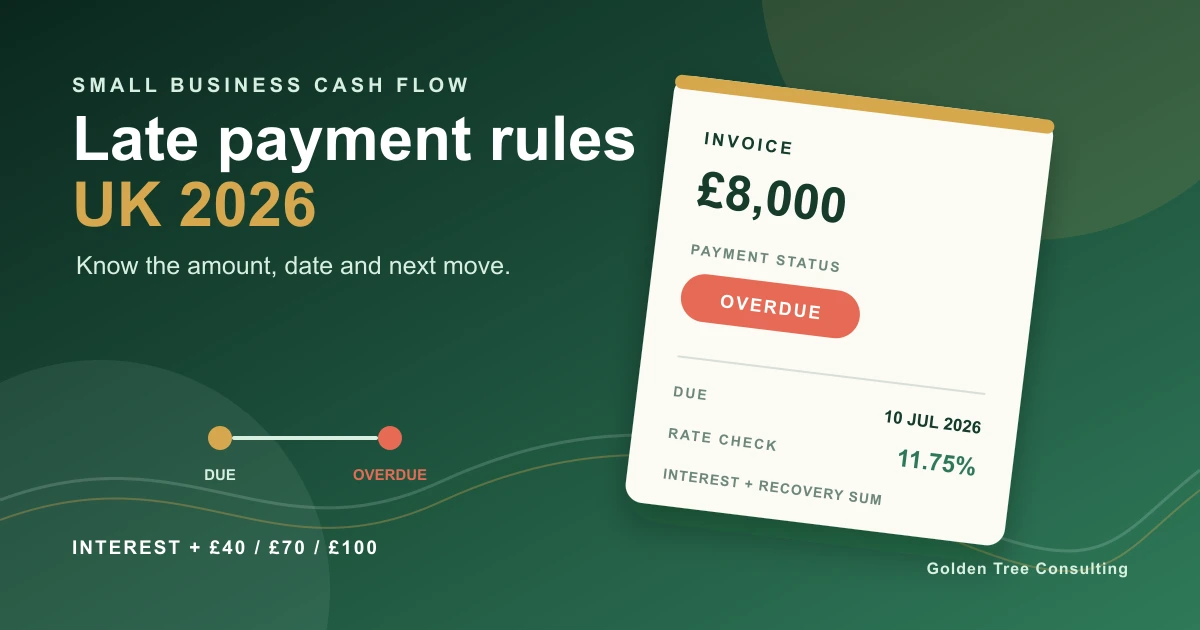
Late Payment Rules UK 2026: Interest, Compensation and the New Bill
Late payment rules UK 2026 explained for small businesses: charge statutory interest, £40-£100 compensation, chase invoices and track the new Bill.
How to Claim VAT Back in the UK: Input Tax Guide for Small Businesses 2026
How to claim VAT back in the UK in 2026: check input tax, VAT invoices, pre-registration costs, blocked expenses and your VAT return.