13-Week Cash Flow Forecast UK: A Practical 2026 Guide for Small Businesses
13-week cash flow forecast UK small businesses can use, with tax dates, payment timing, worked figures and a weekly review routine.
A business can be profitable on paper and still struggle to pay a supplier next week. The problem is often timing. A customer may owe you £7,200, but the money is not in your bank account when wages, rent and VAT need paying.
A 13-week cash flow forecast UK small businesses can use is a simple way to see that pressure early. It lays out the money you expect to receive and pay each week, then shows the bank balance left at the end of each week. You can spot the lowest point, test a late customer payment and decide what to do while there are still choices.
Quick answer: start with cleared cash, add receipts only when you have a sensible payment date, list every committed payment, include tax and payroll, then roll the forecast forward every week. The useful question is not only “will the business make a profit?” It is “will there be enough cash on the day each bill is due?”
Our bookkeeping service can help you reconcile the starting figures and build a weekly process. If you need a wider view of margins, costs and decision-making, our annual accounts service can sit alongside the forecast. A forecast is a management tool, not a substitute for proper accounts.
13-week cash flow forecast UK: what it shows
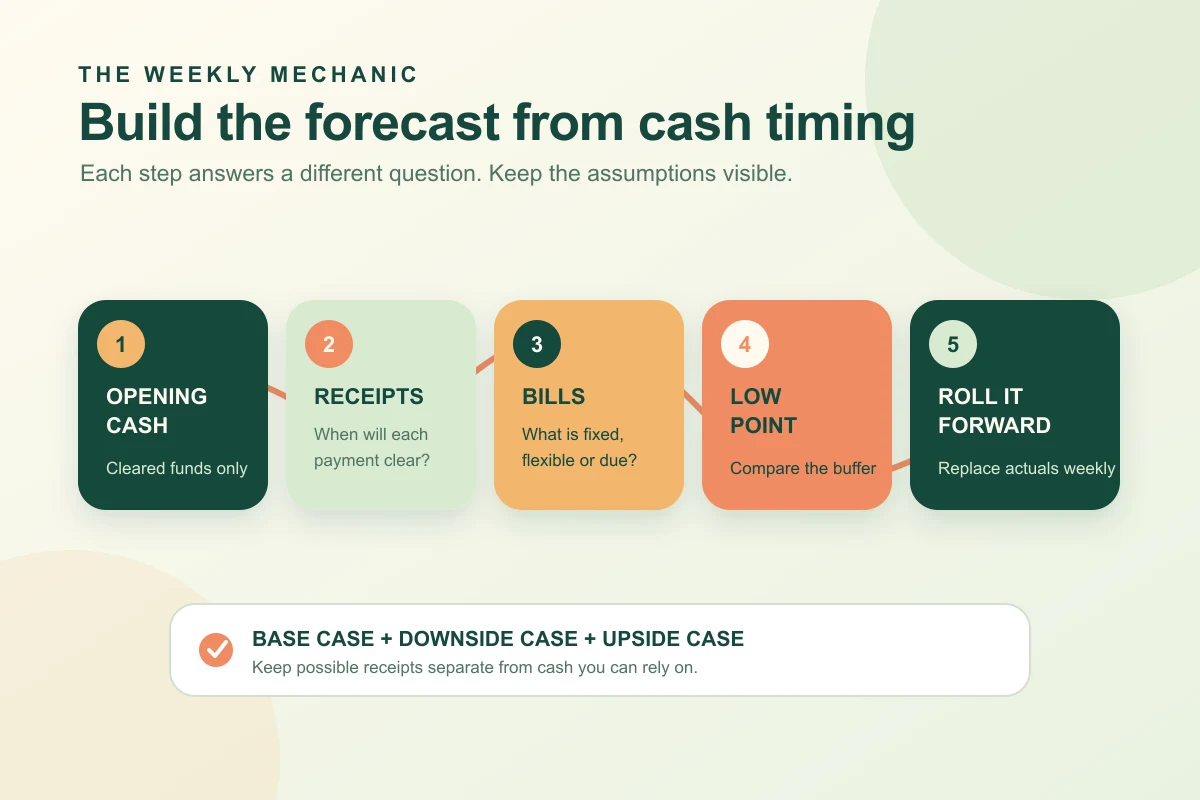
A cash flow forecast is a forward-looking list of expected bank movements. It starts with the cash you have now, adds the money likely to arrive, subtracts the money likely to leave and carries the closing balance into the next week.
The forecast is not an HMRC form. Thirteen weeks is a useful management horizon because it covers one quarter. It is long enough to show a large supplier invoice, payroll cycle, VAT payment or loan instalment, while the near-term customer receipts can still be checked against real conversations and invoices.
| Forecast line | What to record | Question to ask |
|---|---|---|
| Opening cash | Cleared money in the business bank account at the start of the week | Is this money actually available, or is it pending? |
| Cash in | Customer receipts, grants, loans, director funds or other confirmed income | When will the money clear, and how confident are we? |
| Cash out | Suppliers, wages, tax, rent, finance, software and other payments | Is the payment committed, or is the date still flexible? |
| Net movement | Cash in minus cash out for that week | Is the business adding or using cash? |
| Closing cash | Opening cash plus net movement | Does the balance stay above the minimum buffer? |
The forecast should show timing rather than just monthly totals. A £12,000 sales figure spread evenly across a month looks calmer than three customer payments that all arrive on the last day. Your bank balance experiences the second version, so your forecast should too.
Cash flow is not the same as profit
Profit and cash answer different questions. Profit asks whether income is greater than costs for an accounting period. Cash flow asks whether money has arrived or left the bank yet.
An invoice can increase reported sales before a customer pays it. A supplier bill can be recorded as a cost before the direct debit leaves the account. Equipment may be paid for now but spread through the accounts over time. Loan repayments include cash leaving the bank even though the capital repayment is not usually a profit-and-loss expense.
Worked example: the profitable invoice that does not pay Friday’s wages
North Street Design sends a client an invoice for £6,000 plus £1,200 VAT, so the amount due is £7,200. The work is complete and the invoice is included in the business records. The client has 30-day terms and is expected to pay on 5 October.
The invoice may support September income in the accounts, depending on the accounting method and circumstances. It is not September cash. If the business starts the week with £8,000 and has £6,500 of wages, rent and supplier payments due before 5 October, the cash position is:
| Item | Amount |
|---|---|
| Cleared opening cash | £8,000 |
| Customer invoice not yet paid | Not available cash |
| Payments due before receipt | -£6,500 |
| Expected cash before the receipt clears | £1,500 |
The forecast should show the £7,200 in the week it is expected to clear, not the day the invoice was raised. If the client says payment may be two weeks late, move the receipt. That one change can reveal an overdraft need or a supplier conversation early enough to do something useful.
What to put into the 13-week forecast
Use a separate row for anything that could change the decision. Combining all payments into “expenses” hides the reason a balance falls. A director should be able to see whether the pressure comes from wages, a quarterly VAT payment, an overdue customer or a planned purchase.
Start with cleared cash
Reconcile the bank before you begin. Include cleared business bank accounts, petty cash if it is genuinely available and any reserve account you intend to use. Keep an undrawn overdraft or credit card facility in a separate note. It is a possible funding option, not cash already in the business.
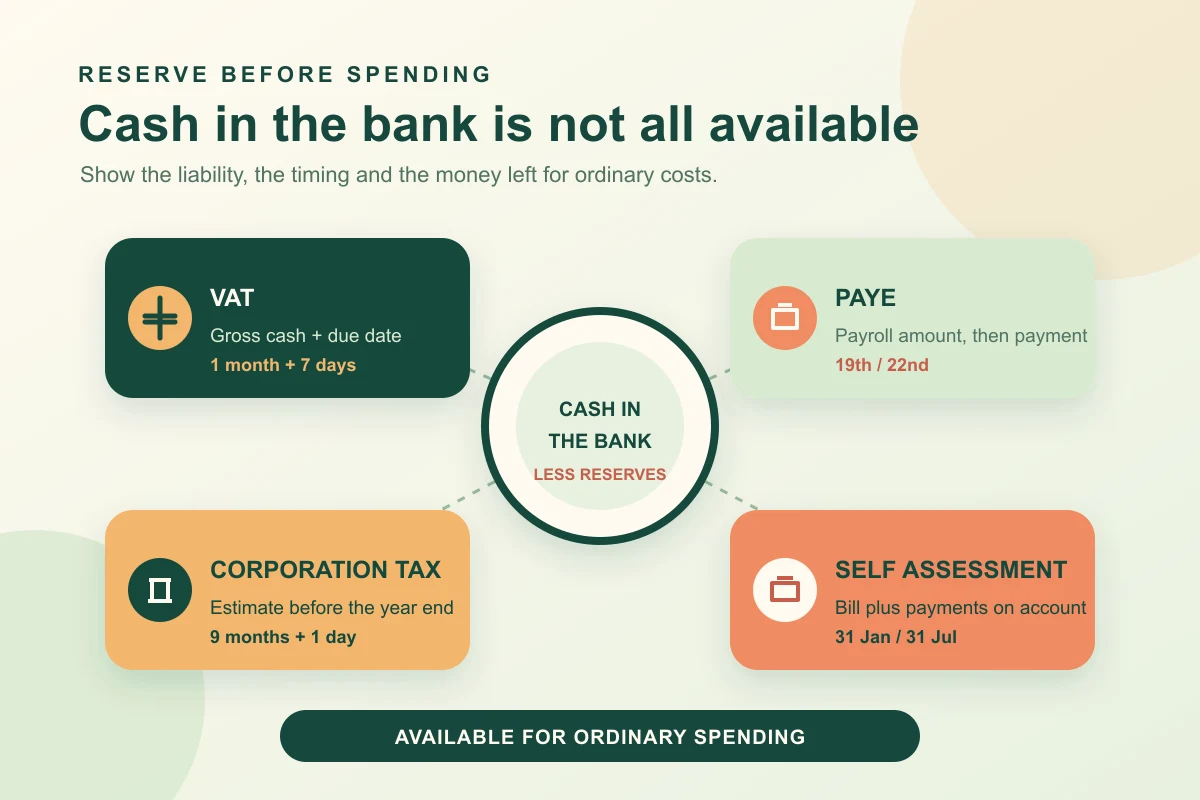
If the business has money held for VAT, payroll or tax, show it as a separate reserve even if it sits in the same bank account. A bank balance of £25,000 can contain £6,000 that belongs to HMRC and £4,000 needed for next month’s wages. The forecast should make that visible.
Add customer receipts by expected date
Start with the sales ledger and divide expected receipts into confidence groups:
| Confidence | Include it how? | Example |
|---|---|---|
| Committed | Put it in the expected clearing week | An issued invoice with a confirmed payment date |
| Likely | Include it, but mark the assumption | A regular customer normally pays within 14 days |
| Possible | Keep it in a separate upside case | A proposal that has not been signed |
Do not treat a sales pipeline as cash. A proposal, verbal promise or expected contract can be useful in an upside scenario, but it should not be allowed to hide a shortfall in the base forecast.
If customers pay by card, check the settlement delay and fees. If an online marketplace pays twice a month, use the actual payout dates. If a customer pays deposits and balances at different stages, split them into separate receipts. The forecast becomes more useful as its timing reflects the way the business really gets paid.
List every committed cash payment
Review the bank feed, supplier ledger, payroll calendar, loan statements and upcoming bills. Common lines include:
- wages, pension contributions and payroll taxes
- suppliers and subcontractors, including CIS deductions where relevant
- rent, rates, utilities, insurance and recurring software
- VAT payments or repayments
- Corporation Tax and other company liabilities
- Self Assessment payments and payments on account for a sole trader or director
- loan capital, interest, hire purchase and lease payments
- planned equipment, stock purchases, marketing or recruitment
- drawings, dividends or money taken by the owner, where appropriate
Put the amount in the week the money is expected to leave. If a bill is due on a Friday but the bank normally takes two days to clear a payment, use the date that matters for the cash account and allow for the payment method.
Put UK tax and payroll dates into the forecast
Tax is where many small forecasts look healthy until an amount suddenly disappears. Business.gov.uk guidance on business taxes specifically recommends including tax planning in budgeting and cash flow forecasting.
Use your actual HMRC account and VAT return dates. The HMRC deadline checker, published in August 2026, can create a calendar based on the taxes and payment methods that apply to you.
| Liability | Timing to allow for | Forecast note |
|---|---|---|
| Employer PAYE and National Insurance | Usually the 22nd of the next tax month for electronic payment, or the 19th for a non-electronic payment | Use the amount shown after payroll and any EPS adjustment |
| VAT | Usually one calendar month and seven days after the accounting period ends | Confirm the actual due date in the VAT online account; the payment must reach HMRC by the deadline |
| Corporation Tax | Usually 9 months and 1 day after the accounting period ends for companies within the ordinary payment rules | Forecast the tax estimate well before the formal due date |
| Self Assessment | 31 January for the balancing payment and first payment on account, with 31 July for the second payment on account where they apply | A payment on account is usually half of the previous year’s bill, not a new expense appearing from nowhere |
| PAYE Settlement Agreement | 22 October after the tax year, or 19 October for a non-electronic payment | Add it only if the business has a PSA liability for employee benefits or expenses |
For a VAT-registered business, cash in is normally the gross customer receipt. At the standard 20% VAT rate, a £1,000 net sale produces a £1,200 customer receipt. That extra £200 is not automatically available for stock, wages or drawings. The VAT due will be reduced by eligible input VAT and may differ under the business’s scheme, but the reserve should be visible until the return is calculated.
The same thinking applies to payroll. Wages may leave the bank on one date, while PAYE, National Insurance and pension contributions leave on another. Keep them on separate rows so a director can see the total employment cost rather than only the net wages.
Worked example: a 13-week rolling forecast
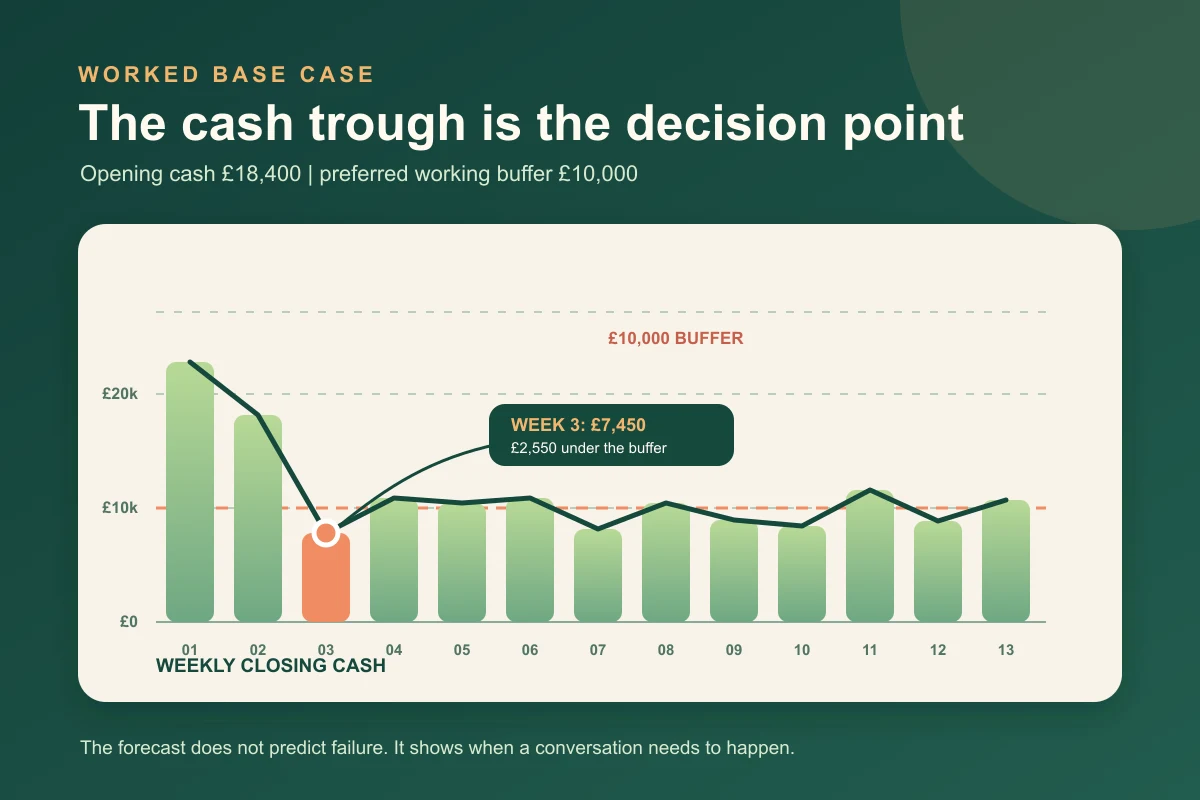
Oak & Field Repairs starts its forecast with £18,400 of cleared cash. The owner wants to keep a minimum working buffer of £10,000. A large supplier payment of £7,500 is due in week 3, and two customers have confirmed payments for weeks 1 and 4.
Here is a simplified base forecast. The figures are illustrative, but the format is the important part.
| Week | Expected cash in | Committed cash out | Closing cash |
|---|---|---|---|
| Opening | £18,400 | ||
| 1 | £7,000 | £4,200 | £21,200 |
| 2 | £2,300 | £6,100 | £17,400 |
| 3 | £1,200 | £11,150 | £7,450 |
| 4 | £6,800 | £3,900 | £10,350 |
| 5 | £3,500 | £4,000 | £9,850 |
| 6 | £5,200 | £4,800 | £10,250 |
| 7 | £2,000 | £4,500 | £7,750 |
| 8 | £6,500 | £4,400 | £9,850 |
| 9 | £4,100 | £5,200 | £8,750 |
| 10 | £3,800 | £4,200 | £8,350 |
| 11 | £6,900 | £4,500 | £10,750 |
| 12 | £2,600 | £4,700 | £8,650 |
| 13 | £5,400 | £3,900 | £10,150 |
The week 3 closing balance is £7,450, which is £2,550 below the owner’s preferred £10,000 buffer. The business is not necessarily insolvent, and the forecast is not a prediction of failure. It is an early signal.
The owner can now test practical responses:
- bring a confirmed customer payment forward by seven days
- ask whether the supplier will accept two agreed instalments
- delay a non-essential equipment purchase after checking the effect on trading
- stop treating the full bank balance as available for drawings
- arrange suitable short-term finance before the cash is needed, if the business can afford it
The owner should not quietly add an unconfirmed sale to the base case just to push week 3 above £10,000. Put that sale into an upside case and label it. Honest assumptions make a forecast useful.
Build base, downside and upside cases
A single forecast can create false certainty. Three short cases are usually more useful than one precise-looking number.
Base case
Use confirmed receipts and normal payment behaviour. Include all known commitments. This is the version you use for ordinary weekly decisions.
Downside case
Move one or two material customer receipts later, reduce uncertain sales and include a likely repair, refund or cost increase. You do not need to invent disaster. The question is what happens if a normal risk turns up.
Upside case
Include possible work, an early customer payment or a cost that could be avoided. Keep it separate from the base case so optimism does not pay an invoice before it arrives.
Worked example: a late receipt changes the decision
In the Oak & Field forecast, the week 4 receipt of £6,800 is confirmed for Monday. In the downside case, move it to week 6. The week 4 closing cash falls from £10,350 to £3,550, before considering any other change. That is a much clearer decision point than a year-end profit forecast saying the business is expected to be profitable.
The owner may decide to request a deposit on future work, shorten payment terms for new jobs or speak to the supplier in week 2. The right choice depends on the business, but the forecast has made the timing visible.
Keep a tax reserve outside ordinary spending
A cash forecast is not a tax calculation. It should still reserve money for tax as soon as it becomes identifiable.
For a sole trader, keep a separate estimate for the Self Assessment bill and any payments on account. A first January bill can contain the tax for the year just ended plus a further payment towards the next year. HMRC’s Self Assessment payment-on-account guidance explains when payments on account apply and why the January amount can be larger than a new taxpayer expects.
For a limited company, show Corporation Tax as a future cash payment even if the exact accounts are not final. The GOV.UK Corporation Tax payment guide confirms the usual 9-month-and-1-day payment rule for companies with taxable profits up to £1.5 million. For accounting periods beginning on or after 1 April 2023, that £1.5 million limit is divided by the number of associated companies plus one. Companies that fall into the large-company instalment regime may have earlier payment dates, so check the payment category before relying on the usual date. The accounting estimate and the cash date are linked, but they are not the same line.
Do not use the forecast to decide that a dividend is affordable just because the bank balance is positive. Check distributable profits, the director’s loan position, VAT, payroll and tax reserves first. Our limited company annual accounts checklist covers the records that support that wider review.
A weekly review routine that takes less time
The forecast is most useful when it becomes a short weekly meeting with the numbers. It does not need to become a second accounting system.
Choose one day each week and follow the same routine:
- Reconcile the bank and replace last week’s forecast with actual cleared movements.
- Check overdue invoices and ask customers for a realistic payment date.
- Review new supplier bills, payroll changes, direct debits and one-off spending.
- Confirm VAT, PAYE, Corporation Tax, Self Assessment and loan dates inside the next 13 weeks.
- Compare the base case with the downside case and note the lowest closing balance.
- Decide one action for any week below the minimum buffer.
- Add a new week at the end of the schedule and write down any changed assumptions.
Use notes beside material estimates. “Client says 5 October” is better than “October receipt”. “VAT due 7 November for period ending 30 September” is better than “VAT soon”. The note preserves the reason for the number when the forecast is reviewed later.
If the business uses accounting software, connect the bank feed but do not assume the feed knows what every payment means. Bank feeds show movements after they happen. The forecast needs decisions about movements before they happen. A monthly bookkeeping review can help keep those two views aligned.
Common cash-flow forecasting mistakes
Counting invoices instead of receipts
An invoice is evidence of money due, not proof of money received. Use payment history, agreed terms and recent customer contact to set the date. Put uncertain receipts into a downside or upside case.
Leaving VAT and payroll until the end
Tax and payroll can be large, predictable payments. If you leave them out because the final figure is not known, the forecast will look better than the bank account feels. Add a sensible estimate and replace it when the return or payroll is ready.
Treating the owner’s bank balance as spare cash
Money may be needed for tax, suppliers, wages, loan covenants or a customer refund. A positive balance is not the same as distributable profit or a safe dividend.
Making the forecast too detailed to maintain
You do not need a row for every low-value stationery receipt. Group small predictable items, but split out anything large, uncertain or close to a decision threshold. A forecast that takes hours to update will be ignored.
Updating only when cash is tight
By the time a shortfall is visible in the bank, the easiest options may have gone. A weekly routine turns the forecast into an early warning, not an emergency document.
When to ask for help
A basic forecast is often something a small business owner can start with a spreadsheet and a bank statement. Ask for help when customer receipts are irregular, VAT and payroll overlap, the business has several finance agreements, the owner takes drawings, or the forecast changes materially every week.
An adviser can help separate cash from profit, check that tax dates are present, reconcile the opening figure and test assumptions against the accounts. We can also help build a monthly bookkeeping routine that gives the forecast better information without asking you to become a full-time bookkeeper.
If your forecast shows a shortfall, contact us before a payment is missed. Share the next 13 weeks, the lowest balance, the bills behind it and the receipts you are relying on through our contact page. That gives the conversation something concrete to work with.
FAQ: 13-week cash flow forecast UK
What is a 13-week cash flow forecast?
A 13-week cash flow forecast is a rolling weekly schedule of the money expected to enter and leave a business over the next 13 weeks. It shows the expected closing bank balance, the lowest point in the period and when action may be needed.
Why use 13 weeks for a cash flow forecast?
Thirteen weeks is one quarter, which gives a small business enough time to see upcoming tax, payroll, supplier and customer-payment pressure without asking it to predict every detail of the year. It is a management convention, not an HMRC filing format.
What should a small business include in a cash flow forecast?
Include cleared opening cash, realistic customer receipts, other confirmed cash in, wages, PAYE, VAT, Corporation Tax, suppliers, rent, loan payments and other cash out. Put each item in the week you expect the money to move.
Is a cash flow forecast the same as a profit and loss account?
No. A cash flow forecast tracks timing of money in the bank, while a profit and loss account tracks income and costs for an accounting period. An unpaid invoice may count as income in the accounts but does not become cash until the customer pays.
Should VAT be included in a cash flow forecast?
Yes. If you are VAT registered, forecast the full amount paid by customers and the full amount paid to suppliers, then include the VAT payment or repayment on its expected date. Keep an estimate of output VAT separate from money available for ordinary spending.
How often should I update a 13-week cash flow forecast?
Update it at least weekly. Replace forecast amounts with actual cleared receipts and payments, move or remove items that changed, add new commitments and extend the schedule by one more week. A forecast that is never refreshed quickly loses its value.
Can an accountant help with a cash flow forecast?
Yes. An accountant or bookkeeper can help reconcile the starting cash, identify tax and payroll dates, test customer-payment assumptions and compare the forecast with the accounts. You still need to provide current information about expected receipts and spending.
The practical next step is small: open the bank statement, list the next 13 weeks and mark the first week where the closing balance falls below the amount you need to operate. If that week is closer than expected, speak to Golden Tree Consulting with the numbers in front of you.

About Golden Tree Consulting
ACCA Affiliated | MBA Qualified
Golden Tree Accounting & Business Consulting provides expert tax, bookkeeping, and advisory services to sole traders and SMEs across Croydon, London, Surrey, and Kent. With multilingual support and decades of combined experience, we help businesses stay compliant and grow.
More Articles You Might Like
Continue exploring our financial insights
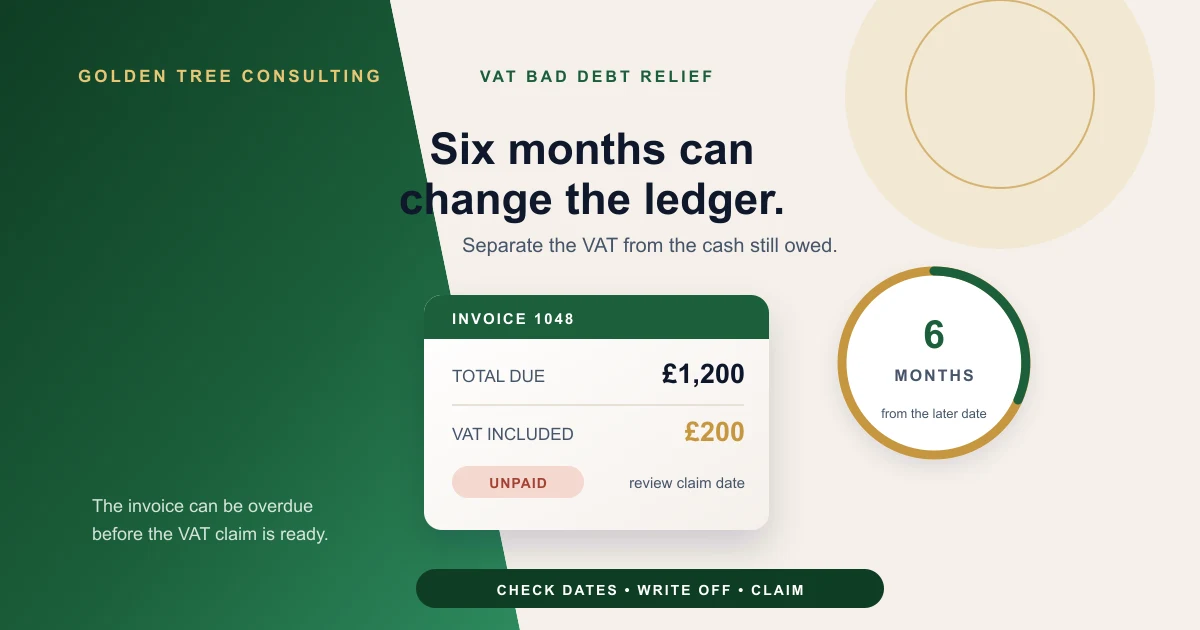
VAT Bad Debt Relief UK 2026: How to Reclaim VAT on Unpaid Invoices
VAT bad debt relief UK 2026 explained: check the six-month rule, calculate the VAT on unpaid invoices, claim it on your return and keep the right records.
VAT Cash Accounting Scheme UK: 2026 Guide for Small Businesses
VAT Cash Accounting Scheme UK rules for 2026, with thresholds, cash-flow examples, eligibility checks, and record-keeping tips.
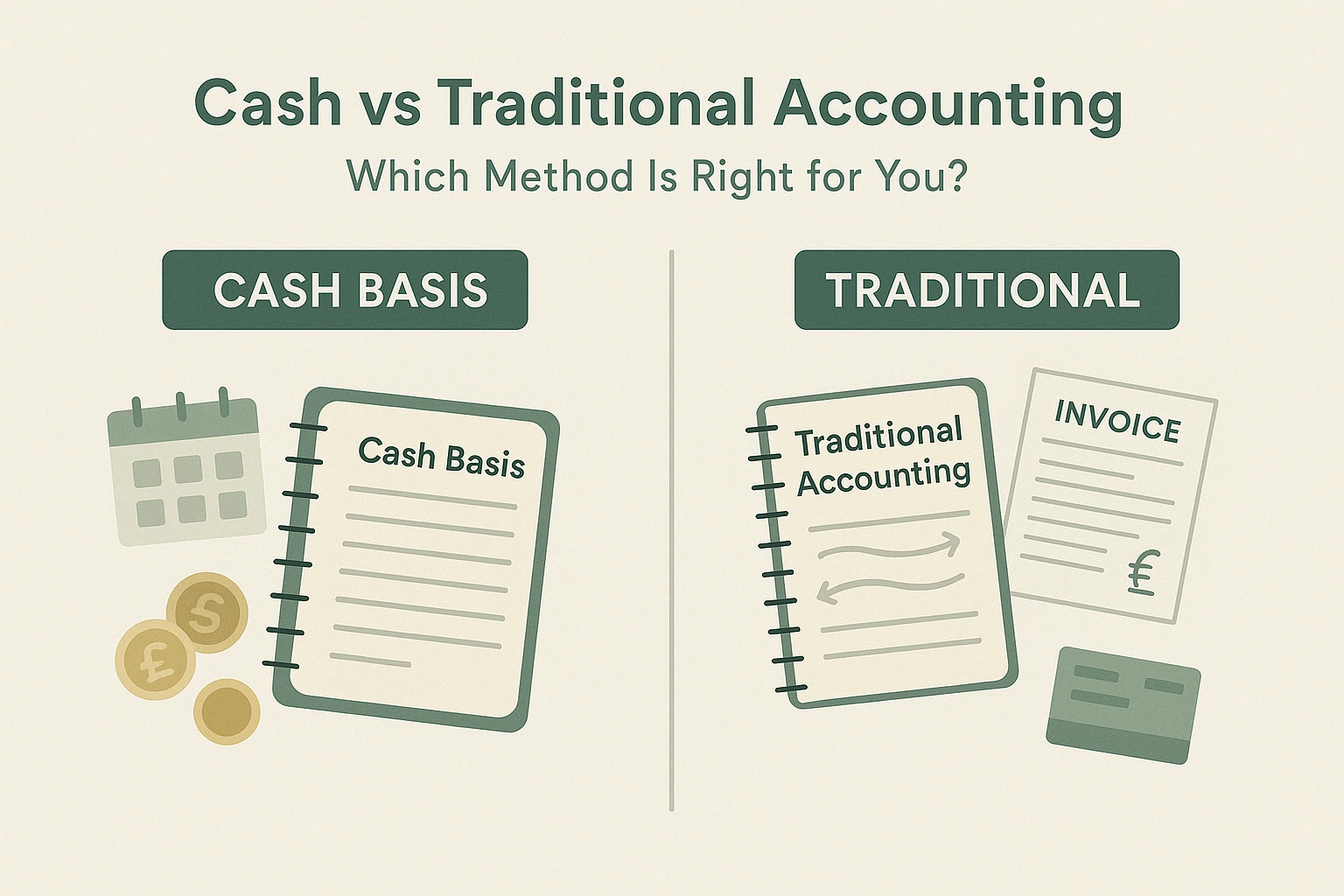
Cash Basis vs Traditional Accounting: Which Is Right for Your Business?
Understand the difference between cash basis and traditional accounting. Learn which method is best for your business structure, especially if you’re a sole trader or in a partnership.