Christmas Temporary Staff Payroll UK: The 2026 Employer Guide
Christmas temporary staff payroll UK guide for employers: 2026 minimum pay, PAYE, holiday pay, pension duties and a final-pay checklist.
 Golden Tree Accounting 12 October 2026 16 min read
On this page Show
- Christmas temporary staff payroll UK: your pre-shift checklist
- Check whether PAYE registration applies before the first payday
- Pay the correct 2026 minimum wage for every hour
- Calculate Christmas temps’ holiday pay from their work pattern
- Assess pension duties for each seasonal worker
- Close the contract cleanly when the Christmas job ends
- Christmas temporary staff payroll FAQs
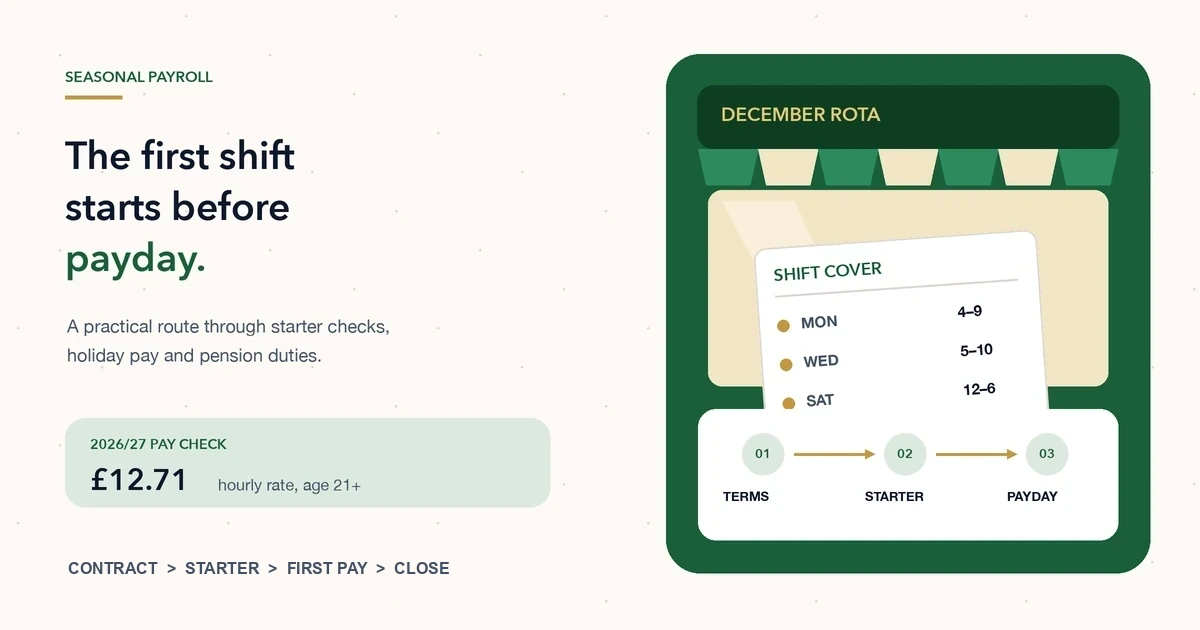
For Christmas temporary staff payroll in the UK, the busy part starts before the first shift. You need to know who employs each worker, what their hours and holiday terms say, and when their first wages will be paid. Leave those checks until December and you can end up fixing starter details while trying to get a shop, restaurant or delivery team through its busiest week.
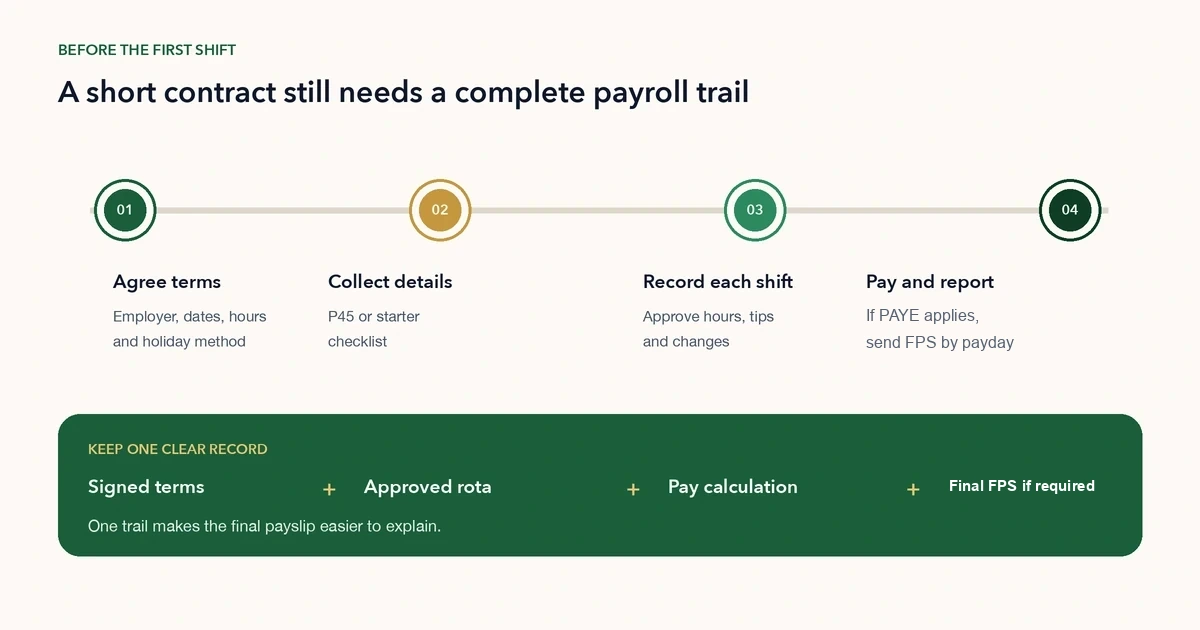
The rules are manageable when you give each new starter a short payroll route: confirm the contract, collect the right information, report pay on time, calculate holiday using the correct method, and assess pension duties. A short job can still create employment-rights and PAYE duties, but the PAYE registration and reporting rules depend on the worker and their pay. Check the criteria before deciding how to run the first payday.
At a glance: from 1 April 2026 the National Living Wage for workers aged 21 and over is £12.71 an hour. If you operate PAYE, send the Full Payment Submission (FPS) on or before payday. Temporary workers accrue paid holiday. In England, Scotland and Wales, only qualifying irregular-hours and part-year workers can use the 12.07% accrual method and rolled-up holiday pay. Assess pension duties individually, and consider postponement only where it fits the rules.
Christmas temporary staff payroll UK: your pre-shift checklist
Before confirming a start date, put these six items on one checklist:
| Check | What to pin down |
|---|---|
| Employer | Is the worker employed directly by you or supplied by an agency? |
| Contract | What are the start and end dates, hours, pay rate and holiday terms? |
| Starter information | Do you have a P45 or a completed HMRC starter checklist? |
| Payday | What is the normal payday, and if PAYE applies, when must the first FPS be sent? |
| Holiday | Are the hours fixed, or does the contract meet the irregular-hours or part-year test? |
| Pension | Who will assess the worker, and will you use postponement for anyone? |
The order matters. The payroll method follows the employment relationship and contract. For example, a business hiring a temp directly usually has the employer duties. When a recruitment agency supplies a worker, check the agreement to establish who is responsible for paying them and operating PAYE. Do not assume the agency handles every obligation simply because it found the person. Clarify who records hours, approves overtime, calculates holiday and answers a pay query.
Ask the agency for the worker’s written terms and a clear responsibility split. Your business may still need to provide accurate hours and flag changes promptly. Keep the agreement and the rota together, so an invoice from an agency is not your only record of who worked each shift.
Check whether PAYE registration applies before the first payday
Taking on one Christmas worker does not always mean you must register as an employer for PAYE. HMRC says you must register if an employee is paid £96 or more a week in the 2026/27 tax year, or if another condition applies, such as receiving expenses or benefits, having another job, receiving a pension, or getting certain state benefits. Read HMRC’s PAYE registration rules for employers before the first payday. If none of its conditions applies, you may not need to register, but you should still keep accurate records of the worker, hours and pay.
If PAYE registration is required, set it up before the first payday. If an agency employs and pays the worker, confirm who is responsible under the agreement rather than registering or reporting twice.
If you operate PAYE and employ someone directly, ask for their P45. If they do not have one, use HMRC’s starter checklist for PAYE to collect the information payroll needs. The old P46 was replaced by this checklist. A new starter’s tax code and previous pay details matter, especially if they also have another job over the Christmas period.
If you operate PAYE, report a new employee through payroll the first time you pay them. Send an FPS on or before payday. If your business pays early because the regular payday falls on a bank holiday, use the usual payday in the FPS rather than reporting earlier than necessary. HMRC’s payroll reporting guidance explains the timing and employee details to include.
If the worker is within your PAYE scheme, include them in the required FPS reporting even if no income tax or National Insurance is due. Payroll software should calculate deductions from the starter details, pay period, tax code and National Insurance category. It does not decide whether the contract is right or whether recorded hours are complete. Check the information before approving the run.
Keep the rota and timesheet signed off by someone who knows what happened on shift. A seasonal worker may swap shifts, stay late for a delivery or cover a bank holiday. Put approved changes into the payroll record before the pay run closes. Ask a new starter to tell you promptly if they have another job or a student loan, and use the correct details in the starter process rather than guessing.
Our first payroll checklist for UK employers covers PAYE registration, payslips and monthly deadlines. For a Christmas hire, the same basic sequence applies even if the worker stays for only a few weeks.
Pay the correct 2026 minimum wage for every hour
The National Minimum Wage depends on the worker’s age and, for apprentices, whether the apprentice rate applies. From 1 April 2026, the UK hourly rates are:
| Worker | Minimum hourly rate from 1 April 2026 |
|---|---|
| Age 21 and over | £12.71 |
| Age 18 to 20 | £10.85 |
| Under 18 and above school leaving age | £8.00 |
| Eligible apprentice rate | £8.00 |
The apprentice rate applies to apprentices under 19, or those aged 19 and over who are in the first year of their apprenticeship. An apprentice aged 19 or over who has finished the first year is entitled to the rate for their age. Use the worker’s age and apprenticeship status, not the job title, to choose the rate. GOV.UK sets out the minimum wage rates for 2026.
Count every hour that qualifies as working time. A closing shift that runs past the rota, required training, and time spent completing work duties can affect the calculation. Check for unpaid time between clock-in and clock-out before you sign off a timesheet. A “Christmas temp” label does not create a lower minimum wage.
Worked example: a 20-hour week for a worker aged 21 or over
Assume a directly employed 22-year-old works 20 paid hours at the 2026/27 National Living Wage:
- 20 hours × £12.71 = £254.20 gross basic pay
- Employer National Insurance at 15% on weekly pay above the £96 secondary threshold: (£254.20 − £96) × 15% = £23.73. Check HMRC’s current employer National Insurance rates and thresholds.
- Approximate wage plus employer National Insurance cost: £277.93
This example assumes category A National Insurance, no Employment Allowance reduction and no other employer relief. It excludes pension contributions, holiday pay, payroll fees and any overtime. If the worker is younger, use the correct age rate first, then check the relevant National Insurance category and threshold.
Calculate Christmas temps’ holiday pay from their work pattern
Temporary and agency workers are entitled to paid statutory holiday. A short contract does not remove that right. You need to work out the correct entitlement for the hours and contract, let the worker take leave where the job allows, and pay any accrued holiday they have not taken when their employment ends. The 12.07% accrual method and rolled-up holiday pay described below apply in England, Scotland and Wales. Northern Ireland has separate rules and does not permit rolled-up holiday pay; see nidirect’s holiday guidance.
The first question is whether the contract qualifies as an irregular-hours or part-year contract. Irregular-hours workers have paid hours that are wholly or mostly variable under their contract in each pay period. A part-year worker is contracted to work only part of the leave year and has a period of at least one week during the term of that contract when they are not required to work and are not paid for that period. The gap must fall within the continuing contract, not after it ends. A part-year worker can still have fixed shifts. A fixed-hours Christmas contract with no week-long unpaid gap during the contract does not qualify as part-year just because it is short. Read the written terms and how hours are actually set.
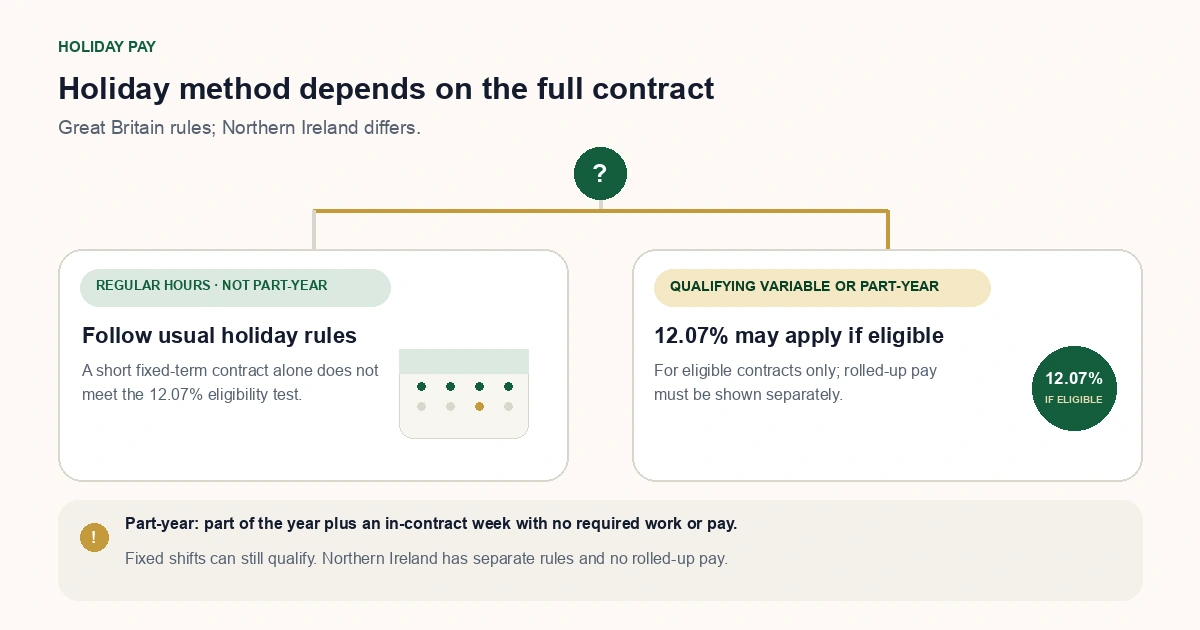
For leave years beginning on or after 1 April 2024, employers in England, Scotland and Wales can calculate holiday entitlement for qualifying irregular-hours and part-year workers as 12.07% of hours worked in each pay period. Rolled-up holiday pay is also permitted for those groups. It must be shown as a separate amount on the payslip and paid at the same time as the worker’s regular pay. The worker must still be able to take holiday. GOV.UK’s holiday entitlement and pay reforms guide explains who qualifies and how to calculate it.
Do not add 12.07% automatically to every temp’s hourly rate. A worker who does not meet the irregular-hours or part-year definition follows the usual statutory holiday rules for their contract and working pattern. Someone with fixed weekly shifts may still be a qualifying part-year worker if the contract covers only part of the leave year and includes an unpaid non-working period of at least a week during the contract. If the contract changes, document the change and review the holiday method from the correct point. Ask for advice if you are unsure which category applies; the contract wording and actual pattern both matter.
Worked example: holiday pay for an eligible irregular-hours worker
Suppose an eligible irregular-hours worker in Great Britain completes 20 hours at £12.71 an hour in a pay period, and you use rolled-up holiday pay:
- Basic pay: 20 × £12.71 = £254.20
- Holiday pay at 12.07%: £254.20 × 12.07% = £30.73
- Total gross pay before tax and other deductions: £284.93
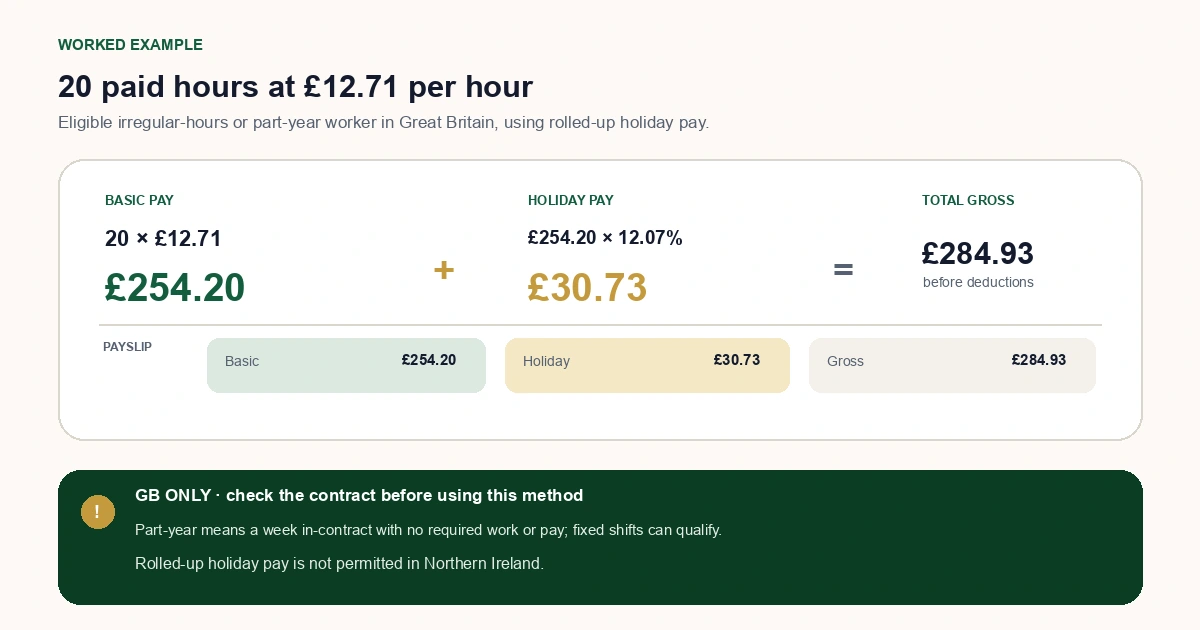
The £30.73 should appear as a distinct holiday-pay line. It is not a second minimum wage rate and it does not buy out the worker’s right to take holiday. The calculation is for an eligible worker in Great Britain. If your Christmas worker has regular hours throughout the year, do not copy this example onto their payslip. A part-year worker with fixed shifts may qualify, depending on the full contract.
If you do not use rolled-up holiday pay, track the leave earned and taken during the contract, and pay any unused statutory leave when the contract ends. A temp who works through December and finishes in January can still have holiday accrued at the leaving date. Put the final holiday amount into the final payroll run and explain it on the payslip.
In England, Scotland and Wales, from 6 April 2026, employers must keep detailed records of annual leave and holiday pay for at least six years. Store the calculation, hours, leave taken and payment evidence alongside the payroll records. GOV.UK explains the holiday pay and entitlement record-keeping rules. Northern Ireland has separate rules, so check the local requirements and keep clear records there too.
Assess pension duties for each seasonal worker
Automatic enrolment duties can apply to temporary staff. Assess each person on the relevant pay reference date using their age and qualifying earnings, even if you expect them to leave after Christmas. If they are not eligible at one assessment, keep checking at the first day of each later pay reference period until they leave or their status changes. For 2026/27, the earnings trigger is £10,000 a year, equivalent to £192 a week or £833 a month. The qualifying earnings band starts at £6,240 a year, or £120 a week. The Pensions Regulator publishes the current automatic enrolment earnings thresholds. A worker can have a right to opt in or join even if they do not meet the automatic enrolment trigger, so avoid reducing the check to one salary figure.
The Pensions Regulator says employers should assess seasonal and temporary staff individually. Where the rules allow, you can postpone automatic enrolment for up to three months. If you use postponement, give each affected worker a written notice no later than six weeks and one day from the postponement date, record the chosen deferral date, and assess the worker on that date. If they are not eligible then but remain employed, continue assessing them at the start of each later pay reference period. A postponement notice must also explain the worker’s right to opt in or join. Postponement delays automatic enrolment; it is not an exemption from pension duties. The Regulator’s seasonal and temporary staff guidance and postponement guide cover the employer’s responsibilities.
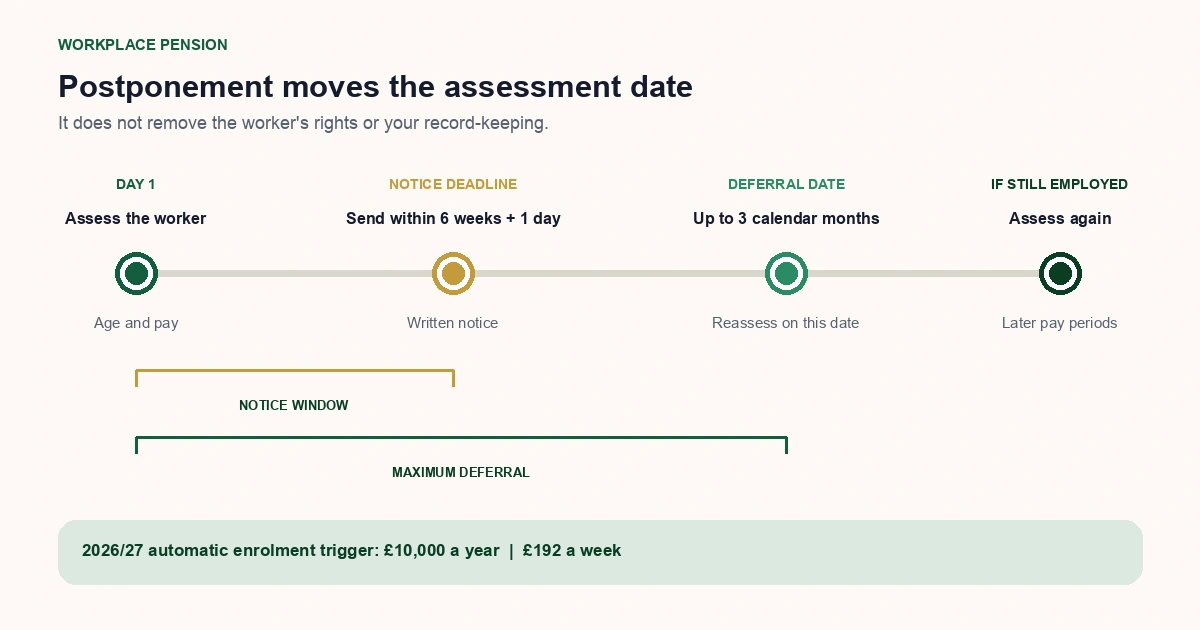
Worked example: a short contract that crosses the earnings trigger
Imagine a 25-year-old Christmas temp is paid £500 a week and will work for five weeks. The weekly pay is above the £192 automatic enrolment trigger, so the employer needs to assess the worker under the pension rules. The contract may end before three months, but that does not erase the assessment. If the employer chooses a valid postponement, the worker must receive the required notice and be assessed by the deferral date if they are still on the payroll.
By contrast, a 19-year-old earning £150 a week would not meet the automatic enrolment age and earnings criteria on those facts. They may still have the right to opt in, and their circumstances could change if their pay or age changes. Assess pay in the relevant pay reference period and follow your pension provider’s process rather than assuming every temp is either eligible or exempt.
Close the contract cleanly when the Christmas job ends
Leaver work is easy to miss when the shop has already taken down the seasonal display. Add the contract end date to the payroll system before the final run. Then check the last approved timesheet, overtime, holiday balance, tax and National Insurance deductions, pension treatment, and any expenses or agreed deductions. Pay the worker on the normal payday unless the contract says otherwise.
If the worker is included in your PAYE scheme, submit the final FPS with the leaving details and issue a P45. Give the worker a final payslip. If they have accrued holiday they have not taken, include the correct payment when the contract ends. If you used rolled-up holiday pay lawfully, check the separate amounts already paid and the leave record. Keep evidence that lets you explain the final figure if the worker asks about it later.
For the next busy period, save a copy of the starter checklist, rota approval, holiday calculation and final-pay review as one process. Our guide to running payroll for one employee has a useful monthly routine, and our payroll service can take care of the filings and checks if you would rather focus on staffing the season.
Christmas temporary staff payroll FAQs
Do I need to register for PAYE for someone who works one Christmas shift?
One shift alone does not decide whether PAYE registration is required. HMRC’s conditions include paying an employee £96 or more a week, as well as other circumstances such as another job, a pension, expenses or benefits. If none applies, you may not need to register, but you still need accurate employment and pay records and must meet minimum wage and holiday rights. If PAYE does apply, report the worker through an FPS. If an agency supplies them, check which organisation employs and pays them.
Do Christmas temps get bank holidays off or extra pay?
There is no automatic right to extra pay just because a shift falls on a bank holiday. The contract can provide enhanced rates or time off, and the employer must still meet statutory holiday rights. Check the written terms and rota before agreeing a rate.
Can I pay holiday pay only when the temp leaves?
You must make sure the worker receives their statutory holiday entitlement. In England, Scotland and Wales, rolled-up holiday pay can be paid with each wage for a qualifying irregular-hours or part-year worker, and it must be listed separately. It is not permitted in Northern Ireland. Otherwise, track leave taken and pay any unused accrued entitlement when employment ends. Do not use a final payment to disguise a missing holiday record.
How often should I assess a temporary worker for a pension?
Assess them at the relevant automatic enrolment point and follow the pension scheme’s payroll process. If you use postponement, set the deferral date and issue the required notice. If the person stays employed at that point, assess them again. Their age and earnings can change their category.
What if a Christmas temp has another job?
Ask the worker to complete the starter process accurately and use the information in their P45 or starter checklist. Their tax code may reflect another job or their previous pay. Do not select a tax code based on a guess or promise that their eventual tax bill will be a particular amount; HMRC reconciles an individual’s tax position using their wider income.
Christmas payroll works best when you have the contract, rota, starter details and first payday lined up before the first shift. Put the same end-date check in your diary now, so holiday pay, the final FPS and pension duties do not get lost when the seasonal job finishes.

About Golden Tree Consulting
ACCA Affiliated | MBA Qualified
Golden Tree Accounting & Business Consulting provides expert tax, bookkeeping, and advisory services to sole traders and SMEs across Croydon, London, Surrey, and Kent. With multilingual support and decades of combined experience, we help businesses stay compliant and grow.
Offices in Croydon and London Bridge.
Related guides

How to Run Payroll for One Employee UK: 2026/27 First Employer Guide
How to run payroll for one employee UK in 2026/27, with PAYE registration, FPS deadlines, employer NI, pensions, and costs.

How to Run Payroll for the First Time in the UK: New Employer Checklist for 2026
Learn how to run payroll for the first time in the UK, from HMRC registration and pensions to PAYE deadlines, costs, and first payday checks.

Tips Tax UK 2026: PAYE, National Insurance and Fair Distribution for Employers
Tips tax UK 2026 explained for employers, including PAYE, National Insurance, tronc schemes, payment deadlines, records and fair distribution.