CIS Monthly Return for Contractors: 2026 Deadlines and Nil Returns
CIS monthly return guide for UK contractors: the 19th deadline, 2026 nil return rules, deductions, payment dates, records and late-filing penalties.
 Golden Tree Accounting 5 October 2026 14 min read
 On this page Show
- Who needs to send a CIS monthly return?
- CIS monthly return deadline for October 2026
- What changed for nil returns from April 2026?
- Check the deduction before you submit
- What to gather before filing
- Submit, pay and correct the return
- Late filing penalties and a missed CIS return
- CIS monthly return questions contractors ask
The CIS monthly return for payments made from 6 September to 5 October 2026 is due by Monday 19 October. That is the date to report what you paid your subcontractors during the tax month. If you also owe HMRC CIS deductions, an electronic payment is usually due by Thursday 22 October. They are separate jobs, and mixing up the dates can leave a return late even when the money has been paid.
Quick answer: the CIS tax month runs from the 6th of one month to the 5th of the next. Your return must reach HMRC by the 19th after that period. From 6 April 2026, mainstream contractors with no subcontractor payments must file a nil return or notify HMRC that the scheme is inactive. A payment to a subcontractor can still need reporting when no deduction was taken.
This guide is for businesses acting as CIS contractors. It covers the monthly return, nil returns, deduction records and payments. If you are a subcontractor trying to claim CIS deductions through your own tax return, see our separate CIS tax return guide for subcontractors. Your position can differ if you work in both roles.
Who needs to send a CIS monthly return?
If your business pays subcontractors for construction work within the Construction Industry Scheme, you normally need to register as a contractor and report in-scope payments to HMRC each month. The term “contractor” has a wider meaning in CIS than it does on a building site. Construction firms, developers and some other organisations can fall within the scheme. A household paying for work on their own home is generally outside it.
Some businesses outside construction can become deemed contractors if their construction spend passes £3 million in a rolling 12-month period. The rules around what counts as construction spend and which contracts are covered are detailed, so a large property or facilities project is a good reason to check the current CIS340 guide from HMRC or speak to an accountant.
The return covers payments made in the previous tax month, including payments to subcontractors paid gross and those where you made a 20% or 30% deduction. HMRC expects a complete monthly record, not just a total of the deductions you withheld. The free HMRC CIS online service or recognised commercial CIS software can be used. Avoid filing the same month through both systems, since one return can overwrite another.
CIS monthly return deadline for October 2026
Each CIS tax month begins on the 6th and ends on the 5th. The return deadline is the 19th of the month in which that tax month ends. It is not the end of the calendar month, and it does not move to the 22nd when you pay electronically.
| Tax month covered | Return due | CIS deductions due by post | CIS deductions due electronically |
|---|---|---|---|
| 6 September to 5 October 2026 | 19 October 2026 | 19 October 2026 | 22 October 2026 |
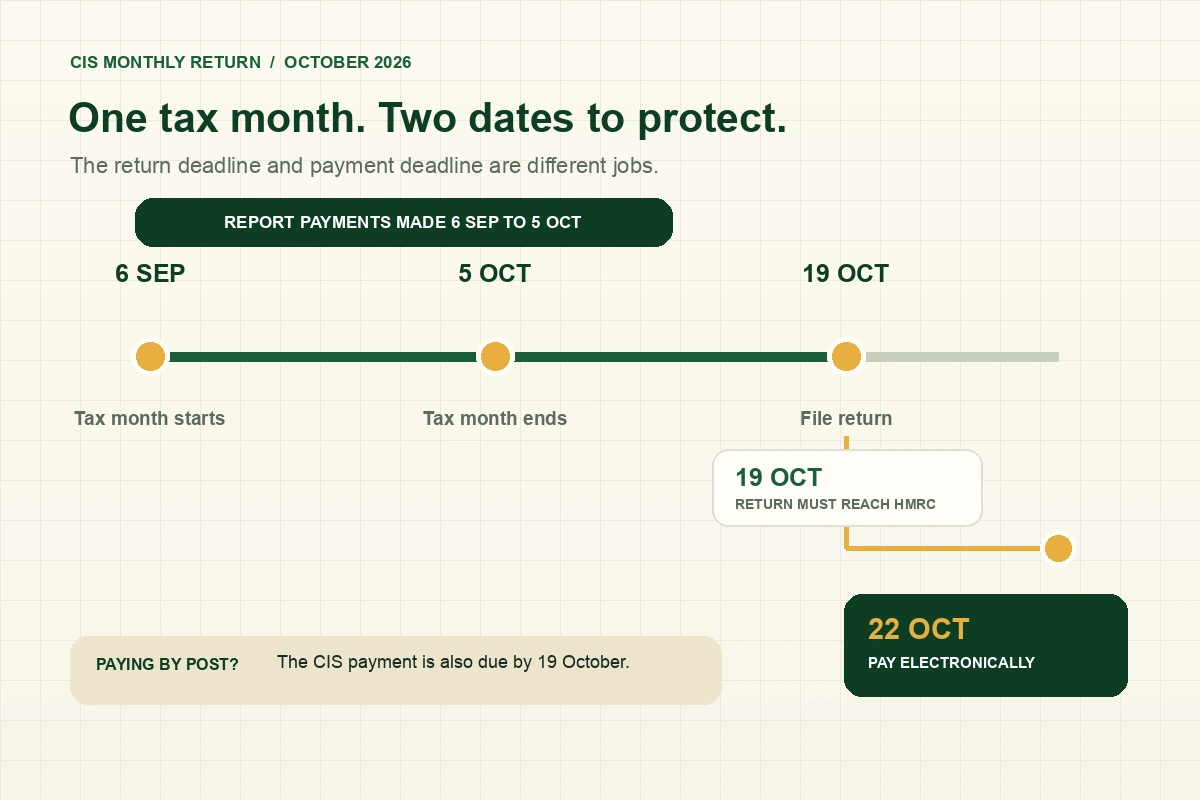
For the current period, record payments made between 6 September and 5 October. File the return by 19 October 2026. Any CIS deductions due can be paid electronically by 22 October 2026. HMRC may also allow quarterly payment if your average monthly payment to HMRC, including relevant PAYE and National Insurance amounts, is below £1,500. That option changes the payment schedule, not your monthly CIS return duty.
What changed for nil returns from April 2026?
From 6 April 2026, the nil return requirement returned for mainstream contractors. If you paid no subcontractors during the tax month, you must either send a return showing no payments or tell HMRC that you will be inactive for a period. Do this by the 19th. If you know you will not use subcontractors for a while, HMRC can mark the CIS scheme inactive for up to six months at a time.
An inactivity notice can save repeated nil returns while a project is paused. It is not a way to ignore a payment that later happens. If you pay a subcontractor during an inactive period, submit a return for that month. HMRC says this lifts the inactivity period automatically. If the pause continues, you can request another period of inactivity.
There is a distinction for deemed contractors. HMRC says they are not legally required to file a nil return when they made no payment, but if they do not tell HMRC about the no-payment period it will issue a penalty. If they confirm that no subcontractors were paid, HMRC says it will cancel that penalty. Since this is an awkward distinction to explain after a notice arrives, check which type of contractor your business is before deciding what to file.
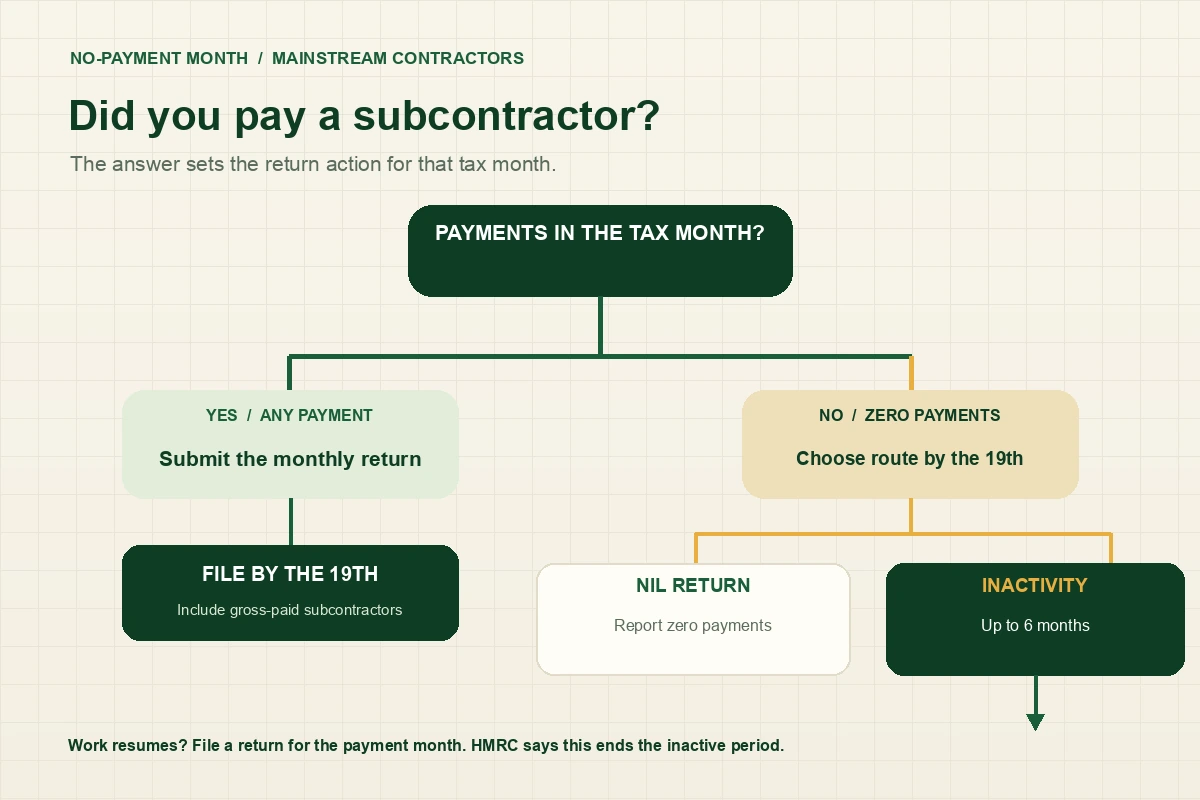
If you did pay a subcontractor, including one paid gross, do not treat the month as nil. Report the payment. If you are unsure whether a payment falls within CIS, check the contract and HMRC guidance before submitting. Incorrect status declarations can carry a penalty of up to £3,000.
Check the deduction before you submit
The return figures should agree with what you paid and the records you kept. A deduction is usually calculated on the payment amount after removing VAT charged by a VAT-registered subcontractor and the qualifying costs the subcontractor directly paid for materials or other permitted items used in the construction work. The rules about materials are specific: you cannot simply deduct an estimated materials allowance from the invoice.
The usual deduction rates are 20% for a subcontractor verified as registered for payment under deduction, 30% if HMRC cannot identify or verify them, and 0% if HMRC has authorised gross payment status. Verify new subcontractors before paying them where required. Keep evidence for direct costs, and make sure a claimed material amount is not overstated.
Worked example: a payment with materials
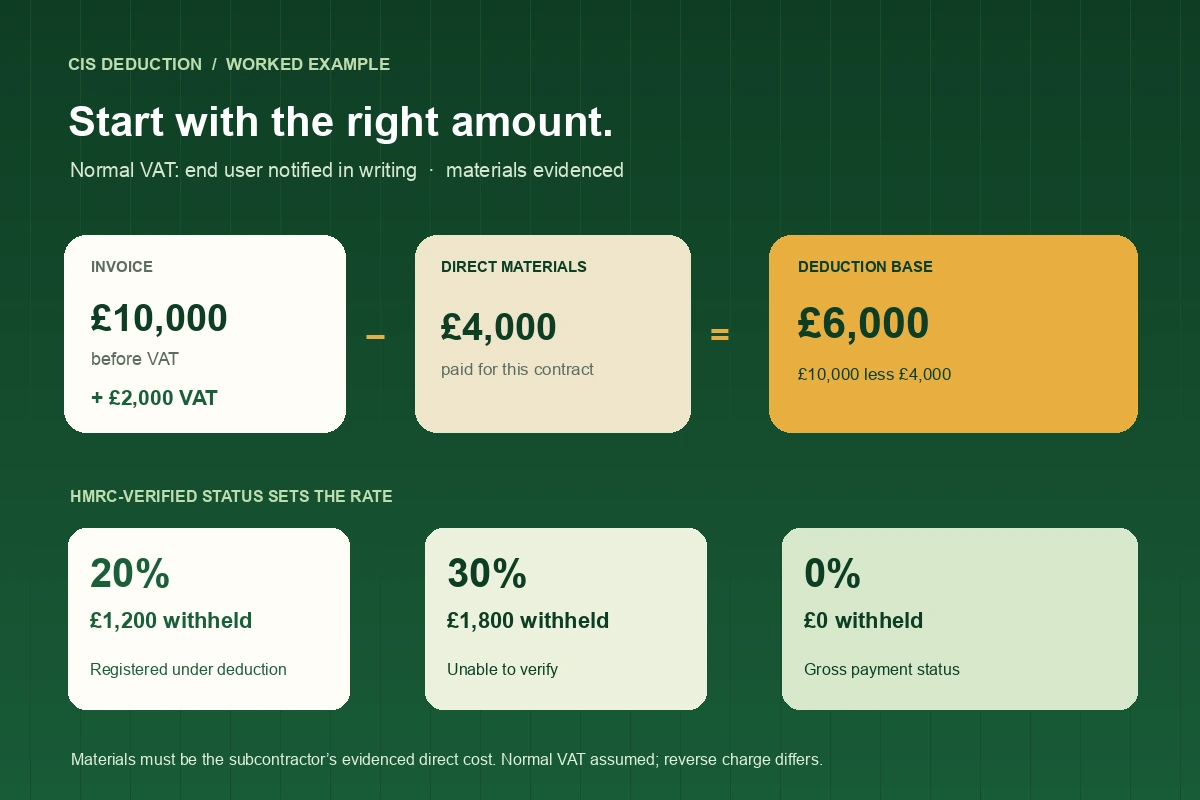
Suppose a VAT-registered subcontractor invoices £10,000 plus £2,000 VAT. They directly paid £4,000 for materials, excluding VAT, used for that contract. This example assumes the customer qualifies as an end user and has notified the supplier in writing, so normal VAT is charged at the standard rate of 20%. Many VAT-registered construction payments reported under CIS use the domestic reverse charge instead. In that case, the subcontractor does not charge VAT to the contractor, who accounts for it through the VAT return. Check HMRC’s construction reverse-charge guidance before applying a VAT example. If HMRC has verified the subcontractor for the standard CIS deduction:
| Calculation | Amount |
|---|---|
| Payment excluding VAT | £10,000 |
| Less eligible direct materials | £4,000 |
| Amount liable to CIS deduction | £6,000 |
| Deduction at 20% | £1,200 |
| Amount paid to subcontractor, including invoice VAT | £10,800 |
If HMRC has instructed you to use the higher 30% rate, the deduction on the same £6,000 base is £1,800, leaving £10,200 to pay including the £2,000 VAT. With gross payment status, the CIS deduction is £0 and the full £12,000 invoice is paid. The figures are an illustration; confirm the subcontractor’s status and the evidence for materials before using them.
The return records the gross payment excluding VAT, the direct material cost and the amount deducted. Keep the invoice and evidence showing that the subcontractor paid for the materials directly. If they are not VAT registered, VAT they actually paid on materials is generally included in the material cost for this calculation; if they are VAT registered, it is generally excluded.
Worked example: a labour-only payment
You pay a subcontractor £2,500 for labour, with no materials to deduct. HMRC has verified them for payment under deduction. The CIS calculation is £2,500 × 20% = £500. You pay the subcontractor £2,000 and send the £500 deduction to HMRC. On the return, record £2,500 gross, £0 direct materials and £500 deducted. If HMRC had told you to use the 30% higher rate, the deduction would be £750 and the net payment would be £1,750.
What to gather before filing
Before you open the CIS online service or your software, reconcile the payments for the tax month against the bank feed and subcontractor ledger. A payment date matters. Work completed in September but paid on 6 October belongs in the next tax month, while a payment made on 5 October belongs in the period ending that day.
Pull together the following for each subcontractor:
- Their name and Unique Taxpayer Reference (UTR), plus the verification result and rate HMRC gave you.
- The date and gross amount paid, excluding VAT for the return.
- The direct material or other eligible cost figure, with receipts or supporting records.
- The CIS amount withheld, the net amount paid and the deduction statement you supplied.
- Evidence that you considered employment status and verified the subcontractor where required.
Your return includes declarations that the people listed are not employees and that the required verification checks have been made. CIS does not turn someone into a self-employed subcontractor just because an invoice says “labour”. The actual working arrangement matters. If the person may be an employee, pause and check employment status rather than signing a declaration you cannot support.
You should give a subcontractor who was paid under deduction a payment and deduction statement within 14 days after the end of the tax month, normally by the 19th. Keep contractor CIS records for at least three years after the end of the tax year they relate to. Our bookkeeping service can help organise the monthly invoice, payment and deduction trail, while our contractor CIS support covers registration and return preparation.
Submit, pay and correct the return
File through the HMRC service or software recognised for CIS. Use one route for a given return and save the submission receipt or confirmation. Then compare the submitted gross payment, materials and deductions with your ledger. A return and a bank payment are separate records: filing does not pay the deductions, and paying HMRC does not file the return.
Pay deductions by the 19th if paying by post or usually by the 22nd if paying electronically. If a date falls on a weekend or bank holiday, confirm the adjusted payment date in HMRC’s current guidance on paying CIS deductions. Use the 13-character payment reference HMRC gives you, without spaces. Contractors with average monthly HMRC payments below £1,500 may be able to pay quarterly, but the monthly return remains due.
If you notice a mistake after filing, correct it through the same channel you used to submit the return. The HMRC CIS online service has an “Amend return” option. If you used commercial software, check with its supplier whether online amendments are supported. You cannot use the HMRC service to amend a return filed through third-party software; if your software does not yet offer corrections, speak to its supplier. Keep a note of what changed and why. Do not put a negative amount into a commercial software return; HMRC says to use zero where an entry would otherwise be negative and retain the details in case HMRC asks.
Late filing penalties and a missed CIS return
HMRC can charge penalties when a return is late, even if it shows no deductions. The standard schedule is:
| How late the return is | Standard penalty |
|---|---|
| 1 day | £100 |
| 2 months | £200 |
| 6 months | £300 or 5% of the CIS deductions on the return, whichever is higher |
| 12 months | A further £300 or 5% of deductions, whichever is higher |
| Later than 12 months | An additional penalty of up to £3,000 or 100% of the deductions, whichever is higher |
If a notice arrives, check which return and period it names. File the outstanding return or tell HMRC what happened, then review whether the penalty is correct. You can appeal within 30 days of the penalty notice if you disagree. HMRC does not accept a penalty appeal by phone. Keep the notice, submission receipt and any evidence supporting a reasonable excuse together.
CIS monthly return questions contractors ask
When is a CIS monthly return due?
A CIS monthly return must reach HMRC by the 19th of the calendar month in which the tax month ends. A CIS tax month runs from the 6th to the 5th. For example, the 6 September to 5 October 2026 tax month has a return deadline of 19 October 2026.
What changed with CIS nil returns in 2026?
From 6 April 2026, mainstream contractors must file a nil return or tell HMRC that the scheme will be inactive when they made no subcontractor payments in the tax month. Deemed contractors have a different legal position, so they should check the current HMRC guidance and still tell HMRC when there were no payments to avoid a penalty notice.
Do I need to file a nil return if I paid no subcontractors?
If you are a mainstream contractor, yes, unless you tell HMRC about a period of inactivity by the 19th. HMRC can mark the scheme inactive for up to six months. Deemed contractors are not legally required to file a nil return, but HMRC says it will issue a penalty if they do not report the no-payment period, then cancel it when they confirm no subcontractors were paid.
What should a CIS monthly return include?
Report all in-scope payments made to subcontractors during the tax month, including payments made gross, at the standard deduction rate or at the higher rate. Keep the gross payment, direct material cost and deduction figures, and make the required verification and employment-status declarations.
Is the CIS return due on the 19th or 22nd?
The monthly return is due by the 19th. The 22nd is the usual deadline for paying CIS deductions to HMRC electronically. If you pay by post, the payment deadline is the 19th.
How much should I deduct under CIS?
The deduction is normally 20% for a subcontractor verified as registered for payment under deduction, 30% if HMRC cannot verify them, or 0% where HMRC has granted gross payment status. Work out the amount liable to deduction after excluding VAT charged by a VAT-registered subcontractor and allowable direct material costs.
Does the subcontractor pay the CIS deduction to HMRC?
The contractor withholds the CIS deduction from the subcontractor’s payment and pays it to HMRC. The subcontractor reports the income and CIS deductions on their own tax return, or through the relevant company payroll set-off rules, so the deduction is credited against their tax position.
CIS rules can turn on the type of business, the contract, the payment date and the subcontractor’s status. Check the current HMRC guidance before filing, especially if you are a deemed contractor, have restarted work after inactivity or are correcting an earlier return. If the contractor and subcontractor sides are both part of your business, keep their records separate and review each role on its own.

About Golden Tree Consulting
ACCA Affiliated | MBA Qualified
Golden Tree Accounting & Business Consulting provides expert tax, bookkeeping, and advisory services to sole traders and SMEs across Croydon, London, Surrey, and Kent. With multilingual support and decades of combined experience, we help businesses stay compliant and grow.
Offices in Croydon and London Bridge.
Related guides
CIS Tax Return for Subcontractors: 2026 Guide to Deductions and Refunds
CIS tax return guide for subcontractors, covering 20% and 30% deductions, refunds, records, deadlines, and worked examples.
VAT Invoice Requirements UK: Full and Simplified Invoices in 2026
VAT invoice requirements UK explained for small businesses, including full and simplified invoices, the £250 threshold, VAT calculations and records.

Business Rates 2026/27 in England: Small Business Guide
Business rates 2026/27 in England: check the new multipliers, Small Business Rate Relief, revaluation caps and how to challenge your rateable value.