VAT Invoice Requirements UK: Full and Simplified Invoices in 2026
VAT invoice requirements UK explained for small businesses, including full and simplified invoices, the £250 threshold, VAT calculations and records.
 Golden Tree Accounting 9 October 2026 16 min read
 On this page Show
- VAT invoice requirements UK: when you must issue one
- Full VAT invoice checklist
- Simplified VAT invoice: the £250 threshold
- Worked example: full VAT invoice for a consultancy
- Mixed rates, credit notes and special wording
- A receipt, statement or pro-forma is not always a VAT invoice
- Keep invoice records that tie back to your VAT return
- Frequently asked questions about VAT invoice requirements
VAT invoice requirements in the UK matter as soon as your business charges VAT to another company. A £1,000 price before VAT becomes £1,200 at the standard 20% rate; if £1,000 is the VAT-inclusive price, it contains £166.67 of VAT instead. Your invoice needs to make clear which figure you mean, and your records must put the sale in the right VAT period.
Most invoice software already produces a suitable document, but its default settings are not proof that every field is correct. The tax point might be different from the invoice date. A mixed-rate sale needs separate VAT lines. A pro-forma document is not a final VAT invoice. Small details can affect both the customer’s reclaim and your own VAT records.
Quick answer: a VAT-registered business must normally issue a VAT invoice when it makes a standard-rated or reduced-rated supply to another VAT-registered person. A full invoice has a defined set of fields. For an individual supply of £250 or less including VAT, a simplified invoice may be available if the customer agrees. Only a VAT-registered business can issue a VAT invoice or charge VAT.
If your invoice totals and VAT return figures do not agree, our VAT returns service can help you review the records before filing. This guide covers the ordinary UK rules for small businesses. Special rules apply to some cross-border sales, construction work, margin schemes and other transactions, so check the relevant HMRC guidance where one of those applies.
VAT invoice requirements UK: when you must issue one
Only a VAT-registered business can issue a VAT invoice. If you are not VAT registered, do not add VAT as a separate charge, even if you think you may register soon. A customer cannot reclaim VAT that you were not entitled to charge.
If you are registered, you must normally give a VAT invoice when you supply standard-rated or reduced-rated goods or services to another VAT-registered person. HMRC says the invoice is usually due within 30 days of the tax point. A supply that is zero-rated is still a taxable supply, but you do not have to issue a VAT invoice for it under the ordinary UK rule. You also do not usually have to issue one for an exempt supply.
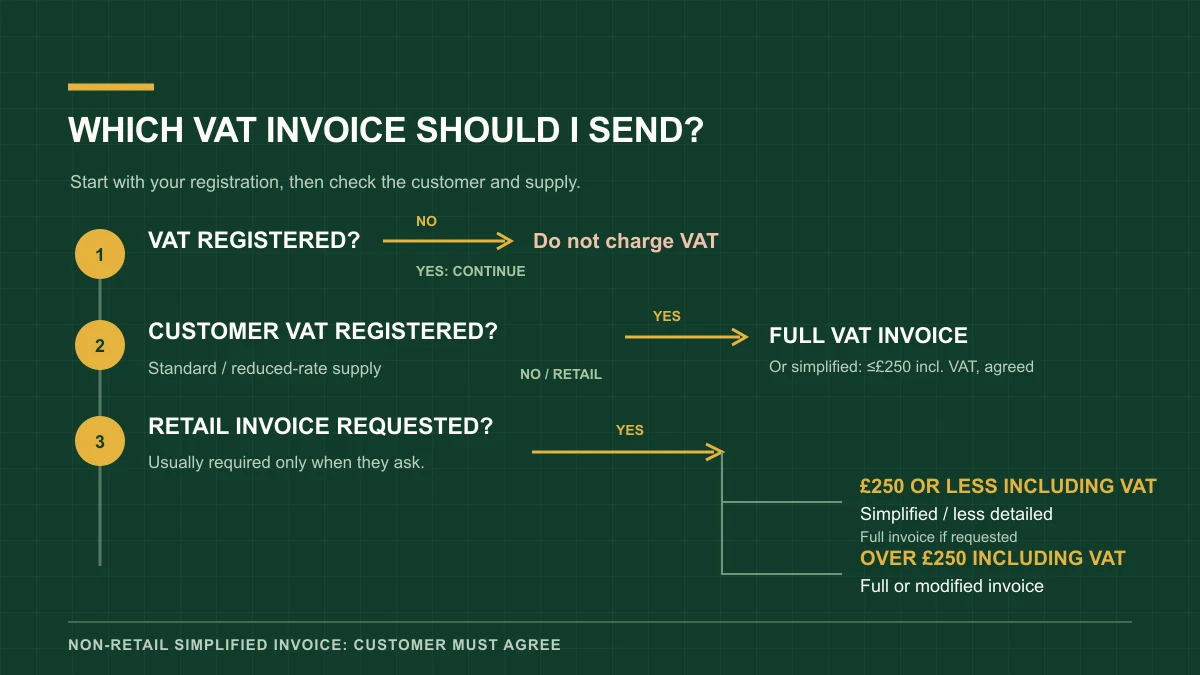
Retail sales to people or businesses that are not VAT registered work differently. You do not usually have to issue a VAT invoice unless the customer asks. If they do, a retailer may use a less detailed invoice for an individual supply of £250 or less including VAT. If the customer asks for a full invoice, provide the full details even if the supply is under £250. For a supply over £250, issue a full or modified VAT invoice.
There are exceptions. A customer may prepare the invoice under an agreed self-billing arrangement. Some construction contracts use authenticated receipts instead. Second-hand margin schemes have their own invoice wording, and you must not issue an ordinary VAT invoice for goods sold under those schemes. If a supply falls into one of these categories, use HMRC’s VAT Notice 700 invoice rules rather than copying a standard invoice template.
The VAT rate follows the goods or service, not the type of customer. Most UK goods and services are standard-rated at 20%. Some are reduced-rated at 5%, some are zero-rated, and some are exempt. Zero-rated and exempt are not interchangeable: zero-rated sales are taxable at 0%, while exempt sales sit outside the normal VAT charge. If one invoice includes different treatments, show the lines and totals separately.
Full VAT invoice checklist
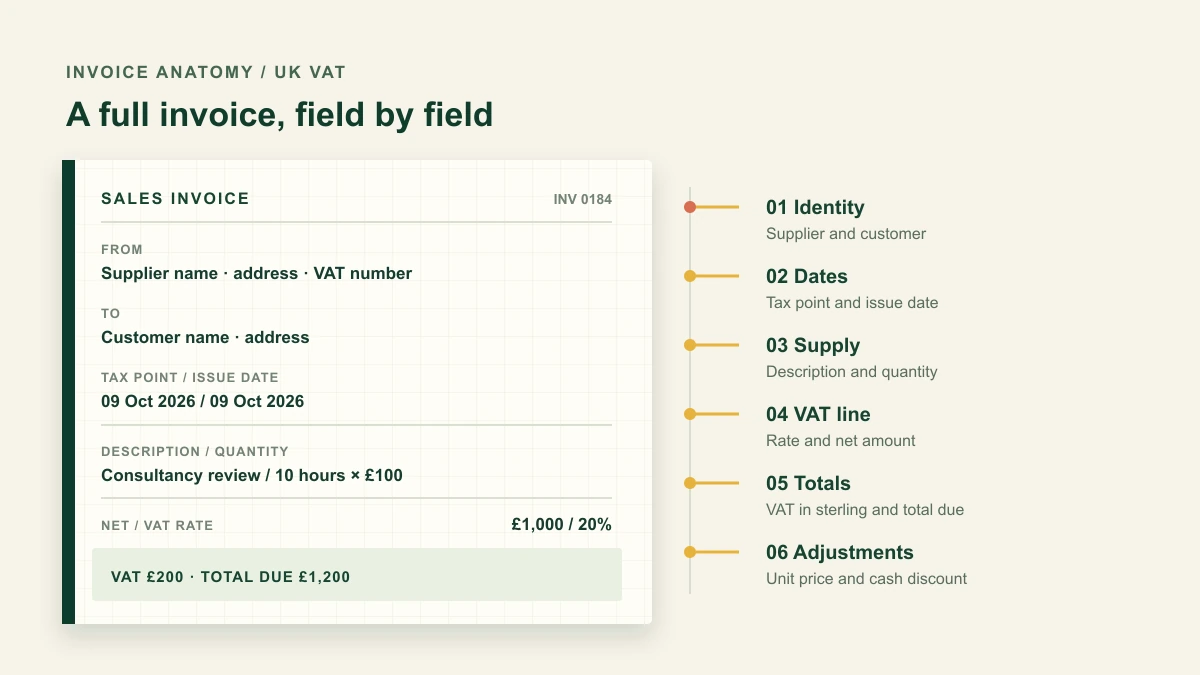
For most business-to-business sales, use a full VAT invoice. HMRC’s requirements include the following details:
| Invoice field | What to show |
|---|---|
| Unique invoice number | A sequential number that identifies the document. You can use one or more numbering series. |
| Tax point | The time of supply for VAT purposes. |
| Issue date | Add it when it differs from the tax point. |
| Supplier details | Your registered name and address, plus your VAT registration number. A trading name can appear too. |
| Customer details | The name and address of the person receiving the goods or services. |
| Description | Enough detail to identify what you supplied. |
| Each line | Quantity or extent, VAT rate and amount before VAT. |
| Totals | Total before VAT, total VAT in pounds sterling and the amount the customer must pay. |
| Discounts and unit prices | Show the rate of any cash discount. Include unit price where it applies. |
The invoice can use a trading name, but the name and address under which you are registered for VAT must appear somewhere on the document. If your business trades as “Oak Studio” but is registered as “Oak Studio Design Limited”, include the registered entity’s details as well as the trading name.
For a service, the quantity or extent might be hours, days or a defined piece of work. “Consultancy” on its own can be vague if the customer needs to identify what was supplied. A short description such as “September 2026 website accessibility review, 8 hours” gives a clearer record without turning an invoice into a project report.
The VAT total must be shown in sterling. If you invoice in another currency for a UK supply, HMRC still requires the total VAT payable to be converted and shown in pounds. The VAT rate and net amount should be clear for each line, especially when one invoice includes supplies with different rates.
Tax point and invoice date are not always the same
The tax point, also called the time of supply, is not always the date you create or send the invoice. Under normal invoice accounting, it generally decides which VAT period contains the transaction. If you use the VAT Cash Accounting Scheme, you usually account for sales VAT when your customer pays instead.
For a typical one-off service, the basic tax point is when the service is completed. For goods, it is usually when they are made available to the customer. An invoice issued within 14 days after that basic tax point can make the invoice date the actual tax point. An invoice issued later normally does not do that unless HMRC has approved an extension. An advance invoice or payment can also create a tax point for the amount invoiced or paid.
This is why an invoice date should not be copied automatically into the VAT return period. If a customer pays a deposit in advance, for example, that payment may affect when VAT is due. Construction contracts, ongoing services and some other arrangements have their own rules. Check the tax point before deciding which return should include the transaction.
HMRC normally expects you to issue the invoice within 30 days of the tax point. That limit is separate from your VAT return filing deadline. Your VAT account shows your own return dates; quarterly online returns are usually due one calendar month and seven days after the accounting period ends.
Simplified VAT invoice: the £250 threshold
A non-retailer can usually issue a simplified VAT invoice when the value of an individual supply is £250 or less including VAT, provided the customer agrees. The threshold is based on the VAT-inclusive amount. It is not £250 before VAT. If the customer asks for a full invoice, give them the full details. If your business is based in Northern Ireland, you cannot use this format for a customer from an EU member state.
A simplified invoice needs to show:
- your name, address and VAT registration number
- the tax point
- a description that identifies the goods or services
- for each VAT rate, the VAT-inclusive total and the rate charged
Do not include exempt supplies on this type of invoice. If the invoice contains a mix of VAT rates, separate each rate so the totals are clear. A till receipt can be a suitable less detailed invoice in some retail situations, but a card slip or payment confirmation on its own is not automatically a VAT invoice.
For an individual supply above £250, you must use a full invoice or, if your customer agrees, a modified VAT invoice. The modified format shows VAT-inclusive values instead of VAT-exclusive values, while retaining the other required details. It is still a VAT invoice, not a receipt with a handwritten VAT amount.
Worked example: a £240 simplified invoice
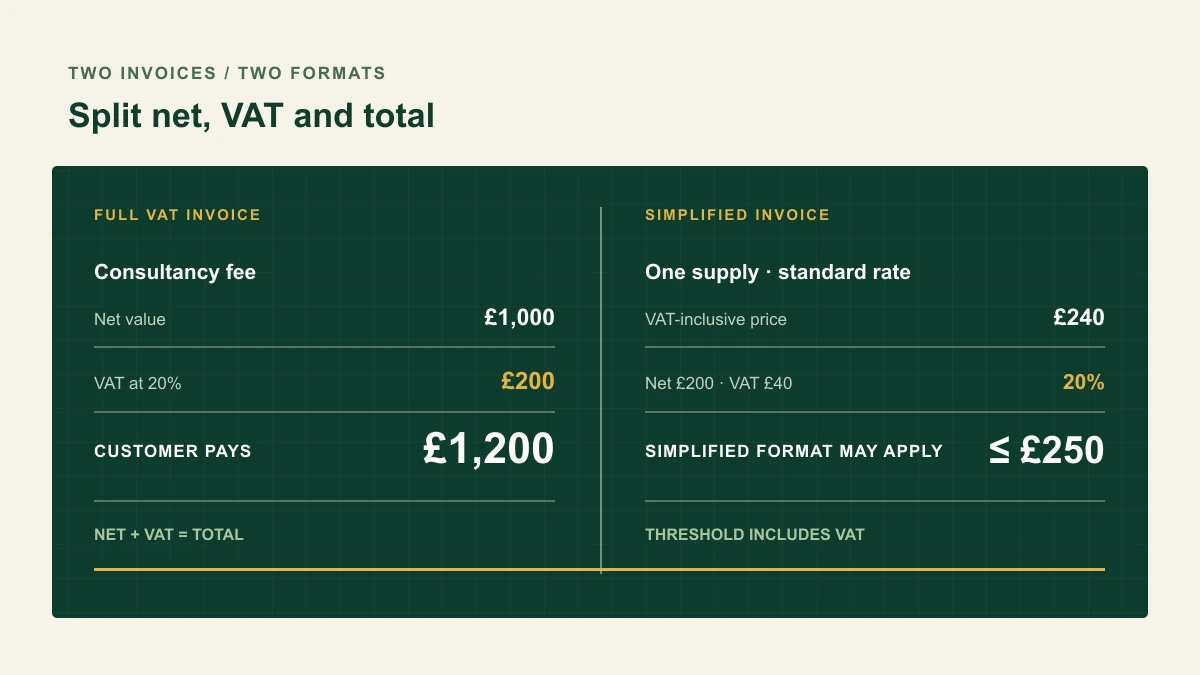
Suppose a VAT-registered designer sells one standard-rated service to a customer for £240 including VAT, and the customer agrees to a simplified invoice. At 20%, the VAT fraction is one-sixth:
- VAT-inclusive amount: £240
- net value: £200
- VAT within the price: £40
Because the individual supply is no more than £250 including VAT, a simplified invoice may be available. It should identify the supply, show the applicable 20% rate and give the VAT-inclusive amount. Showing the £40 VAT calculation as well can make the customer’s records easier to check.
If the same service costs £300 before VAT, the total is £360. That is above the simplified-invoice limit, so use a full invoice or agree a modified VAT invoice with the customer.
Worked example: full VAT invoice for a consultancy
Assume a consultant supplies 10 hours of work at £100 per hour to a VAT-registered company. The work is standard-rated and there are no discounts:
| Calculation | Amount |
|---|---|
| 10 hours × £100 before VAT | £1,000.00 |
| VAT at 20% | £200.00 |
| Total due | £1,200.00 |
The invoice should identify the supplier and customer, use a unique sequential number, show the tax point and issue date if they differ, describe the 10 hours of work, and show the £1,000 net value, 20% rate and £200 VAT total. The customer sees the £1,200 amount to pay. The supplier records £200 of output VAT, subject to the normal timing rules.
This calculation only works if 20% is the correct rate for the supply. Some goods and services are reduced-rated, zero-rated or exempt. A business should not use the standard rate simply because its software selected it by default. Check the classification of the actual supply, and keep the reasoning with the invoice records if the treatment is not obvious.
Mixed rates, credit notes and special wording
If you sell several items at different VAT rates, show each rate separately. For example, a retailer might have standard-rated and zero-rated products in the same order. The invoice should not apply one blended rate to the whole basket. Keep each product’s VAT treatment in the accounting system, then check the totals against the invoice.
Where an invoice includes zero-rated or exempt supplies, make clear that no VAT is payable on those lines and show their values separately. Do not label an exempt supply as zero-rated. The two treatments can affect the seller’s wider VAT position, including input-tax recovery.
Some transactions need special wording. Under the domestic reverse charge, the customer may account for VAT instead of the supplier, so the supplier should not show VAT as if it were an ordinary charge. Margin-scheme invoices also follow different rules. If you sell across the Northern Ireland and EU goods boundary, additional details may apply. These are areas where a general template can be misleading; check the relevant HMRC notice or ask your accountant before sending the invoice.
If you reduce a charge after issuing an invoice, use a credit note or replacement invoice where appropriate. Keep the correction linked to the original document. A credit or debit note should include the information from the VAT invoice, the reason for the adjustment, the amount credited before VAT, and the number and date of the original invoice. Keep both documents so the sales record and VAT account show what changed.
A receipt, statement or pro-forma is not always a VAT invoice
A quotation tells a customer what you expect to charge. A pro-forma invoice is usually a request or offer before the supply is completed. A statement summarises account activity, and a delivery note records goods delivered. None of these documents automatically replaces a proper VAT invoice.
HMRC says a pro-forma invoice cannot be used to reclaim input VAT, even if it includes all the fields of a VAT invoice. Mark it clearly as not being a VAT invoice. Once you make the supply or receive payment, issue the proper invoice.
If you are the customer and receive an invoice with missing or incorrect details, ask the supplier for a corrected VAT invoice before reclaiming the VAT. A valid VAT invoice is the usual evidence for an input-tax claim. HMRC can consider alternative evidence in limited circumstances where the supply happened and the business took reasonable steps to obtain the correct document, but that decision is not automatic.
Our guide to claiming VAT back on business purchases explains what buyers should check before including input VAT in a return. If your team receives many supplier invoices, a monthly bookkeeping review can catch missing VAT numbers, duplicate bills and wrong rates while the supplier can still correct them.
Keep invoice records that tie back to your VAT return
Keep copies of every VAT invoice you issue, including one that you later cancel or replace. Keep the invoices you receive as well. HMRC’s current guidance says VAT records generally need to be kept for at least 6 years. Some schemes, such as the VAT One Stop Shop, have a 10-year retention period.
Most VAT-registered businesses must also keep specified VAT records digitally under Making Tax Digital for VAT, unless HMRC has agreed an exemption. Those records include the time and value of supplies, VAT on sales and purchases, and adjustments. If your records and VAT-return software use more than one product, the transfer between them needs to meet the digital-link rules. The official VAT record-keeping guidance explains what must be stored and how the records connect.
Before you submit a return, check a sample of sales invoices against the VAT account:
- does each sale have the right tax point and VAT period?
- is the VAT rate correct for the goods or service?
- do mixed-rate lines have separate totals?
- does the customer receive the full or simplified invoice format that applies?
- do credit notes point back to the original invoice?
- can you find the invoice again from the amount in the return?
That check is easier when invoices are numbered consistently and records are reviewed each month. Our VAT registration threshold guide explains when a business must register; once registered, put a VAT invoice check into the same bookkeeping routine as bank reconciliation.
Frequently asked questions about VAT invoice requirements
What must a full VAT invoice include in the UK?
A full VAT invoice needs a unique sequential number, the tax point, the issue date if different, supplier and customer details, a clear description, quantity or extent, the VAT rate and net amount for each line, the total before VAT, any cash discount rate, total VAT in sterling and the unit price where it applies.
When can I use a simplified VAT invoice?
A non-retailer can usually issue a simplified invoice for an individual supply of £250 or less including VAT if the customer agrees. If the business is based in Northern Ireland, this format is not available for a customer from an EU member state. If the customer asks for a full invoice, provide the full details. The simplified invoice shows the supplier’s name, address and VAT number, the tax point, a description and, for each VAT rate, the VAT-inclusive total and rate. Retailers have separate rules for less detailed invoices.
Can I issue a VAT invoice if my business is not VAT registered?
No. Only a VAT-registered business can issue a VAT invoice or charge VAT. If you are not registered, do not show an amount as VAT on a customer invoice.
Do I need to send a VAT invoice to every customer?
You must normally issue one when you make a standard-rated or reduced-rated supply to another VAT-registered person. Retailers usually need to give an unregistered customer a VAT invoice only if asked; for a supply of £250 or less including VAT, a less detailed version is allowed unless the customer asks for a full invoice. Above £250, issue a full or modified invoice. Exceptions include self-billing and some special VAT schemes.
Can I reclaim VAT from an invalid invoice?
A valid VAT invoice is the usual evidence for reclaiming input VAT. Ask the supplier to correct an invoice that is missing required details. HMRC can consider alternative evidence in specific circumstances, but this is not automatic.
How long must I keep VAT invoices?
Most businesses must keep VAT records, including invoices, for at least 6 years. VAT One Stop Shop records have a 10-year retention period.
For your next return, compare a few sales invoices and supplier bills with the VAT account before filing. If the tax point, rate or customer details are unclear, resolve that document first and keep the correction with the original record.

About Golden Tree Consulting
ACCA Affiliated | MBA Qualified
Golden Tree Accounting & Business Consulting provides expert tax, bookkeeping, and advisory services to sole traders and SMEs across Croydon, London, Surrey, and Kent. With multilingual support and decades of combined experience, we help businesses stay compliant and grow.
Offices in Croydon and London Bridge.
Related guides
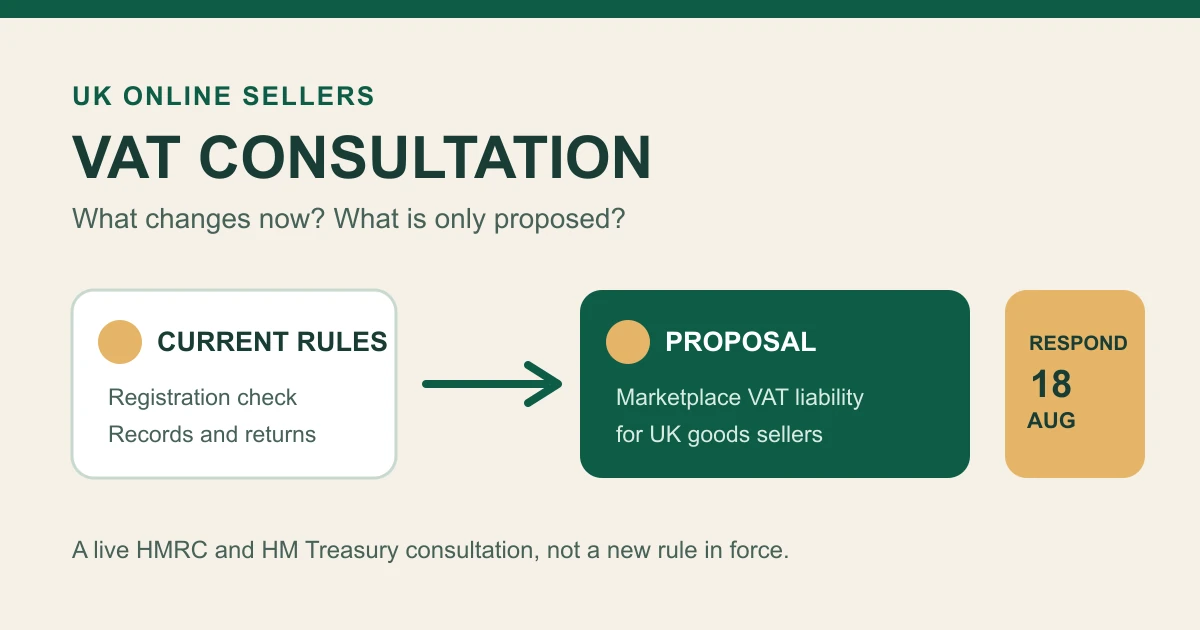
Online Marketplace VAT Consultation: What UK Sellers Need to Know
Online marketplace VAT consultation explained for UK sellers, including the 18 August 2026 response deadline and practical record checks.
VAT Flat Rate Scheme 2026: Is the 16.5% Rule Costing Your Business Money?
VAT Flat Rate Scheme 2026 guide for small businesses, covering the 16.5% limited-cost rule, thresholds, examples and exit checks.
CIS Monthly Return for Contractors: 2026 Deadlines and Nil Returns
CIS monthly return guide for UK contractors: the 19th deadline, 2026 nil return rules, deductions, payment dates, records and late-filing penalties.