Business Rates 2026/27 in England: Small Business Guide
Business rates 2026/27 in England: check the new multipliers, Small Business Rate Relief, revaluation caps and how to challenge your rateable value.
 Golden Tree Accounting 2 October 2026 14 min read
 On this page Show
- Business rates 2026/27 in England: what changed?
- The 2026/27 business rates multipliers
- How to calculate business rates 2026/27
- Small Business Rate Relief in 2026/27
- Revaluation reliefs: transitional or supporting small business?
- Check or challenge your rateable value
- Put the bill into your business cash-flow plan
- Business rates 2026/27 FAQs
A business rates 2026/27 bill in England is not just the new rateable value multiplied by a headline rate. The new rating list took effect on 1 April 2026, the multipliers changed, and your final bill can also depend on Small Business Rate Relief, revaluation protections and local decisions. The useful first step is to separate those parts, then check each one against your own property and bill.
Quick answer: start with the rateable value shown on your bill, multiply it by the rate that applies to your property, then subtract any relief. Non-RHL properties below £51,000 generally use the 43.2p small business multiplier for 2026/27. Qualifying retail, hospitality and leisure properties in that value band use 38.2p. Small Business Rate Relief is a separate discount, and a qualifying property valued at £13,500 can receive 50% relief. The council confirms the amount payable.
This guide covers England. The 2026 revaluation also applies in Wales, but rates and relief rules differ. Scotland and Northern Ireland have separate systems.
Business rates 2026/27 in England: what changed?
Business rates are a tax on most non-domestic properties, such as shops, offices, workshops, pubs and warehouses. The local council sends the bill and collects payment. The Valuation Office sets the property’s rateable value, which broadly estimates the yearly rent it could have achieved on the open market at a set date.
The current list began on 1 April 2026. Its rateable values use rental evidence from 1 April 2024. That date is a valuation snapshot, not a statement of what your property is worth today or what you currently pay in rent. If market rents in your area moved sharply before or after the snapshot, the new figure may still feel out of step with your experience.
The GOV.UK revaluation guide explains that all properties receive a new rateable value and the multipliers are revised at revaluation. A changed value does not automatically mean your bill changes by the same percentage. A lower multiplier, Small Business Rate Relief or a transition cap can alter the final result.
There is one practical distinction to keep in mind: the rateable value is not your bill. It is one input. The council applies the relevant multiplier and reliefs, and may account for other adjustments. If the figure on your bill looks surprising, compare the valuation and the calculation separately.
The 2026/27 business rates multipliers
The multiplier is the number of pence charged for each pound of rateable value before reliefs. For example, 43.2p is 0.432 pounds. The English multipliers from 1 April 2026 are:
| Property or multiplier type | 2026/27 rate | What to check |
|---|---|---|
| Standard multiplier | 48.0p | Non-RHL properties with a rateable value from £51,000 to £499,999 |
| Small business multiplier | 43.2p | Non-RHL properties with a rateable value below £51,000 |
| Small retail, hospitality and leisure multiplier | 38.2p | Qualifying RHL properties with a rateable value below £51,000 |
| Standard retail, hospitality and leisure multiplier | 43.0p | Qualifying RHL properties with a rateable value from £51,000 to £499,999 |
| High-value multiplier | 50.8p | All property types with a rateable value of £500,000 or more |
The rates are published in the government’s 2026/27 multiplier notice. There are special arrangements for the City of London, and qualifying retail, hospitality and leisure (RHL) status depends on the property and how it is used. The GOV.UK guide to qualifying RHL properties explains the conditions. A shop is not automatically eligible just because customers visit it. Use the rate printed on your bill as a cross-check and ask your council if the category seems wrong.
The 43.2p small non-RHL multiplier and Small Business Rate Relief are different things. The multiplier is used to calculate the starting charge. Relief is a discount from the bill for businesses that meet its rules. A property can receive the small non-RHL multiplier without qualifying for full or partial Small Business Rate Relief.
How to calculate business rates 2026/27
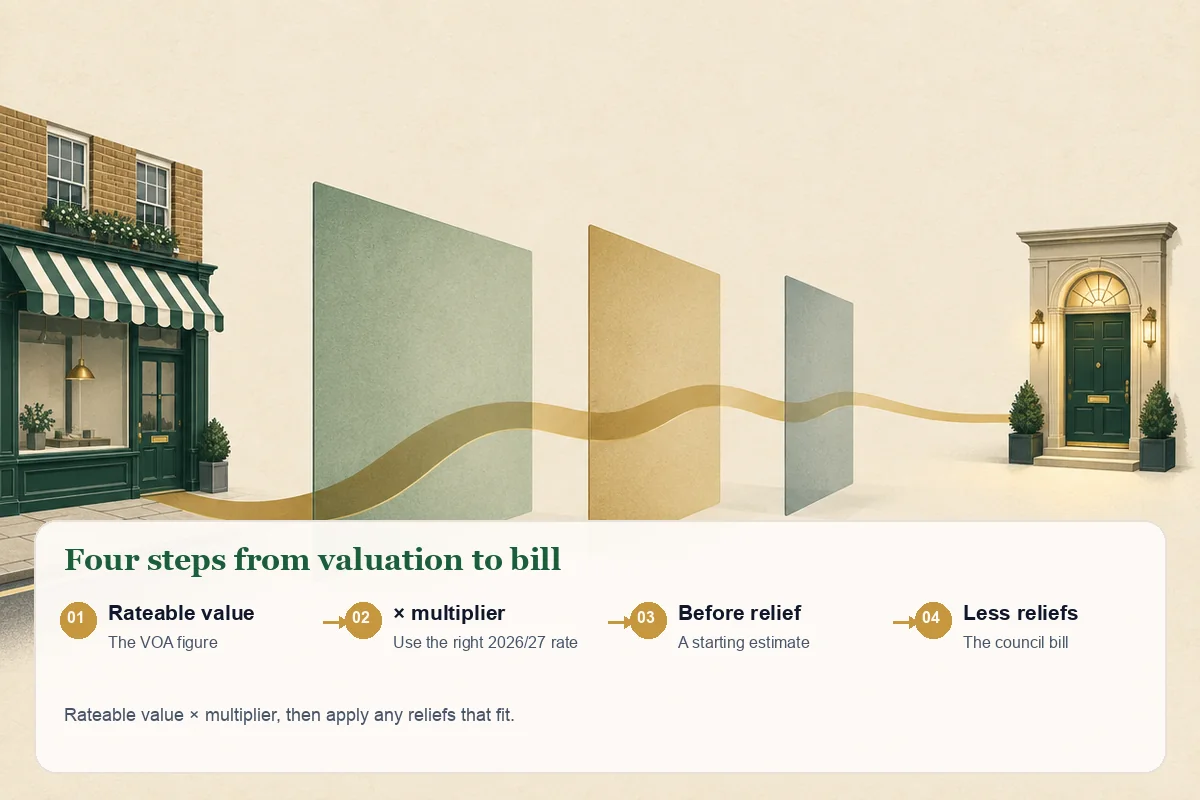
Use this simple starting formula:
Rateable value × multiplier = charge before relief
Then subtract any relief that applies. The council’s bill is the amount to pay, not your own estimate. The examples below show the arithmetic and where it can stop matching the bill.
Example 1: a non-RHL business using the small multiplier
Suppose a non-RHL workshop has a rateable value of £25,000 and the 43.2p small business multiplier applies:
- £25,000 × 0.432 = £10,800 before relief
That is a starting figure, not a promise that £10,800 will appear as the final bill. If the business qualifies for a relief, the amount may be lower. A revaluation cap, local supplement, or a property-specific adjustment can also affect the bill. Compare your estimate with the council’s calculation and ask which line accounts for any difference.
Example 2: £13,500 rateable value and 50% relief
For an eligible single-property, non-RHL business with a rateable value of £13,500, the small business multiplier is 43.2p and the Small Business Rate Relief taper gives 50% relief:
- £13,500 × 0.432 = £5,832 before relief
- £5,832 × 50% = £2,916 relief
- £5,832 − £2,916 = £2,916 after this relief
This is the guide’s worked example, not a personalised quote. It assumes the business meets the eligibility rules and excludes other reliefs, local additions and adjustments. The council confirms the bill. The small business rate relief rules include a £13,500 example with the same 50% rate.
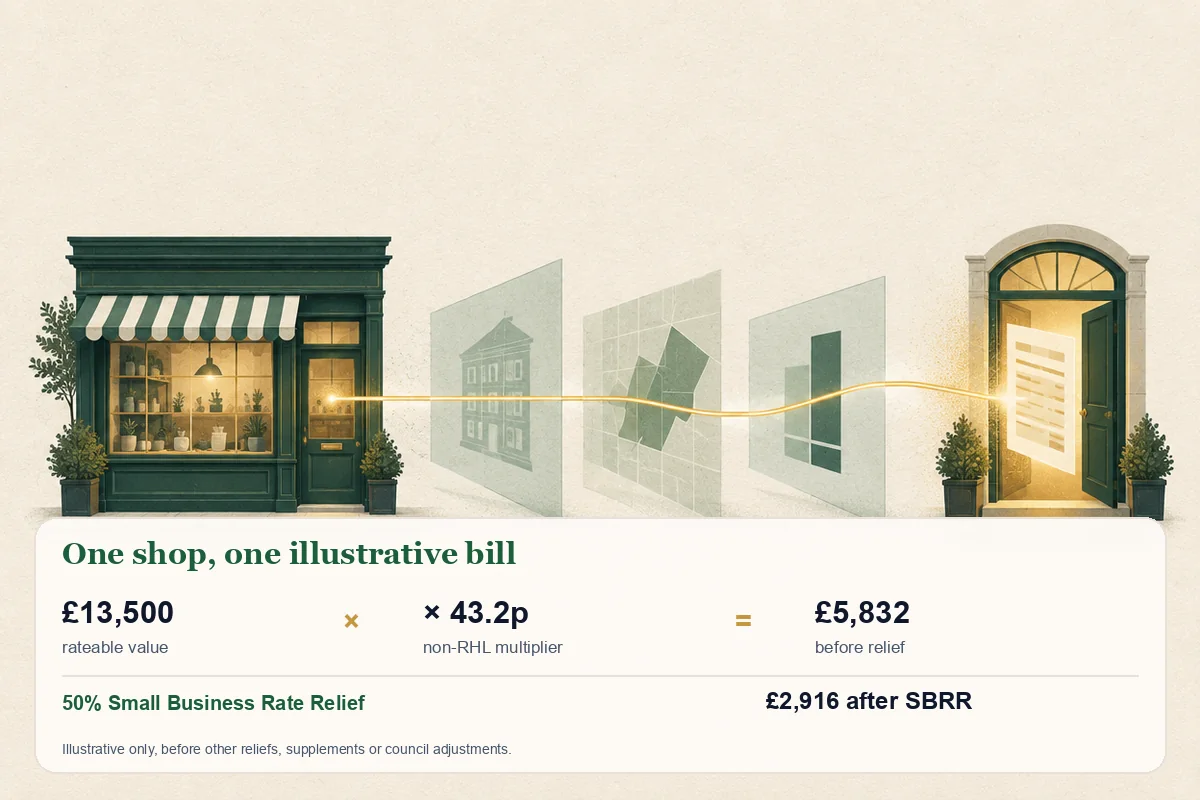
If the same rateable value belongs to a qualifying RHL property, the small RHL multiplier is 38.2p instead. That gives a starting charge of £5,157 and, with 50% SBRR, £2,578.50 after that relief. The council confirms which multiplier applies.
Example 3: a qualifying retail, hospitality or leisure property
Imagine an eligible small RHL property with a rateable value of £40,000. If the 38.2p small RHL multiplier applies:
- £40,000 × 0.382 = £15,280 before relief
That figure does not include any separate relief. The business must meet the RHL conditions for its property and use. Do not apply the 38.2p rate just because the business trades in retail or hospitality. The council’s bill shows the multiplier used, and the council can explain how it classified the property.
For a larger property, the multiplier can be different again. A property with a value at or above £500,000 may be affected by the high-value multiplier unless another category applies. If the property qualifies as RHL, check which RHL multiplier the council used. The official notice and your bill are safer guides than a generic online calculator that asks only for the rateable value.
Small Business Rate Relief in 2026/27
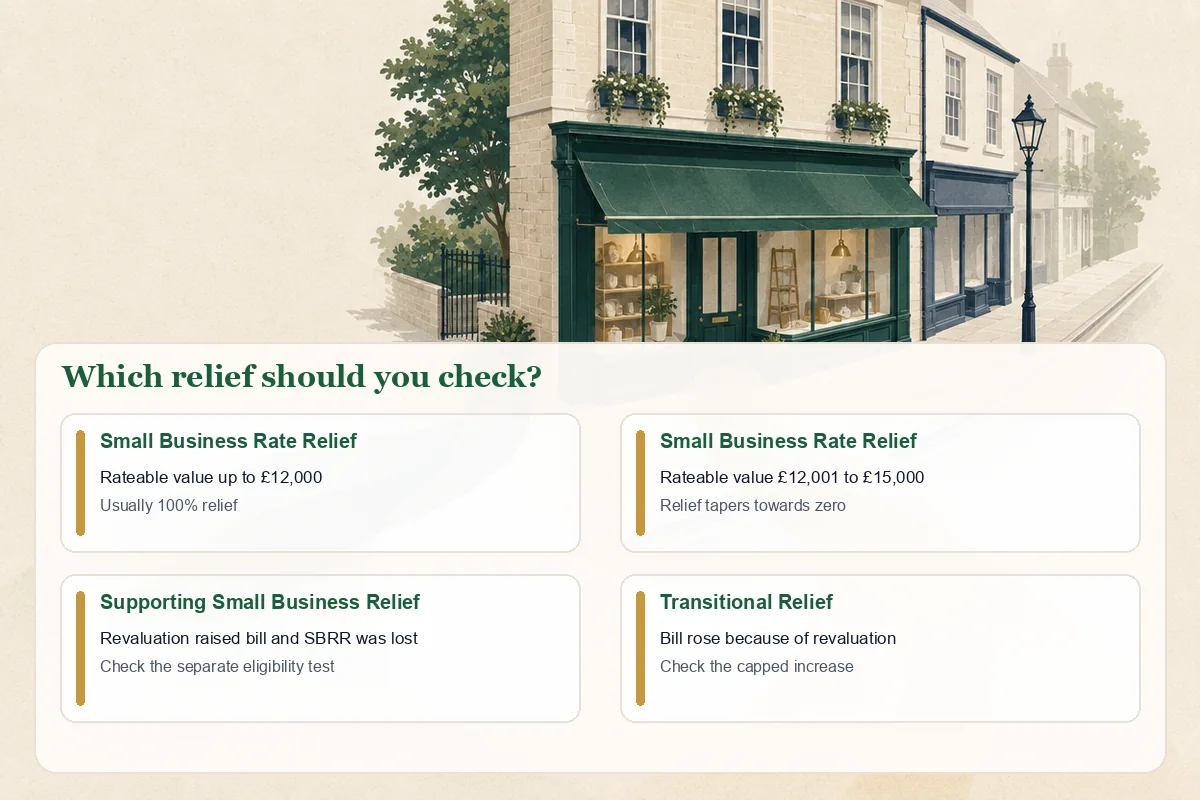
Small Business Rate Relief (SBRR) can reduce or remove the bill for a business with a low rateable value. For a business using just one property:
- If its rateable value is £12,000 or less, it can usually receive 100% relief.
- From £12,001 to £15,000, relief tapers gradually from 100% to zero.
- At £15,000, there is no SBRR under this scale.
The boundaries are based on rateable value, not turnover, profit, rent paid or the owner’s personal income. If the property’s value is £12,000, the relief can remove the business rates bill. At £12,001, the relief does not suddenly vanish. It starts to taper, which is why two neighbouring properties can receive different percentages.
The usual rule is that the business only uses one property. There are exceptions for some businesses with additional low-value properties. If you have more than one premises, do not assume that the first property still qualifies. From 27 November 2025, a business that takes on a second property may keep SBRR on its main property for 36 months, compared with 12 months for a second property acquired earlier. After that period, SBRR on the main property may continue if no other property has a rateable value above £2,899 and the combined rateable value is below £20,000, or £28,000 in London. Ask your council to assess your specific arrangement.
SBRR is normally claimed or confirmed through the local council. If your bill does not show a relief you think you qualify for, contact the council that issued it. Tell them how many properties your business uses and give them the rateable values. Also report changes, such as taking on another premises or leaving one, so the council can update the account.
Revaluation reliefs: transitional or supporting small business?
Two protections may matter when a new valuation increases the bill, but their tests are not identical. Transitional Relief phases some increases in over time. Supporting Small Business Relief can help when the revaluation raises the bill and the business loses some or all of certain existing reliefs. They are not alternative names for the same scheme.
For 2026/27, the Transitional Relief increase caps depend on the property’s rateable-value band. For properties outside London, GOV.UK lists maximum increases of 5% up to £20,000, 15% from £20,001 to £100,000, and 30% above £100,000. The corresponding London boundaries are £28,000 and £28,001. These percentages apply to eligible bill increases caused by revaluation. Relief is applied before some other reliefs and local supplements, so the finished bill can differ from a rough cap calculation. Your council should apply the scheme automatically when you qualify.
Supporting Small Business Relief has a separate test. The property’s bill must have increased because of revaluation, and the business must have lost some or all of SBRR, rural rate relief, RHL relief or the previous Supporting Small Business Relief. For 2026/27, the increase is capped at £800 or a percentage of the 2025/26 bill, whichever is greater. Its percentages are 5%, 15% and 30% across the same broad value bands, with different London thresholds. The previous bill for this calculation includes specified reliefs.
| Question | Transitional Relief | Supporting Small Business Relief |
|---|---|---|
| Why might it apply? | Revaluation has increased the bill | Revaluation increased the bill and the business lost certain reliefs |
| What does it limit? | How quickly an eligible revaluation increase reaches the full bill | The increase against the previous year’s bill, subject to the £800 or percentage cap |
| Who confirms it? | The local council, normally on the bill | The local council, which adjusts the bill if the business qualifies |
The Transitional Relief guidance and Supporting Small Business Relief guidance show the detailed tests and examples. If your bill rose after 1 April, check both the rateable value and the relief lines. A new value alone will not tell you whether a protection has been applied.
Check or challenge your rateable value
The Valuation Office sets rateable values. Your local council calculates the bill and decides many relief questions. That means a challenge to the property value and a question about the amount billed go to different places.
Start by looking up the current value in the business rates valuation account. Check that the property description, floor area, use and other details look right. Keep relevant evidence nearby, such as lease terms, rent reviews, measured areas, plans and a dated note of any change to the premises. The Valuation Office may use information about rent and leases when reviewing a property.
The current process is to submit a Check case, receive a decision, and then submit a Challenge if you still disagree and have valid grounds. Those grounds may include an incorrect valuation, incorrect property details or a case where the property should not be valued in that way. A challenge is not simply a request for a lower figure because the bill is hard to afford. If the issue is the bill amount, SBRR or another relief, contact the local council. The council cannot change the rateable value set by the Valuation Office.
If you use a rating adviser, check their experience, fees and professional standing before signing anything. The government notes that ratepayers can deal with the Valuation Office themselves and do not have to hire a representative. Be cautious of firms that promise a particular reduction before reviewing the property evidence.
Put the bill into your business cash-flow plan
Business rates are a premises cost, so include them beside rent, utilities, insurance and service charges in your forecast. Use the bill amount and instalment dates for the cash plan. Keep a separate note of your own estimate, especially if you expect a relief or challenge to change the amount later. Do not delay paying a billed instalment unless the council has confirmed a change or agreed a payment arrangement.
Most bills are set up over 10 monthly instalments. You can ask the council to arrange payment over 12 months instead, which may make monthly cash planning easier. Check your bill or contact the council early, since payment dates and the steps to change them can depend on the local authority.
Our guide to a 13-week cash-flow forecast for a small business explains how to place fixed bills alongside wages, suppliers and customer receipts. If you run a limited company, the annual accounts checklist covers the records that support regular reporting. Our bookkeeping service can help keep property costs and payments recorded consistently. We do not set rateable values or decide business rates relief, so those questions belong with the Valuation Office or the council.
When the amount due changes, update the cash forecast with the actual council bill and instalments. A new estimate is useful for planning, but the dated bill is the number to reconcile against your bank payments and bookkeeping records.
Business rates 2026/27 FAQs
What are the changes to Small Business Rate Relief for 2026/27?
The main rateable-value bands remain £12,000 or less for up to 100% relief and £12,001 to £15,000 for tapering relief. Eligibility still depends on how many properties the business uses, with limited exceptions. The 2026 revaluation may have changed a property’s rateable value, so check the current value and ask the council to confirm the relief on your bill.
How do I work out business rates in 2026?
Multiply your current rateable value by the multiplier on your bill to get the charge before relief. Then check the council’s relief and adjustment lines. For example, a non-RHL property at £25,000 and 43.2p gives £10,800 before relief. Do not use this as the final amount if your property qualifies for a different multiplier or a relief.
What rateable value qualifies for Small Business Rate Relief?
A property with a rateable value of £12,000 or less can usually receive 100% SBRR if it is the only property the business uses. From £12,001 to £15,000, the discount reduces gradually. Extra properties can affect eligibility, so ask your council to check the full set of premises.
Is Small Business Rate Relief ending in 2026/27?
The relief is still available in England in 2026/27. The new rating list may change your rateable value and therefore the amount of relief you receive. If you have not received relief but think you qualify, contact the council that sent your bill.
Who do I contact if my business rates bill looks wrong?
Contact your local council about the multiplier, relief, instalments or bill calculation. Contact the Valuation Office if you believe the rateable value or property details are wrong. For a valuation challenge, follow the Check and Challenge steps and provide evidence for your grounds.
Before you pay the next instalment, put the valuation, multiplier and relief lines beside the council’s total. That simple check will show whether you need to query the bill with the council or investigate the property value with the Valuation Office.

About Golden Tree Consulting
ACCA Affiliated | MBA Qualified
Golden Tree Accounting & Business Consulting provides expert tax, bookkeeping, and advisory services to sole traders and SMEs across Croydon, London, Surrey, and Kent. With multilingual support and decades of combined experience, we help businesses stay compliant and grow.
Offices in Croydon and London Bridge.
Related guides

Crypto Tax UK 2026: Capital Gains, Staking Income and HMRC Records
Crypto tax UK 2026 explained with Capital Gains Tax rates, staking and mining income, exchange records, reporting routes and worked examples.
Vaping Products Duty UK 2026: Retailer Guide to Stock, Costs and Stamps
Vaping Products Duty UK starts 1 October 2026. See retailer approval rules, £2.20 per 10ml calculations, stamp checks, old-stock dates and records.
HMRC MTD Letter 2026: What to Check If You've Been Signed Up
Received an HMRC MTD letter? Check the £50,000 qualifying-income test, correct changed income sources and catch up with the 2026/27 steps.