Companies House Accounts Changes 2028: What Small Companies Need to Prepare
Companies House accounts changes 2028 explained for UK small companies: software-only filing, P&L, abridged accounts and a practical preparation checklist.
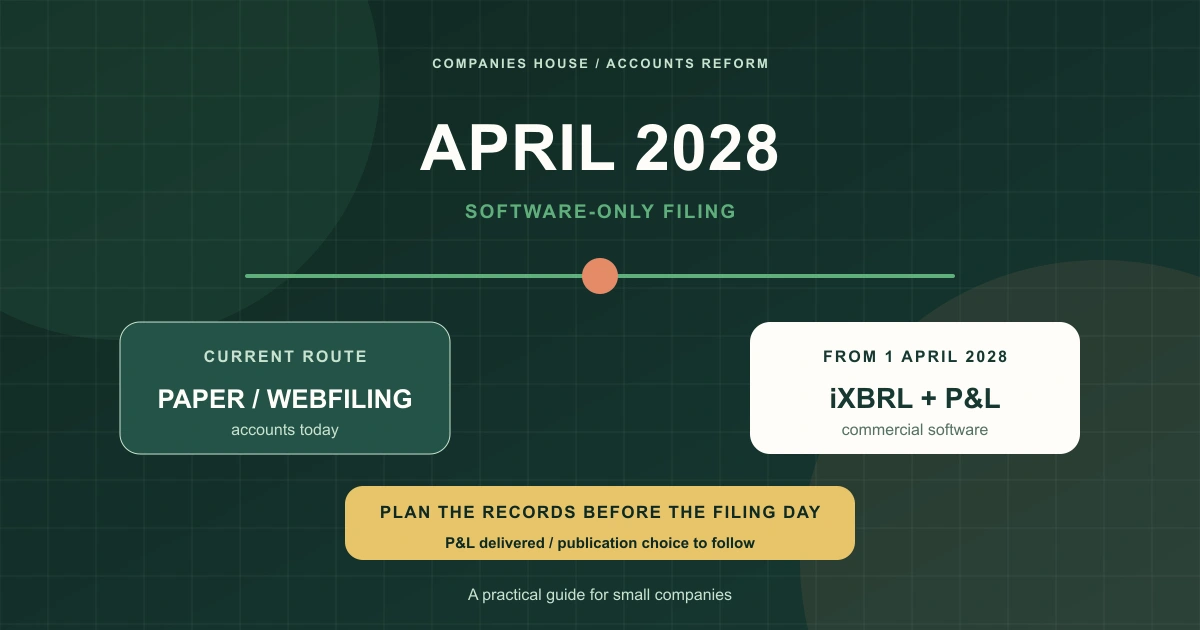
If you currently file micro-entity accounts through Companies House WebFiling, put 1 April 2028 in your planning calendar. The Companies House accounts changes 2028 package will move annual accounts filing towards commercial software, require small companies and micro-entities to deliver a profit and loss account, and remove the option to file abridged accounts.
That sounds like a problem for 2028, but the useful work starts earlier. You need time to check your company size, tidy the records behind the accounts, ask your software provider the right questions and decide whether you will file yourself or use an accountant. The public-register position for your profit and loss account matters too, although the detailed opt-out process has not been published yet.
Quick answer: from 1 April 2028, all UK registered companies will need to file annual accounts through commercial software in iXBRL format. Small companies and micro-entities will need to deliver a profit and loss account, with an option to opt out of publication on the public register. Abridged accounts will go, and audit-exemption statements will become more detailed.
The change does not bring forward your current accounts deadline, change the usual nine-month filing period for private companies or replace the Company Tax Return. It changes how accounts are prepared and delivered to Companies House. Our annual accounts service can help if you want someone to review the current timetable and the records behind it.
Companies House accounts changes 2028: what is actually changing?
Companies House announced the reform package in June 2026 under the Economic Crime and Corporate Transparency Act 2023. The government’s Companies House accounts announcement says the package will take effect from April 2028 rather than April 2027.
Here is the practical version of the announcement:
| Announced change | What it means for a small company |
|---|---|
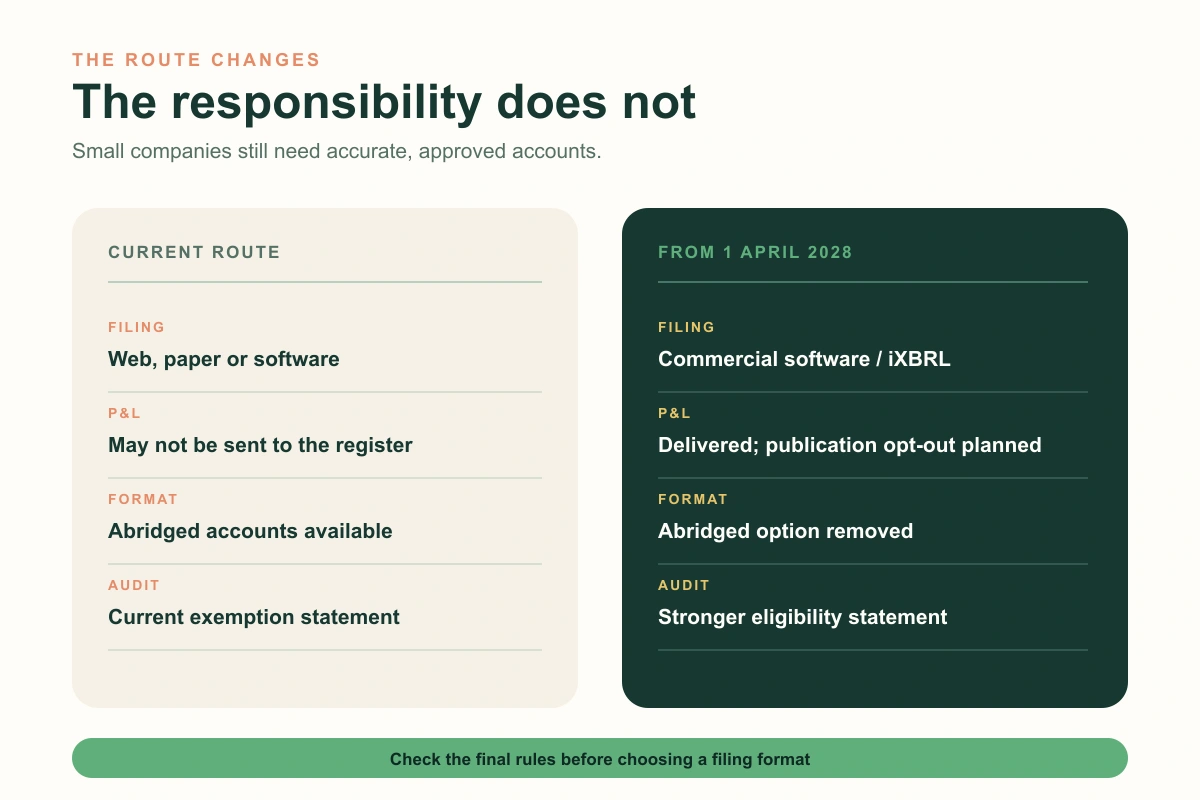
| Commercial software filing | Annual accounts will need to be filed in iXBRL format using commercial software. |
| Profit and loss account | Small companies and micro-entities will deliver a copy of the P&L to Companies House. |
| Publication choice | Smaller companies will be able to opt out of putting the P&L on the public register. The process is still to be confirmed. |
| Abridged accounts | The current option to file abridged accounts will be removed. |
| Audit exemption | Directors will need to make a stronger statement confirming the exemption and the company’s eligibility. |
| Accounts components | The component parts of the filed accounts and reports will need to be delivered together. |
| Shortened accounting periods | A business reason will be needed if a company wants to shorten its accounting reference period more than once in five years, subject to forthcoming regulations. |
The reform is about the quality, consistency and delivery of company information. It is not a new Corporation Tax charge. It does not turn a small company into a public company, and it does not mean that every detail of the accounts will automatically appear on the register. The P&L publication opt-out is part of the announced package.
Why 1 April 2028 is a preparation date, not a panic date
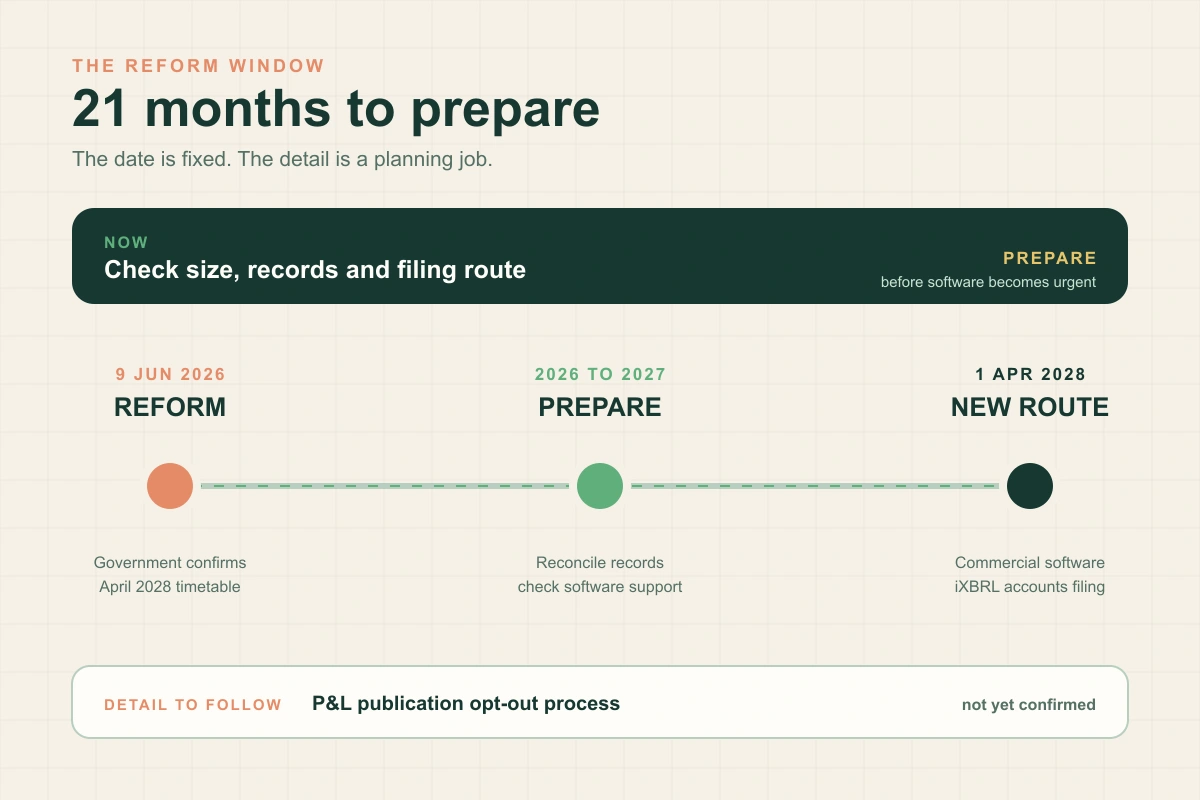
The government moved the start date from April 2027 to April 2028 after listening to companies and professional bodies. It says this gives all companies one full accounting year plus nine months, or 21 months, to get ready.
That notice is useful, but it is not a reason to leave everything until March 2028. A software change is rarely just a download. The accounts still depend on reconciled bank records, correctly classified transactions, payroll postings, director balances, asset information and a clear year-end cut-off. If those records are incomplete, new filing software will simply present the same uncertainty in a different format.
Your current filing deadlines continue to matter. A private company normally has nine months from its accounting reference date to deliver acceptable annual accounts to Companies House. First accounts can be due 21 months after incorporation when they cover more than 12 months. A 30 September year end, for example, normally leads to a 30 June filing deadline. If that filing falls after 1 April 2028, the company should expect to use the new software route, subject to the final transitional rules.
The date also gives directors a sensible point for a conversation with their accountant. Ask which accounting periods will be affected, when the agent will move to the new filing route and what information the company must provide. A good answer should mention iXBRL, not just say that “the software will take care of it”.
Will my company be affected?
The software change is broad. Companies House says all UK registered companies will need to file annual accounts using commercial software from 1 April 2028. That includes companies that prepare their own accounts and companies that ask an accountant or another agent to file for them.
The P&L change is especially important for small companies and micro-entities because their current filing options can show less information on the public register. The classification still matters for the accounts regime and possible audit exemption. Use the current thresholds as a starting point, not as a substitute for checking the rules for the relevant accounting period.
For accounting periods beginning on or after 6 April 2025, the current GOV.UK accounts guidance says a company is generally small if it meets at least two of these three conditions:
| Test | Small company limit | Micro-entity limit |
|---|---|---|
| Annual turnover | £15 million or less | £1 million or less |
| Balance sheet total | £7.5 million or less | £500,000 or less |
| Average employees | 50 or fewer | 10 or fewer |
Worked example: a micro-entity with more than one test
Imagine Oak Lane Design Ltd has £920,000 of annual turnover, a £420,000 balance sheet total and 8 employees on average. It passes all three micro-entity tests. It may be eligible for the micro-entity accounts regime, subject to the company type, group and two-year qualification rules.
From April 2028, that status will not remove the P&L obligation. Oak Lane will still need to prepare and deliver a copy of its profit and loss account to Companies House. It should be able to opt out of publication on the public register, but the detailed mechanism is not available yet. It will also need a software filing route.
Worked example: a small company outside the micro limits
River Street Kitchens Ltd has £12.4 million turnover, a £8.2 million balance sheet total and 44 employees. It passes the turnover and employee tests for a small company, even though its balance sheet total is above £7.5 million. The “two out of three” test matters.
That company is already operating at a different scale from a micro-entity, but the April 2028 software filing, P&L delivery and abridged-accounts changes still need to be built into its accounts timetable. Size does not make the filing route optional.
Some companies cannot use the small-company or micro-entity provisions, including certain public companies, ineligible groups and regulated businesses. A company can also move between classifications as its figures change. If the answer affects an audit exemption or the accounts format, get the classification checked before the year end.
What software-only filing means in practice
iXBRL stands for Inline Extensible Business Reporting Language. You do not need to become a software developer. In practice, it means the accounts are filed in a structured digital format that allows the figures and labels to be read by systems as well as people.
From 1 April 2028, Companies House says its web and paper-based accounts filing services will close. That change applies to annual accounts only. Web services will remain available for non-accounts filings such as confirmation statements and director updates.
There are two sensible routes:
- choose commercial software that can prepare and submit the type of accounts your company needs; or
- appoint an accountant or filing agent and confirm that their software route is ready for the new requirement.
The second route does not transfer the legal responsibility for the accounts. Directors remain responsible for the company’s records, performance and filing obligations. A filing agent can reduce the practical work, but it cannot make inaccurate records correct.
Worked example: a WebFiling user planning ahead
Suppose Riverside Studio Ltd has a 30 September year end and currently files its micro-entity accounts through WebFiling. Under the ordinary private-company timetable, those accounts are due by 30 June of the following year. The accounts for the year ending 30 September 2027 would normally be due on 30 June 2028, after the announced reform start date.
Riverside should ask its current provider now whether the package will support commercial iXBRL filing for the relevant accounts. If not, it needs time to compare software or appoint an accountant. The exact transitional treatment for different accounting periods should be checked against the final rules, but waiting until the filing deadline is not a sensible test of the new system.
Do not assume that ordinary bookkeeping software can file statutory accounts. Ask specifically about Companies House accounts, iXBRL, micro-entity and small-company formats, amended accounts, presenter credentials and the route for attaching all required components.
A profit and loss opt-out is not a profit and loss exemption
This is the point most likely to be misunderstood. Small companies and micro-entities will need to deliver a profit and loss account to Companies House from 1 April 2028. The announcement says they can opt out of publishing the P&L on the public register. It does not say that they can skip preparing the P&L.
The company will still need accounts for its members and information for HMRC as part of the Company Tax Return. Companies House, HMRC and law enforcement will still have access to a P&L that is not published publicly. The opt-out is about public-register publication, not about hiding the figures from the authorities or avoiding the accounting work.
Worked example: private publication, public responsibility
Imagine Maple Works Ltd has £84,000 turnover, £27,000 of allowable operating costs and a draft accounting profit of £57,000 before other adjustments. The directors may decide that public P&L publication is not right for the company if the final rules allow the planned opt-out and the company meets the conditions.
That decision would not remove the need to support the £57,000 figure with bank reconciliations, sales records, purchase invoices, payroll postings and year-end adjustments. It would not remove the need to prepare the accounts, send the relevant information to HMRC or meet the filing deadline. Privacy and record quality are separate decisions.
The government says the opt-out details will be confirmed in due course. Do not rely on an online article that promises a particular form, fee or privacy result before Companies House publishes the process.
What happens to abridged accounts and audit exemption?
The current abridged-accounts option will be removed from 1 April 2028. Small companies will need to file full accounts prepared under the small companies accounting regime. That does not mean that a small company loses every accounting simplification, and it does not automatically mean an audit is required.
Audit exemption is a separate question. A qualifying small company can still be able to submit unaudited accounts, but the directors will need to make a stronger statement confirming the exemption and the company’s eligibility. Treat that wording as a director responsibility, not as a box to tick without checking.
The package also says the component parts of the filed accounts and reports must be delivered together. That makes the handover pack more important. A missing directors’ report, auditor’s report where required, balance-sheet signature or supporting component can delay acceptance or require a correction.
There is a further change for accounting reference periods. Companies House guidance says that from 1 April 2028 a business reason will be needed if a company wants to shorten its accounting reference period more than once in five years. The wording is subject to forthcoming regulations, so ask for the final position before changing a year end for planning reasons.
None of these points changes the basic distinction between Companies House and HMRC. Annual accounts go to Companies House. The Corporation Tax payment and Company Tax Return follow HMRC rules. A company can have one set of accounts supporting both processes, but the deadlines and filing channels are not identical.
What a small company should do now
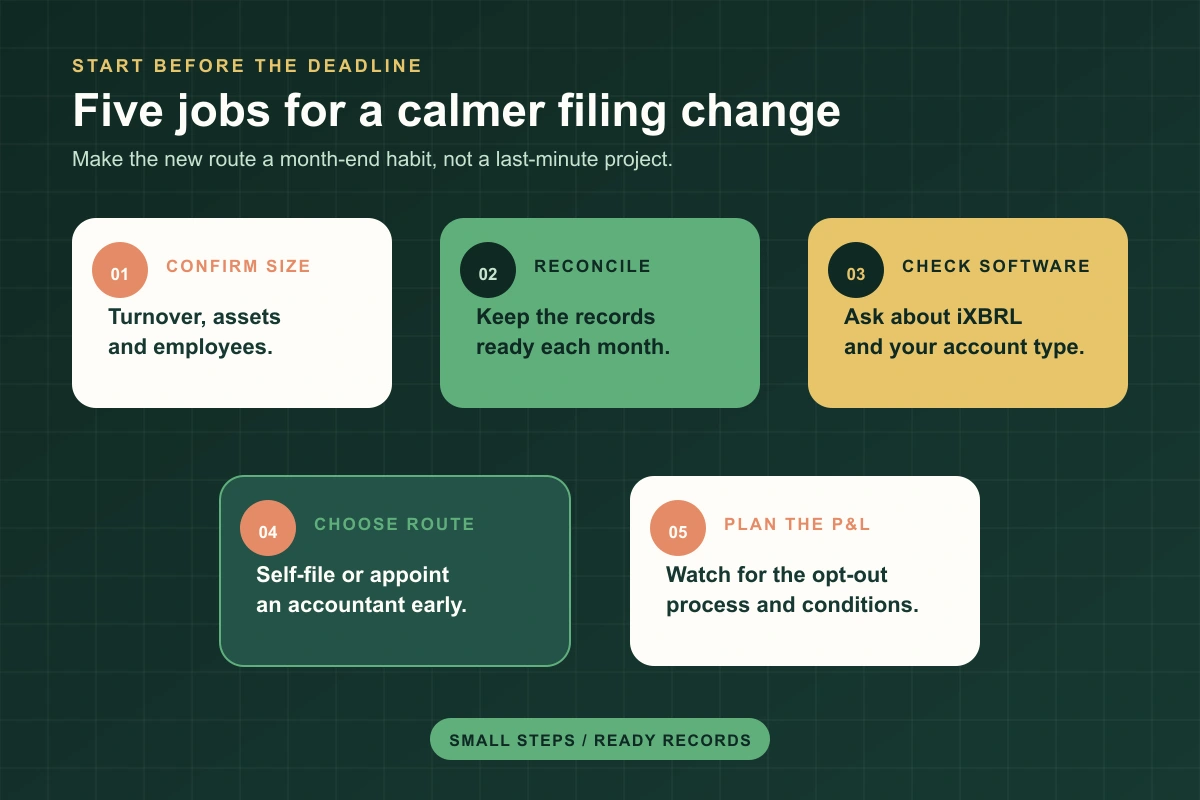
The best preparation is ordinary financial housekeeping done early enough to be useful. Put these jobs into the next few month-end reviews:
1. Confirm your company size and filing route
Record the turnover, balance sheet total and average employee count used for the current classification. Check the previous year too, because some exemptions depend on more than one accounting period. Note whether the company is part of a group or falls into a category that cannot use the small-company regime.
2. Reconcile the records every month
Match the bookkeeping ledger to business bank accounts, cards, payment processors and finance accounts. Attach sales invoices, purchase invoices and receipts to the transactions they explain. Keep payroll, pension and VAT records with the month they relate to. Our bookkeeping service can help put a repeatable month-end routine in place.
3. Ask software providers precise questions
Ask whether the package can prepare and file your account type in iXBRL format, when that feature will be available, how amendments work and whether all account components can be submitted together. Ask how data is exported if you change provider. A vague promise that the product is “Companies House compatible” is not enough.
4. Decide who will file the accounts
If you self-file, allow time to learn the software, set up presenter details and test the account format. If an accountant files for you, confirm that the firm has a plan for the April 2028 route. You still need to provide accurate records and approve the accounts.
5. Create a clear digital records pack
Use consistent names for statements, invoices, contracts, payroll reports and director paperwork. Keep a separate schedule for fixed assets, loans, dividends, personal expenses paid by the company and company expenses paid by directors. These items often create the questions that slow down accounts preparation.
6. Separate the P&L publication question from the tax question
The future opt-out may matter to your company, but it does not change how profit is calculated for Corporation Tax or how records are retained. Ask what will be public, what must still be delivered and which rules apply to your company’s accounts period.
Common mistakes to avoid before 2028
Treating April 2028 as the first time to look at the records
If your books are behind now, a filing-format change will not fix them. Start with bank reconciliations and a list of unexplained items. It is much easier to resolve a director balance or missing invoice while the transaction is fresh.
Assuming a privacy opt-out means the P&L does not matter
The P&L still needs to be prepared and delivered. The publication choice does not remove HMRC access, director responsibility or the need for evidence.
Buying software without checking the filing function
A package can be excellent for invoices and bank feeds but still not prepare statutory accounts or submit iXBRL. Get the answer in writing and ask which account types it supports.
Confusing the accounts deadline with the Corporation Tax deadline
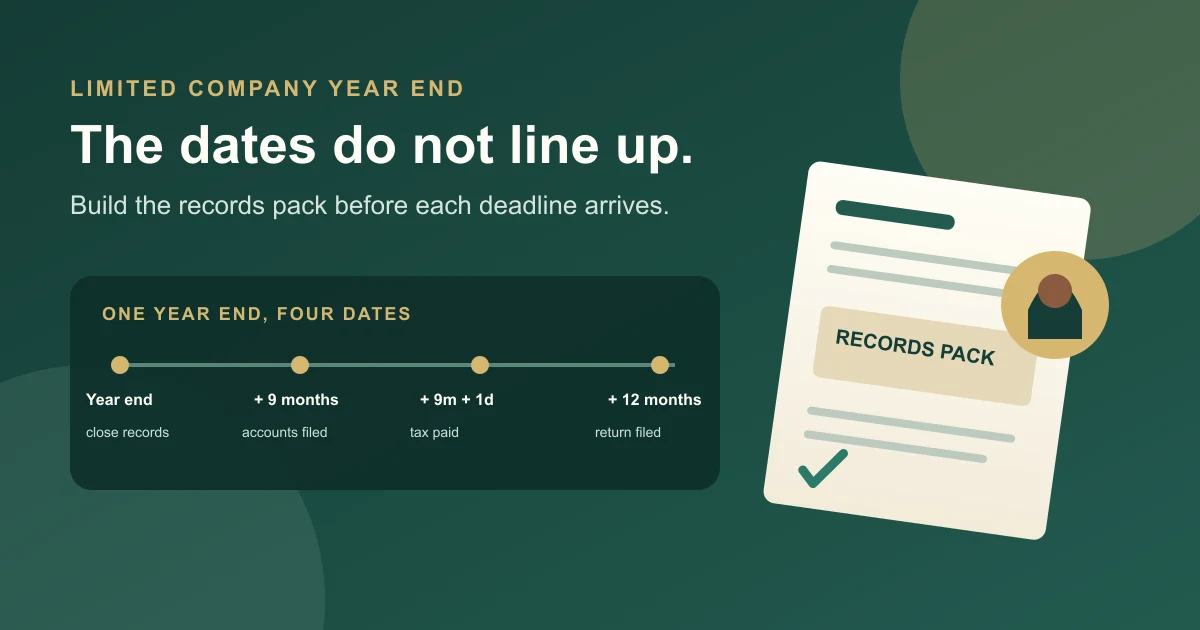
The usual dates sit close together, but they are not the same. A private company’s annual accounts are normally due nine months after the accounting reference date. Corporation Tax is normally due nine months and one day after the end of the Corporation Tax accounting period, while the Company Tax Return is normally due 12 months after that period ends.
Choosing an accounts format without checking eligibility
Micro-entity and small-company thresholds are not just labels for a website menu. Groups, regulated activities, public-company status and changing figures can affect eligibility. Check the relevant accounting period and the full conditions.
FAQs about Companies House accounts changes 2028
What are the Companies House accounts changes in 2028?
From 1 April 2028, all UK registered companies will need to file annual accounts using commercial software in iXBRL format. Small companies and micro-entities will need to deliver a profit and loss account, with an option to opt out of publication on the public register. Abridged accounts will no longer be available.
When do the new Companies House filing rules start?
The announced accounts reforms take effect from 1 April 2028. The government moved the timetable from April 2027 and says companies have one full accounting year plus nine months, or 21 months, to prepare. Check the final regulations for transitional detail.
Will micro-entities have to file a profit and loss account?
Yes. A micro-entity will need to prepare and deliver a copy of its P&L to Companies House from 1 April 2028. It will have an option to opt out of publishing the P&L on the public register, but the detailed process has not been confirmed.
Can a small company keep its profit and loss account private?
The announced package gives small companies and micro-entities an option to opt out of public-register publication. Companies House, HMRC and law enforcement will still have access. The conditions and procedure are still to be confirmed.
Can I still file accounts on paper or through WebFiling?
Not for annual accounts once the reforms take effect. Companies House says paper and web-based accounts filing will close from 1 April 2028. Web services will remain available for non-accounts filings such as confirmation statements and director updates.
What happens to abridged accounts?
The abridged-accounts option will be removed from 1 April 2028. Small companies will need to file full accounts prepared under the small companies accounting regime, subject to the planned P&L publication opt-out.
Do I need new accounting software before 2028?
Maybe. Self-filers should check that their chosen package can prepare and submit the right accounts in iXBRL format before 1 April 2028. If an accountant files for you, ask what software route the firm will use and what information it will need.
The sensible next step is a short accounts-readiness review, not a software purchase made in a hurry. Check the year end, size classification, records and filing route, then keep the answers with the company’s compliance calendar. If you want a second pair of eyes, use our contact page to arrange a review before the next year end.

About Golden Tree Consulting
ACCA Affiliated | MBA Qualified
Golden Tree Accounting & Business Consulting provides expert tax, bookkeeping, and advisory services to sole traders and SMEs across Croydon, London, Surrey, and Kent. With multilingual support and decades of combined experience, we help businesses stay compliant and grow.
More Articles You Might Like
Continue exploring our financial insights
Limited Company Annual Accounts: 2026 Records and Deadline Checklist
Limited company annual accounts checklist for 2026: records to prepare, Companies House and HMRC deadlines, examples and filing changes.
Corporation Tax Payment Deadline UK 2026: 1 October Guide for Small Companies
Corporation Tax payment deadline UK 2026 explained: calculate your bill, check 1 October dates, pay HMRC correctly and avoid late-payment interest.
IR35 for Contractors UK 2026: Inside vs Outside and What to Do Next
IR35 for contractors UK 2026 explained with inside and outside tests, CEST, client duties and practical records for your next contract.