HMRC Tax Adviser Registration: What Small Business Clients Need to Know Before 18 November 2026
HMRC tax adviser registration guide: ARN checks resume 18 November 2026. Learn what clients should ask, which checks continue and when to act.
 Golden Tree Accounting 23 October 2026 15 min read
On this page Show
- What HMRC tax adviser registration means for a small business client
- Keep 7, 17 and 18 November separate
- What the agent reference number checks pause does, and does not, change
- HMRC agent authorisation is a separate step
- What to ask your accountant before 18 November
- What if an adviser misses a registration step?
- HMRC tax adviser registration FAQs
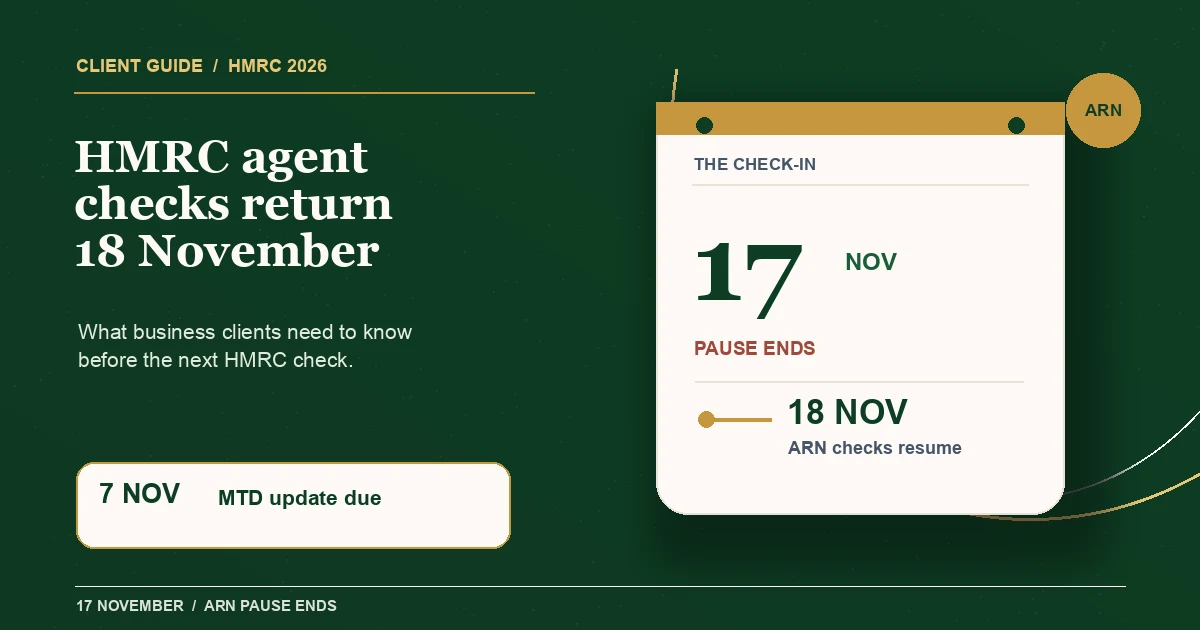
HMRC tax adviser registration has an important date for small business clients: 18 November 2026, when HMRC plans to resume agent reference number checks for some phone and webchat contacts. If you use an accountant or tax adviser, this change can sound like your return, tax account or access to HMRC is about to stop. The practical client action is simpler: ask your adviser which registration group applies to their work, and check any request to authorise a tax service before approving it.
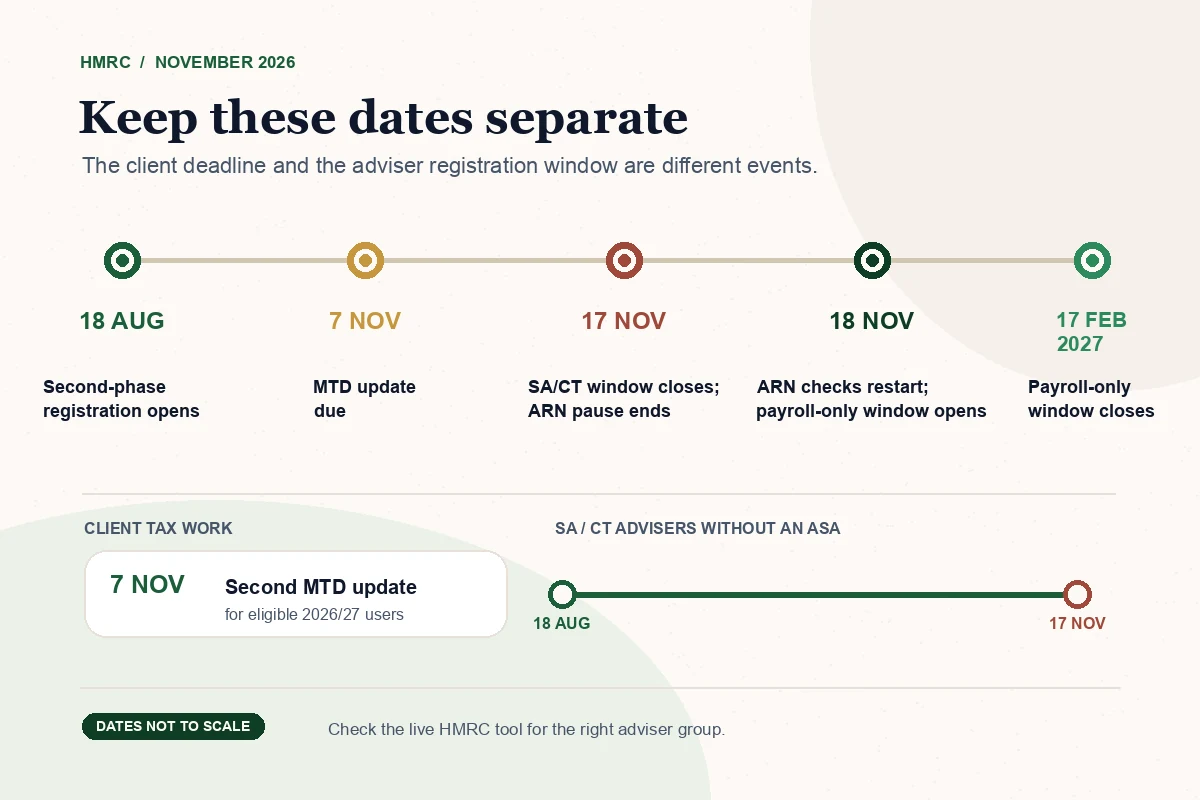
The dates can be easy to mix up. The detailed HMRC registration guidance gives some Self Assessment and Corporation Tax advisers until 17 November to register. HMRC says the paused agent reference number (ARN) checks resume on 18 November. A separate Making Tax Digital for Income Tax quarterly update is due on 7 November for people who need to use MTD in the 2026/27 tax year. Those dates relate to different jobs. HMRC set out the check pause and the MTD deadline in its 15 October Agent Update.
At a glance: You do not register as an agent to file your own tax return. HMRC’s new registration duty applies to paid businesses handling another person’s tax affairs, subject to exemptions. Ask your adviser whether it applies to them, keep normal security checks in place, and never share your Government Gateway password. The 7 November MTD update is a separate deadline for people required to use the service.
What HMRC tax adviser registration means for a small business client
HMRC is introducing mandatory registration for many tax advisers who interact with HMRC for a client as part of a paid business. The registration is mainly an obligation on the adviser or firm. It does not mean each small business must register as a tax adviser to file its own return, nor does it mean every existing client must start again with a new accountant.
The registration rules are being brought in by service group. An adviser who deals with Self Assessment or Corporation Tax may fall into a different window from a business that only provides payroll services. Some organisations and activities are exempt. A firm that already has an Agent Services Account (ASA) does not need to register again under this rollout. The right answer depends on what the adviser does for clients and which HMRC systems they use, so a single date should not be applied to every accountant.
The rules can affect how an adviser deals with HMRC on your behalf. They do not transfer responsibility for the accuracy of your tax return. You still need to give complete records, review questions from your accountant, and tell them when your circumstances change. If your adviser is checking a filing or an HMRC message with you, make sure the request is expected and relates to your business.
Running payroll for your own employees does not, on its own, make you a tax adviser under this registration process. HMRC lists employers and in-house tax teams dealing with their own staff as an exception. The registration question is about a business acting for somebody else, usually for payment. That distinction matters if you run a small payroll in-house but also pay an outside firm to deal with other taxes.
For practical purposes, treat this as an adviser status check. Ask the person handling your tax to explain whether their work is covered, which registration window applies, and whether HMRC has asked them for anything. You can also use HMRC’s tax adviser registration checker to see the categories and exceptions. The live guidance matters because a payroll-only business and an accountant handling tax returns do not necessarily follow the same timetable.
Keep 7, 17 and 18 November separate
Three November dates appear in current HMRC guidance and updates. Only one is a client submission date, and it applies to people required to use Making Tax Digital for Income Tax in 2026/27.
| Date | What happens | Who should pay attention |
|---|---|---|
| 7 November 2026 | Second quarterly update for the 2026/27 tax year is due | Sole traders and landlords who need to use MTD for Income Tax in 2026/27, including those whose 2024/25 qualifying income was over £50,000, subject to exemptions |
| 17 November 2026 | The detailed guidance shows the end of the current registration window for advisers handling Self Assessment or Corporation Tax without an ASA; HMRC’s temporary ARN check pause also runs through this date | Advisers in that registration group, and clients who want to understand what their accountant is doing |
| 18 November 2026 | HMRC says agent reference number checks resume for some phone and webchat contacts; the payroll-only registration window begins for the relevant advisers | Advisers in the payroll-only group and clients checking what a genuine HMRC contact may involve |
| 17 February 2027 | The detailed guidance shows the end of the payroll-only registration window | Advisers who provide only the services covered by that later group |
The dates are close together, but the tasks are not interchangeable. The 17 November and 18 November registration dates below come from HMRC’s detailed registration timetable. For an MTD start on 6 April 2026, HMRC’s current guidance uses qualifying income over £50,000 in the 2024/25 tax year. The qualifying income test covers self-employment and property income, and exemptions can apply.
HMRC writes to people selected from their latest return, but says a missing letter does not remove your responsibility to check whether you need to use MTD. Use its eligibility tool if you are unsure. The Agent Update sets out the 7 November deadline, and our guide to HMRC’s MTD letter explains how to respond. Your accountant’s mandatory registration deadline is a different matter, and does not extend or replace your MTD filing obligation.
A worked example: sole trader with a Self Assessment adviser
Suppose a freelance designer has used the same accountant for Self Assessment for several years. The accountant has an SA agent account but has not yet set up an ASA. The detailed HMRC guidance places advisers with Self Assessment or Corporation Tax services and no ASA in the window that runs from 18 August to 17 November 2026. The designer does not submit a tax adviser registration form. They can ask the accountant whether the firm falls into that group and whether it has made its application.
If the adviser applies within the correct window and HMRC is still considering the application, HMRC guidance says the adviser can continue interacting with HMRC while the application is processed. The client should keep responding to reasonable requests for records and should not assume that a return is automatically filed or delayed because of the registration process. Confirm the filing date and submission status directly with the adviser.
A worked example: limited company accountant that also runs payroll
Now consider a limited company that uses one firm for its Corporation Tax return, annual accounts and monthly payroll. The business does not fit the later payroll-only group just because payroll is one part of the service. The same firm also handles Corporation Tax work. The company should ask the accountant which registration group applies to the full service and whether it already has an ASA.
If you are planning your own year-end as well, keep company filing dates visible alongside this HMRC change. Our annual accounts service explains the support we provide with company records and statutory accounts. The date an adviser registers does not change the filing date shown for your company at Companies House or HMRC.
A worked example: a provider that only supplies payroll services
A business that only provides payroll services and has no ASA appears in the later group shown in HMRC’s detailed guidance: 18 November 2026 to 17 February 2027. If that provider also handles Self Assessment, Corporation Tax or other tax affairs for clients, it may not qualify for the payroll-only window. The provider should check its services against HMRC’s live guidance rather than relying on its job title or marketing description.
As a client, ask the provider whether it acts only on payroll or also contacts HMRC about other taxes for your business. Our payroll services page describes the records and approvals that help keep a payroll relationship clear. You do not need to send the provider your personal HMRC sign-in credentials to answer a registration question.
What the agent reference number checks pause does, and does not, change
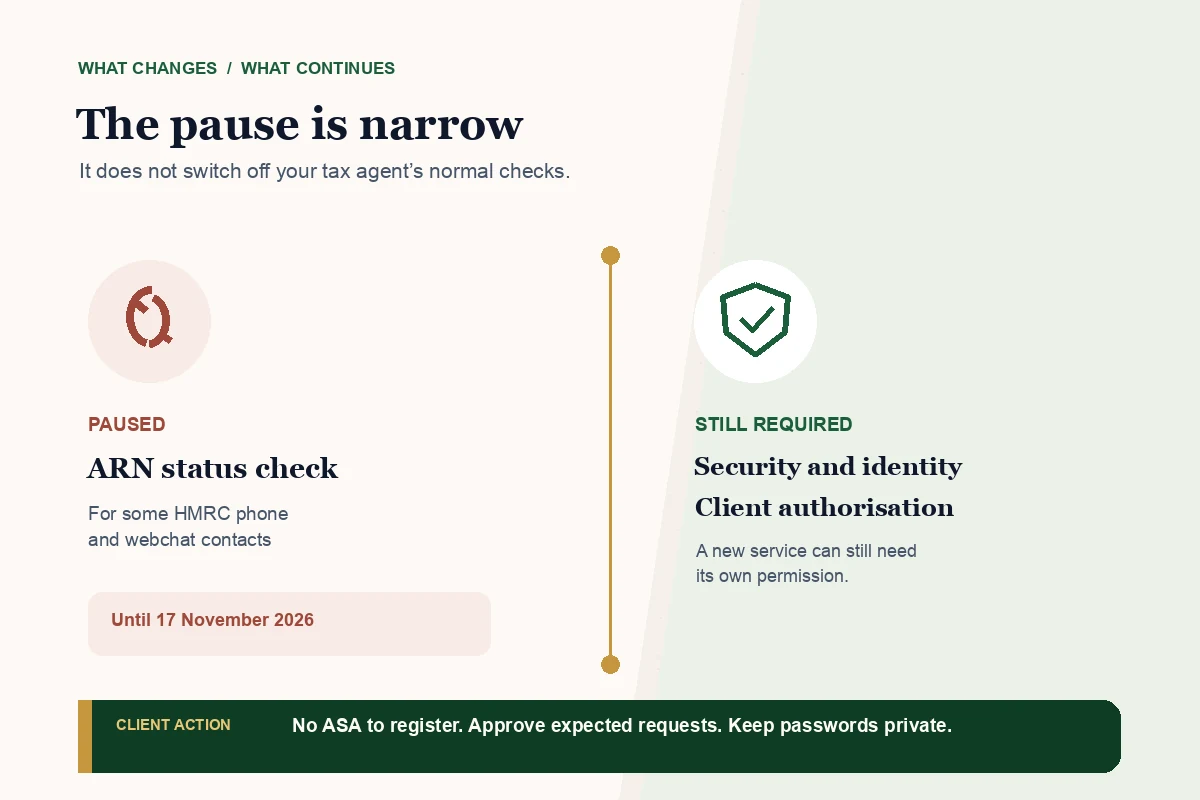
HMRC introduced checks asking some tax advisers for an agent reference number (ARN) when contacting HMRC by phone or webchat. The ARN is an identifier for the agent. HMRC paused those checks for these contact situations until 17 November 2026, and says they resume on 18 November. HMRC describes an ARN as 11 characters: four letters, including “ARN”, followed by seven digits, for example XARN1234567. It is not your personal tax reference, and the pause does not switch off every check HMRC makes. The Agent Update explains the scope of the pause, including the checks that continue.
HMRC says security, identity and client authorisation checks continue during the pause. It may also ask for an ARN in other situations. When checks resume, an adviser could be asked to confirm their details before discussing a client’s affairs through some phone or webchat routes. A conversation may take longer if an adviser has to complete a check, but the published update does not say that client tax accounts or returns will be disabled on 18 November.
Your part remains the same: keep your own login details private, respond to legitimate requests from your accountant, and approve only the tax services you want that adviser to handle. A pause in one agent check does not create permission for someone to bypass HMRC’s normal security process.
HMRC agent authorisation is a separate step
An adviser can register with HMRC and still need your permission before dealing with a tax service for you. Registration confirms information about the adviser or business. Authorisation connects that adviser to your tax records for a particular service. HMRC explains that clients must authorise agents separately, and a new service can require its own authorisation.
If your accountant asks you to approve access, check the service name and what they will do. For example, permission for Self Assessment does not automatically mean the same firm has permission for every other tax service. If you are a director, distinguish your personal Self Assessment from the company’s Corporation Tax or PAYE records. The message should match the work you have agreed with the firm.
Use the official HMRC route to grant or remove access. HMRC’s guide to applying for an Agent Services Account explains the relationship between an agent account and client authorisation. Its getting started guidance for tax agents also tells advisers to obtain authorisation and not use a client’s sign-in details.
Do not send your personal Government Gateway username, password or security codes by email, text, messaging app or phone. If an unexpected person contacts you, pause and call your accountant using a number you already trust. If you think someone has accessed your account, change your password and follow HMRC’s account security advice.
What to ask your accountant before 18 November
You do not need a long audit. A short written check can tell you whether anything needs to happen before a filing or payroll date. Ask:
- Does your work for my business fall under HMRC’s mandatory tax adviser registration rules?
- Which HMRC registration group applies to your services, and what is its date?
- Do you already have an Agent Services Account, or have you applied within the relevant window?
- Is there any client authorisation you need me to approve, and which tax service does it cover?
- Does this change affect a return, payroll run or quarterly update you are already handling for me?
Keep the reply with your engagement letter or bookkeeping records. It gives both sides a record of what was agreed without asking you to decide how HMRC classifies the adviser. If the answer is unclear, ask the firm to point you to the exact HMRC category it uses. The HMRC registration guidance should be the reference for the current date and any exception.
If your accountant says no action is needed, keep your usual process for sending records and approving filings. A registration change does not replace your bookkeeping routine. For example, keep invoices, bank records, payroll reports and HMRC letters in a place your adviser can access securely. Our Self Assessment service can help sole traders and individuals prepare returns from complete records.
What if an adviser misses a registration step?
If an adviser says they are late or unsure, ask what HMRC has told them and how it affects your work. Do not assume that every client filing is cancelled. HMRC allows an adviser to continue interacting during the relevant window and while an application is considered when they apply in their correct window. That does not create a general grace period for every adviser who has missed a date. The position depends on the adviser’s group, the date they applied and the services they provide. The registration guidance explains what happens after a missed window.
Ask for a clear plan for any return or payment that is due soon: who is preparing it, when you need to supply records, when you will review the figures, and how the submission will be confirmed. If a change of adviser is needed, get a copy of your bookkeeping data, prior returns, payroll records and HMRC correspondence. You can also check your own HMRC account and contact HMRC through official channels when a tax matter needs your attention.
An adviser registration issue does not remove your own obligation to meet a tax deadline. If you think a deadline could be missed, contact the adviser promptly and agree the next practical step. Keep copies of the messages and records you supplied. A specific conversation about an actual filing is more useful than trying to interpret the whole registration scheme from a headline.
HMRC tax adviser registration FAQs
Do I need to register with HMRC as a tax adviser for my own tax return?
No. The registration rules are aimed at businesses that interact with HMRC about another person’s tax affairs for payment, subject to exceptions. You remain responsible for your own return and need to meet your own filing and payment dates.
What changes on 18 November 2026?
HMRC plans to resume ARN checks for some agent phone and webchat contacts. It does not announce a general pause to tax filing or access to client accounts on that date. Your accountant should tell you if a specific service or authorisation needs attention.
Do I need to approve my accountant again when HMRC checks restart?
Not solely because the ARN check pause ends. Keep existing authorisations in place unless you want to change them. If your accountant asks for new permission, confirm the tax service and approve it through HMRC’s official process.
Does my accountant need a new Agent Services Account?
An adviser who already has an Agent Services Account does not need to register again under the mandatory registration process. The right position depends on the services the firm provides, so ask your accountant to confirm their status and check HMRC’s live registration tool.
Is the 7 November 2026 MTD deadline part of agent registration?
No. The quarterly update due on 7 November is for people who need to use MTD for Income Tax in 2026/27. The start-year test uses qualifying income from an earlier tax year. If you have not received a letter, HMRC says you are still responsible for checking. It is separate from the adviser registration window ending on 17 November and the ARN check restart on 18 November.
What should I do if I am unsure about an authorisation request?
Do not share a password or security code. Contact your accountant using a known number or email address and ask which tax service the request covers. You can review or change agent access through your HMRC account.
Before 18 November, save one written note of your adviser’s answer, check any authorisation request through HMRC, and keep your own filing dates in view. That is enough to keep the registration change separate from the tax work you already need to complete.

About Golden Tree Consulting
ACCA Affiliated | MBA Qualified
Golden Tree Accounting & Business Consulting provides expert tax, bookkeeping, and advisory services to sole traders and SMEs across Croydon, London, Surrey, and Kent. With multilingual support and decades of combined experience, we help businesses stay compliant and grow.
Offices in Croydon and London Bridge.
Related guides
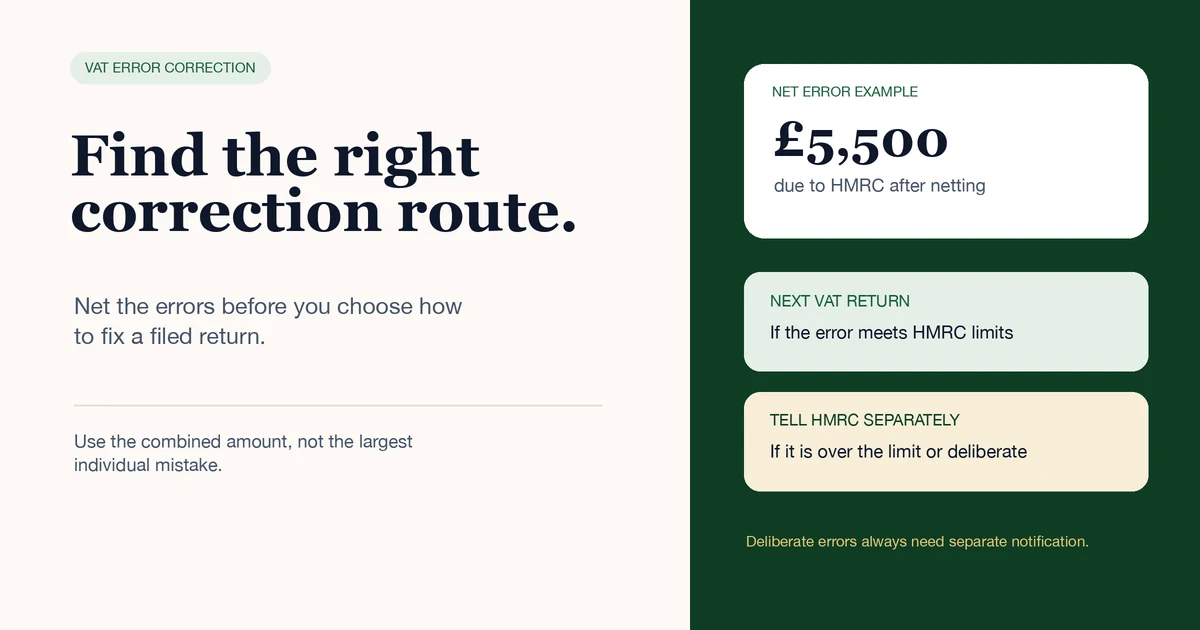
VAT Error Correction UK: How to Fix a Return After Filing
VAT error correction UK guide: learn when to adjust your next return, when to notify HMRC, how to calculate the net error and what records to keep.
UK E-Invoicing 2029: What Small Businesses Need to Know
UK e-invoicing 2029: the planned VAT invoice mandate explained. Learn what counts, who is affected, what PDFs mean and how small businesses can prepare.

HMRC MTD Letter 2026: What to Check If You've Been Signed Up
Received an HMRC MTD letter? Check the £50,000 qualifying-income test, correct changed income sources and catch up with the 2026/27 steps.