UK E-Invoicing 2029: What Small Businesses Need to Know
UK e-invoicing 2029: the planned VAT invoice mandate explained. Learn what counts, who is affected, what PDFs mean and how small businesses can prepare.
 Golden Tree Accounting 30 October 2026 16 min read
On this page Show
- UK e-invoicing 2029: what is changing?
- Who is affected by the UK e-invoicing mandate?
- What the e-invoicing roadmap says about timing
- What small businesses can do before the final rules
- Does this replace Making Tax Digital for VAT?
- Common assumptions to avoid
- UK e-invoicing 2029: frequently asked questions
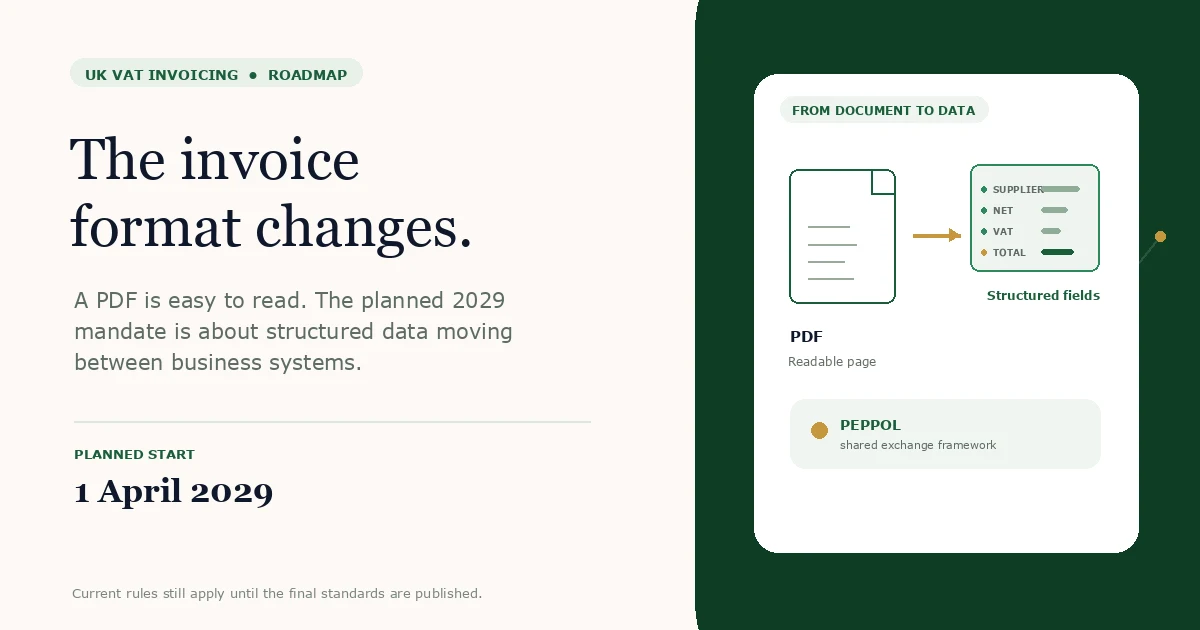
UK e-invoicing 2029 is a change to the way many VAT invoices will move between businesses. The government has announced that, from 1 April 2029, VAT-registered persons will need to issue and receive VAT invoices electronically, unless an exemption applies. The key point is that an e-invoice under this plan is structured data exchanged between financial systems. A PDF attached to an email may be electronic today, but a PDF on its own will not meet the roadmap’s future definition.
That gives small businesses time to prepare, but not enough detail to buy a new system on guesswork. Technical standards are due to be consulted on in Spring 2027. The government expects to publish detailed requirements between October 2027 and April 2028. Until those rules are settled, sensible preparation means understanding your invoice flows and asking your software provider what it plans to support.
At a glance: The planned start date is 1 April 2029. The mandate covers VAT invoices, not every receipt or business document. Peppol is named as the UK’s interoperability framework. A PDF alone is not the structured exchange described in the roadmap. There is no need to rush into a software switch before the technical rules are published.
UK e-invoicing 2029: what is changing?
An e-invoice for the planned mandate is not simply a picture or a document stored online. It is invoice information arranged in a structured format so one financial system can send it to another and the receiving system can read the fields as data. That can include the supplier, customer, invoice number, dates, line items, VAT treatment and amount due.
Think about the difference between sending a photograph of a till receipt and sending the transaction details in a format that bookkeeping software can process. A person can read both, but the second one carries fields that a system can sort and validate. The future standard will determine exactly which fields and formats are required. Those technical details have not been published yet.
The UK roadmap names Peppol as its core interoperability framework. In plain English, the framework is intended to help separate systems exchange e-invoices using common rules. It does not mean that every business will use the same accounting package, and it does not tell you which provider to buy. The detailed implementation design will answer more of those questions.
There is a wording trap here. Under HMRC’s current VAT Notice 700 guidance on electronic invoicing, a PDF sent electronically can be treated as an electronic invoice if the current conditions are met. The 2029 roadmap uses a narrower definition for the planned mandate: structured invoice data exchanged directly between financial systems. So a business may already email PDF invoices and still need a different way to meet the future requirement.
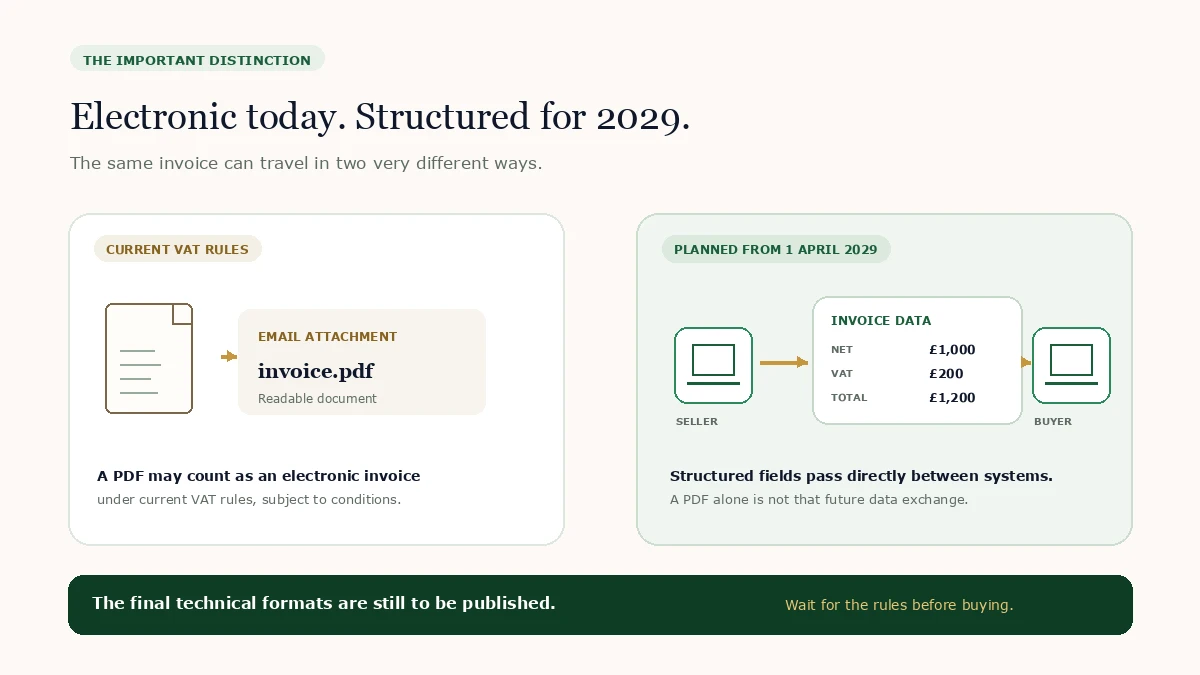
A £1,200 invoice, in today’s and future formats
Imagine a VAT-registered consultancy charging another VAT-registered company £1,000 plus 20% VAT for a piece of work. The invoice shows £1,000 net, £200 VAT and £1,200 to pay. Today, the consultant might email a PDF that contains the required invoice details. That can satisfy current electronic-invoice rules if the required controls are in place.
Under the roadmap, the relevant invoice would need to be issued in structured data and exchanged through a compliant process once the mandate begins. The receiving company’s software could read the supplier, date, net amount and VAT amount as fields, rather than relying on someone or a document-capture tool to extract them from the PDF. The invoice still needs to be accurate. Software cannot decide whether the service was correctly treated as standard-rated or whether the customer should reclaim the VAT.
The example assumes a UK standard-rated supply at 20%. The right VAT treatment depends on what is supplied and to whom. Reduced-rated, zero-rated, exempt, cross-border and special-scheme transactions have different rules. This guide explains the planned invoice format change, not how to classify every transaction.
A £72 sale to a consumer
Suppose a VAT-registered shop sells a standard-rated item to a consumer for £72 including VAT. At 20%, the VAT fraction is one-sixth, so the amount is £60 before VAT plus £12 VAT. A till receipt is normally enough unless the customer asks for a VAT invoice. This is why the 2029 announcement should not be read as a requirement to turn every till receipt into an e-invoice. The existing invoice rules and the final mandate details still decide which documents are in scope.
Who is affected by the UK e-invoicing mandate?
The roadmap says VAT-registered persons, including public sector bodies, will have to issue and receive VAT invoices electronically from 1 April 2029, subject to exemptions. That is the group to keep in view while details are being developed. It is broader than a rule aimed only at large companies, so a small VAT-registered business should not assume its size alone takes it outside the plan.
The mandate is tied to VAT invoices. It does not say that every sales receipt, quote, expense claim or internal document must become an e-invoice. Existing VAT rules determine when a VAT invoice is normally required. For example, a formal VAT invoice is generally required for a taxable supply to another VAT-registered business, while a shop does not normally have to issue a full VAT invoice to every consumer unless one is requested. Exceptions and special arrangements can apply.
| Business situation | What the roadmap means at this stage |
|---|---|
| VAT-registered supplier issuing a VAT invoice | Plan for an electronic structured invoice from 1 April 2029, subject to the final rules and exemptions. |
| VAT-registered business receiving VAT invoices | It will need a way to receive and process structured invoices under the mandate. |
| Business that is not VAT registered | Its own sales invoices are not VAT invoices. Do not assume the mandate makes it register for VAT. |
| Consumer receiving a till receipt | Do not assume every receipt becomes a structured e-invoice. The announced scope is VAT invoices, and the existing invoice rules still matter. |
| VAT-registered business using a PDF today | A PDF may meet current electronic-invoice rules, but a PDF alone does not meet the future structured-data definition. |
The government is developing an exemption for digital exclusion. The final eligibility test and the application process still need detail, so a business that may struggle to use digital services should not rely on an exemption until the rules are published.
The planned requirement also does not change the current VAT registration threshold or turn an unregistered sole trader into a VAT-registered business. A business near the registration threshold should continue to use HMRC’s VAT registration guidance to decide whether and when it must register. E-invoicing is a future format requirement for in-scope VAT invoices, not a replacement for the existing registration rules.
Twelve supplier invoices in one month
Take a VAT-registered design studio that receives 12 valid supplier invoices, each for £250 net plus £50 VAT at 20%. The month’s total is £3,000 net, £600 VAT and £3,600 payable. Under the future mandate, a structured receiving process may bring each invoice’s supplier, date and VAT amount into the studio’s bookkeeping system as data. Staff should still check the supplier, business purpose, VAT rate and evidence before claiming the £600 as input VAT. Faster data entry does not make an incorrect invoice valid.
What the e-invoicing roadmap says about timing
There are several years between the announcement and the planned start. That period is for standards, final requirements and implementation work. It is not a reason to wait until 2029 to ask how your business invoices customers.
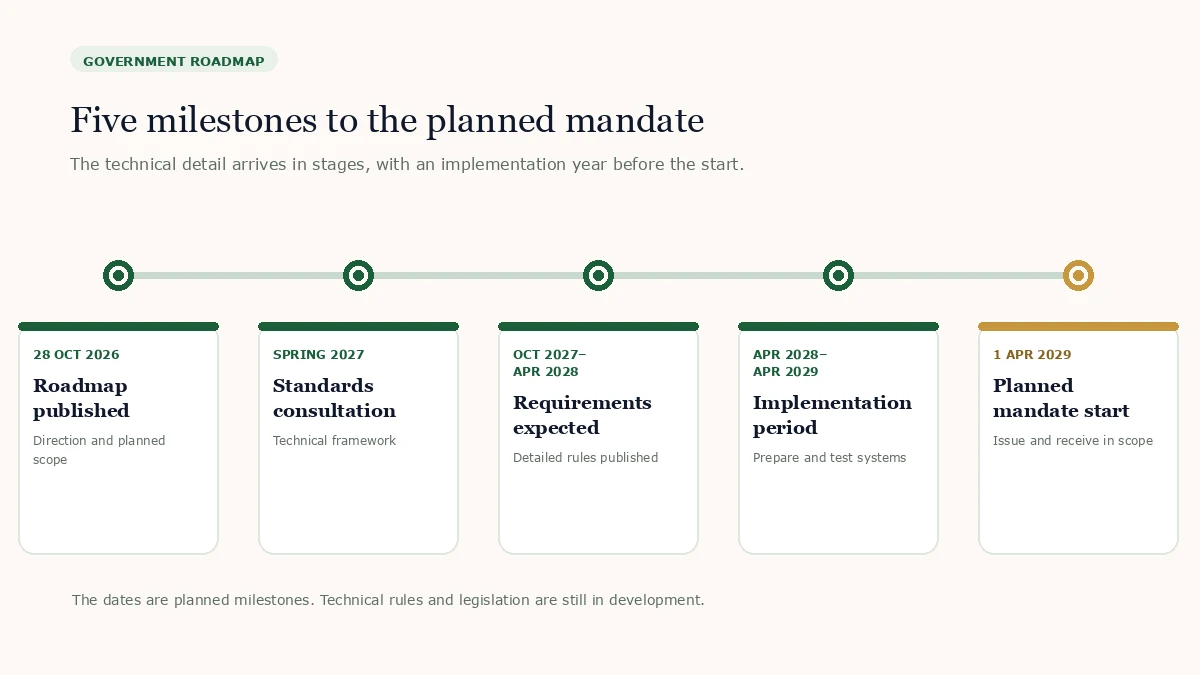
| Expected date | Government milestone | What a small business can do |
|---|---|---|
| 28 October 2026 | The government publishes its e-invoicing roadmap. | Read the published scope and keep the announcement with your tax-planning notes. |
| Spring 2027 | Consultation on technical standards is planned. | Follow the consultation if invoice formats or software choices affect your business. |
| October 2027 to April 2028 | Detailed requirements are expected to be published. | Compare your software provider’s documented support with the final requirements. |
| April 2028 to April 2029 | The roadmap allows an implementation period. | Test the invoice exchange with customers and suppliers before the start date. |
| 1 April 2029 | The planned mandate begins. | Issue and receive in-scope VAT invoices using a process that meets the final rules. |
These are roadmap dates, not a statement that every technical rule is already law. The official e-invoicing roadmap sets out the government’s plan. Its companion e-invoicing requirements paper explains the policy direction and says enabling provisions are intended for Finance Bill 2026-27. Parliament and future technical guidance still matter.
The roadmap also distinguishes the invoice mandate from digital reporting to HMRC. HMRC’s separate consultation on possible e-invoicing digital reporting runs until 20 January 2027. It asks for views on whether, and in what circumstances, selected invoice data could be used by government. The consultation does not introduce a reporting duty, and no decision to add one has been made. The roadmap says the UK Peppol Authority will not receive copies of VAT invoices. Do not assume that structured invoicing means HMRC automatically gets every invoice.
What small businesses can do before the final rules
Preparation now should be small, useful and reversible. You can make a clear map of what already happens without replacing software or changing a valid invoice process years ahead of the mandate.
1. Map your sales and purchase invoices
Write down how a typical invoice travels from creation to payment. For sales, note the person or system that creates it, how it reaches the customer and where the paid amount is recorded. For purchases, note how supplier invoices arrive, who checks them and how they reach the bookkeeping system.
Include the exceptions. Some businesses use a platform for sales, a separate payroll provider, a bookkeeper’s portal or spreadsheets for one customer. Those paths are easy to miss if you only look at the invoice template. Our small business bookkeeping service can help bring sales documents, supplier bills and bank records into one review.
2. Identify which invoices are VAT invoices
Do not count every document in the business as an invoice that will be covered. Separate VAT invoices from receipts, quotes, pro-forma invoices, statements and documents for transactions where a VAT invoice is not normally required. Ask your accountant about unusual sales, exports, reverse charge transactions or special VAT schemes.
Our UK VAT invoice requirements guide covers the existing invoice information and common format choices. That remains useful now. The roadmap changes the exchange format in future; it does not remove the need for correct VAT invoice details.
3. Ask your software provider a specific question
Instead of asking whether a product is “ready for 2029”, ask what the provider will support after the technical standard is final. Will it be able to create, send, receive and retain structured VAT invoices? Will it connect to other systems using the UK framework? Will you need a separate service, and how will invoices be reviewed before they enter the books?
A provider may not be able to give a definitive answer today because the required technical detail is not final. That is fine. Note the response and ask again when the government publishes the standards. Be cautious about sales claims that promise complete compliance before the rules they rely on are settled.
4. Check your customer and supplier mix
List the businesses you invoice regularly and the suppliers from whom you receive VAT invoices. If most transactions are with a few customers, discuss the expected exchange method with them after the technical rules are clearer. A format only works when both sides can send and receive the data.
This is also a good time to remove duplicate customer records and make sure VAT numbers, registered names and addresses are current. Structured exchange can move information faster, but it will not correct a supplier master record that has been wrong for years.
5. Keep the VAT check in place
Automation can reduce rekeying, but it does not remove your responsibility to account for VAT correctly. Keep a person responsible for checking unusual rates, credit notes, duplicate invoices, missing purchase evidence and transactions that belong in a different VAT period. A machine-readable invoice is still only as useful as its source data and the checks around it.
If you currently file VAT through accounting software, carry on following the digital record and return rules that apply today. Our VAT returns team can review your current process and help you list the questions to revisit when the final e-invoicing specification is available.
Does this replace Making Tax Digital for VAT?
No. Making Tax Digital for VAT concerns digital records and the way most VAT returns are submitted. E-invoicing concerns the format used to exchange in-scope invoices between supplier and customer systems. They relate to VAT records, but one does not automatically satisfy the other.
A business may already keep digital VAT records and submit returns through compatible software while still emailing PDFs to customers. That workflow can be valid under current rules. The 2029 mandate is intended to add structured invoice exchange for in-scope VAT invoices. The final technical rules will explain how invoice data must connect to the systems a business already uses.
Do not assume that buying an MTD-compatible package today guarantees it will meet every future e-invoicing requirement. Ask the provider about its roadmap and wait for the government’s detailed standards before making a decision based on a specific feature list.
Common assumptions to avoid
“We already send PDFs, so we are covered.” A PDF may be electronic under current VAT guidance, but it is not, by itself, structured data passed between systems as described in the 2029 roadmap.
“We have to replace our accounting package now.” The technical standards consultation is not scheduled until Spring 2027, and detailed requirements are expected later. Review options when there is enough information to compare them.
“Every invoice or receipt will go through Peppol.” The announced mandate is for VAT invoices. A quote, till receipt or internal expense document does not automatically become one. Existing VAT invoice rules and the final scope matter.
“HMRC will receive every invoice.” The roadmap says the Peppol Authority will not receive copies of VAT invoices. A separate proposal about digital reporting remains under consideration, with no decision to introduce it announced.
“The exemption will cover us because our business is small.” The government is developing a digital-exclusion exemption, but its detailed test has not been published. Size alone should not be treated as an exemption.
UK e-invoicing 2029: frequently asked questions
What is e-invoicing in the UK?
For the planned 2029 mandate, an e-invoice is structured invoice data exchanged directly between a supplier’s and customer’s financial systems. The receiving system can read the invoice fields as data. A PDF or scan on its own is not this structured exchange.
Is e-invoicing mandatory in the UK?
The government has announced a planned mandate from 1 April 2029 for VAT-registered persons to issue and receive VAT invoices electronically, subject to exemptions. The detailed technical rules and legislation are still to come, so the plan should not be described as a fully implemented current requirement.
Who will need to use e-invoicing from 2029?
The roadmap covers VAT-registered persons who issue or receive VAT invoices, including public sector bodies, subject to exemptions. It does not say that every business document or consumer receipt must become an e-invoice. Check the final scope when the detailed rules are published.
Will a PDF invoice meet the 2029 e-invoicing requirement?
A PDF emailed to a customer can count as an electronic invoice under current VAT rules. A PDF alone does not meet the roadmap’s future definition of structured data exchanged between financial systems. The final standards will say which formats and exchange arrangements are acceptable.
When will the UK e-invoicing technical rules be published?
The government plans to consult on technical standards in Spring 2027. It expects to publish detailed requirements between October 2027 and April 2028, at least 12 months before the planned 1 April 2029 start.
Do I need to change my accounting software now?
No immediate software change is required by the roadmap timetable. Map how your invoices move and ask your provider about its plans. Review the answer against the published technical rules before committing to a migration.
The practical next step is to save the roadmap, note which customers and suppliers exchange VAT invoices with you, and ask your software provider for its next update after the Spring 2027 consultation. If you want help reviewing your current VAT records and invoice flow, speak to our VAT team and we can make a short list of the decisions that can wait for the final rules.

About Golden Tree Consulting
ACCA Affiliated | MBA Qualified
Golden Tree Accounting & Business Consulting provides expert tax, bookkeeping, and advisory services to sole traders and SMEs across Croydon, London, Surrey, and Kent. With multilingual support and decades of combined experience, we help businesses stay compliant and grow.
Offices in Croydon and London Bridge.
Related guides
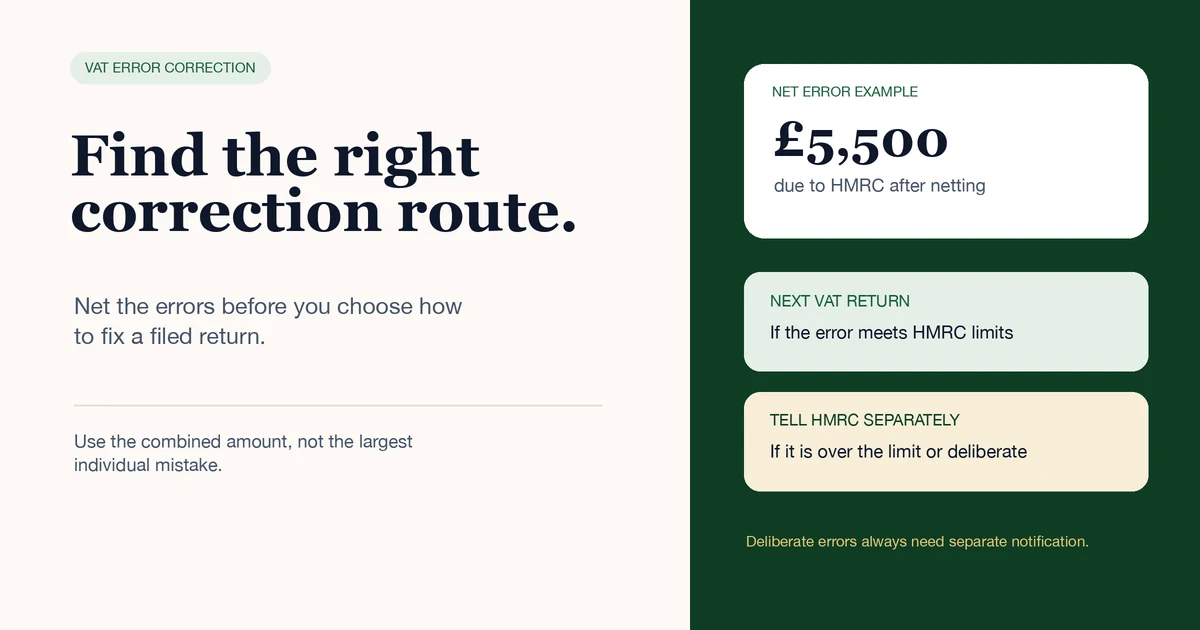
VAT Error Correction UK: How to Fix a Return After Filing
VAT error correction UK guide: learn when to adjust your next return, when to notify HMRC, how to calculate the net error and what records to keep.
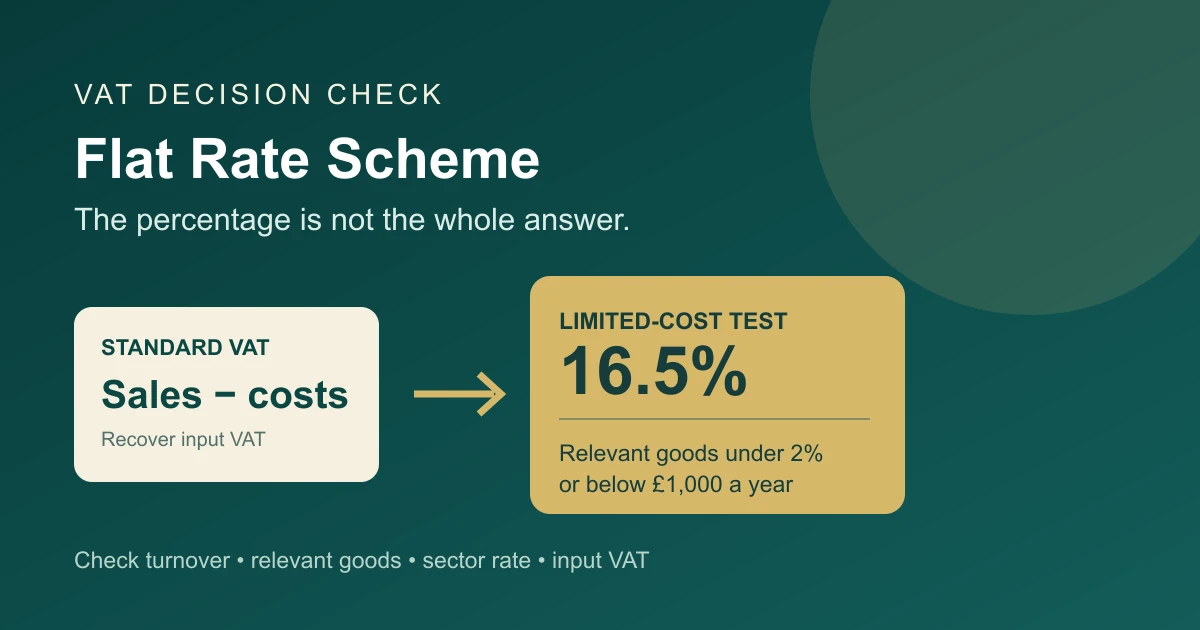
VAT Flat Rate Scheme 2026: Is the 16.5% Rule Costing Your Business Money?
VAT Flat Rate Scheme 2026 guide for small businesses, covering the 16.5% limited-cost rule, thresholds, examples and exit checks.
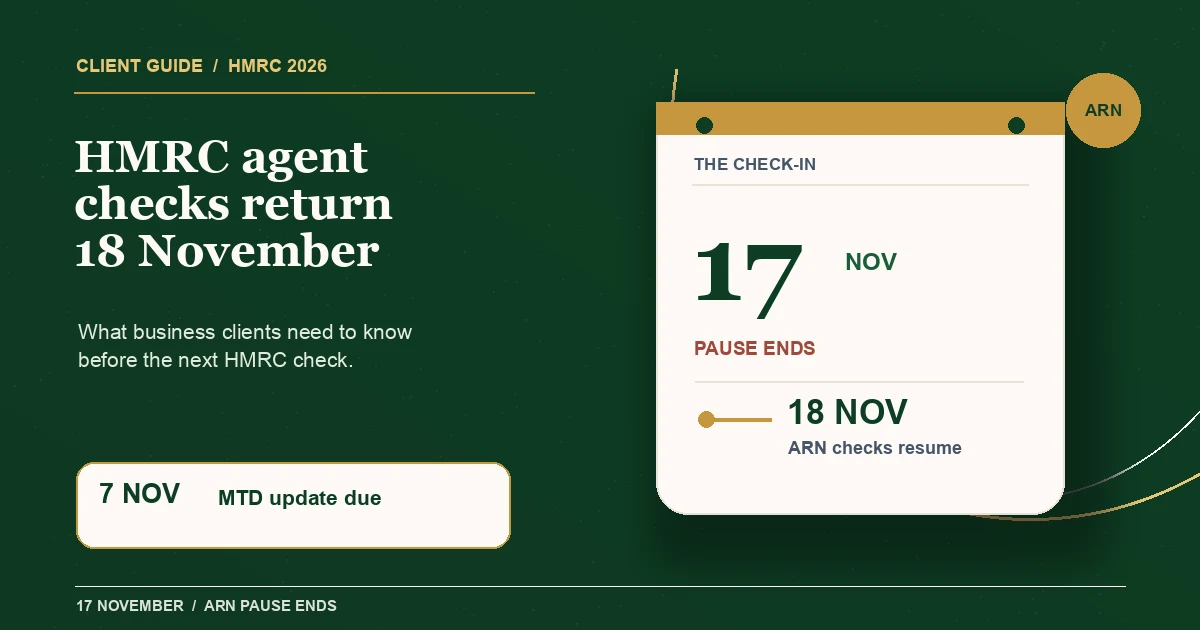
HMRC Tax Adviser Registration: What Small Business Clients Need to Know Before 18 November 2026
HMRC tax adviser registration guide: ARN checks resume 18 November 2026. Learn what clients should ask, which checks continue and when to act.