VAT Error Correction UK: How to Fix a Return After Filing
VAT error correction UK guide: learn when to adjust your next return, when to notify HMRC, how to calculate the net error and what records to keep.
 Golden Tree Accounting 2 November 2026 16 min read
On this page Show
- How to correct a VAT return in the UK
- Work out the net value of the VAT error
- VAT error correction UK thresholds and the Box 6 test
- How to adjust an eligible error on your next return
- When to tell HMRC about a VAT error separately
- How long do you have to correct a VAT return?
- Penalties and interest after a VAT return error
- A short process for your next VAT close
- VAT error correction UK: common questions
VAT error correction UK rules give you two routes after a return has been filed: adjust your next return for an eligible net error, or tell HMRC separately. For businesses with a VAT period ending 30 September 2026, the usual online filing and payment deadline is 7 November. It falls on a Saturday, and HMRC says the return deadline does not move to the next working day. Allow time for your payment to reach HMRC. Checking the figures now may bring an older error to light, but the deadline does not change the correction route for a return you already sent.
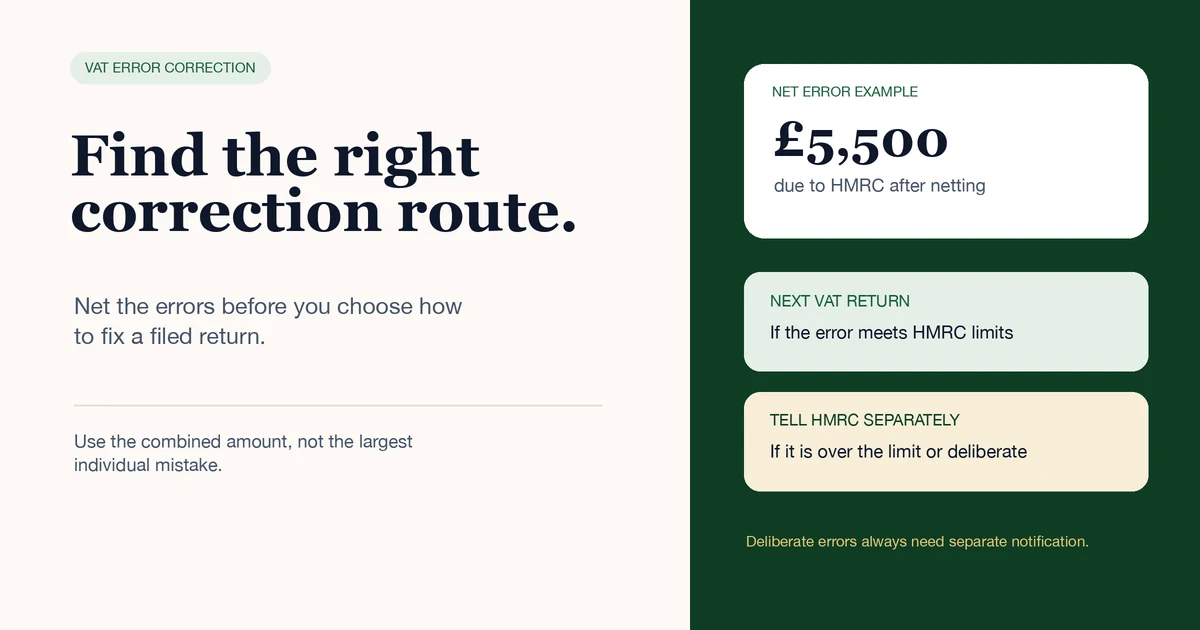
The amount to compare with HMRC’s limits is the net value of the errors, not the largest individual mistake. Add the VAT owed to HMRC, subtract the VAT due back to you, then compare the result with the £10,000 and £50,000 limits and, where needed, the Box 6 test. Deliberate errors always need separate notification.
Quick answer: you do not normally replace an already filed VAT return by sending the same period again. An eligible correction goes on your next return. Larger errors, errors outside the limits and deliberate errors must be reported to HMRC through its separate error-correction process.
How to correct a VAT return in the UK
The first question is whether HMRC has received the return. If the return is still a draft, correct the bookkeeping records and the figures before filing. Keep a note of what changed and why, then submit the accurate return for that period.
If you have already filed it, use HMRC’s correction process. In broad terms, a qualifying net error can be included on your next VAT Return. If it is too large, fails the Box 6 test or was deliberate, you must notify HMRC separately. The rules are in HMRC’s guide to correcting errors in a VAT Return and the more detailed VAT Notice 700/45.
That is different from fixing an invoice. If a supplier’s VAT invoice is wrong, ask for a replacement invoice or credit note and make sure you have the right evidence before reclaiming input VAT. Our guide to UK VAT invoice requirements explains what the document should show. A change in the price after a sale, a credit note, a partial-exemption adjustment and a genuine bad-debt relief claim also have their own VAT treatment. They are not automatically errors on an old return.
The distinction matters because a VAT return can be wrong even when the invoice looks fine. A missed sale, duplicate purchase entry or incorrect VAT code may change the return total without changing the document itself. Start with the accounting records, not with a second attempt to file the old period.
Work out the net value of the VAT error
HMRC asks you to net the errors found in earlier returns. First total the amounts that mean more VAT is due to HMRC. Then total the amounts that mean VAT is due back to the business. Subtract the second total from the first.
Include errors across the affected earlier periods in the calculation. Do not calculate each invoice in isolation and choose a correction route for each one. The figure is the combined net amount, and you should retain a period-by-period schedule so another person can follow your arithmetic.
Worked example: underpaid and overclaimed VAT
A business finds three mistakes while preparing its next return:
| Error found | VAT effect |
|---|---|
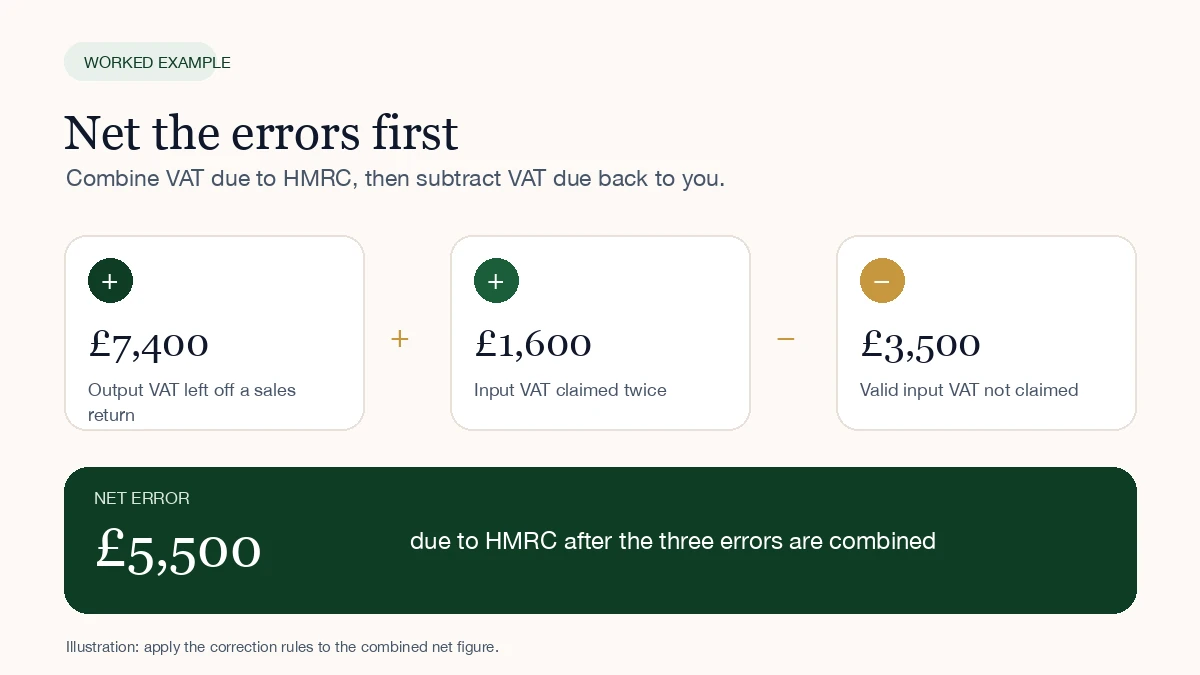
| A sales invoice was left out, so output VAT was underdeclared | £7,400 due to HMRC |
| Input VAT was claimed twice on a supplier bill | £1,600 due to HMRC |
| A valid purchase invoice was missed, so input VAT was underclaimed | £3,500 due back to the business |
| Net error | £5,500 due to HMRC |
The total due to HMRC is £9,000. Subtract the £3,500 due back to the business and the net error is £5,500 payable. If the errors were not deliberate and the combined amount meets HMRC’s limits, the business can usually add the net figure to its next return.
Deliberate errors do not go into the ordinary netting calculation. Keep them separate and notify HMRC, even if other errors would reduce the overall amount. If you are dealing with more than one VAT period, list each amount by period before you calculate the net figure.
VAT error correction UK thresholds and the Box 6 test
Once you have the net amount, choose the correction route. HMRC’s rules for errors in previously submitted returns are:
| Net value of errors | Correction route |
|---|---|
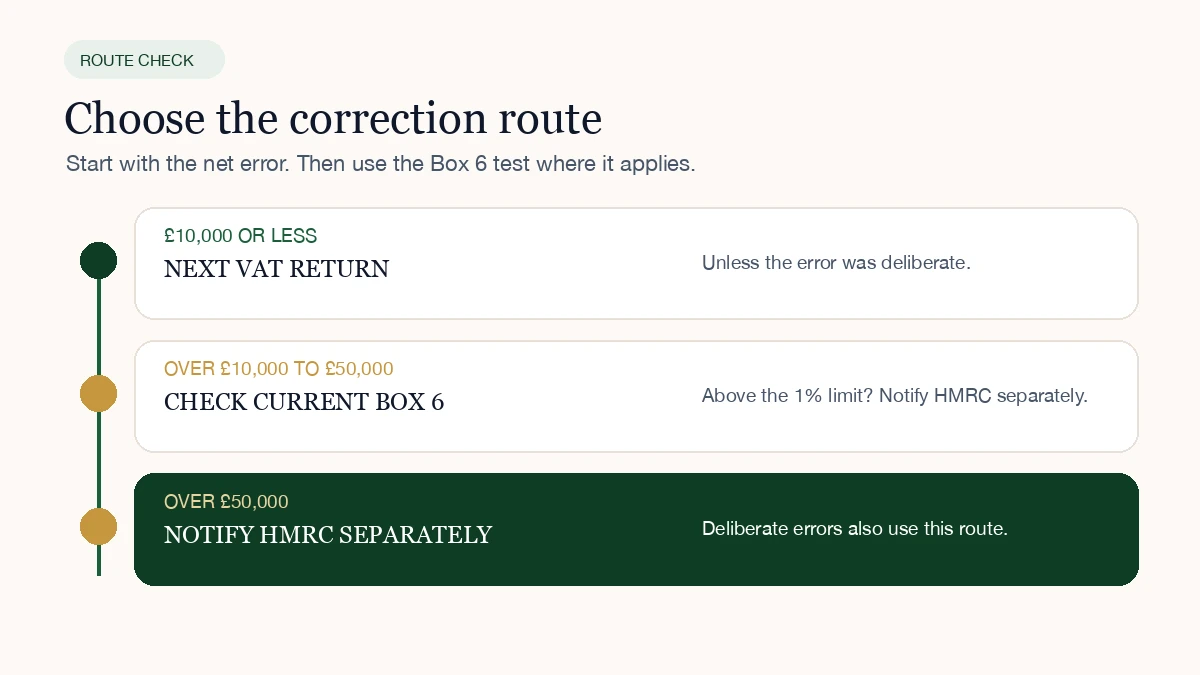
| £10,000 or less | Usually adjust your next VAT Return |
| More than £10,000 and up to £50,000 | Adjust your next return only if the amount meets the Box 6 test for the return period in which you found the error |
| More than £50,000 | Notify HMRC separately |
| Any amount if the error was deliberate | Notify HMRC separately |
For an error above £10,000, the relevant comparison is with Box 6, net outputs, on the VAT Return for the period in which you discover the error. HMRC’s detailed notice says the net error can be adjusted on the next return when it does not exceed 1% of that Box 6 figure, subject to the £50,000 cap. If it exceeds the Box 6 limit, use the separate notification route. If your figure is close to the boundary, check HMRC’s current wording before submitting.
Worked example: the same net error, a different Box 6 figure
Suppose your net error is £18,000. Your current return has Box 6 net outputs of £1,200,000. One per cent is £12,000, so the £18,000 error is above the Box 6 limit. You must tell HMRC separately.
If Box 6 were £2,000,000, one per cent would be £20,000. The £18,000 error is below that figure and under £50,000, so the next-return route may be available, provided the error was not deliberate and the other conditions are met.
Do not confuse the Box 6 test with the VAT registration threshold, the amount of VAT you owe or your profit. It is a percentage comparison using the current return’s Box 6. When you are deciding the route, use the VAT Return for the period in which you found the error, not the older return where it first appeared.
HMRC also lets you choose to report an error separately even when it is small enough for a next-return adjustment. That can be useful where the facts are complicated or you want HMRC to consider a disclosure for penalty purposes.
Worked example: a deliberate error below £10,000
A retailer finds that £4,800 of output VAT was deliberately left off a submitted return. The amount is below £10,000, but the ordinary next-return threshold does not apply to deliberate errors. The retailer must notify HMRC separately and keep the original sales records, the calculation and an explanation of how the omission happened.
How to adjust an eligible error on your next return
For a qualifying net error, HMRC says to add the amount to your next VAT Return. Put extra VAT due to HMRC in Box 1. Put VAT due back to the business in Box 4. The correction belongs in the return for the period in which you found the error, not as a replacement filing for the old period.
Record the correction in your VAT account and keep the working behind it. The note should show when you found the error, which period it belongs to, what went wrong, the amount and how you worked it out. Save relevant sales invoices, purchase invoices, bank records, credit notes and any explanation from the person who found the mistake.
A later adjustment does not erase the history of the original return. If HMRC asks how the next return changed, your records should make the link easy to trace. The general rules for keeping those records are covered in our guide to how long to keep business records in the UK.
If the correction increases the amount payable, budget for it before the next payment date. You may owe interest from the original VAT payment due date if the earlier return meant you paid too little on time. An adjustment on a later return does not automatically remove that interest.
When to tell HMRC about a VAT error separately
You must use the separate notification route when the net error is over £50,000, when an error above £10,000 fails the Box 6 test, or when the error was deliberate. HMRC also allows you to use this route for errors of any size.
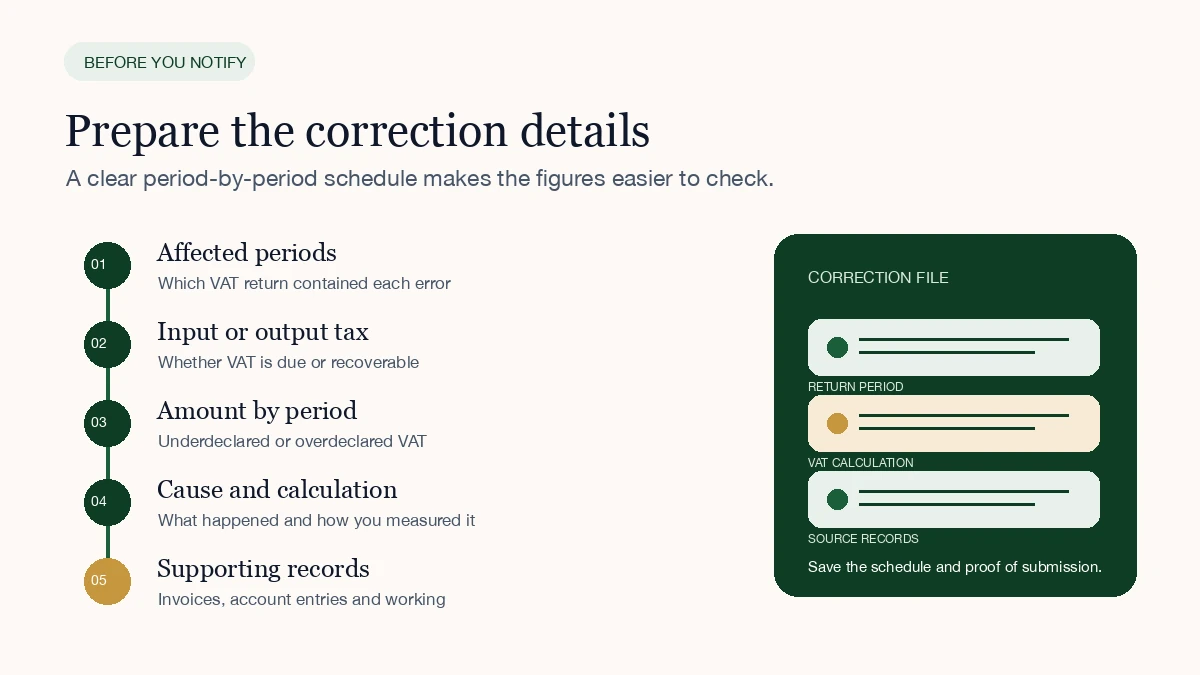
The current HMRC online error-correction service asks for details that let it understand the error and check your calculation. Prepare these before you start:
- how each error happened
- the VAT accounting period affected
- whether it is an input tax or output tax error
- the amount underdeclared or overdeclared in each period
- how you calculated the VAT difference
- whether the error caused you to pay HMRC money that was not due
- the total adjustment or refund you are claiming
HMRC’s notice gives written contact details for businesses that cannot use the online service. Follow the current instructions in VAT Notice 700/45 rather than relying on an old copy of a VAT652 form or an address saved in a previous file. If you make a written notification, include your VAT registration number and the same period-by-period calculation.
If a single error is already large enough to breach the £50,000 limit or the Box 6 test, HMRC says you should notify it promptly rather than waiting until the end of the next VAT accounting period. Keep a copy of what you send and any response. If HMRC does not confirm receipt within the period stated in its notice, contact the error-correction team.
How long do you have to correct a VAT return?
For most non-deliberate errors, the time limit is four years, but the exact start date depends on the type of mistake. For underdeclared or overdeclared output VAT and overclaimed input VAT, the four years normally run from the end of the VAT accounting period in which the error happened. For underclaimed input VAT, HMRC counts from the due date of that return.
There is a limited exception for a tax-point error where VAT was declared on the return immediately before or after the return where it belonged, as long as the later return is within the four-year window. HMRC’s detailed notice also says the ordinary four-year limit does not apply to deliberate errors. If a correction is old, near the limit or involves more than one accounting period, get advice before relying on the general rule.
If you forgot to reclaim input VAT
You need to have incurred the input VAT and hold the associated VAT invoice before you claim it. If the invoice was missing when the return was due, HMRC says you can usually claim the input VAT on a later return once you receive the evidence, subject to the time limit.
If you already had the invoice and the right to reclaim but left the amount off the return, the earlier return may contain an error. Add the amount to your net-error schedule and apply the normal correction limits. Our guide to claiming VAT back in the UK explains what usually supports an input tax claim.
If you charged a customer too much VAT, a refund claim can also raise an unjust enrichment question. In plain English, HMRC may refuse a repayment if the business passed the mistaken charge to the customer and would keep the repayment without reimbursing them. Check the rules before treating a gross refund figure as money the business can retain.
Penalties and interest after a VAT return error
Finding and correcting a mistake does not always mean there will be a penalty. HMRC says it will not charge an inaccuracy penalty where the error happened despite the business taking reasonable care. A careless or deliberate error can lead to a penalty. If you discover an error and leave it uncorrected, HMRC may treat it as careless.
There is a detail that is easy to miss: an adjustment on the next VAT Return is not, by itself, a disclosure for penalty purposes. If an error may have resulted from careless conduct, HMRC’s notice says you should tell it separately if you want it to consider a lower penalty. Telling HMRC before it starts an enquiry can affect how a disclosure is treated, but it does not guarantee that a penalty will be reduced to zero.
Interest is separate. If the error meant VAT was paid late or underpaid by the original due date, late payment interest may apply even after you correct the return. Late-submission penalties are a different system again. For current details, use HMRC’s VAT penalties and interest guidance. A correction does not cancel a late return or payment penalty that has already arisen.
A short process for your next VAT close
Use the same sequence each time you find a possible old error:
- Check the filing status. If the period is still a draft, correct the records and file the accurate return. If it was submitted, do not send it again as a replacement.
- Identify every affected period. Note the tax point, the return where the figure was reported and the period where it should have appeared.
- Separate output tax from input tax. Mark whether each amount means more tax is due to HMRC or more is due back to your business.
- Calculate the net error. Add all amounts due to HMRC and subtract amounts due to you. Keep deliberate errors separate.
- Apply the limits. Check the £10,000 threshold, Box 6 percentage and £50,000 cap using the period in which you discovered the error.
- Use the right route and keep the proof. Adjust the next return or notify HMRC separately, then save your calculations, documents and confirmation.
You can use our VAT returns service if you want an accountant to review the figures and correction route before you file. That is particularly useful when a business has mixed VAT rates, several affected periods, a refund claim or an error close to the four-year limit. The current VAT return dates guide has the filing and payment dates for each quarterly stagger.
VAT error correction UK: common questions
How do I correct a VAT return after submitting it?
Calculate the net value of the errors across the affected earlier returns. If the amount meets HMRC’s limits and the errors were not deliberate, add the correction to your next VAT Return. If the error is over the limit, fails the Box 6 test or was deliberate, notify HMRC separately.
Can I resubmit or amend an old VAT return?
Do not send the same return a second time to replace the first one. Correct the accounting records and use one of HMRC’s error-correction routes. If the return is still a draft and has not been submitted, fix it before filing.
What is the VAT error correction threshold?
A net error of £10,000 or less can usually be adjusted on the next return. If the net error is more than £10,000 but no more than £50,000, you can use that route only when the error meets the Box 6 test. An error over £50,000 or a deliberate error must be reported separately.
How far back can I correct a VAT return?
The usual time limit is four years, but the starting date varies for some input tax claims. A tax-point error moved between adjacent periods has a limited exception, and deliberate errors are not covered by the ordinary four-year limit. Check VAT Notice 700/45 for the exact case.
Do I need to tell HMRC if I adjust my next VAT return?
The next-return adjustment is not a disclosure for penalty purposes. If the error may have been careless, HMRC’s detailed guidance says to notify it separately if you want it to consider a penalty reduction. Deliberate errors must always be reported separately.
What if I forgot to reclaim input VAT?
If you were waiting for a valid VAT invoice, you may be able to claim the input VAT on a later return once it arrives. If you already had the required evidence when you filed the earlier return, count it in your net-error calculation and use the relevant correction route.
Once you have chosen the route, keep one correction schedule with the VAT records for the next period. It should show the original figures, corrected figures, calculation, evidence and the date you told HMRC or included the adjustment.

About Golden Tree Consulting
ACCA Affiliated | MBA Qualified
Golden Tree Accounting & Business Consulting provides expert tax, bookkeeping, and advisory services to sole traders and SMEs across Croydon, London, Surrey, and Kent. With multilingual support and decades of combined experience, we help businesses stay compliant and grow.
Offices in Croydon and London Bridge.
Related guides
UK E-Invoicing 2029: What Small Businesses Need to Know
UK e-invoicing 2029: the planned VAT invoice mandate explained. Learn what counts, who is affected, what PDFs mean and how small businesses can prepare.
VAT Invoice Requirements UK: Full and Simplified Invoices in 2026
VAT invoice requirements UK explained for small businesses, including full and simplified invoices, the £250 threshold, VAT calculations and records.
HMRC Tax Adviser Registration: What Small Business Clients Need to Know Before 18 November 2026
HMRC tax adviser registration guide: ARN checks resume 18 November 2026. Learn what clients should ask, which checks continue and when to act.