Late Payment Rules UK 2026: Interest, Compensation and the New Bill
Late payment rules UK 2026 explained for small businesses: charge statutory interest, £40-£100 compensation, chase invoices and track the new Bill.
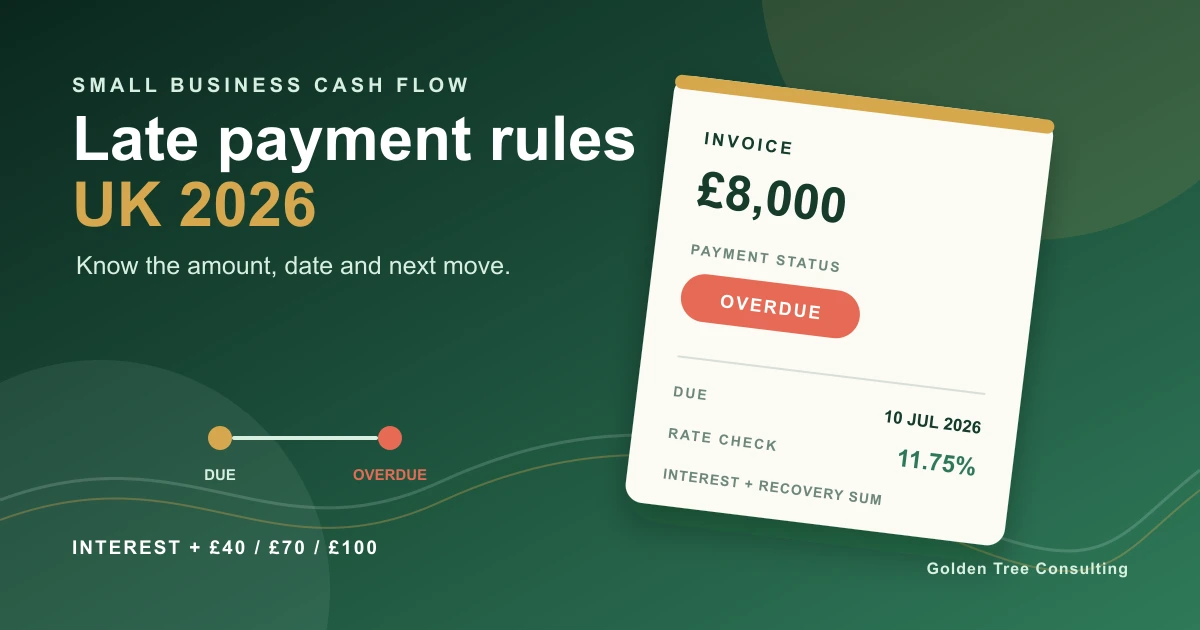
An overdue invoice is not just an annoyance. If an £8,000 customer payment arrives two months late, you still have to cover wages, VAT, suppliers and your own tax planning while the money sits somewhere in the customer’s approval process. The late payment rules UK 2026 framework gives you a practical way to calculate what may be due and a paper trail for asking for it.
There is a live policy reason to look at this now. The Government has introduced the Commercial Payments Bill, which proposes new rules on payment terms, interest and disputes. It has completed committee stage in the House of Lords, but it is not law yet. Your invoice today is governed by the rules currently in force, not by a headline about what the Bill might do later.
Quick answer: for a qualifying commercial debt, check the agreed due date, calculate statutory interest at 8% above the Bank of England base rate if no different contractual rate applies, and add the correct £40, £70 or £100 recovery sum where appropriate. Keep the invoice, contract, delivery evidence and chase history together. If the amount is disputed, pause before adding charges and establish exactly what is being challenged.
Our bookkeeping service can help keep an aged-debt report, cash-flow forecast and invoice evidence in one place. If a late customer payment is affecting annual accounts or a funding conversation, our annual accounts service can help you reconcile the numbers before you make a decision.
Late payment rules UK 2026: what applies today
The current rules cover qualifying commercial transactions for goods or services. They are not a general penalty for every unpaid bill, and they do not replace the contract. The first document to read is the signed agreement or accepted terms. Look for the payment period, the date that starts the clock, any interest clause, dispute process and any conditions attached to accepting the work.
The GOV.UK guide to when a commercial payment becomes late says an agreed payment date is usually within 60 days for business transactions and 30 days for public authorities. Businesses can agree a longer period than 60 days, but it needs to be fair to both sides. A long payment term printed in a purchase order is not automatically the end of the conversation.
If you did not agree a payment date, the law generally treats the payment as late 30 days after the customer receives the invoice or after you deliver the goods or provide the service, if that is later. That is why delivery notes, acceptance emails and a clear invoice date matter. The date in your accounting software is useful, but it is not the only evidence.
| Situation | What to check | Practical record |
|---|---|---|
| The contract gives a due date | Count from the agreed date and check whether the interest clause changes the statutory route | Signed contract, purchase order and invoice |
| No payment date was agreed | Check when the invoice was received and when the goods or service was delivered | Invoice email, delivery note or completion confirmation |
| The customer says the invoice is disputed | Identify the exact line, amount or service point being challenged | Dispute log, evidence supplied and agreed response date |
| The customer is a public authority | Check the public-sector payment terms and any contract wording | Contract, acceptance record and invoice submission proof |
The customer may be slow, but your records should not be. Put the due date, expected payment date and actual payment date in your invoice register. That one small habit makes a later calculation much less argumentative.
How to calculate statutory interest on a late invoice
Statutory interest is normally 8% plus the Bank of England base rate for a qualifying business-to-business debt. The GOV.UK statutory interest guidance says you cannot claim statutory interest if the contract already provides a different interest rate. Read the contract before reaching for the calculator.
The Bank of England’s current Bank Rate table shows Bank Rate at 3.75% as at 26 August 2026. That gives a current statutory calculation rate of 11.75%. This is a date-stamped illustration, not a rate to copy forever. Check the rate again when you issue a charge, especially if the overdue period crosses a Bank Rate change.
| Calculation input | Figure at 26 August 2026 |
|---|---|
| Bank of England Bank Rate | 3.75% |
| Statutory addition | 8.00% |
| Combined annual rate | 11.75% |
| Annual interest on £1,000 | £117.50 |
| Daily interest on £1,000, using 365 days | About £0.32 |
The basic calculation is:
invoice debt x annual interest rate x days overdue / 365Worked example: £1,200 invoice, 45 days late
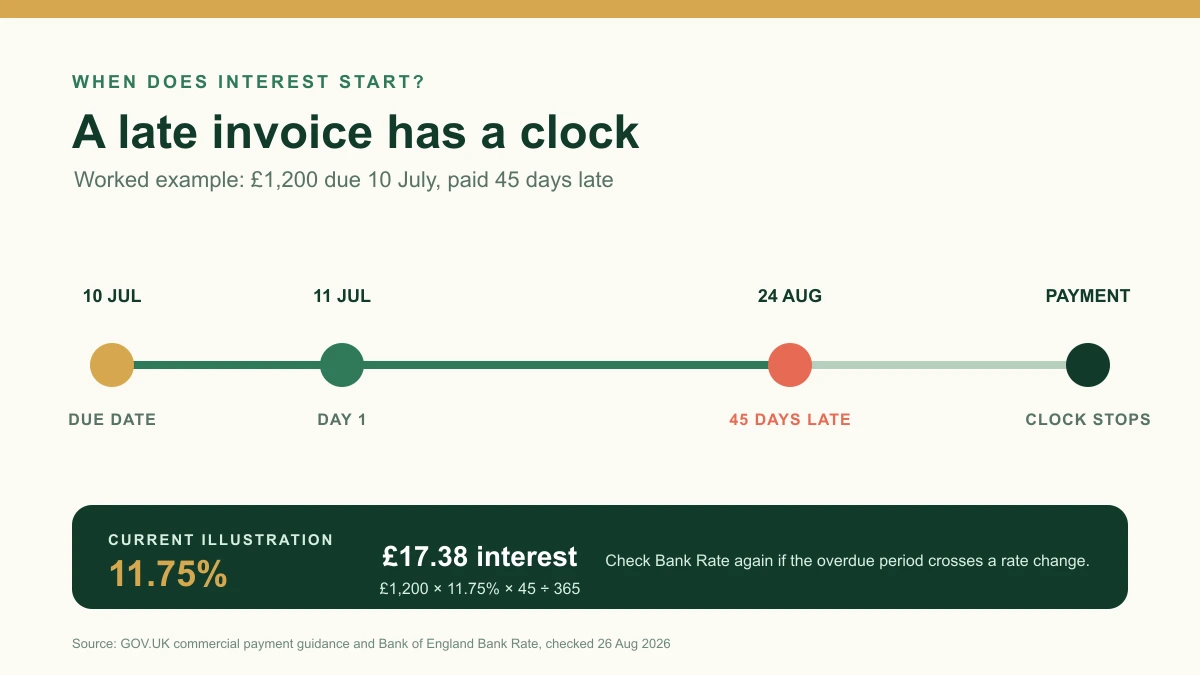
Suppose a consultancy invoice for £1,200, including VAT, was due on 10 July 2026 and paid on 24 August 2026. On this illustration, the customer paid 45 days late and the contract does not contain a different interest rate.
- £1,200 x 11.75% = £141.00 annual interest
- £141.00 / 365 = about £0.3863 per day
- £0.3863 x 45 days = £17.38 interest, rounded to the nearest penny
The interest is not a substitute for the unpaid invoice. It is a separate amount that reflects the time the debt remained overdue. Send a revised or separate invoice with the calculation and the dates, rather than typing a vague surcharge into the original document.
If Bank Rate changes during the overdue period
Do not apply today’s rate to every historic day without checking. If Bank Rate changes halfway through the overdue period, split the calculation into separate date ranges. Use the rate that applies to each range, then add the results. The Small Business Commissioner’s interest calculator is useful for a guide figure, but the Commissioner says it calculates to two decimal places and should be treated as an aid rather than a substitute for checking the facts.
There are other reasons a simple calculation can be wrong. A credit note can reduce the debt, a part-payment changes the balance, and a genuine dispute can affect what is actually payable. If your invoice is in a foreign currency, or if the customer has entered insolvency proceedings, take advice before adding charges.
The £40, £70 and £100 recovery sums
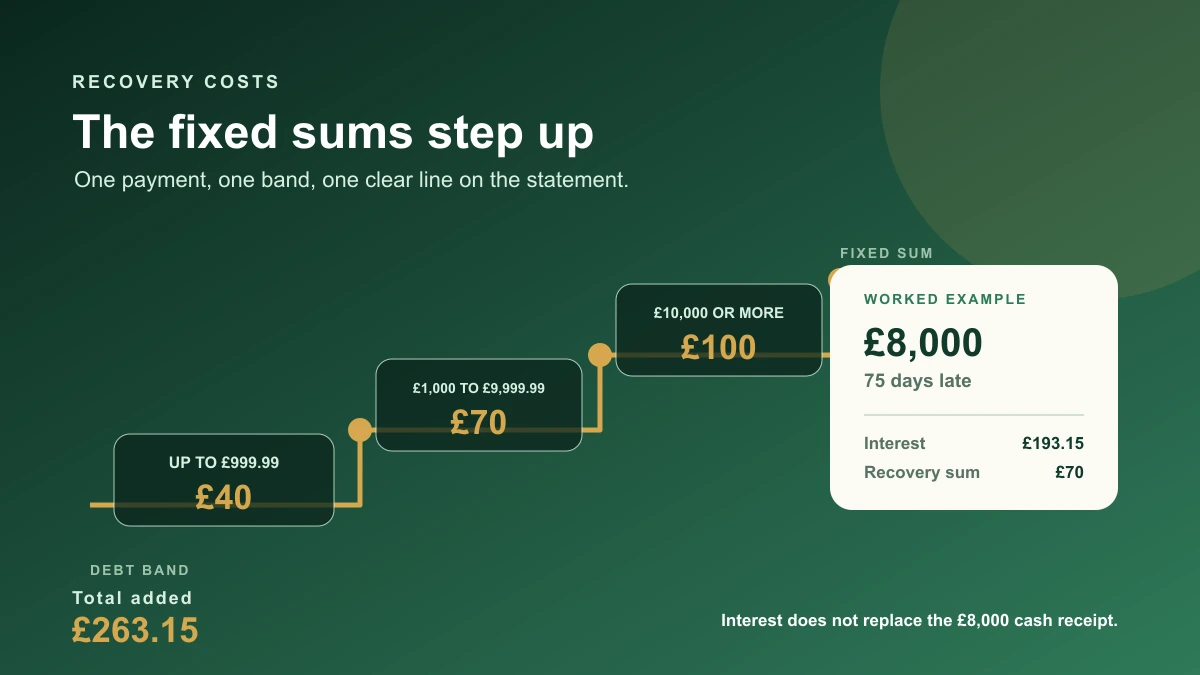
Interest is only one part of the current system. You can also charge a fixed sum for the cost of recovering a qualifying late commercial payment. The GOV.UK recovery-costs guidance sets out the bands:
| Amount of the late debt | Fixed recovery sum |
|---|---|
| Up to £999.99 | £40 |
| £1,000 to £9,999.99 | £70 |
| £10,000 or more | £100 |
You can normally charge the fixed sum once for each late payment. The amount is based on the debt, not on the size of your business or how many reminder emails you sent. A £900 invoice does not qualify for £70 just because you spent an afternoon chasing it.
The fixed sum does not necessarily prevent a supplier from claiming additional reasonable recovery costs. That area needs care. Keep evidence of the cost and check the contract and the statutory route before adding an administration charge that has no clear basis. An invented fee can turn a straightforward payment request into a dispute.
Worked example: £8,000 invoice, 75 days late
Now take an £8,000 invoice that is 75 days overdue at the 11.75% illustration rate:
- £8,000 x 11.75% = £940.00 annual interest
- £940.00 x 75 / 365 = £193.15 interest
- The debt sits in the £1,000 to £9,999.99 band, so the fixed recovery sum is £70
- Total added to the invoice, before any separately evidenced reasonable costs: £263.15
The important cash-flow point is that the customer still owes the original £8,000. Interest and compensation recognise the delay, but they do not pay your staff or supplier invoices while you wait. That is why aged-debt reporting and a short cash-flow forecast belong together.
What to send when an invoice becomes overdue
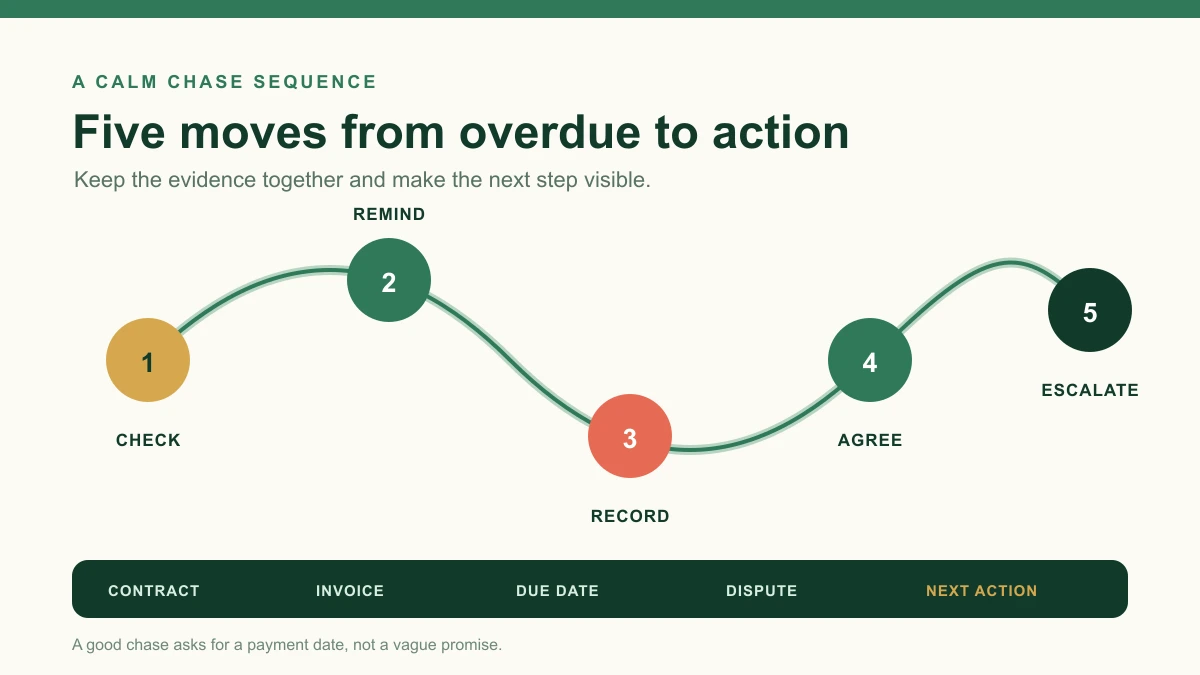
The most effective chase is usually factual. A customer may have missed an approval step, used the wrong purchase-order number or sent a remittance advice without making the payment. Your first message should make it easy to fix the problem.
Check the invoice pack
Before chasing, open the contract, purchase order, invoice, delivery or completion evidence and any customer acceptance message. Confirm that the bank details match the agreed record and that the invoice went to the correct address. If you are VAT registered, check the VAT number and invoice details as well. A preventable admin error weakens your position and delays payment.
Send a short overdue reminder
State the invoice number, invoice date, due date, amount outstanding and the payment date you expect. Ask the customer to tell you within a defined period if there is a dispute. Keep the wording neutral. “Please confirm the payment date for invoice 1048, £8,000, due 10 July” is more useful than a long paragraph about how unfair the delay feels.
If you intend to claim statutory interest or the fixed recovery sum, say so clearly and show the calculation. Link to the relevant terms. Do not hide a charge in a revised total that the customer cannot reconcile.
Record the reason and the next date
Add every contact to the invoice register. Record who replied, what they said, which document is missing and when they promised to respond. If the customer says the work was incomplete, write down the exact point and send the evidence that answers it. If the dispute is genuine, it is better to separate the disputed line from the undisputed balance than to let the whole ledger become foggy.
Escalate in proportion to the debt
For a small amount, a phone call and a clean statement may solve the issue. A larger or repeated delay may need a formal letter before action, a negotiated instalment plan or a small-claims route. The GOV.UK guidance on claiming interest in court explains how interest can be worked out in a money claim. That is not a replacement for legal advice, particularly where the contract, liability or evidence is contested.
What the Commercial Payments Bill could change
The Bill matters because it shows the direction of policy, but a proposal is not a current invoice rule. The official UK Parliament Bill page records that the Commercial Payments Bill [HL] completed committee stage on 21 July 2026. The next report stage has not been scheduled, and the Bill has not completed its passage through Parliament.
The Government’s Commercial Payments Bill overview says the proposed package would:
- impose maximum 60-day payment terms, with limited exemptions
- mandate interest on late payments at 8% above Bank Rate
- give suppliers a fixed sum where a purchaser raises a dispute late or without enough information
- prohibit retention deductions in construction contracts, with timing to be consulted on
- give the Small Business Commissioner stronger investigation, dispute and enforcement powers
- require large businesses to report more information about interest owed and paid
The same overview says there will be a lead-in period and transition period, and that the measures will not apply retrospectively. That distinction is vital. If the Bill becomes law, the contract date, payment date and dispute date will still matter. Do not rewrite your current invoice ledger as if the proposed regime already applies.
| Question | Current position | Proposed direction in the Bill |
|---|---|---|
| Payment terms | Business parties can agree more than 60 days if the period is fair | Maximum 60 days with limited exemptions |
| Late interest | Usually available at 8% above Bank Rate unless a different contractual rate applies | Interest would be mandatory at 8% above Bank Rate |
| Disputes | Follow the contract and evidence; a dispute can change what is payable | Fixed sum proposed for late or insufficiently supported disputes |
| Enforcement | Supplier normally has to chase or use a court route | Stronger Small Business Commissioner powers proposed |
| Old invoices | Apply the rules in force for the relevant transaction | Government says the new measures will not be retrospective |
For now, the sensible response is better information. Keep copies of your standard terms, review long payment clauses before accepting new work and make sure your invoice register can show the date the customer received the invoice. You do not need to wait for Parliament to improve those controls.
A bookkeeping routine that protects cash flow
Late payment is easier to spot when your books show the difference between sales, invoices and cash received. A profit and loss report can say that the work was profitable while the bank account says the money is still missing. Both statements can be true.
Use a weekly aged-debt review for every customer who buys on credit. At a minimum, the report should show:
- customer and invoice number
- invoice date, agreed due date and date sent
- gross amount, VAT amount where relevant and balance outstanding
- days overdue and any interest rate that applies
- dispute status, named contact and promised payment date
- next action, owner and a note of the last communication
Add those totals to a 13-week cash-flow forecast. The forecast should show when you expect money to arrive, not only when you raised the invoice. If an £8,000 receipt moves from week 4 to week 10, the forecast should show the gap and the decisions it creates. You may need to delay a purchase, ask a supplier for terms, move a tax reserve or speak to your accountant before the cash becomes tight.
Worked example: the cash gap is bigger than the interest
Assume a small agency starts week 1 with £9,000 in the bank. It expects an £8,000 customer payment in week 4, with planned payroll, supplier and tax outflows of £7,600 before the next major receipt. If the customer pays on time, the projected balance after those outflows is £9,400. If the payment moves to week 10, the same balance drops to £1,400 before any unexpected cost.
The current-rate interest illustration on that invoice after 75 late days is £193.15, plus £70 fixed compensation. That additional £263.15 may be valid, but it does not replace the missing £8,000 in week 4. The early warning from the forecast is therefore worth more than the charge itself. It gives you time to chase, adjust the payment plan or price future work with a deposit.
Our bookkeeping support can help turn invoice data into a weekly debt report and forecast. If the delay affects the figures in a set of accounts, keep the invoice, payment history and calculation together so the year-end review has an explanation rather than a mystery balance.
Common mistakes with late commercial payments
Treating every unpaid invoice as a qualifying commercial debt
The statutory route is specific. Check who bought the goods or service, what the contract says and whether the debt is genuinely due. A consumer transaction, a disputed amount or a contract with a different interest clause may need a different approach.
Using the wrong rate for the whole period
Bank Rate can change. A calculation made in a spreadsheet six months ago may not be right today. Put the rate and the date checked on the calculation, then split the days if the rate changed.
Adding compensation before checking the band
The fixed sums are linked to the debt amount. Check whether the balance is up to £999.99, from £1,000 to £9,999.99 or £10,000 and above. If part-payment has been made, record the balance and the date before recalculating.
Sending a charge with no explanation
A customer is more likely to pay an amount they can match to an invoice, due date and calculation. Attach a statement, show the days overdue and identify the contractual or statutory basis. Keep the original invoice unchanged where possible and issue a separate interest note.
Confusing late payment with bad debt relief
If an invoice may never be paid, that becomes a separate accounting and VAT question. Do not assume that adding statutory interest makes the original debt recoverable, or that writing off a debt removes every tax consequence. Check the accounting and VAT treatment with someone who has the full records.
FAQ: late payment rules UK 2026
What are the late payment rules in the UK in 2026?
For a qualifying commercial debt, you can usually claim statutory interest at 8% above the Bank of England base rate and fixed recovery compensation of £40, £70 or £100. A different contractual interest rate can change the route, and consumer debts are treated separately.
How much late payment interest can a UK business charge in 2026?
As at 26 August 2026, the Bank of England Bank Rate is 3.75%, so the statutory rate is 11.75% for qualifying business-to-business debts. The rate can change, so split the calculation if Bank Rate changes during the overdue period.
Can I charge £40 for a late invoice?
Usually, yes, for a qualifying commercial debt up to £999.99. The fixed recovery sum is £40 for debts up to £999.99, £70 for £1,000 to £9,999.99 and £100 for £10,000 or more. It can normally be charged once for each late payment.
When does statutory interest start on a late commercial invoice?
It normally starts when the payment becomes late, which is usually the day after the agreed due date. If no payment date was agreed, the statutory timetable can make the debt late 30 days after the invoice is received or the goods or service is delivered, if that is later.
Does the Commercial Payments Bill change the law now?
No. The Commercial Payments Bill is still progressing through Parliament and is not yet law. It proposes changes including maximum 60-day payment terms with limited exemptions, mandatory interest and stronger Small Business Commissioner powers.
Can I charge late payment interest if my contract has a different rate?
You cannot claim statutory interest when the contract already provides a different interest rate. Check the signed contract and terms before adding a statutory charge, and get legal advice if the clause is unclear or disputed.
What should I do if a customer disputes my invoice?
Keep the dispute separate from the rest of your ledger, ask for the precise reason and evidence, check the contract and continue to document dates and communications. Do not add charges blindly while the amount or service is genuinely disputed.
The practical task for this week is simple: export your overdue invoices, sort them by value and days late, and choose the next action for each one. Confirm the rate and contract before adding interest. If the ledger is tangled, contact Golden Tree Consulting with the invoice list and terms, and we can help you establish what the numbers actually say before you send the next chase.

About Golden Tree Consulting
ACCA Affiliated | MBA Qualified
Golden Tree Accounting & Business Consulting provides expert tax, bookkeeping, and advisory services to sole traders and SMEs across Croydon, London, Surrey, and Kent. With multilingual support and decades of combined experience, we help businesses stay compliant and grow.
More Articles You Might Like
Continue exploring our financial insights
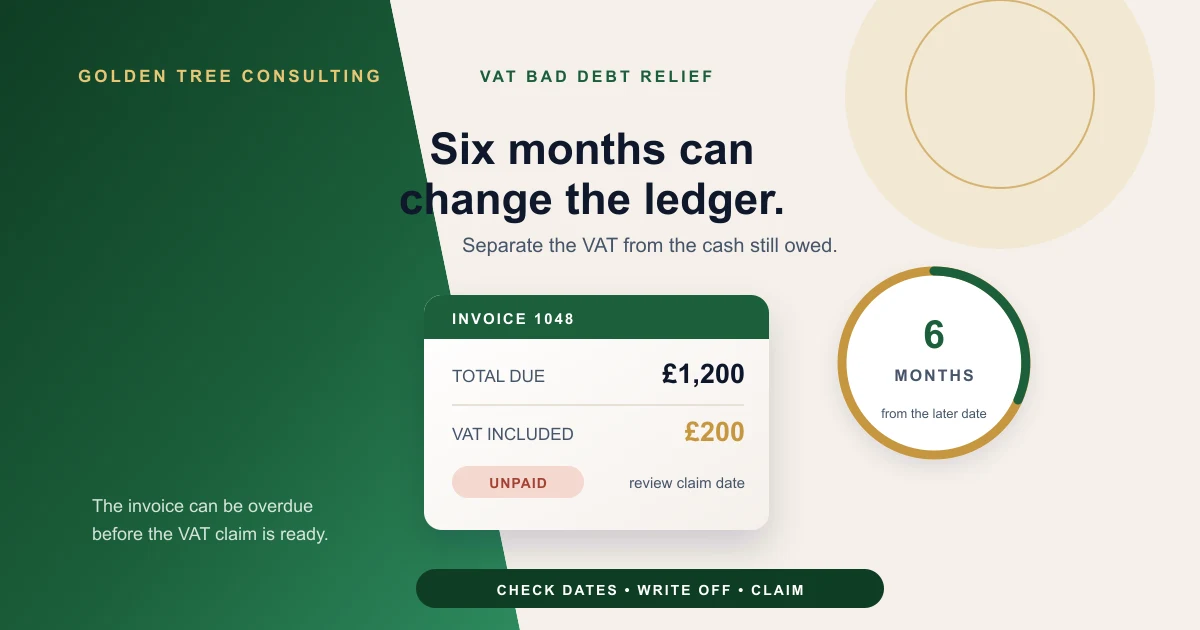
VAT Bad Debt Relief UK 2026: How to Reclaim VAT on Unpaid Invoices
VAT bad debt relief UK 2026 explained: check the six-month rule, calculate the VAT on unpaid invoices, claim it on your return and keep the right records.
VAT Cash Accounting Scheme UK: 2026 Guide for Small Businesses
VAT Cash Accounting Scheme UK rules for 2026, with thresholds, cash-flow examples, eligibility checks, and record-keeping tips.
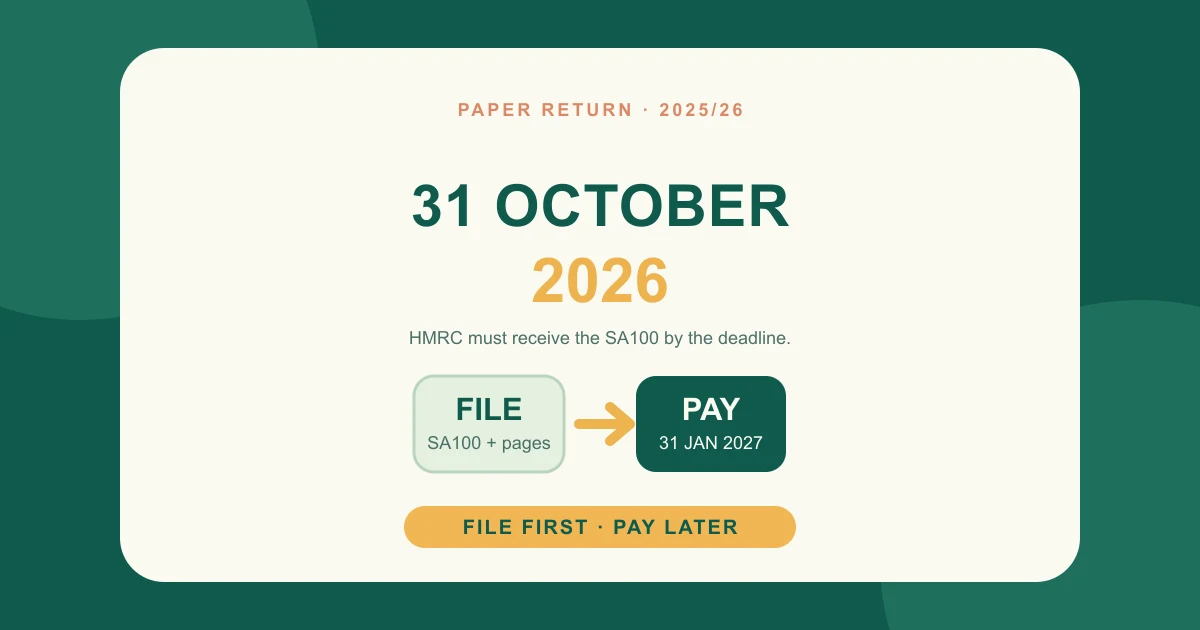
Self Assessment Paper Tax Return Deadline 2026: 31 October UK Guide
Self Assessment paper tax return deadline 2026 explained: what to post, where to send SA100, penalties, payment dates and a 31 October checklist.