P800 Tax Calculation Letter: Why You Got One and How to Get Your Refund
What a P800 tax calculation letter means for 2025/26, why HMRC sends one, how to claim a refund online, how underpaid tax is collected through your tax code, and what to do if the figures look wrong.
 Golden Tree Accounting 27 September 2026 6 min read
 On this page Show
A P800 is a tax calculation letter from HMRC. It tells you that you paid too much or too little tax through PAYE in the last tax year, and explains how the refund will be paid or the underpayment collected. HMRC sends them between June and March after the tax year ends, so P800s for 2025/26 are arriving now.
Quick answer: if your P800 says you are owed money and you can claim online, you need the reference number from the letter and your National Insurance number. A bank transfer arrives within 5 working days. If it says you owe tax under £3,000, HMRC usually collects it through your tax code over the next tax year. If the figures look wrong, contact HMRC before you pay or claim.
If you want someone to check the calculation against your payslips and P60, our tax refund service can do that and deal with HMRC for you.
Who gets a P800?
Only people who pay tax through PAYE: employees and people with a workplace or private pension. If you are registered for Self Assessment, you do not get a P800. HMRC adjusts your Self Assessment bill instead.
GOV.UK says you might get one because you:
- were on the wrong tax code, for example because HMRC had the wrong figures for your income
- finished one job, started another and were paid by both in the same month
- started receiving a pension at work
- received Employment and Support Allowance or Jobseeker’s Allowance
Wrong or emergency tax codes are the most common cause. Our guide to tax code 1257L explains the standard code, and the 1257L M1 emergency tax guide explains why an emergency code can overcharge you after a job change.
P800 or Simple Assessment?
Some people get a Simple Assessment letter instead. HMRC uses it when you owe tax that cannot be taken through your tax code, you owe more than £3,000, or you have to pay tax on your State Pension. A Simple Assessment has its own payment deadline.
If your P800 says you are owed a refund
The letter tells you how you will be paid.
If it says you can claim online:
- use HMRC’s online service with the reference number from the P800 and your National Insurance number
- choose a bank transfer, which arrives within 5 working days, or ask for a cheque, which takes about 6 weeks
- you can also claim through your Personal Tax Account or the HMRC app if you have a UK bank account
If it says HMRC will send a cheque: you do not need to do anything. The cheque should arrive within 14 days of the date on the letter. If you are owed tax for more than one year, you get one cheque for the whole amount.
HMRC will never text or email you a link to claim a tax refund. If you get a message like that, it is a scam. Use GOV.UK or the HMRC app directly.
Once a refund is on its way, our guide to HMRC repayment pending explains what each status means and how long the bank payment takes.
If your P800 says you owe tax
HMRC usually collects the underpayment by changing your tax code, so a little more tax comes out of your wages or pension each payday. This happens automatically if:
- you pay Income Tax through an employer or pension provider
- you earn enough above your Personal Allowance to cover it
- you owe less than £3,000
The extra tax is usually spread in equal instalments over 12 months from the start of the next tax year. For a P800 about 2025/26 that means from 6 April 2027. You can pay it earlier if you would rather clear it.
Worked example
Sam changed jobs in 2025/26 and was paid by both employers in the same month. Both used his full allowance for that month, so he underpaid £480 of tax. His P800 arrives in November 2026.
Because he owes less than £3,000 and still has a PAYE job, HMRC will adjust his 2027/28 tax code. That spreads the £480 over 12 months, about £40 a month extra tax from April 2027. He can pay the £480 before then if he prefers.
If you think your P800 is wrong
Check the letter against your own records before you claim or pay:
- Pay and tax for each job or pension against your P60s, P45 and final payslips.
- Benefits, such as a company car or medical insurance, against your P11D if you had one.
- Other income, such as taxable state benefits, against your statements.
- The tax code used, against the code on your payslips.
If something is wrong, contact HMRC and tell them which amounts you think are wrong and what they should be. If HMRC agrees, it sends a new calculation. If it disagrees, it writes to explain why.
If you have not had a P800 but think you overpaid
You do not have to wait for a letter. If you think you paid too much tax and HMRC has not sent a P800, you can claim a refund yourself. You can claim overpaid tax for up to 4 years after the end of the tax year it relates to.
FAQ: P800 tax calculations
What is a P800?
HMRC’s tax calculation letter. It tells an employee or pensioner they paid too much or too little tax through PAYE last tax year, and what happens next.
When does HMRC send P800 letters?
Between June and March after the tax year ends. For 2025/26 that is June 2026 to March 2027.
How long does a P800 refund take?
Within 5 working days by bank transfer if you claim online, about 6 weeks for a cheque you request, or within 14 days of the letter date if HMRC sends a cheque automatically.
What if my P800 says I owe tax?
Under £3,000 with enough PAYE income, HMRC usually collects it through your tax code over the next tax year. You can pay it earlier.
What if I think my P800 is wrong?
Contact HMRC with the amounts you think are wrong and the correct figures. If HMRC agrees, it issues a new calculation.
Sources

About Golden Tree Consulting
ACCA Affiliated | MBA Qualified
Golden Tree Accounting & Business Consulting provides expert tax, bookkeeping, and advisory services to sole traders and SMEs across Croydon, London, Surrey, and Kent. With multilingual support and decades of combined experience, we help businesses stay compliant and grow.
Offices in Croydon and London Bridge.
Related guides
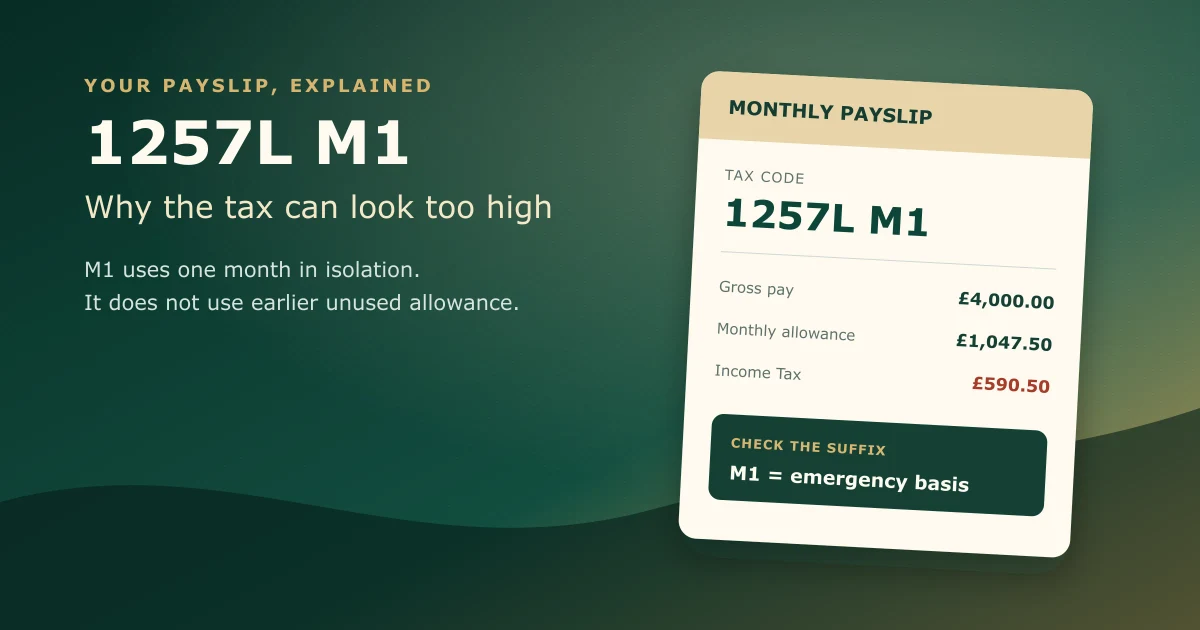
1257L M1 Tax Code Explained: Emergency Tax Guide for 2026/27
1257L M1 tax code explained for 2026/27, with emergency tax calculations, refund examples, and practical steps to correct your code.
Tax Code 1257L Explained: What It Means for Your Pay in 2026/27
What tax code 1257L means for 2026/27: the £12,570 Personal Allowance, how it is spread across your pay, what M1, W1 and X mean, when the code is wrong and how to get overpaid tax back.

How to Get Your UTR Number: Online in 72 Hours or by Post
How to get a Unique Taxpayer Reference (UTR) in the UK: register for Self Assessment online and get it within 72 hours, where to find a UTR you already have, company UTRs and what to do if it has not arrived.