Tax Code 1257L Explained: What It Means for Your Pay in 2026/27
What tax code 1257L means for 2026/27: the £12,570 Personal Allowance, how it is spread across your pay, what M1, W1 and X mean, when the code is wrong and how to get overpaid tax back.
 Golden Tree Accounting Updated 27 September 2026 9 min read
On this page Show
- What the numbers and letter in 1257L mean
- How 1257L works on a payslip: a worked example
- Income Tax rates that apply with 1257L in 2026/27
- Other codes you might see instead of 1257L
- Emergency codes: 1257L M1, W1 and X
- When 1257L might be the wrong code
- How to check your tax code
- How to get overpaid tax back
- FAQ: tax code 1257L
- Sources
1257L is the standard UK tax code for the 2026/27 tax year. It means you get the full £12,570 tax-free Personal Allowance on one job or pension, spread across the year: about £1,047.50 a month or £241.73 a week. Most employees have this code, and for most of them it is correct.
The number and letter are only half the story. A suffix such as M1, W1 or X after the code changes how payroll uses the allowance, and that is where most payslip surprises come from.
Quick answer: 1257L means the standard £12,570 Personal Allowance, taxed at the normal rates. 1257L M1 or 1257L W1 is an emergency code that gives you one month’s or one week’s allowance at a time. If your code has changed, you have two jobs, or you started a job without a P45, check your HMRC record. You may have paid too much tax.
If you think a wrong code has cost you money, our tax refund service can check your payslips and HMRC record. Employers applying codes can use our payroll service.
What the numbers and letter in 1257L mean
A tax code tells your employer or pension provider how much of your pay to leave untaxed.
- 1257 is your tax-free allowance with the last digit removed. Add a zero and you get £12,570.
- L means you get the standard Personal Allowance with nothing added or taken off.
HMRC’s tax code guidance says 1257L is the code currently used for most people who have one job or pension. The Personal Allowance has been £12,570 since April 2021, so the code has not changed for several tax years.
Payroll spreads the allowance evenly across the tax year from 6 April 2026 to 5 April 2027:
| How often you are paid | Tax-free pay each period on 1257L |
|---|---|
| Yearly | £12,570.00 |
| Monthly | £1,047.50 |
| Every 4 weeks | £966.92 |
| Weekly | £241.73 |
Your payroll software may show slightly different pennies because of how the tax tables round, but these are the amounts to expect.
How 1257L works on a payslip: a worked example
Take a salary of £30,000 a year, paid monthly, for someone taxed at the rates for England, Wales and Northern Ireland.
- Monthly gross pay: £2,500
- Tax-free allowance for the month: £1,047.50
- Taxable pay: £1,452.50
- Income Tax at 20%: £290.50 a month
Over the full year that comes to £3,486, which matches the annual calculation: (£30,000 − £12,570) × 20%.
National Insurance, pension contributions and student loan repayments are worked out separately and do not depend on the tax code.
Income Tax rates that apply with 1257L in 2026/27
These are the rates for England, Wales and Northern Ireland, from GOV.UK’s Income Tax rates page:
| Band | Taxable income | Rate |
|---|---|---|
| Personal Allowance | Up to £12,570 | 0% |
| Basic rate | £12,571 to £50,270 | 20% |
| Higher rate | £50,271 to £125,140 | 40% |
| Additional rate | Over £125,140 | 45% |
Scotland has its own bands and rates. A Scottish taxpayer’s code starts with S (for example S1257L) and a Welsh taxpayer’s with C (C1257L).
If you earn over £100,000
Your Personal Allowance goes down by £1 for every £2 of adjusted net income above £100,000, and it disappears completely at £125,140. If HMRC knows your income is in that range, your code will be lower than 1257L, or 0T.
Other codes you might see instead of 1257L
If your code is not 1257L, it is usually because something in your tax position changes the allowance or the rate. These are the ones HMRC lists that come up most often:
| Code or letter | What it means |
|---|---|
| 1257L M1, W1, X, NONCUM | Emergency code: each pay period is taxed on its own |
| Lower number, e.g. 1100L | Something reduces your allowance, such as a company car, medical insurance or tax owed from an earlier year |
| M | You receive 10% of your partner’s allowance through Marriage Allowance |
| N | You transfer 10% of your allowance to your partner |
| BR | All income from this job or pension is taxed at 20%, usually a second job |
| D0 / D1 | All income from this source is taxed at 40% / 45% |
| 0T | No allowance on this source, often because it is used up or your employer is waiting for details |
| K (e.g. K475) | You have untaxed income or benefits worth more than your allowance, so an amount is added to your taxable pay |
| NT | No tax is taken from this income |
Emergency codes: 1257L M1, W1 and X
PAYE normally works cumulatively. Each payday, payroll looks at your pay and allowance from 6 April to date, so allowance you did not use earlier in the year is still there when you are paid.
With an M1 (monthly) or W1 (weekly) code, payroll ignores earlier periods. You get one period’s allowance each payday, even if you earned nothing in the months before. X does the same where pay dates vary. HMRC’s emergency tax code guidance says a new-job code update can take up to 35 days.
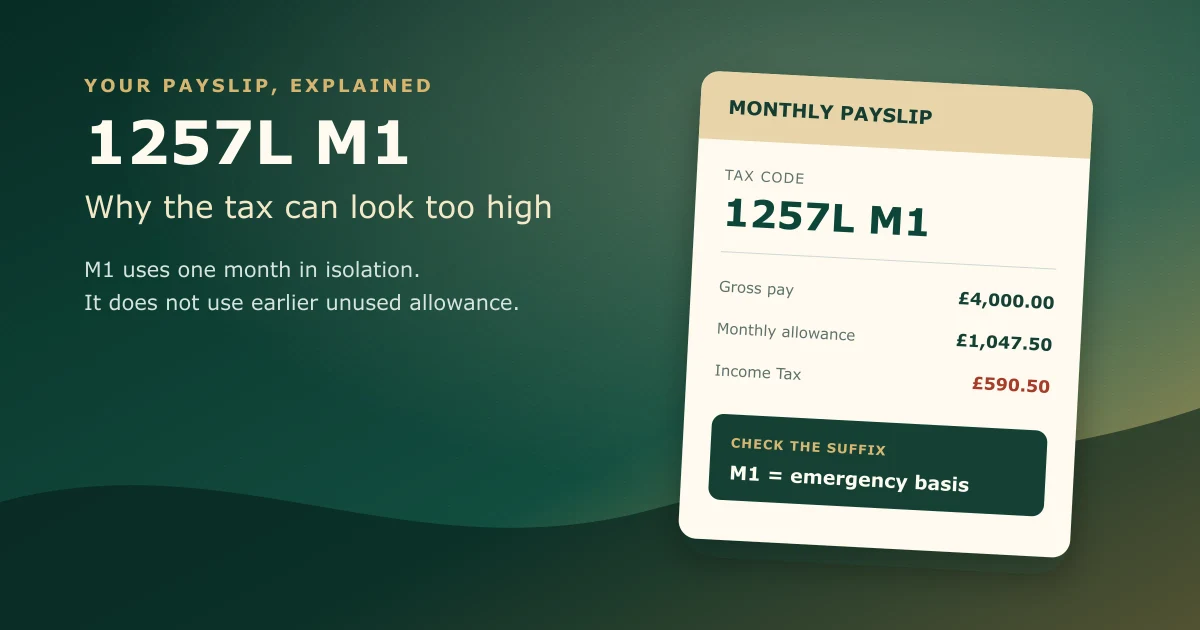
A quick example: you start a job in June after no earnings in April and May, and receive £4,000 in June.
- On 1257L M1, payroll uses one month’s allowance of £1,047.50, so you pay £590.50 of Income Tax.
- On cumulative 1257L, payroll uses three months’ allowance of £3,142.50, so you pay £171.50.
That is £419 more in June on the emergency code. It usually comes back through a later payslip once HMRC sends a cumulative code. Our 1257L M1 emergency tax guide covers why you might be on one, what payroll should check and how the refund works.
When 1257L might be the wrong code
1257L is correct for most people. It can be wrong for you if:
- You have more than one job or pension. Only one source should usually get the allowance. If both show 1257L, you are probably paying too little tax, which HMRC will collect later.
- You have company benefits. A company car, fuel or medical insurance reduces your allowance, so your code should be lower.
- You use Marriage Allowance. Your code should end in M or N instead of L.
- HMRC is collecting tax through your code. Underpaid tax from an earlier year, or untaxed income such as rent, can lower the number.
- You earn over £100,000. Your allowance is tapered, so a full 1257L would give you too much.
- You started a job without a P45. You may be on an emergency code, or on 1257L when your allowance was already used by another job.
How to check your tax code
You can find your code on your payslip, on a P2 coding notice from HMRC, or online:
- Sign in to the HMRC app or your Personal Tax Account.
- Check the code against each job or pension listed.
- Check that old jobs are shown as ended and that the estimated pay looks sensible.
- If something is wrong, update it in the same service. HMRC then sends the new code to your employer.
Your employer cannot change your code just because you ask. Payroll must use the code HMRC sends, or the starter checklist and P45 details when you join.
How to get overpaid tax back
During the tax year: once HMRC issues the correct code, payroll usually refunds the overpayment through a lower tax deduction, or a refund line, on your next payslip.
After the tax year ends: HMRC reconciles your PAYE record and may send a P800 tax calculation. HMRC sends these between June and March after the tax year. If you are owed money, the P800 explains how you will get it; our P800 guide walks through claiming it. Our guide to HMRC repayment pending explains what the refund statuses mean once a repayment is on its way.
Earlier years: you can claim overpaid tax for up to 4 years after the end of the tax year. In 2026/27 that means claims going back to 2022/23, until 5 April 2027.
If you also have self-employed or side-hustle income, a Self Assessment return may be the better place to put your whole tax position right. See our guide to the Self Assessment registration deadline.
FAQ: tax code 1257L
What does tax code 1257L mean?
It means you get the standard £12,570 tax-free Personal Allowance on this job or pension. The number is the allowance without its last digit, and L means the standard allowance with no adjustments.
Is 1257L the right tax code for 2026/27?
For most people with one job or pension and no company benefits, untaxed income or tax owed from earlier years, yes.
How much can I earn tax-free on 1257L?
£12,570 across the 2026/27 tax year: about £1,047.50 a month on a monthly payroll, or about £241.73 a week on a weekly payroll.
What does 1257L M1 or W1 mean?
They are emergency suffixes. Payroll gives you one month’s or one week’s allowance and ignores earlier periods, which can mean too much tax until HMRC sends a cumulative code.
I have two jobs. Should both have 1257L?
Usually not. The allowance normally goes against one job, and the other gets a code such as BR. If both show 1257L, tell HMRC so you do not build up an underpayment.
How do I get back tax I overpaid?
If the code is corrected during the year, payroll refunds it through a later payslip. After the year ends, HMRC may send a P800. You can claim for up to 4 years after the end of the tax year.
Sources

About Golden Tree Consulting
ACCA Affiliated | MBA Qualified
Golden Tree Accounting & Business Consulting provides expert tax, bookkeeping, and advisory services to sole traders and SMEs across Croydon, London, Surrey, and Kent. With multilingual support and decades of combined experience, we help businesses stay compliant and grow.
Offices in Croydon and London Bridge.
Related guides
1257L M1 Tax Code Explained: Emergency Tax Guide for 2026/27
1257L M1 tax code explained for 2026/27, with emergency tax calculations, refund examples, and practical steps to correct your code.
P800 Tax Calculation Letter: Why You Got One and How to Get Your Refund
What a P800 tax calculation letter means for 2025/26, why HMRC sends one, how to claim a refund online, how underpaid tax is collected through your tax code, and what to do if the figures look wrong.
PAYE Settlement Agreement Deadline 5 July 2026: Employer Guide
PAYE Settlement Agreement deadline guide for 2026, with PSA dates, eligible benefits, tax gross-up examples, and employer checklist.