Property Income Tax Rates 2027: What the Budget Rise Means for Landlords
Property income tax rates 2027 rise to 24%, 44% and 49% from 6 April. See landlord examples, mortgage interest relief and what to review.
 Golden Tree Accounting 4 November 2026 15 min read
On this page Show
- Property income tax rates 2027: the proposed figures
- How your other income affects the property rate
- Rental income tax and mortgage interest after the change
- Which property costs and allowances still matter?
- Does the property income tax rise apply to a company?
- What landlords can review before 6 April 2027
- Property income tax rates 2027 FAQs
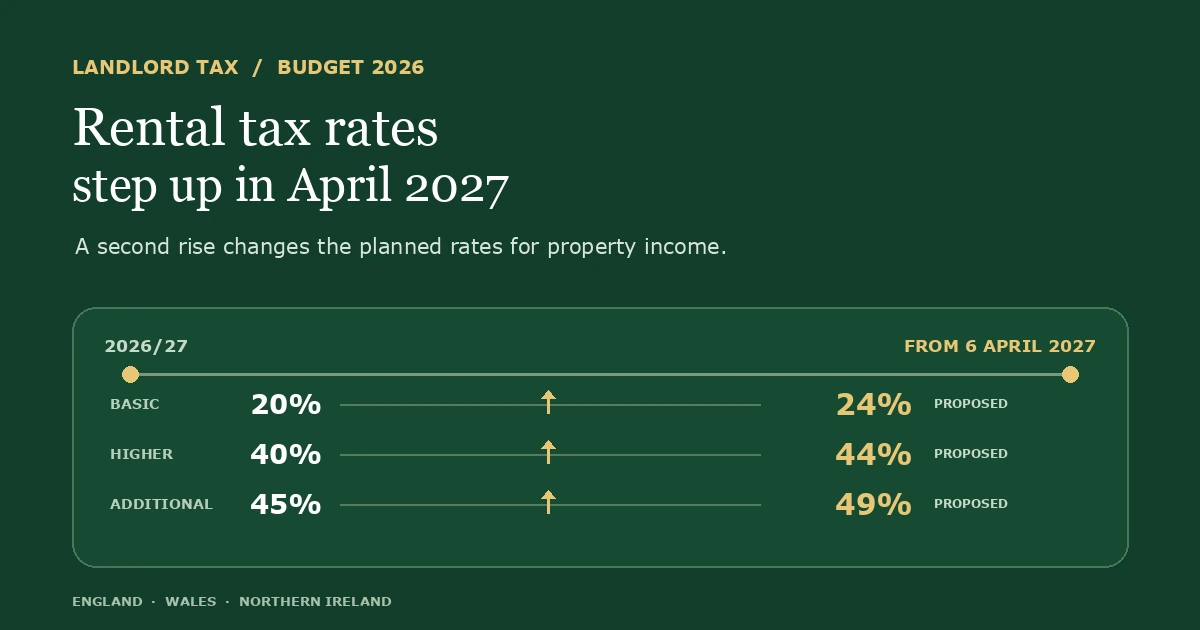
From 6 April 2027, the planned property income tax rates 2027 are 24%, 44% and 49% for the basic, higher and additional bands in England, Wales and Northern Ireland. In 2026/27, property income is charged at the main rates of 20%, 40% and 45%. The Budget 2026 change is a second rise: the previous plan had already set separate property rates at 22%, 42% and 47%, and the new proposal adds another two percentage points.
That difference matters when you compare a future Self Assessment estimate with the amount you pay now. The 24% rate does not apply to every pound of rent for every landlord. Your other income, personal allowance, allowable costs, ownership share and mortgage interest can all change the calculation.
Quick read: the announced 2027/28 rates are 24%, 44% and 49%; the change is due to be legislated in Finance Bill 2026-27. Property income sits after employment, trading and pension income in the Income Tax calculation. Residential mortgage interest for an individual landlord is handled through a tax reduction, not as an ordinary expense.
Property income tax rates 2027: the proposed figures
The current tax year is 2026/27, which runs from 6 April 2026 to 5 April 2027. For that year, property income uses the main Income Tax rates. From 6 April 2027, the Government plans to use a separate set of rates for property income.
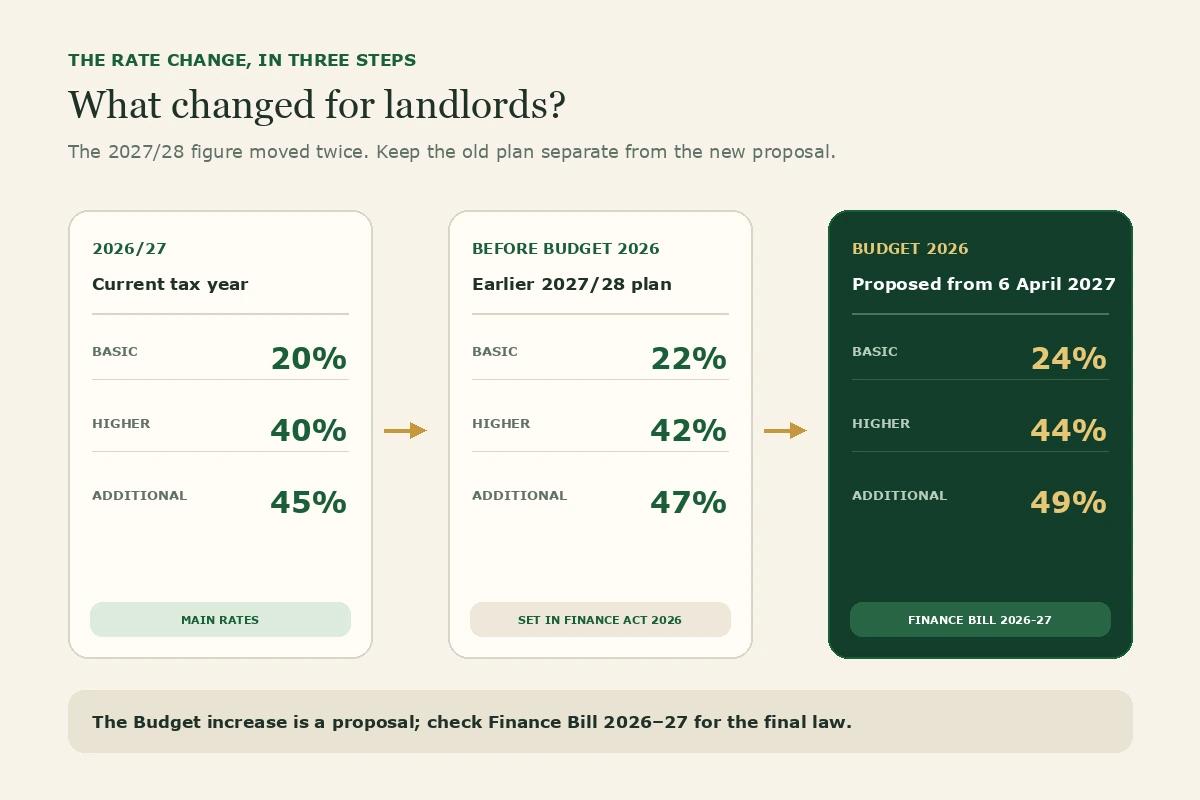
| Tax band | Property income rate in 2026/27 | Rate already set for 2027/28 before Budget 2026 | Budget 2026 proposal for 2027/28 |
|---|---|---|---|
| Basic | 20% | 22% | 24% |
| Higher | 40% | 42% | 44% |
| Additional | 45% | 47% | 49% |
The first two columns of future rates can be easy to mix up. The 2025 Budget introduced separate property rates of 22%, 42% and 47%. Those rates were included in the Finance Act 2026. Budget 2026 then announced a further two-point increase, so the current proposal is 24%, 44% and 49%. The GOV.UK measure notice sets out the new rates and planned start date.
The Budget document says the change will take effect on 6 April 2027 and will be legislated in Finance Bill 2026-27. The rates are announced policy, but the proposed change is not yet part of the Finance Act. Check the final legislation and updated HMRC guidance before you make a decision that depends on the exact calculation.
The current GOV.UK announcement lists the proposed rates for England, Wales and Northern Ireland. Scotland and Wales have powers to set property income rates through their devolved tax systems. If you are a Scottish or Welsh taxpayer, check for a devolved decision before using the examples below.
How much does a four-point increase mean in pounds?
If £20,000 of your property profit falls fully inside one tax band, has no mortgage-interest tax reduction and no other allowance changes the result, the simple comparison is:
| Band used by the property profit | Tax at the 2026/27 rate | Tax at the proposed 2027/28 rate | Difference |
|---|---|---|---|
| Basic | £4,000 at 20% | £4,800 at 24% | £800 |
| Higher | £8,000 at 40% | £8,800 at 44% | £800 |
| Additional | £9,000 at 45% | £9,800 at 49% | £800 |
This is a rate comparison, not a forecast of every landlord’s bill. A landlord with a salary, pension, savings, a property allowance, a loss brought forward or a mortgage will need a fuller calculation.
How your other income affects the property rate
Property income is not assessed in a separate little tax system that ignores the rest of your return. Under the announced calculation order, income from employment, self-employment and pensions is considered first, property income follows, then savings and dividends. Available personal allowances and other reliefs are generally set against non-property, savings and dividend income first.
For 2026/27, the standard Personal Allowance is £12,570. The basic rate band covers the first £37,700 of taxable income after allowances, and the higher rate continues up to £125,140. Income above that is in the additional rate band. The proposed property rates use these bands, while the rate applied to each part of your property income depends on the space left after the rest of your income has been accounted for.
Worked example: a landlord whose rent stays in the basic band
Mina earns £30,000 from employment and has £20,000 of taxable property profit after allowable non-finance costs. She has no other income, no residential mortgage interest and no special reliefs.
Her Personal Allowance is set against her salary first. That leaves £17,430 of taxable employment income. The basic rate band is £37,700, so there is room for £20,270 of property income in the basic band. Mina’s full £20,000 rental profit fits there.
| Mina’s rental profit | 2026/27 | Proposed 2027/28 |
|---|---|---|
| Property profit in the basic band | £20,000 | £20,000 |
| Property rate | 20% | 24% |
| Tax on that property profit | £4,000 | £4,800 |
Under these assumptions, the extra tax on the rental profit is £800 for the year, or roughly £67 a month. The calculation concerns the tax on the property profit only. Mina’s salary tax and any other tax on her return are separate.
Worked example: rent split between two bands
Arun earns £45,000 from employment and has £20,000 of taxable property profit, with no mortgage interest. His taxable salary after the £12,570 Personal Allowance is £32,430. That leaves £5,270 in his basic rate band. The first £5,270 of property profit is taxed at the basic rate, and the remaining £14,730 falls in the higher band.
| Part of Arun’s property profit | 2026/27 calculation | Proposed 2027/28 calculation |
|---|---|---|
| First £5,270 | £5,270 × 20% = £1,054 | £5,270 × 24% = £1,264.80 |
| Remaining £14,730 | £14,730 × 40% = £5,892 | £14,730 × 44% = £6,481.20 |
| Tax on the £20,000 property profit | £6,946 | £7,746 |
The difference is still £800 because both portions of the profit rise by four percentage points. Arun’s calculation shows why you should not label all rent “basic rate” or “higher rate” based on one headline income figure. The band is applied to slices of taxable income.
Rental income tax and mortgage interest after the change
For an individual landlord letting a residential property, mortgage interest is not normally deducted from rental income as an expense. Instead, eligible residential finance costs can produce a tax reduction. The reduction is calculated using the lowest of the finance costs, the property business profit and adjusted total income above the Personal Allowance. Limits can reduce the available amount, and unused costs may carry forward. HMRC explains the finance-cost reduction calculation and worked examples.
The Finance Act 2026 amended the existing rules so that the reduction will use the property basic rate from 2027/28 (Schedule 1, paragraph 40 of the Act). Budget 2026 proposes that rate at 24%. The Government’s older technical note still shows 22%, because it describes the previous plan. The latest Budget rate and the existing statutory link point towards a 24% finance-cost reduction if the announced change is enacted as published. HMRC has not yet replaced its older worked example with one using the Budget 2026 rates, so treat 24% as a planning assumption until the Finance Bill and updated guidance settle the detail.
Worked example: a higher-rate landlord with mortgage interest
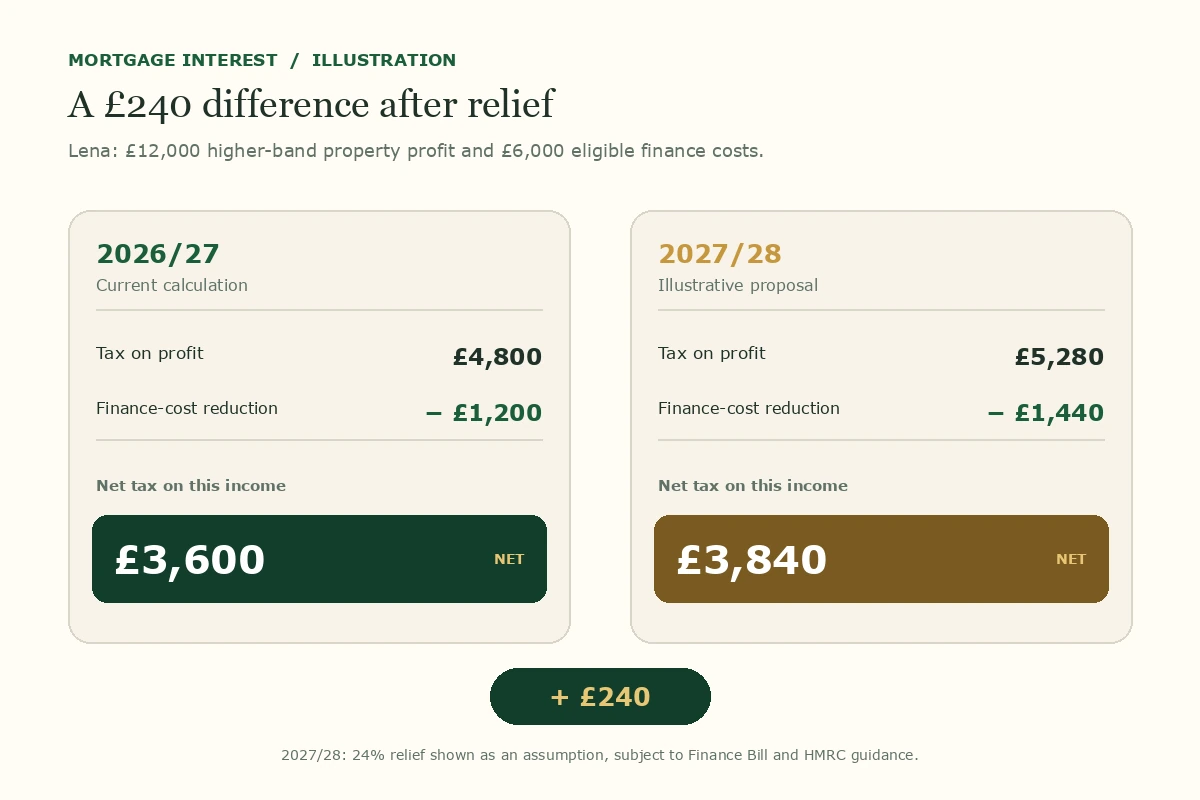
Lena earns £60,000 from employment. Her salary uses the basic rate band and part of the higher rate band, so all of her £12,000 property profit falls into the higher band. She also has £6,000 of eligible residential finance costs. Assume the full tax reduction is available and there are no other reliefs or income sources.
| Calculation | 2026/27 | Proposed 2027/28 |
|---|---|---|
| Tax on £12,000 property profit | £12,000 × 40% = £4,800 | £12,000 × 44% = £5,280 |
| Finance-cost tax reduction | £6,000 × 20% = £1,200 | £6,000 × 24% = £1,440 |
| Net tax on this property income | £3,600 | £3,840 |
On these assumptions, Lena’s tax rises by £240, not £480. The higher property rate adds £480, while the larger finance-cost reduction offsets £240. If her finance costs, property profits or adjusted total income limit the reduction, the result will differ.
Do not copy the result across to every mortgage. Interest, arrangement fees, the type of property, profit, other income and any costs carried forward can affect the tax reduction. Keep the lender’s annual interest statement separate from routine repairs and other day-to-day property costs.
Which property costs and allowances still matter?
The property rates apply to taxable property income, not automatically to the gross rent shown on a tenant or letting-agent statement. HMRC allows day-to-day costs such as letting-agent fees, insurance, accountancy, qualifying repairs, utilities and service charges to reduce the property profit. Improvements are generally capital costs rather than ordinary rental expenses, though the records may matter if you later sell.
If your gross property income is £1,000 or less, the property allowance may mean it is tax-free. If it is higher, you can usually compare claiming the £1,000 allowance with deducting actual allowable expenses. You cannot claim both against the same income, and the property allowance is not available if you claim the tax reducer for residential finance costs. HMRC explains the property allowance exclusions and its rental income and expense rules. Check both before choosing.
For a property business with more than one letting, HMRC generally combines receipts and expenses across the relevant properties to work out an overall profit or loss. A loss can usually be carried forward against later profits from the same property business. Keep the receipts, invoices, bank evidence and calculation that show how you arrived at the figure on your return.
The reporting route does not change just because the rates change. Individuals who meet the existing criteria continue to report rental profit through Self Assessment. HMRC says a return is normally needed when property income is over £10,000 before expenses or over £2,500 after allowable expenses. If you do not already file a return, the registration deadline is usually 5 October after the tax year in which you had the income.
Making Tax Digital for Income Tax is a separate check. The new property rates do not remove any digital record keeping or quarterly update requirement that applies to you. Our Making Tax Digital guide for landlords explains the qualifying-income test and current reporting steps. For a record-retention timetable across tax, VAT and payroll, see our guide to how long to keep business records in the UK.
Does the property income tax rise apply to a company?
The Budget measure applies to individuals who receive property income, including individual partners with a share of rental profits. It is not a new 24%, 44% or 49% Corporation Tax rate for a company that owns a property. A company records rent and allowable costs in its accounts and pays Corporation Tax on its taxable profit. HMRC says companies can generally deduct interest on property loans when calculating that profit, subject to company tax rules.
A company owner may also pay tax when money is taken out as salary or dividends. Those are different calculations. Moving a property into a company can involve Capital Gains Tax, Stamp Duty Land Tax, lender consent, legal fees and a change to future tax treatment. A rate comparison on its own is not enough to show that incorporation will save money.
If you own property jointly, make sure the rental profit is allocated according to the legal and beneficial ownership position. Married couples and civil partners have specific rules for jointly owned property, and changing a split can require evidence and formal steps. Do not use the 2027 rates as a reason to change an ownership record without checking the wider consequences.
What landlords can review before 6 April 2027
You have time to build a useful estimate before the new tax year starts. A short schedule for each property can make the rate change easier to assess:
- Add up gross rent and other receipts for the tax year.
- Separate allowable running costs from capital improvements.
- List residential finance costs separately from deductible expenses.
- Record your salary, pension, trading, savings and dividend income.
- Check your ownership share and any property losses carried forward.
- Estimate which slices of property income may fall in the basic, higher or additional band.
- Revisit the calculation when Finance Bill 2026-27 and updated HMRC guidance are published.
A rental estimate is not the same as a complete tax calculation. Personal allowances, pension contributions, Gift Aid, losses, joint ownership, finance-cost limits and income above £100,000 can affect the outcome. Your own position may differ from the examples here, so get advice before transferring a property, changing ownership or making a large tax decision.
If you want help bringing rent statements, invoices, mortgage interest and your wider income together, our Self Assessment team can review the records and the return route. Keep the monthly paperwork current, then ask for a forecast using your actual numbers before the new rates take effect.
Property income tax rates 2027 FAQs
What are the property income tax rates from April 2027?
Budget 2026 proposes a property basic rate of 24%, a higher rate of 44% and an additional rate of 49% from 6 April 2027 in England, Wales and Northern Ireland. The change is due to be legislated in Finance Bill 2026-27. Check the final law and any devolved rate decision before relying on these figures.
Is rental income taxed at 24% for every landlord?
No. Your total income determines how much of the property profit falls into each tax band. A landlord with other income may have some rental profit taxed at 24%, some at 44%, and possibly some at 49%. Allowances and eligible finance-cost relief can also change the final bill.
How much extra tax will a landlord pay in 2027/28?
There is no single figure for every landlord. If £20,000 of property profit falls fully in the basic band, with no finance-cost reduction, the illustration in this guide gives £4,000 at 20% for 2026/27 and £4,800 at the proposed 24% rate for 2027/28. A landlord’s actual result depends on their other income, expenses, allowances, ownership and mortgage.
Can I deduct mortgage interest from rental income?
An individual landlord letting residential property generally cannot deduct mortgage interest as an ordinary expense. Eligible finance costs may instead produce a tax reduction. Existing legislation links that reduction to the property basic rate from 2027/28. Budget 2026 proposes that rate at 24%, but the full result should be checked against the enacted Finance Bill and updated HMRC guidance.
Do the new property income rates apply to limited companies?
No. The Budget proposal applies to individuals, including individual partners who receive property income. A company pays Corporation Tax on its property business profit. A shareholder may then have a separate tax bill on salary or dividends taken from the company.
Do the new rates change how I report rental income?
No. The rate change does not replace Self Assessment or alter the usual property record keeping. If you need to file, report rental income and costs through the property section of the return. Making Tax Digital is separate and applies only when its qualifying-income and other conditions are met.
Before you act on a forecast, write down the property profit after ordinary expenses, the finance costs, your other income and the share that belongs to you. That gives you a sound starting point for checking the 2027/28 estimate when the final rules are published.

About Golden Tree Consulting
ACCA Affiliated | MBA Qualified
Golden Tree Accounting & Business Consulting provides expert tax, bookkeeping, and advisory services to sole traders and SMEs across Croydon, London, Surrey, and Kent. With multilingual support and decades of combined experience, we help businesses stay compliant and grow.
Offices in Croydon and London Bridge.
Related guides

Making Tax Digital for Landlords 2026: Quarterly Updates and Digital Records
Making Tax Digital for landlords in 2026 explained, with thresholds, quarterly update dates, joint lets, records, and worked examples.

Crypto Tax UK 2026: Capital Gains, Staking Income and HMRC Records
Crypto tax UK 2026 explained with Capital Gains Tax rates, staking and mining income, exchange records, reporting routes and worked examples.

MTD Quarterly Update Deadlines 2026/27: Sole Trader and Landlord Guide
MTD for Income Tax quarterly update deadlines for 2026/27 explained for sole traders and landlords, with the next 7 November 2026 update, records, examples and filing steps.