How Long to Keep Business Records in the UK? 2026 Guide
How long to keep business records in the UK depends on the tax and payroll rules. Use this 2026 guide to set the right retention dates.
 Golden Tree Accounting 16 October 2026 15 min read
On this page Show
- How long to keep business records: a quick comparison
- Self-employed records and Self Assessment
- VAT invoices and digital records
- Limited company accounting records
- PAYE, minimum wage and holiday pay records
- Set a disposal date for every record group
- Store records so you can find them, then remove them safely
- Frequently asked questions
“How long to keep business records” doesn’t have one answer in the UK. A sole trader’s Self Assessment paperwork, a VAT invoice and an employee’s payroll record can all have different retention periods, with different dates from which the clock starts. Choosing the wrong date can leave you without evidence for an HMRC check, or leave personal information sitting around for longer than you need it.
This guide compares the main UK rules in force on 16 October 2026. It gives you a practical way to set a disposal date for each record, including where more than one rule applies. Your business structure, the type of record and any open enquiry can change the result, so treat the examples as a starting point rather than personal tax advice.
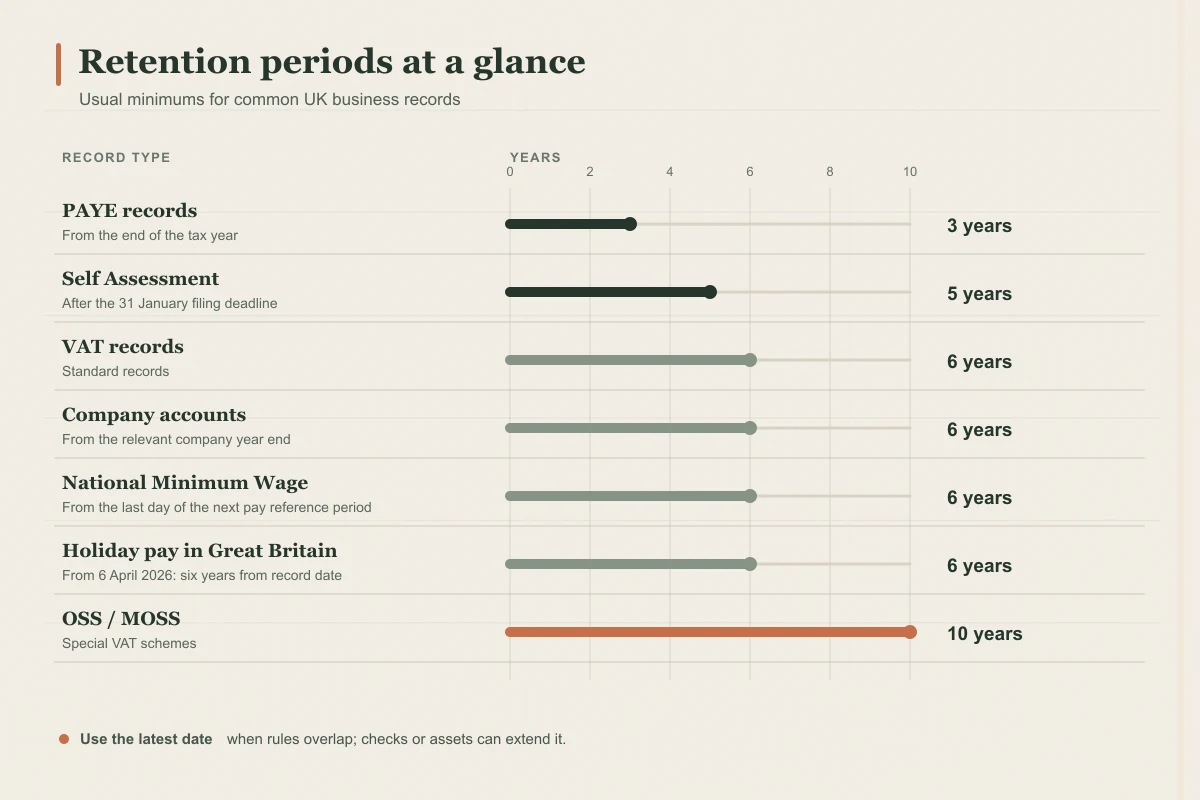
Quick answer: Sole traders usually keep Self Assessment records for five years after the filing deadline; VAT records for six years; company accounting records for six years from the relevant financial year end; PAYE records for three years after the tax year; and minimum wage records for six years. Other rules can extend these periods.

How long to keep business records: a quick comparison
Start by grouping records according to what they prove. The same bank statement can support your Self Assessment figures, VAT return and company accounts, so its disposal date may be later than the date for a record used for just one purpose.
| Record type | Usual minimum period | When the clock starts |
|---|---|---|
| Sole trader Self Assessment | 5 years | After the 31 January filing deadline for the tax year |
| VAT records | 6 years | Keep at least six years; special VAT schemes can differ |
| Company accounting records | 6 years | From the end of the last company financial year they relate to |
| PAYE records | 3 years | From the end of the tax year they relate to |
| National Minimum Wage evidence | 6 years | From the last day of the pay reference period after the one covered |
| Annual leave and holiday pay records in Great Britain | 6 years | From the date the record is made, for records made from 6 April 2026 |
The table is a starting point, not a universal deletion schedule. HMRC can require a longer period in specific cases, and you may need records for a live dispute, contract, asset or insurance matter. When a document supports more than one duty, compare each relevant period and keep it until the latest date that applies.
Self-employed records and Self Assessment
If you’re a sole trader, you normally need to keep your business records for at least five years after the 31 January filing deadline for the relevant tax year. This is the deadline by which most online Self Assessment returns and any tax due must be submitted and paid.
For example, the online deadline for the 2025/26 tax return is 31 January 2027. The ordinary retention period runs until at least 31 January 2032. Keep the records for longer if HMRC opens a check, or if you have another reason to retain them. If you submit your return more than four years after its filing deadline, HMRC says you must keep the relevant records for 15 months after you submit it. Check the specific dates against HMRC’s record-keeping guidance for self-employed people.
Records should let you explain how you arrived at the figures on your return. That normally means sales invoices and till records, bank statements, purchase receipts, mileage details, stock records, details of grants or other income, and evidence for expenses. Keep a note of cash transactions too. A bank feed won’t explain a cash purchase or tell you whether a transfer was income, a refund or money you moved between your own accounts.
Imagine a freelance designer files their 2025/26 return on time, reporting £48,000 in sales and £7,200 in allowable expenses. Their sales invoices, expense receipts, mileage log and bank statements should normally be kept until 31 January 2032. If HMRC asks how a £1,100 laptop purchase was treated, the invoice and the note showing its business use help support the answer. The return summary alone may not.
If you’re self-employed and approaching a filing date, our Self Assessment service can help prepare the return from clear, organised evidence. For a wider overview of registration, filing and the return itself, see our Self Assessment tax return guide.
VAT invoices and digital records
VAT-registered businesses must keep VAT records for at least six years. These include the VAT account, copies of sales invoices, purchase invoices, credit notes and other records that explain the figures in each return. A VAT invoice is also a business record, so the retention rule continues after the customer has paid and the return has been filed.
Some schemes have a longer period. If you use the VAT One Stop Shop (OSS) or Mini One Stop Shop (MOSS) for eligible cross-border consumer sales, keep the relevant records for ten years. Keep other supporting business records for as long as the separate VAT or tax rule requires.
If Making Tax Digital for VAT applies to you, the digital records must satisfy HMRC’s digital record-keeping rules. Storing an image of a paper invoice can preserve the source document, but it doesn’t on its own meet every MTD requirement. The figures that make up a VAT return need to be held digitally, and digital links between software products may be required. Read HMRC’s VAT record-keeping guidance and check the rules for your software and any exemption.
Consider a VAT-registered shop with a return covering the quarter ending 30 September 2026. Its sales invoices, purchase invoices and VAT account should be retained for at least six years. That may mean a longer period than the owner’s PAYE records for the same quarter. The team should be able to find the invoice behind a box 4 reclaim, not just the final amount submitted in the return.
Our VAT returns service includes support with the records behind a return. For invoice fields and the evidence to keep, see our separate UK VAT invoice requirements guide.
Limited company accounting records
A limited company must usually keep accounting records for six years from the end of the last company financial year they relate to. Companies House and HMRC expect a company to keep records that show its transactions, assets and liabilities, including invoices, receipts, bank statements, orders, contracts and stock information. Records must let the company explain and check each transaction.
The six-year rule has exceptions. You may need to retain records for longer if a transaction covers more than one accounting period, the company buys an asset it expects to keep for more than six years, a Company Tax Return was filed late, or HMRC has started a compliance check before the normal period ends. If the company sells an asset, records such as the purchase invoice and improvement costs may also be needed to calculate a later disposal gain. Don’t discard these simply because an ordinary annual accounts folder has reached six years.
Suppose a company’s financial year ends on 31 March 2026. If a set of invoices and bank statements relates to that financial year, the usual six-year period runs to 31 March 2032. If the company bought a machine on 1 February 2026 and expects to use it until 2034, keep the purchase and depreciation evidence beyond March 2032. The asset exception can matter even when the routine accounts records have reached their standard date.
There’s a separate rule when a company is struck off. GOV.UK says to keep its other business documents, such as bank statements, invoices and receipts, for seven years after the strike-off date. That clock starts from the strike-off, not the company financial year end, so it is separate from the ordinary six-year accounting-record period. If the company employed people, keep copies of its employers’ liability insurance policy and schedule too. Read GOV.UK’s company closure records guidance.
Company directors remain responsible for ensuring the records are kept. Handing bookkeeping to an accountant or software provider doesn’t transfer the legal duty to the provider. Our annual accounts service can help with a company’s year-end records, and our bookkeeping service can help keep the underlying transactions in order during the year.
PAYE, minimum wage and holiday pay records
Payroll has more than one retention clock. For PAYE, employers must normally keep records for three years from the end of the tax year they relate to. HMRC’s PAYE records include details of employees, payments, deductions, tax codes and reports made to HMRC. A P60 or payroll report is useful, but keep the source information and the calculation trail behind it too.
Minimum wage records created on or after 1 April 2021 have a separate six-year rule. It also covers older records that were still due to be kept on 31 March 2021 under the previous three-year rule. The period starts from the last day of the pay reference period after the one the records cover, not the period they cover. For a monthly-paid worker, if the records cover June 2026 and the next pay reference period ends on 31 July 2026, retain them until at least 31 July 2032. Weekly and other payroll cycles have their own following period end date. You must also be able to produce an individual pay reference period’s records in a single document. GOV.UK explains the minimum wage records employers must keep.
From 6 April 2026, employers in Great Britain must keep detailed records of annual leave and holiday pay for six years from the date the record is made. The requirement covers records that show a worker’s entitlement and how holiday pay was calculated. The rule is for Great Britain; Northern Ireland has different employment legislation, so employers there should check the guidance that applies in Northern Ireland. Keep holiday records in a way that lets you explain the calculation, rather than relying on a single balance in payroll software. See GOV.UK’s annual leave and holiday pay record guidance.
Here’s a simple overlap. A café’s PAYE records for 2025/26 normally reach their three-year date on 5 April 2029. If a payroll record also proves that a worker received the right minimum wage, use the separate six-year period from the last day of the pay reference period after the one it covers. A leave calculation made on 20 April 2026 also falls under the new six-year holiday-record rule in Great Britain. Put those records into the longer-dated group instead of deleting them with the routine PAYE files.
Set a disposal date for every record group
You don’t need to keep every file forever. You do need a reliable way to tell which rule applies before you delete or shred it. A short retention register can do that without turning into a second bookkeeping system.
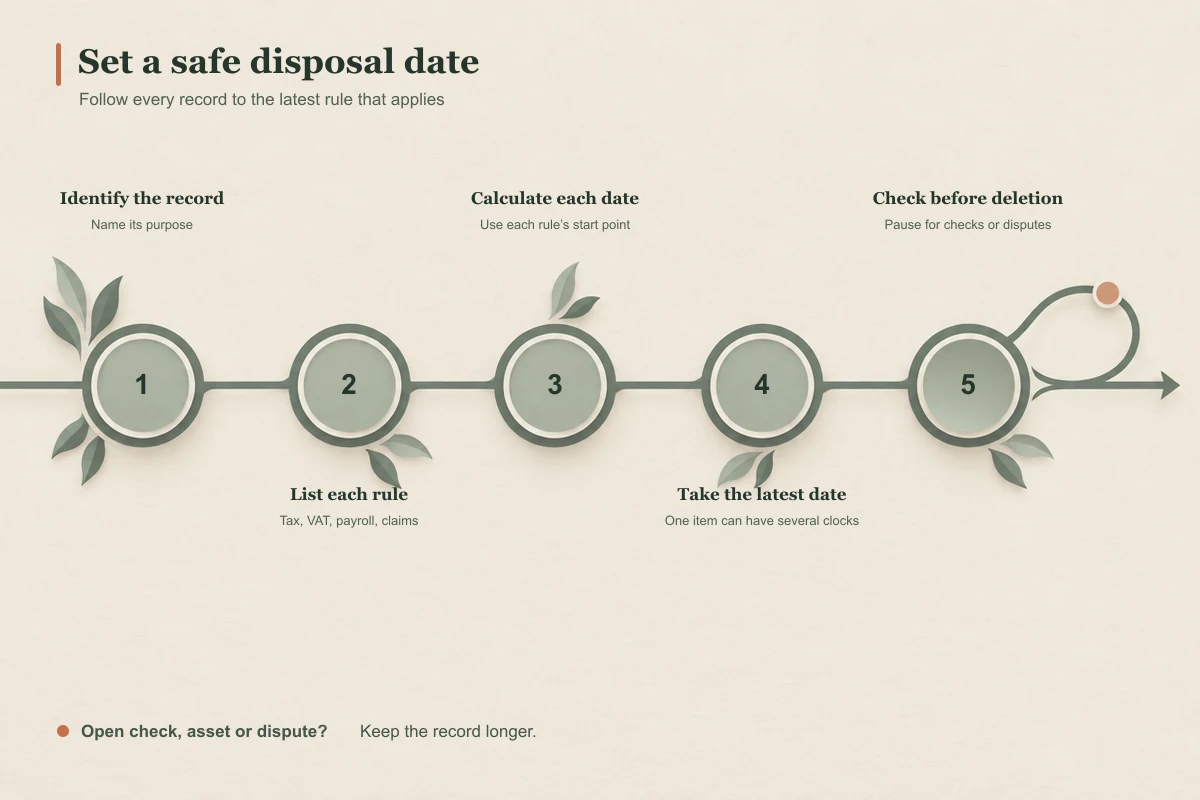
Use this process when creating or reviewing your record folders:
- Name the record and its purpose. “Supplier invoice, VAT return and company accounts” is more useful than “scan 014”.
- List every rule that uses it. Consider Self Assessment, Corporation Tax, VAT, PAYE, minimum wage, holiday pay and any open enquiry or claim.
- Write down each trigger and end date. Record whether the period starts at a filing deadline, the end of a tax year, a company year end, or the date a record was made.
- Use the latest applicable date. Add a reminder shortly before that date so someone can check for an enquiry, asset, dispute or other extension before deletion.
- Delete securely when the duty ends. If no rule or business need remains, erase digital copies and dispose of paper safely. Keep a short deletion log if that helps you demonstrate the policy was followed.
For example, a director’s mileage log may support their company accounts and a payroll expense review. A sole trader’s bank statement may support both turnover and a VAT return. The important point is to attach the longest relevant date to the record or folder, not to give every document in your cloud drive a blanket six-year label.
Store records so you can find them, then remove them safely
Good record keeping is partly about retention and partly about retrieval. If HMRC asks for the receipt behind a return figure, finding the right file quickly is easier when the filename includes a date, supplier and purpose. Keep a consistent folder structure, back up the records, limit access to the people who need it, and check that an export can still be opened without a particular software subscription.
Digital storage doesn’t remove the need for source evidence. Keep the original electronic invoice where available, and make sure a scan is complete and readable before disposing of a paper copy. If your records use an accounting platform, export key reports and data regularly. Software access can end after a subscription change, business closure or account dispute, which is a poor time to discover that the only copy was inside a login you no longer control.
Some records contain employee or customer personal data. The UK GDPR storage limitation principle says personal data shouldn’t be kept longer than needed for the purpose. A legal tax or employment retention requirement is a reason to keep relevant records during that period, but it doesn’t justify holding every detail indefinitely. When the retention period ends, remove data that no longer has a business, legal or dispute-related purpose. See the ICO guidance on storage limitation.
If your company stops trading or you close a sole trade, make a final schedule before cancelling software or shredding old files. Keep a named person responsible for the archive, confirm where any accountant-held records sit, and make sure someone can respond if HMRC asks a question later. For advice on a specific enquiry, legal claim or insolvency, speak to a qualified adviser who can assess the facts.
Frequently asked questions
How long should a sole trader keep tax records in the UK?
Usually five years after the 31 January Self Assessment filing deadline for the tax year. For 2025/26, the ordinary end date is 31 January 2032. Late filing and HMRC checks can change how long you should retain the evidence.
How long do I need to keep VAT records?
At least six years for ordinary VAT records. Keep relevant OSS or MOSS records for ten years. If you use MTD for VAT, make sure the digital records meet HMRC’s rules as well as being retained for the required period.
Do limited companies have to keep records for six years?
Usually, for six years from the end of the company financial year the records relate to. Longer periods can apply to transactions across periods, long-life assets, late Company Tax Returns and HMRC checks.
Can I delete business records after six years?
Only after checking the record’s purpose and start date. Six years can be too long for some records and too short for others. Compare all the tax, payroll and company rules that apply, then check for a live enquiry or dispute.
How long should I keep payroll records?
PAYE records are normally kept for three years from the end of the tax year. Minimum wage records need six years, and certain annual leave and holiday pay records in Great Britain made from 6 April 2026 also need six years.
What happens to records when I close my business?
You still need to keep the records required for returns, accounts and employment obligations. If a limited company is struck off, GOV.UK advises keeping its other business documents, such as bank statements, invoices and receipts, for seven years after strike-off. Write down each final date, store the archive securely and give someone responsibility for answering later requests. See GOV.UK’s company closure records guidance. Closing a bank account or bookkeeping subscription doesn’t meet those record-keeping duties.
The practical next step is to pick one folder, calculate the disposal date for its records and write that date beside the folder. Once the same approach is in place for VAT, payroll, tax returns and company accounts, annual clean-up becomes a check against a list instead of guesswork.

About Golden Tree Consulting
ACCA Affiliated | MBA Qualified
Golden Tree Accounting & Business Consulting provides expert tax, bookkeeping, and advisory services to sole traders and SMEs across Croydon, London, Surrey, and Kent. With multilingual support and decades of combined experience, we help businesses stay compliant and grow.
Offices in Croydon and London Bridge.
Related guides
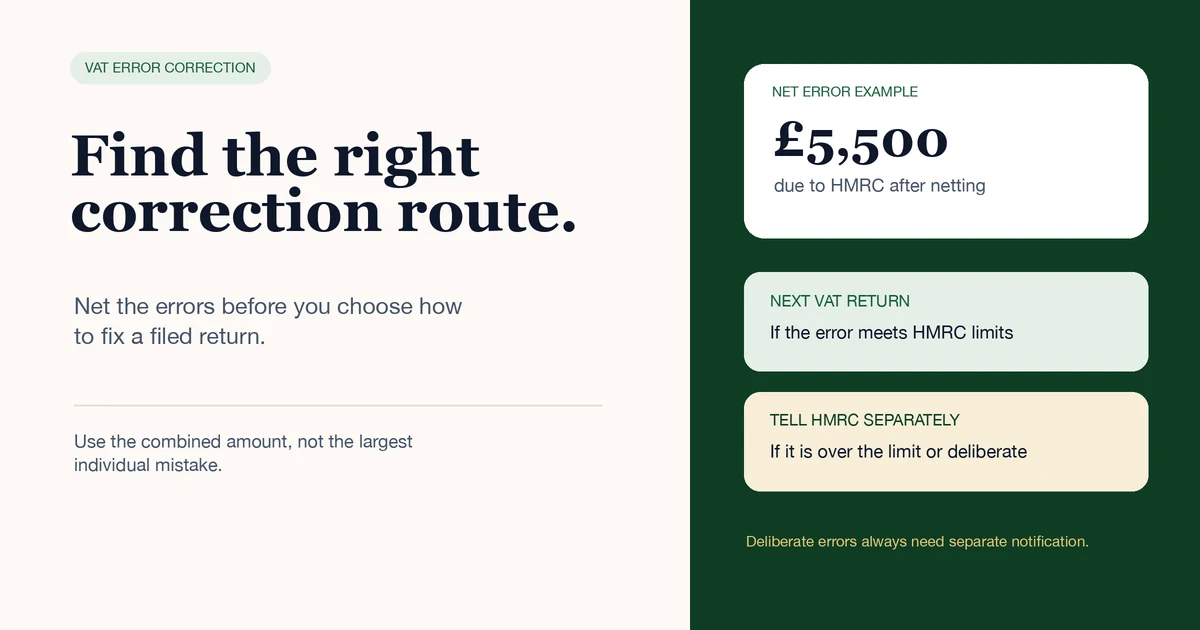
VAT Error Correction UK: How to Fix a Return After Filing
VAT error correction UK guide: learn when to adjust your next return, when to notify HMRC, how to calculate the net error and what records to keep.
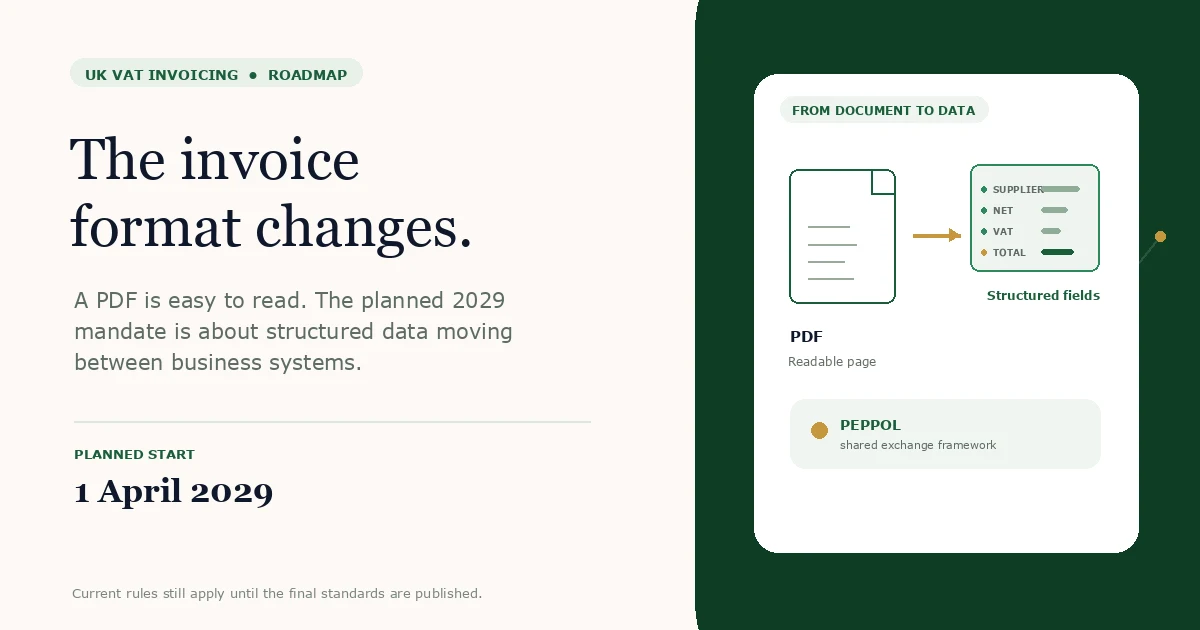
UK E-Invoicing 2029: What Small Businesses Need to Know
UK e-invoicing 2029: the planned VAT invoice mandate explained. Learn what counts, who is affected, what PDFs mean and how small businesses can prepare.

Vaping Products Duty UK 2026: Retailer Guide to Stock, Costs and Stamps
Vaping Products Duty UK starts 1 October 2026. See retailer approval rules, £2.20 per 10ml calculations, stamp checks, old-stock dates and records.