Summer VAT Cut 2026: 5% Rate Guide for Meals and Family Attractions
Summer VAT cut 2026 rules for children's meals and family attractions, with dates, eligibility, pricing examples, and setup checks.
 Golden Tree Accounting 22 June 2026 15 min read
 On this page Show
- Summer VAT cut 2026: the dates and rates
- What qualifies for the temporary 5% VAT rate?
- What is excluded?
- Pricing the summer VAT cut without damaging your records
- Advance bookings, prepayments, and the admission date
- A practical setup checklist before 25 June
- Common mistakes to avoid
- FAQ: summer VAT cut 2026
- What to do today
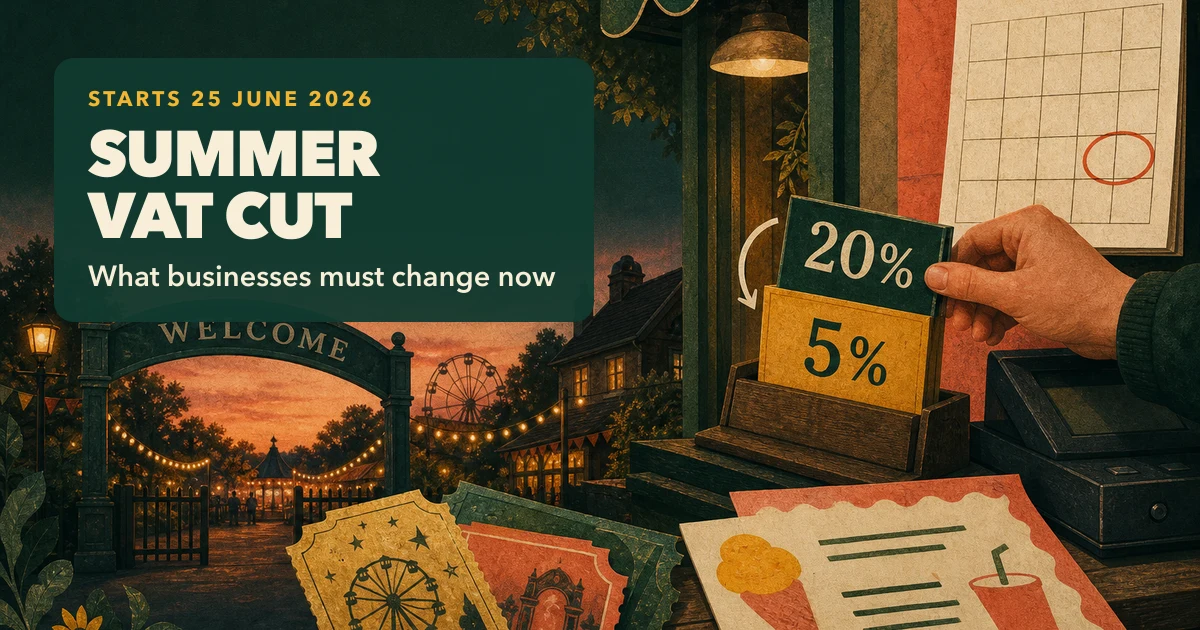
The summer VAT cut 2026 starts on 25 June, only three days after this guide is published. For a limited period, qualifying children’s meals, children’s and family entertainment tickets, and admission to listed family attractions move from the standard 20% VAT rate to 5%. The temporary rate runs through 1 September 2026, inclusive.
That short notice creates a practical job for restaurants, cafés, cinemas, theatres, soft play centres, zoos, museums, theme parks, farm attractions, and similar businesses. Products must be classified, prices decided, till and ticketing systems changed, advance sales reviewed, and the standard rate restored on 2 September. A rushed blanket change to every family-facing sale will be wrong.
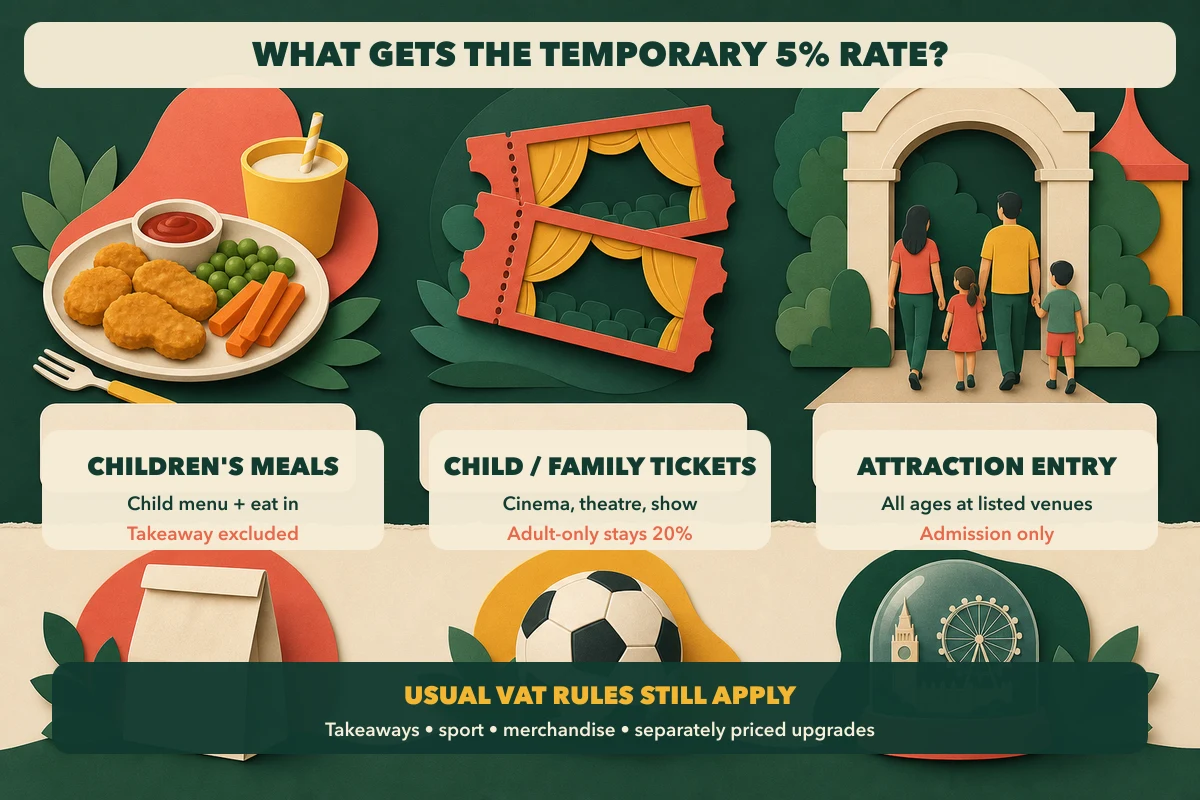
Quick summary: the 5% rate applies only to specified supplies from 25 June to 1 September 2026. Children’s sit-down meals must be marketed, presented, and priced as children’s meals. Child and family tickets qualify at cinemas, theatres, concerts, exhibitions, and shows. At listed family attractions, admission for adults and children can qualify. Takeaways, sport, merchandise, and separately priced upgrades keep their usual VAT treatment.
If you need to check product codes or prepare the next return, our VAT returns service, bookkeeping support, and contact page are the sensible places to start.
Summer VAT cut 2026: the dates and rates
HMRC’s Revenue and Customs Brief 5 (2026) sets out a temporary 5% reduced rate in place of the normal 20% standard rate for supplies that meet the conditions. It applies across England, Wales, Scotland, and Northern Ireland.
| Point | Rule |
|---|---|
| Announcement date | 21 May 2026 |
| Reduced-rate period starts | 25 June 2026 |
| Temporary VAT rate | 5% |
| Final day at the temporary rate | 1 September 2026 |
| Usual treatment resumes | 2 September 2026 |
| Main sectors | Restaurants, cafés, cinemas, theatres, shows, exhibitions, and listed family attractions |
The most useful official reference is HMRC’s temporary reduced-rate brief. You can also check the current GOV.UK VAT rates table and VAT Notice 709/1 for catering.
HMRC’s brief says the change is subject to the relevant statutory instrument being made and coming into force. Check that final legal step and your software provider’s release notes before you process the first reduced-rate sale. A government announcement is not a substitute for a working VAT code in the till.
What qualifies for the temporary 5% VAT rate?
The relief has three branches. Each branch has its own test.
Children’s meals eaten on the premises
A meal can qualify where both conditions are met:
- it is held out for sale only as a meal for children
- it is supplied as catering by a restaurant, café, or similar establishment for consumption on the premises
HMRC looks at how the meal is marketed, presented, and priced. A dedicated children’s menu is strong evidence. A smaller portion from the adult menu does not qualify merely because a child orders it. Lower-calorie meals, discounted adult dishes, and shared meals intended for adults and children are outside this specific relief.
A fixed-price children’s meal can include a main course, dessert, and non-alcoholic drink. If the whole package is sold as one children’s meal, the package can qualify. An optional upgrade taken from the standard menu keeps its normal VAT treatment. Calling an item “free” does not settle the VAT position.
Takeaway meals do not qualify under this measure. That distinction matters for cafés that sell the same food to eat in and take away. Staff need a clear button or order type, not a guess when the till is closed.
Worked example 1: a £12 children’s meal
Assume a restaurant currently sells a qualifying children’s meal for £12 including 20% VAT.
At 20% VAT:
- net sale: £10.00
- VAT: £2.00
- customer price: £12.00
If the restaurant preserves the same £10 net selling price and passes on the full rate cut:
- net sale: £10.00
- VAT at 5%: £0.50
- new customer price: £10.50
- customer saving: £1.50
If the restaurant keeps the gross price at £12, the VAT is £0.57, calculated as £12 × 5/105, and net revenue becomes £11.43. The government says it expects businesses to pass the VAT saving to customers, so the pricing decision should be documented rather than left to whoever edits the till.
Children’s and family admission tickets
The 5% rate applies to children’s tickets for:
- cinema screenings
- theatrical performances
- shows and concerts
- exhibitions
A children’s ticket must be marketed and sold as a right of admission for a child. When adult and child tickets are sold separately, the child ticket gets 5% and the adult ticket normally remains at 20%.
A genuine family ticket sold for one price can qualify in full where it includes at least one child admission. A general four-person ticket that is not marketed as a family ticket does not gain the relief simply because a family happens to buy it.
Worked example 2: a theatre family ticket
A theatre sells a family ticket for two adults and two children at £72 including 20% VAT.
The current split is:
- net ticket value: £60.00
- VAT at 20%: £12.00
- gross price: £72.00
If the same £60 net value is charged at 5% during the relief period:
- net ticket value: £60.00
- VAT at 5%: £3.00
- gross price: £63.00
- customer saving: £9.00
The family label and sales presentation matter here. Four standalone adult tickets do not become a qualifying family package because one customer arrives with children.
Admission to listed family attractions
Qualifying attractions get a broader rule. The reduced rate can apply to admission for all customers, regardless of age, where the venue is within HMRC’s listed categories and suitable for families with children.
The list includes:
- amusement parks, fairs, water parks, and theme parks, excluding pay-per-ride charges
- circuses
- adventure parks and outdoor adventure centres
- museums, planetariums, heritage sites, nature reserves, and botanical gardens
- zoos, aquariums, wildlife parks, and farm visitor attractions
- soft play centres, indoor bounce parks, and indoor play facilities
- observation platforms, towers, wheels, and similar attractions
Only the admission charge gets this treatment. Food, souvenirs, photographs, premium parking, fast-track upgrades, and other separately supplied extras keep their normal VAT rate unless they independently qualify under another rule.
Some admissions are already exempt, especially supplies by public authorities or eligible cultural bodies. An exempt supply does not become a 5% taxable supply just because the new measure exists. That could affect input VAT recovery, so do not switch an exempt code without advice.
What is excluded?
The exclusions are as important as the headline rate.
| Supply | Temporary 5% rate? | Reason |
|---|---|---|
| Children’s meal from a dedicated menu, eaten in | Yes | Meets the children’s meal and on-premises tests |
| Smaller adult meal described as a “light bite” | No | Not held out only as a children’s meal |
| Children’s hot takeaway | No | Takeaway meals are excluded from this relief |
| Child cinema ticket | Yes | Specifically covered child admission |
| Standalone adult cinema ticket | No | Adult-only entertainment ticket remains at its usual rate |
| Family theatre ticket including children | Yes | The whole qualifying family package can receive 5% |
| Entry to a listed soft play centre | Yes | Admission for all ages can qualify |
| Pay-per-ride fairground charge | No | HMRC excludes pay-per-ride attractions |
| Football match or sports participation | No | Spectating and participation in sport are outside the measure |
| Souvenir bought at a zoo | No | Merchandise keeps its normal VAT treatment |
Mixed supplies need care. If a package includes admission, food, merchandise, and an upgrade for one price, normal VAT rules decide whether you have one supply or several and how the consideration is split. Do not invent an allocation because it produces a convenient result. Keep the commercial evidence, price lists, and method used.
Pricing the summer VAT cut without damaging your records
There are two obvious pricing choices.
You can keep the net price unchanged and reduce the customer-facing gross price. That passes the full VAT saving on. You can also keep the gross price unchanged, which increases net revenue because less of the selling price is VAT. The government has stated that it expects the savings to be passed to customers, though HMRC’s VAT brief focuses on the tax treatment rather than dictating a retail price.
Worked example 3: a £24 attraction ticket
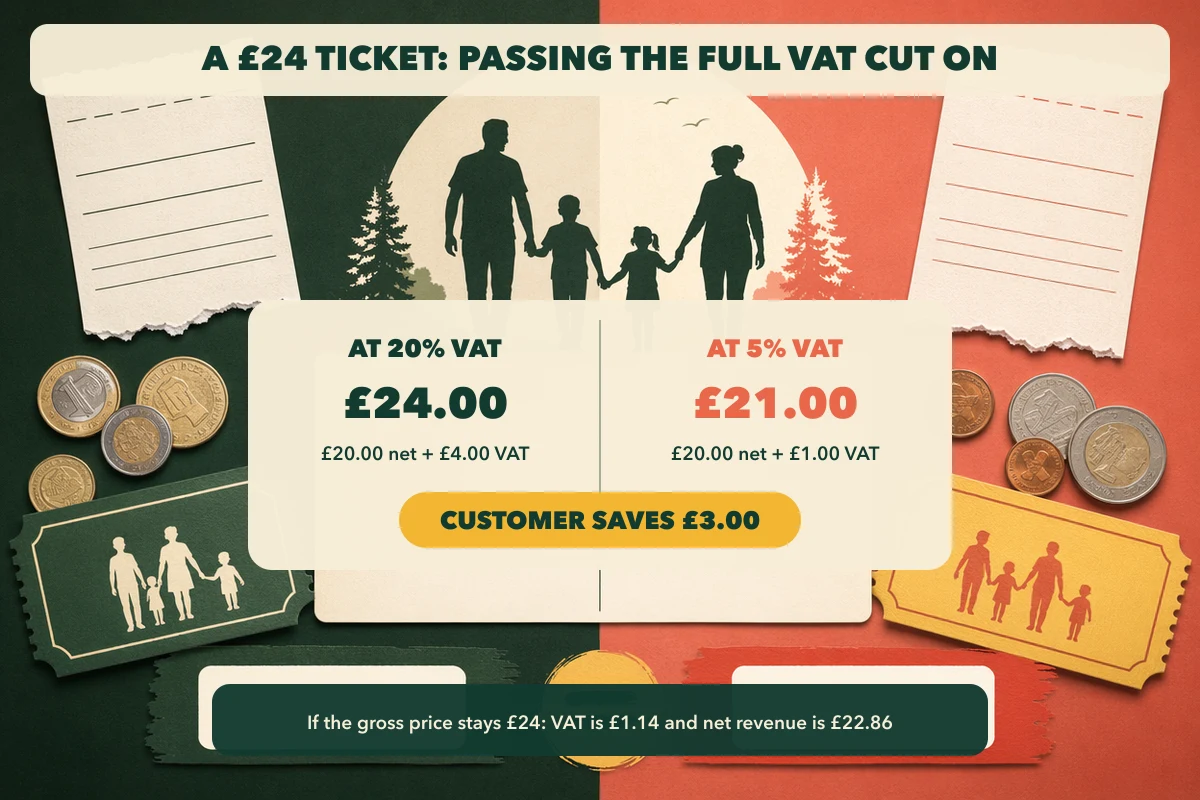
For a £24 VAT-inclusive admission ticket at 20%:
- net revenue is £20.00
- VAT is £4.00
At 5%, keeping the £20 net price gives:
- net revenue of £20.00
- VAT of £1.00
- customer price of £21.00
- customer saving of £3.00
If the attraction keeps charging £24, VAT is £1.14 and net revenue is £22.86. That is £2.86 more net revenue than before. Neither calculation is difficult. The control problem is making sure the website, ticket partner, walk-up till, invoices, refunds, gift vouchers, and bookkeeping use the same choice.
Worked example 4: admission plus merchandise
Assume a farm attraction sells these items separately:
- admission ticket: £30 including 20% VAT before the relief
- activity booklet and souvenir: £12 including 20% VAT
- old total: £42
The ticket contains £25 net revenue and £5 VAT. If the attraction passes on the full cut, the ticket falls to £26.25, made up of £25 net plus £1.25 VAT. The £12 merchandise price is unchanged because it does not qualify.
The new basket total is £38.25, a customer saving of £3.75. Applying 5% to the full £42 basket would understate VAT on the merchandise. That is why separate product codes matter.
Advance bookings, prepayments, and the admission date
For admission, HMRC says the temporary rate follows the date of admission. A ticket bought on 28 June for an event on 5 September remains at the standard rate because the admission takes place after the relief window. A ticket bought in May for entry on 20 July can fall within the change-of-rate provisions.
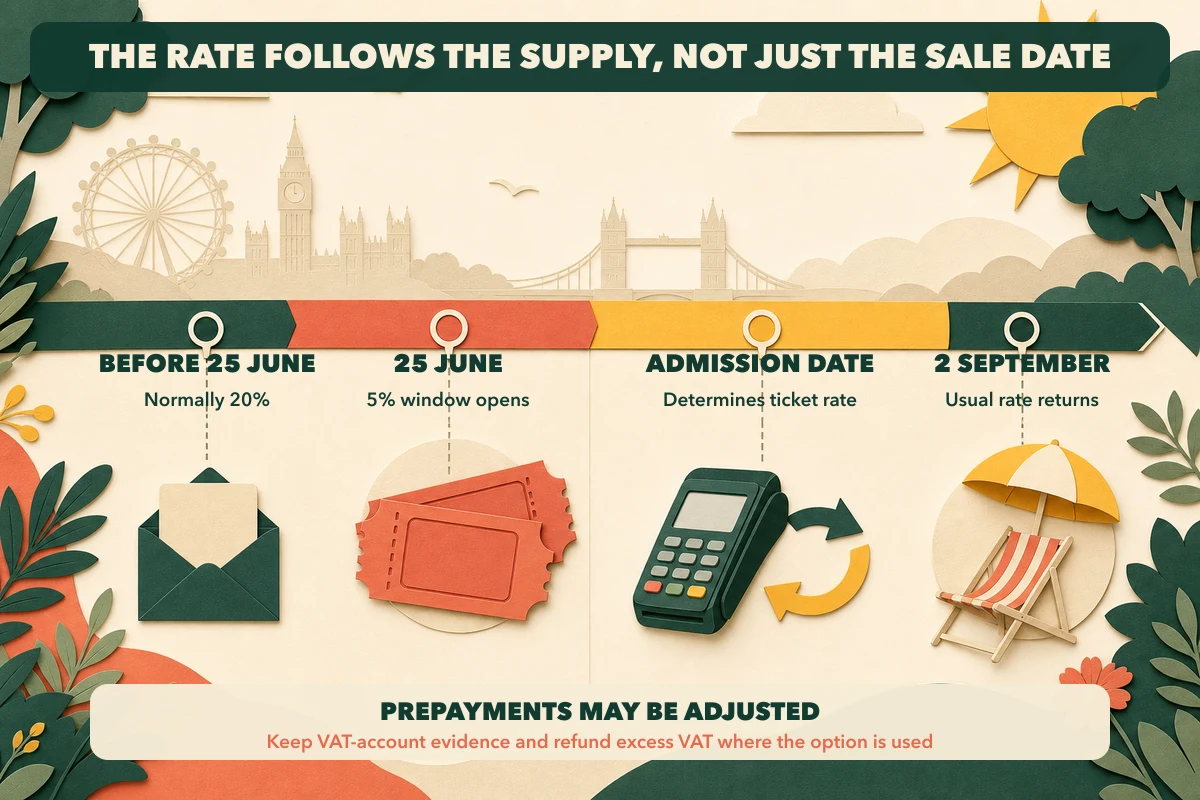
Businesses that received advance payment and accounted for 20% VAT may choose to apply the lower rate under the existing change-of-rate rules. If that option is used, HMRC expects excess VAT paid by the customer to be refunded and the VAT account adjusted.
Worked example 5: a prepaid July family ticket
A customer paid £84 in April for a qualifying family attraction visit on 18 July 2026. At 20%, the price contains:
- net amount: £70.00
- VAT: £14.00
At 5% on the same £70 net value:
- revised gross price: £73.50
- VAT: £3.50
- potential refund to the customer: £10.50
The operator should not simply change the VAT return and keep the £10.50 described as VAT. It needs a controlled adjustment, customer refund evidence, and records that link the original sale to the amended treatment. Your specific contract terms and tax point can change the answer, so get advice where deposits, vouchers, agents, or non-refundable bookings are involved.
Season passes are another trap. A pass allowing repeat entry outside 25 June to 1 September will not normally qualify if it costs more than a single-day ticket. A repeat-entry ticket used only inside the relief period can qualify. A longer pass priced exactly the same as a single visit may also fit HMRC’s stated exception.
A practical setup checklist before 25 June
Three days is not much time, but a controlled setup is still possible.
Classify products before changing VAT codes
Create a short list with one row for each product or ticket type. Record its normal VAT treatment, temporary treatment, reason, selling channels, and owner. Flag bundles and borderline items for review.
Decide and approve prices
For every qualifying item, record whether the gross price falls or stays fixed. Keep the net, VAT, and gross calculation. Update customer-facing prices at the same time across menus, websites, ticket platforms, kiosks, and printed notices.
Add a separate 5% tax code
Do not overwrite the standard-rate code used by unrelated sales. Add or activate a 5% code, map only qualifying products to it, and give it clear start and end dates where the software allows.
Test real baskets
Run at least these tests:
- one qualifying children’s meal eaten in
- the same food ordered as takeaway
- one child ticket and one adult ticket
- one genuine family ticket
- attraction admission plus merchandise
- an advance booking inside the window
- a booking for admission on or after 2 September
- a refund against an original 20% sale
Keep screenshots or till reports from the test. A clean audit trail is more useful than a meeting note saying “the system looked fine”.
Brief staff in plain English
Front-line staff do not need a VAT lecture. They need to know which menu, ticket, or admission button to press and when to ask a manager. Give them examples of the awkward cases, especially takeaway orders, adult tickets, upgrades, and refunds.
Schedule the reversal now
Set a diary task for close of business on 1 September or before opening on 2 September, depending on your trading pattern. Check future bookings as well as walk-up sales. Temporary tax changes have a habit of becoming permanent software settings if nobody owns the reversal.
Our VAT Cash Accounting Scheme guide may also help if your VAT timing follows customer payments. The temporary rate and cash accounting rules solve different problems, so check both the liability and the period in which the sale enters the return.
Common mistakes to avoid
The most likely errors are operational:
- changing every children’s food item to 5%, including takeaway sales
- treating all adult entertainment tickets as reduced-rated
- missing that adult admission to a listed attraction can qualify
- applying 5% to merchandise and upgrades sold alongside admission
- converting an existing exempt cultural admission into a taxable 5% sale
- using purchase date instead of admission date for future tickets
- adjusting advance sales without refunding excess VAT or keeping evidence
- forgetting to restore the usual rates on 2 September
- calculating VAT as 5% of the gross amount instead of using the 5/105 VAT fraction
That last point is a familiar source of small differences. On a £24 VAT-inclusive sale at 5%, VAT is not £1.20. It is £24 × 5/105 = £1.14, rounded to the nearest penny under the business’s normal method.
If a return includes a mix of 20%, 5%, zero-rated, and exempt sales, reconcile turnover by VAT code before submission. Our VAT registration guide explains the wider registration position, while our VAT returns team can review the temporary rate setup and the resulting return.
FAQ: summer VAT cut 2026
When does the 5% summer VAT rate start and end?
It starts on 25 June 2026 and applies through 1 September 2026, inclusive. Usual VAT treatment resumes from 2 September 2026.
Do all children’s meals qualify for 5% VAT?
No. The meal must be held out for sale only as a children’s meal and supplied for consumption on the premises by a restaurant, café, or similar establishment. Takeaways, shared meals, and smaller adult portions do not qualify under this relief.
Are adult tickets reduced to 5%?
It depends on the supply. Standalone adult cinema, theatre, concert, show, and exhibition tickets normally remain at their usual rate. A genuine family ticket including children can qualify in full. Admission for adults to listed family attractions can also qualify.
Does the 5% rate apply to food and souvenirs sold inside an attraction?
Not automatically. The attraction rule covers admission. Separately sold food, merchandise, parking, photographs, and upgrades keep their normal VAT treatment unless another VAT rule applies.
What happens to tickets sold before 25 June for a visit in July?
HMRC’s change-of-rate provisions may allow the lower rate to be applied to qualifying admission inside the relief period. If the business adjusts VAT already accounted for at 20%, it should update its VAT records and refund the excess VAT paid by the customer.
Does a season pass qualify?
A pass allowing repeat admission beyond 1 September will not normally qualify if it costs more than a single-day ticket. Repeat entry entirely within the relief period can qualify. Check unusual pass terms against HMRC’s brief.
Must a business reduce its customer prices?
The government’s announcement says it expects eligible businesses to pass on the VAT saving. HMRC’s tax guidance explains which rate applies, while each business must set and document its prices correctly.
What to do today
Export your product list and mark every line 5%, usual rate, exempt, or needs review. Then test one mixed basket before trading starts on 25 June. If the classification or advance-booking treatment is unclear, send us the product list and booking terms before changing the VAT code.

About Golden Tree Consulting
ACCA Affiliated | MBA Qualified
Golden Tree Accounting & Business Consulting provides expert tax, bookkeeping, and advisory services to sole traders and SMEs across Croydon, London, Surrey, and Kent. With multilingual support and decades of combined experience, we help businesses stay compliant and grow.
Offices in Croydon and London Bridge.
Related guides
VAT Bad Debt Relief UK 2026: How to Reclaim VAT on Unpaid Invoices
VAT bad debt relief UK 2026 explained: check the six-month rule, calculate the VAT on unpaid invoices, claim it on your return and keep the right records.

How to Claim VAT Back in the UK: Input Tax Guide for Small Businesses 2026
How to claim VAT back in the UK in 2026: check input tax, VAT invoices, pre-registration costs, blocked expenses and your VAT return.
VAT Return Dates 2026/27: UK Quarterly Deadlines for Small Businesses
VAT return dates for 2026/27 explained for UK small businesses: the next quarterly deadlines for every stagger, payment rules, how to submit, fixing errors and penalties.