VAT Return Dates 2026/27: UK Quarterly Deadlines for Small Businesses
VAT return dates for 2026/27 explained for UK small businesses: the next quarterly deadlines for every stagger, payment rules, how to submit, fixing errors and penalties.
 Golden Tree Accounting Updated 27 September 2026 17 min read
 On this page Show
- VAT return dates 2026/27: every quarterly deadline
- Worked example 1: quarter ending 30 September 2026
- What changes your VAT return date?
- The records to get ready before filing
- Worked example 2: one coding error can change the VAT bill
- What happens if you submit a VAT return late?
- What happens if you pay VAT late?
- How to avoid the deadline-week rush
- How to submit your VAT return
- If you spot an error after filing
- When to ask for help
- VAT return dates 2026/27 FAQ
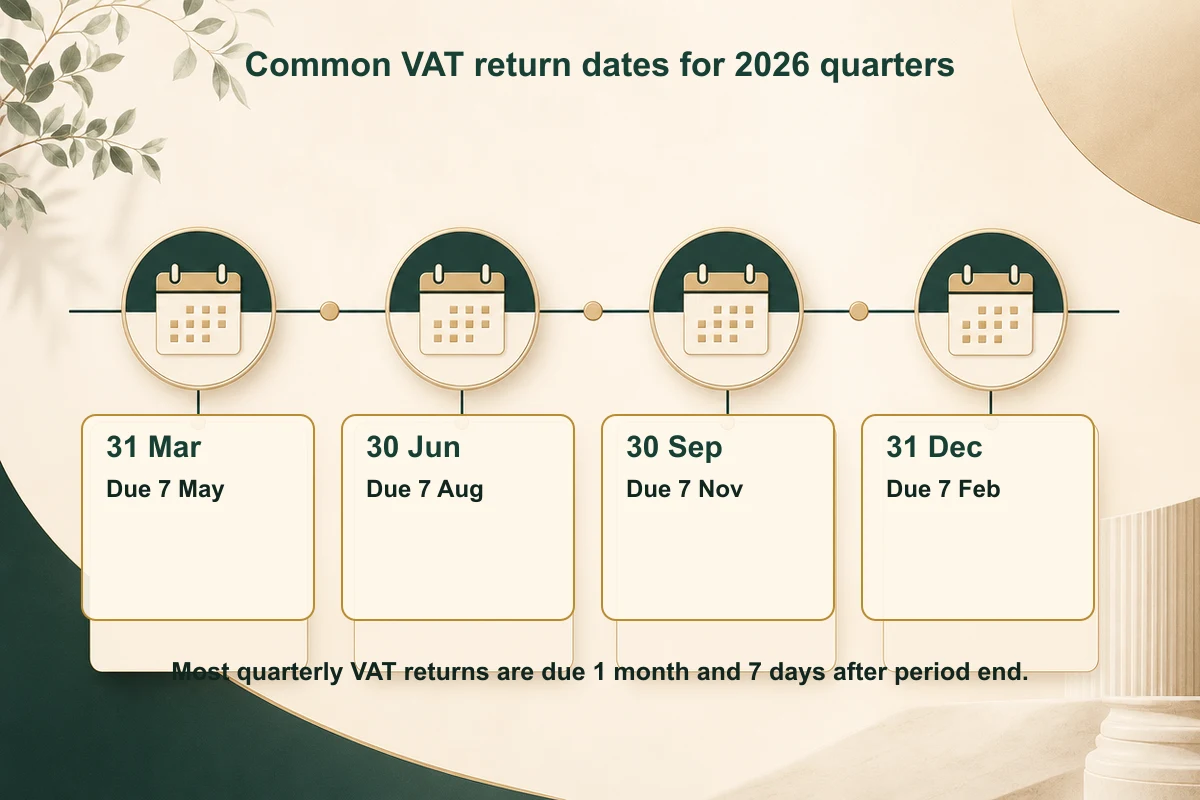
For most UK small businesses filing quarterly, the VAT return deadline is one calendar month and seven days after the VAT period ends. The next common deadline is Saturday 7 November 2026, for quarters ending 30 September 2026, and it does not move because it falls on a weekend. Quarters ending 31 October are due by 7 December 2026, and quarters ending 30 November by 7 January 2027.
That date covers the return and, in most standard quarterly cases, the VAT payment too. Filing the return without paying the VAT is only half the job. Paying the VAT without fixing the return is not much better. HMRC’s systems can charge late submission penalties, late payment penalties, and interest, and those are three different problems.
Quick summary: a quarter ending 30 September 2026 is due by Saturday 7 November 2026. A 31 December 2026 quarter is due by Sunday 7 February 2027, and a 31 March 2027 quarter by Friday 7 May 2027. Weekend and bank holiday deadlines do not move, so file and pay before them. Check your VAT online account because your stagger, annual accounting, payments on account and unusual periods can change the answer.
If you want the deadline handled without a last-week scramble, we can help through our VAT returns service, bookkeeping support, and contact page.
VAT return dates 2026/27: every quarterly deadline
Most VAT-registered businesses file quarterly. GOV.UK’s VAT return guidance says returns are usually submitted every three months, and the deadline is normally one month and seven days after the end of the VAT period. GOV.UK’s payment guidance gives the same practical rule for paying the VAT bill.
HMRC puts quarterly businesses into one of three “stagger” groups. Your group decides which months your quarters end in. The return and the payment are due on the same date.
| Your quarters end in | Quarter ends | Return and payment due |
|---|---|---|
| March, June, September, December | 30 September 2026 | Saturday 7 November 2026 |
| 31 December 2026 | Sunday 7 February 2027 | |
| 31 March 2027 | Friday 7 May 2027 | |
| 30 June 2027 | Saturday 7 August 2027 | |
| April, July, October, January | 31 October 2026 | Monday 7 December 2026 |
| 31 January 2027 | Sunday 7 March 2027 | |
| 30 April 2027 | Monday 7 June 2027 | |
| May, August, November, February | 31 August 2026 | Wednesday 7 October 2026 |
| 30 November 2026 | Thursday 7 January 2027 | |
| 28 February 2027 | Wednesday 7 April 2027 | |
| 31 May 2027 | Wednesday 7 July 2027 |
Your VAT online account is the final source for your own dates, especially if you changed stagger, joined a scheme or had a long or short first period.
Weekends and bank holidays do not move the deadline. GOV.UK says you must submit your return and make sure your payment reaches HMRC on or before the deadline, even if it falls on a weekend or bank holiday. For 7 November 2026, that means paying by Friday 6 November unless you use a same-day method such as Faster Payments.
Direct Debit is the exception on timing. Set it up in your VAT online account at least 3 working days before you submit the return, and HMRC collects the payment automatically after the deadline. If you set it up later, the payment will not be taken and you will have to pay another way.
Official references worth keeping open are GOV.UK’s VAT online account page, GOV.UK’s VAT payment page, and GOV.UK’s VAT penalties and interest collection.
Worked example 1: quarter ending 30 September 2026
Assume a VAT-registered design agency has a quarterly VAT period ending 30 September 2026. Its deadline is Saturday 7 November 2026.
By the time the return is filed, the agency needs to check:
- sales invoices dated in the VAT period
- customer credits and refunds
- purchase invoices and receipts
- bank transactions and card processor payouts
- reverse charge entries, if any
- imports, postponed VAT accounting, or overseas services
- VAT adjustments, bad debt relief, and previous corrections
Here is a simple set of figures:
| Item for the September 2026 quarter | Net amount | VAT |
|---|---|---|
| Standard-rated sales | £52,000 | £10,400 |
| Standard-rated purchases | £18,500 | £3,700 |
| VAT due before adjustments | £6,700 | |
| Previous small correction | £120 added | |
| VAT to pay | £6,820 |
The return and payment are due by 7 November 2026. If the business waits until 5 November to reconcile the bank, there is almost no time left to investigate missing purchase invoices or coding errors. A better rhythm is to close the quarter by mid-October, review the return before the end of October, then file and pay before the final week.
That is not just tidiness. It protects cash flow. A £6,820 payment that arrives as a surprise on 5 November is harder to absorb than the same payment forecast three weeks earlier.
What changes your VAT return date?
The one month and seven days rule is the normal pattern, not a promise that every VAT business has the same date.
Your deadline may differ if you use:
| Situation | What can change |
|---|---|
| Monthly VAT returns | Deadlines follow monthly periods, often used where the business regularly reclaims VAT |
| Annual Accounting Scheme | You usually make payments during the year and file one annual return |
| Payments on account | Larger VAT businesses may make interim payments with a balancing payment |
| Non-standard VAT periods | HMRC may set a shorter or longer first period, or a changed stagger |
| VAT group registration | The group representative member manages the group return date |
| Deregistration or final return | HMRC may issue a specific final period and deadline |
Annual accounting deserves special care. It can reduce the number of VAT returns, but it does not mean VAT is ignored all year. Businesses usually make advance payments and then file one annual return. The timing can be useful, but the cash-flow effect needs checking before you choose it.
Monthly VAT returns can be useful where a business often receives repayments, for example because it exports, makes zero-rated supplies, or has heavy input VAT. The trade-off is more frequent admin. If records are messy quarterly, monthly filing will not magically make them cleaner. It just gives you twelve chances a year to discover the mess.
If you’re unsure which cycle you are on, do not guess from last year’s diary. Log in to the VAT online account or ask your accountant to check the current obligation. We see deadline errors when a business changes period, changes agent, joins a scheme, or assumes every quarter works like the last one.
The records to get ready before filing
A VAT return is a summary, not a pile of invoices. The return is only as reliable as the records behind it.
For a standard small business VAT return, we would expect to review:
- sales invoices, till reports, platform statements, or payment processor reports
- credit notes and refunds
- purchase invoices and receipts with valid VAT evidence
- bank feed transactions and reconciliations
- import VAT statements, postponed VAT accounting statements, and customs records where relevant
- reverse charge entries for construction, overseas services, or other affected transactions
- VAT codes in the bookkeeping software
- previous VAT return balances and any outstanding corrections
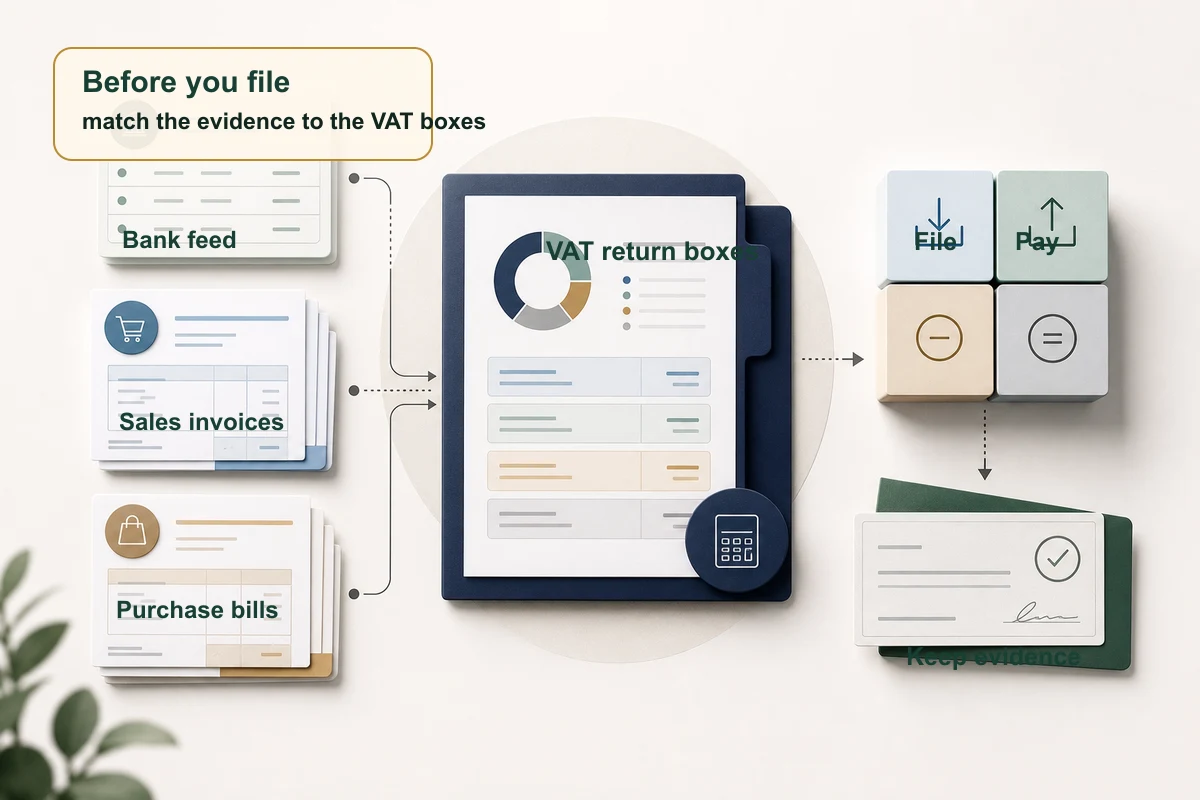
Right, so what actually goes wrong? Usually it is not one dramatic error. It is five small ones. A card processor payout is posted as sales even though the invoices are already in the system. A supplier invoice is claimed without a VAT invoice. A mixed-rate receipt is put wholly to 20%. A credit note is missed. A director pays a business cost personally and forgets to send the receipt.
The VAT return deadline is the moment those small errors become urgent. Monthly bookkeeping makes the return easier because the evidence is already in place. Our bookkeeping service is designed around that: keep the records current, then the VAT return becomes a review exercise rather than a rescue job.
Worked example 2: one coding error can change the VAT bill
Assume a cafe has these draft VAT figures for the quarter ending 30 September 2026:
- output VAT on sales: £8,200
- input VAT on purchases: £3,100
- draft VAT payable: £5,100
During review, the owner spots that a new coffee machine was posted as a general expense without VAT. The invoice shows:
- net cost: £2,400
- VAT at 20%: £480
- gross cost: £2,880
If the cafe has a valid VAT invoice and the purchase is for taxable business use, that missing £480 input VAT can reduce the VAT payable:
| Draft position | Amount |
|---|---|
| Draft VAT payable | £5,100 |
| Missing input VAT claim | £480 |
| Corrected VAT payable | £4,620 |
That is why review matters. The goal is not to push the VAT bill down at any cost. The goal is to file the right return with the right evidence. Sometimes the review increases the bill because output VAT was missed. Sometimes it reduces the bill because input VAT was missed. Either way, the return is better.
Your specific situation may differ, especially if you use a VAT scheme such as the Flat Rate Scheme or Cash Accounting Scheme. We recently covered the VAT Cash Accounting Scheme because timing can change where payments, invoices, and claims sit on the return.
What happens if you submit a VAT return late?
HMRC’s late submission system uses penalty points. For a quarterly VAT business, the penalty threshold is usually four points. Once you reach that threshold, HMRC charges a £200 penalty. Later missed returns can create further £200 penalties while you remain at the threshold.
The threshold depends on how often you submit:
| Filing frequency | Penalty point threshold |
|---|---|
| Annual | 2 points |
| Quarterly | 4 points |
| Monthly | 5 points |
There are rules for removing points, but they are not instant. You usually need a period of compliance and all outstanding returns filed. In plain English: do not treat the first late point as harmless just because it is not yet a fine. It can sit there waiting for the next missed return.
Late submission penalties can apply even if the VAT return is nil or repayment. That catches people out. If your return says HMRC owes you money, it still needs filing on time.
What happens if you pay VAT late?
Late payment is a separate system. GOV.UK’s VAT late payment guidance says late payment interest is charged from the first day payment is overdue until it is paid in full. Late payment penalties can then apply if the VAT remains unpaid for long enough.
For VAT payments under the current rules:
| Payment position | Penalty effect |
|---|---|
| Up to 15 days overdue | No first or second late payment penalty, but interest can still apply |
| 16 to 30 days overdue | First late payment penalty at 3% of VAT outstanding at day 15 |
| 31 or more days overdue | First penalty includes 3% at day 15 plus 3% at day 30, then a second daily penalty at a 10% annual rate from day 31 |
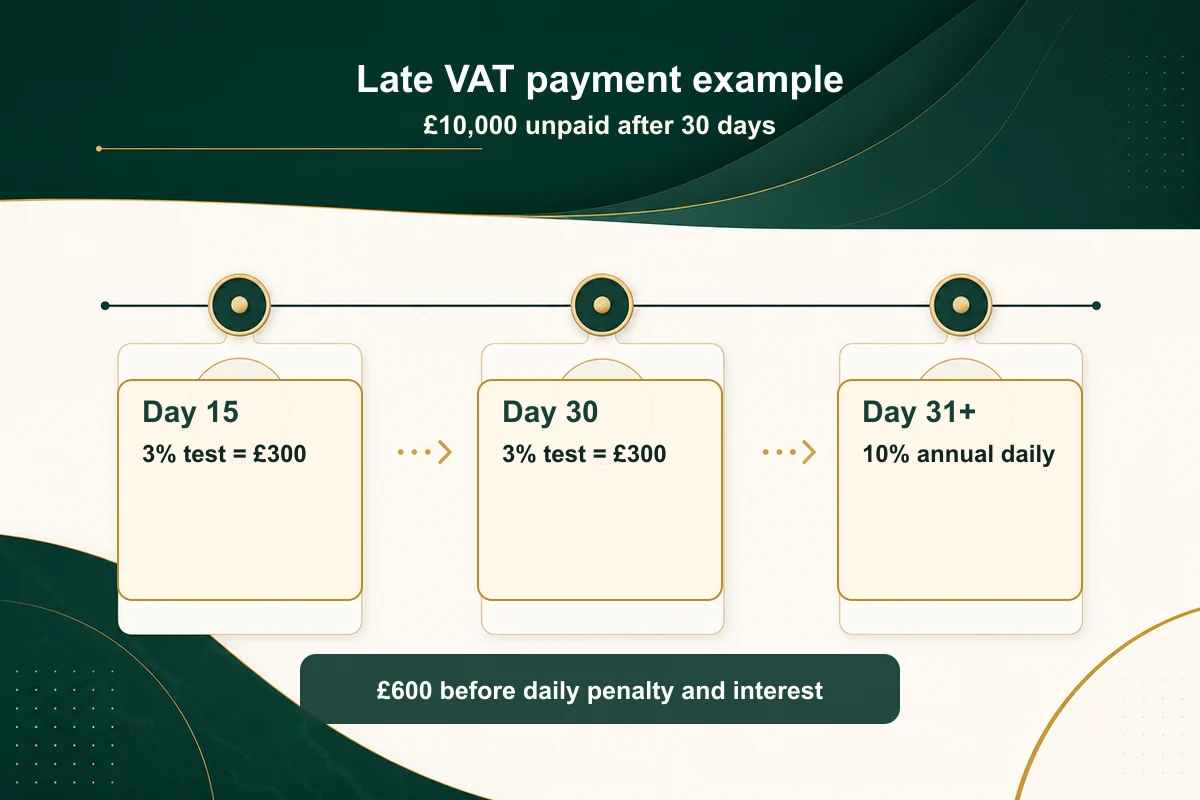
Worked example 3: £10,000 VAT paid after 30 days
Assume a business files its VAT return on time, but £10,000 of VAT is still unpaid after 30 days.
The first late payment penalty would be:
| Penalty stage | Calculation | Amount |
|---|---|---|
| Day 15 test | £10,000 × 3% | £300 |
| Day 30 test | £10,000 × 3% | £300 |
| First late payment penalty before daily penalty | £600 |
If the debt continues into day 31 and beyond, a second late payment penalty starts to build daily at a 10% annual rate on the outstanding balance. Late payment interest is separate.
This is where a Time to Pay arrangement can matter. HMRC says agreeing a payment plan may mean lower or no late payment penalties, depending on timing and whether you keep to the arrangement. If you know you cannot pay, speak to HMRC early rather than waiting for penalty letters.
How to avoid the deadline-week rush
The best VAT return process starts before the quarter ends.
For a quarter ending 30 September 2026, a sensible timetable looks like this:
| Date | Job |
|---|---|
| 30 September | VAT quarter ends |
| 1 to 10 October | Import bank transactions, card payouts, sales invoices, and purchase bills |
| 11 to 20 October | Reconcile bank, check VAT codes, chase missing invoices |
| 21 to 31 October | Review return, check payment forecast, agree adjustments |
| 2 to 5 November | Submit return and pay (7 November is a Saturday) |
| 7 November | HMRC deadline |
That leaves room for real life. The supplier who sends invoices late. The director who paid for software on a personal card. The Stripe payout that combines sales, fees, and refunds. The customer credit note that sits in emails rather than the accounts system. VAT has a talent for finding the one missing document at the worst time.
If you use Xero, QuickBooks, FreeAgent, Sage, or another cloud system, the software should help, but do not skip review. Bank rules can post transactions quickly and still post them wrongly. Receipt capture can read a gross amount but miss the VAT treatment. A neat dashboard is not evidence by itself.
How to submit your VAT return
- Reconcile the bookkeeping first. Match every bank line, card payout and loan movement before you look at the VAT figures.
- Check the period. Make sure invoices dated on either side of the quarter end are in the right return.
- Review the draft return box by box. Compare boxes 1, 4, 6 and 7 with the previous quarter and ask why anything moved a lot.
- Check unusual items separately. Imports and postponed VAT accounting, the domestic reverse charge, and sales that are zero-rated, exempt or outside the scope.
- Submit through Making Tax Digital compatible software. All VAT-registered businesses must keep digital records and file through MTD software, and HMRC’s online form is no longer available for most.
- Pay so the money arrives in time, or make sure your Direct Debit was set up at least 3 working days before you submit. Keep the submission receipt.
A nil return still has to be filed. Late submission points apply to nil and repayment returns too.
If you spot an error after filing
You may be able to correct an earlier mistake on your next VAT return. HMRC allows this if the net value of the errors is no more than the greater of:
- £10,000, or
- 1% of the box 6 figure on the return for the period in which you found the error, up to £50,000
Above that limit you normally have to tell HMRC separately, and deliberate errors must always be reported separately. Keep a note of what went wrong, which period it belongs to and how you worked out the correction.
For example, a £12,000 net error found by a business whose box 6 is £1,600,000 can go on the next return, because 1% of box 6 is £16,000. The same error for a business with box 6 of £400,000 would need separate notification, because the limit is then £10,000.
When to ask for help
You should get help before the deadline if any of these apply:
- your VAT quarters are not clear in the VAT online account
- bank reconciliations are more than a month behind
- you have imported goods, overseas services, or postponed VAT accounting
- you use the domestic reverse charge for construction
- sales include a mix of standard-rated, zero-rated, exempt, and outside-scope income
- you have received a VAT assessment, penalty, or interest notice
- you cannot pay the VAT by the deadline
- you are not sure whether old errors need adjusting on the next return or reporting separately
The last point matters. Small VAT errors can often be corrected on a later return if they meet HMRC’s conditions, but larger or more serious errors may need separate disclosure. Do not simply hide an old error inside the next box 1 or box 4 figure and hope for the best.
If you’d like us to review your VAT position before the next deadline, start with our VAT returns service or send the details through the contact page. We can check the VAT period, records, coding, payment forecast, and any scheme issues before the deadline becomes expensive.
VAT return dates 2026/27 FAQ
What is the next VAT return deadline?
For a quarter ending 30 September 2026, the return and payment are due by Saturday 7 November 2026. Quarters ending 31 October are due by 7 December 2026, and quarters ending 30 November by 7 January 2027. Check your VAT online account because your business may have a different stagger or scheme.
Does the VAT deadline move if it falls on a weekend?
No. The return must be filed and the payment must reach HMRC by the deadline even if it is a weekend or bank holiday. Pay earlier or use a same-day method. Direct Debits set up at least 3 working days before you submit are collected automatically.
Are VAT returns due every three months?
Most VAT-registered small businesses submit VAT returns quarterly, but some submit monthly or annually. Monthly returns are common for repayment traders. Annual accounting reduces the number of returns but usually involves payments during the year.
Can I file a VAT return before the deadline?
Yes. You can file before the deadline once the VAT period has ended and the records are ready. Filing early can help cash-flow planning because you know the payment figure sooner. Do not file before checking bank reconciliations, VAT codes, and missing purchase invoices.
Does a nil VAT return still need filing?
Yes. If HMRC expects a VAT return, you need to submit it even if there is no VAT to pay or the return is nil. Late submission points can still apply to nil and repayment returns.
What if I cannot pay my VAT bill?
File the return on time if you can, then contact HMRC as early as possible about payment. A Time to Pay arrangement may reduce or prevent some late payment penalties, but interest can still apply. The worst option is silence: HMRC does not treat a missed payment better because the return was ignored too.
Can Golden Tree Consulting file my VAT return?
Yes, if we have the right authorisation, software access, and records. We can also clean up the bookkeeping before filing so the return is based on evidence rather than guesswork. For a tight deadline, send sales, purchase, bank, and VAT account records as early as possible.

About Golden Tree Consulting
ACCA Affiliated | MBA Qualified
Golden Tree Accounting & Business Consulting provides expert tax, bookkeeping, and advisory services to sole traders and SMEs across Croydon, London, Surrey, and Kent. With multilingual support and decades of combined experience, we help businesses stay compliant and grow.
Offices in Croydon and London Bridge.
Related guides

How to Claim VAT Back in the UK: Input Tax Guide for Small Businesses 2026
How to claim VAT back in the UK in 2026: check input tax, VAT invoices, pre-registration costs, blocked expenses and your VAT return.
VAT Cash Accounting Scheme UK: 2026 Guide for Small Businesses
VAT Cash Accounting Scheme UK rules for 2026, with thresholds, cash-flow examples, eligibility checks, and record-keeping tips.
VAT Registration Threshold UK 2026: When Small Businesses Need to Register
VAT registration threshold UK rules for 2026, with turnover tests, dates, penalties, voluntary registration, and worked examples.