Capital Allowances 2027: How the Proposed 50% First-Year Allowance Works
Capital allowances 2027 may raise the main-rate first-year allowance to 50% and cut writing-down relief to 12%. See what small businesses should check.
 Golden Tree Accounting 9 November 2026 18 min read
On this page Show
- Capital allowances 2027: what the Budget proposed
- Which allowance might apply to equipment?
- How the proposed 50% first-year allowance would work
- Purchase dates and the accounting period both matter
- What changes for sole traders, partnerships and limited companies?
- Practical checks before you order equipment
- Capital allowances 2027: common questions
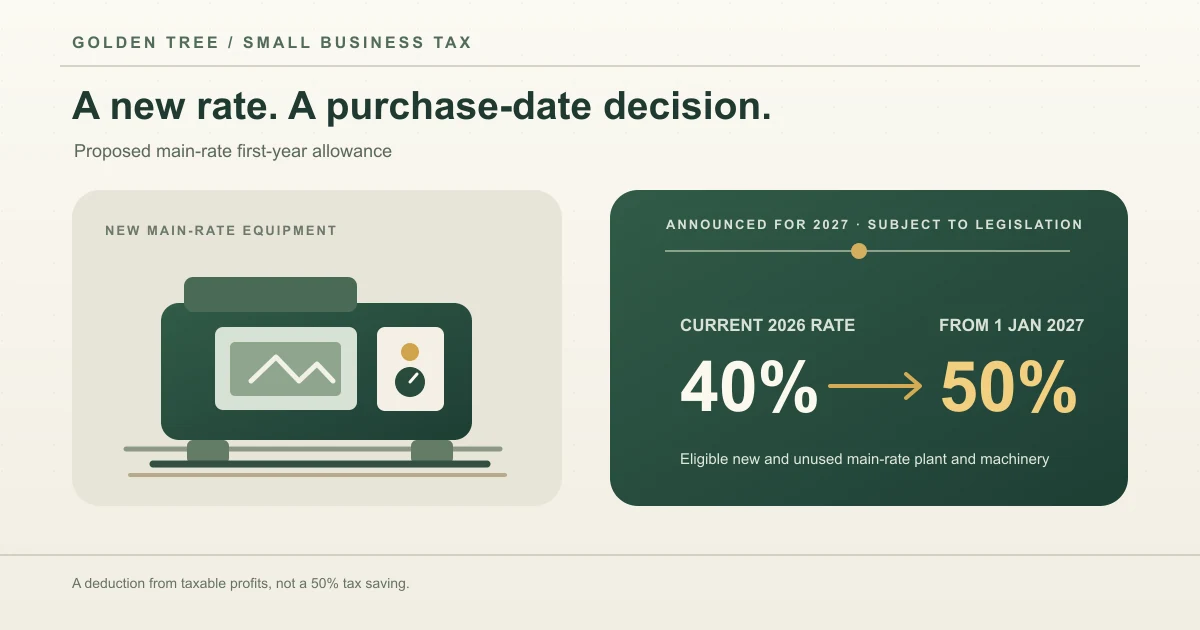
Capital allowances 2027 will change the way some small businesses claim tax relief on equipment. In the 2026 Budget, the government announced a proposed increase in the main-rate first-year allowance from 40% to 50% for qualifying expenditure from 1 January 2027. It also proposed reducing the main-rate writing-down allowance from 14% to 12% for accounting periods beginning from April 2027. Both changes are subject to legislation, so treat them as announced policy rather than settled law.
The headline percentages can give the wrong impression. A 50% allowance is not a 50% discount on a machine, and it does not automatically make waiting until January worthwhile. Some purchases may qualify for a 100% deduction through the annual investment allowance, or through full expensing for companies. There is already a separate 50% first-year allowance for certain special-rate assets bought by companies. The Budget proposal concerns the main-rate allowance. The useful question is which rule fits the asset and your accounting method.
At a glance: from 1 January 2027, the Budget proposes a 50% first-year allowance for qualifying new and unused main-rate plant and machinery. From 1 April 2027 for Corporation Tax and 6 April 2027 for Income Tax, the main-pool writing-down rate is proposed to fall to 12%. The £1 million annual investment allowance remains a separate route to a possible 100% deduction.
Capital allowances 2027: what the Budget proposed
Capital allowances let a business deduct some or all of the cost of certain long-term assets from taxable profits. The rules cover plant and machinery such as equipment, tools, computers, vans and some building fixtures. They do not generally let you deduct the purchase of a building or land as plant and machinery. Ordinary accounting depreciation is usually added back when the business profit for tax is calculated, then the relevant capital allowance is claimed instead.
The Budget announcement makes two changes to the main-rate treatment. First, it proposes a 50% first-year allowance for qualifying expenditure from 1 January 2027. This would replace the 40% rate that currently applies to qualifying purchases made from 1 January 2026. Second, it proposes reducing the main-rate writing-down allowance from 14% to 12% for accounting periods beginning on or after 1 April 2027 for companies and 6 April 2027 for Income Tax businesses.
The changes do not apply to every purchase or every business in the same way. The proposed 50% rate is for qualifying main-rate plant and machinery. The current 40% guidance says assets must be new and unused, must qualify for the main rate and must not be cars. Companies can already claim a separate 50% first-year allowance on qualifying special-rate assets under HMRC’s full-expensing guidance. That existing allowance is not the 2027 proposal. Special exclusions can apply, including some leasing situations. The proposal is in the HMRC policy paper on the 2026 Budget capital allowance changes, and the final claim should follow the law and HMRC guidance in force when you file.
The policy paper is a statement of intended changes, not proof that every detail is final. Finance Bill 2026-27 is expected to provide the legislation. Keep that distinction in mind if a supplier, online article or software prompt describes the 50% rate as already available. As at 9 November 2026, the operative rate for qualifying main-rate first-year allowance expenditure is still 40%.
Which allowance might apply to equipment?
Before comparing 40% with 50%, check whether the item could instead be covered by the annual investment allowance or full expensing. These rules can give a larger deduction in the purchase period, but they have their own eligibility conditions. The allowance is a tax calculation. It does not change the asset’s commercial price, and the best tax treatment should not be the only reason to buy something your business does not need.
| Relief | Broad position | Point to check |
|---|---|---|
| Annual Investment Allowance (AIA) | Up to 100% of qualifying plant and machinery, subject to the £1 million limit | Cars and some other assets are excluded; the limit may need adjusting for a short accounting period or shared between connected businesses. |
| Full expensing | 100% first-year deduction on qualifying new main-rate plant and machinery bought by companies | It is not available to sole traders or partnerships, and used assets and cars do not qualify. |
| Proposed main-rate first-year allowance | 50% of qualifying new and unused main-rate plant and machinery from 1 January 2027 | Subject to legislation; not a general 50% claim on every equipment purchase. |
| Writing-down allowance (WDA) | A percentage deduction from a tax pool balance carried forward | The proposed main rate is 12% for periods starting from the relevant April 2027 date; the special-rate pool remains separate. |
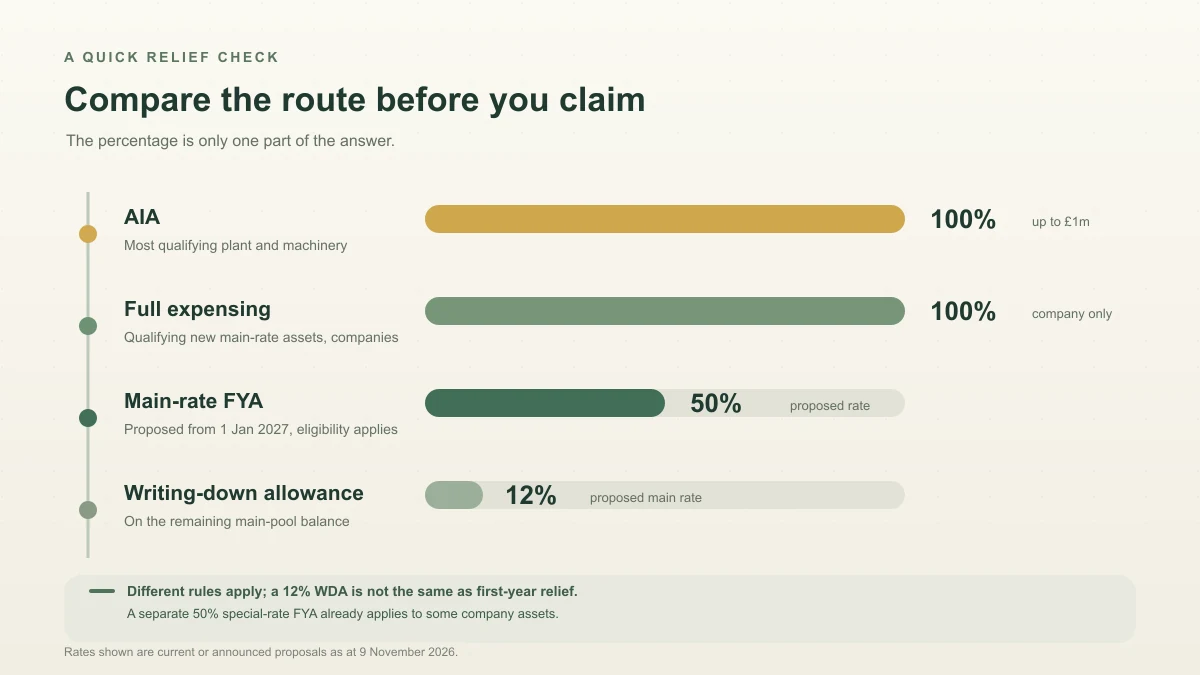
The annual investment allowance is currently £1 million for each accounting period. It can cover most qualifying plant and machinery, and can give a full deduction in the period the asset is bought. That is why a business should not assume the proposed 50% rate will always be its best claim. The AIA limit applies across qualifying purchases in the period, and certain connected businesses may need to share the allowance. A short period can also reduce the available limit.
Full expensing is another 100% route, but only for companies and qualifying new and unused main-rate plant and machinery. A company cannot claim full expensing and AIA on the same expenditure. It may need to allocate a limited AIA amount across several purchases, then use full expensing or another allowance for the rest. The details matter when there are several assets, a mix of main-rate and special-rate items, or assets bought for leasing.
The proposed first-year allowance may matter when an asset cannot use AIA or full expensing, and it is designed to benefit businesses that do not get the company-only full-expensing relief. That does not mean it is always the right claim. A business may choose not to claim the maximum first-year deduction, for example where keeping taxable profits in a particular period has a practical value. The treatment should be considered with losses, other reliefs and the business owner’s wider tax position.
How the proposed 50% first-year allowance would work
A first-year allowance lets a business deduct an eligible proportion of the purchase cost in the accounting period in which it buys the asset. Under the current rules, a qualifying new and unused main-rate item may receive a 40% first-year deduction. The Budget proposes increasing that first-year percentage to 50% for expenditure from 1 January 2027. Any cost not deducted in the first year is generally added to the main pool for writing-down allowances, unless another rule applies.
Worked example: a £10,000 machine
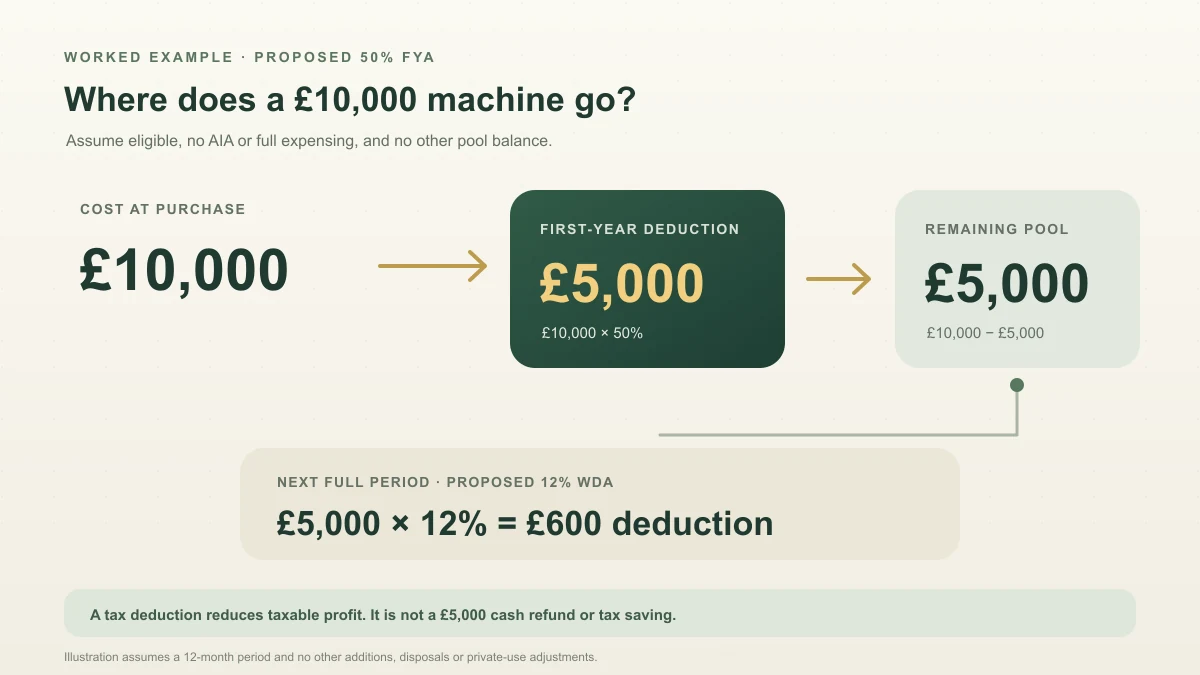
Suppose a limited company buys a new, unused machine for £10,000 in a 12-month accounting period beginning after 1 January 2027. Assume it is eligible for the proposed 50% first-year allowance, does not qualify for full expensing, and the company does not use AIA on it. The calculation would be:
| Step | Calculation | Amount |
|---|---|---|
| Purchase price | £10,000 | |
| Proposed first-year allowance | £10,000 × 50% | £5,000 deduction |
| Amount left in the main pool | £10,000 − £5,000 | £5,000 |
| Next-period WDA at the proposed 12% rate | £5,000 × 12% | £600 deduction |
The £5,000 first-year allowance reduces the company’s taxable profit by £5,000, assuming the company can use the deduction in that period. It does not hand the company £5,000 in cash or cut its tax bill by £5,000. The tax saving depends on the corporation tax rate and the company’s profit position. If the company makes a loss, the deduction may affect how much loss it has instead of producing an immediate cash saving.
The £600 calculation is also deliberately simple. It assumes the next accounting period is 12 months, begins when the 12% rate applies, and has no other main-pool balances, additions, disposals or private-use adjustments. Real pool calculations can include several assets and more than one tax rate. The WDA is calculated on the remaining pool balance, not as 12% of the original machine price every year.
For comparison, a 40% first-year deduction on the same £10,000 item would be £4,000, leaving £6,000 in the pool. At a later 12% WDA rate, 12% of £6,000 is £720. The proposed 50% rate brings £1,000 of the deduction forward compared with 40%; it does not create an extra £1,000 deduction over the asset’s life. The difference is mainly about timing, assuming the same asset eventually receives full relief and there are no other adjustments.
If the item qualified for AIA instead, a business could potentially deduct the full £10,000 in the purchase period, subject to the AIA limit and other conditions. For a company eligible for full expensing, a qualifying new main-rate item may also receive a 100% first-year deduction. The example therefore shows how the proposed 50% route works, not a recommendation to select it without comparing the alternatives.
Worked example: a £2,400 machine under AIA
Suppose a sole trader using traditional accounting buys a qualifying machine for £2,400, uses it wholly for the business and has enough AIA available. If the trader chooses AIA, the deduction can be the full £2,400 in that purchase period. On trading profit of £46,000 before the purchase, that leaves £43,600 before other adjustments and reliefs. The trader cannot also claim the proposed 50% first-year allowance on the same expenditure. This example assumes the asset qualifies, the business has the full AIA limit available and no other rule reduces the claim.
Worked example: a £20,000 main pool at 14% and 12%
To see what the proposed WDA reduction means, compare two separate businesses, each with a £20,000 opening main-pool balance for a full 12-month accounting period and no additions, disposals or private use. At the current 14% rate, the simple deduction is £2,800. At the proposed 12% rate, the simple deduction is £2,400. The second business claims £400 less from taxable profits in that period. The comparison does not mean one business can choose between the two rates, and a £400 smaller deduction is not automatically a £400 increase in its tax bill.
Purchase dates and the accounting period both matter
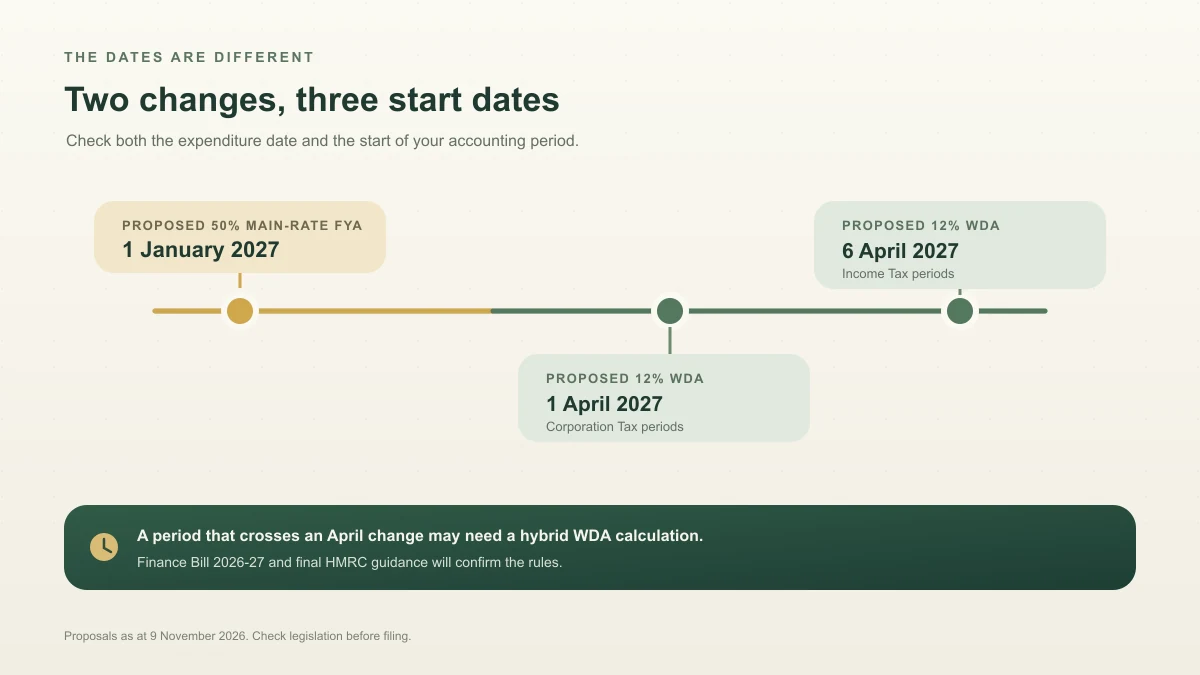
The government has proposed two separate start dates. The 50% first-year allowance would apply to qualifying expenditure from 1 January 2027. The 12% main-rate WDA would apply to accounting periods beginning on or after 1 April 2027 for Corporation Tax, or 6 April 2027 for Income Tax. Those are not interchangeable dates.
Imagine a limited company with a year end of 31 December 2027. Its accounting period began on 1 January 2027, before the proposed 1 April WDA start date. The company should not assume that the entire period uses a flat 12% rate. Transitional rules may require a hybrid calculation for a period that crosses the change. A sole trader’s period can also run across the 6 April date. HMRC’s detailed calculation guidance should be checked once the legislation and updated rates are published.
For a first-year allowance, the relevant purchase date may not be the date equipment arrives or the invoice is paid. GOV.UK says that, where payment is due within less than four months, the purchase date is usually when the contract is signed. If payment is due more than four months later, it is usually the payment due date. Hire purchase has additional rules: the item generally needs to be in use before the capital allowance claim, and interest is not included in the qualifying cost. A deposit, delivery slot or supplier quote may not tell you which tax period contains the expenditure.
That is a reason to retain the signed order, invoice, payment schedule and delivery or installation records. If a contract is amended, an asset is supplied in stages, or the purchase is financed, ask your accountant which date the tax rules treat as the expenditure date. A few days can put a purchase on a different side of 1 January, but a rushed or artificial change to the contract can create more uncertainty than it removes.
What changes for sole traders, partnerships and limited companies?
The type of business affects which relief is available and how the claim is reported. A limited company can consider AIA, full expensing and other company allowances if the asset qualifies. A sole trader or partnership cannot use company full expensing. It may still have AIA, first-year allowances or WDA available under traditional accounting, depending on the asset and the final rules.
There is an important exception for cash basis. If you are a sole trader or partnership using cash basis, most equipment is generally claimed as an allowable business expense when paid, rather than through capital allowances. Business cars have separate rules. This difference is easy to miss if you compare a cash-basis return with a company accounts example. Our guide to cash basis accounting for sole traders explains how the method affects recording income and costs.
If you use traditional accounting, you normally record the asset in your accounts and calculate the tax deduction under the capital allowance rules. If you are a director, the company’s purchase belongs to the company; paying for equipment personally and claiming it back can require additional bookkeeping. If the equipment is partly for private use, the business-use proportion and the type of business structure affect the claim. Keep that private element visible in the records rather than assuming the invoice total is automatically claimable.
The claim is normally made through the relevant tax return. Sole traders use Self Assessment, partnerships use a partnership return, and limited companies include a separate capital allowances calculation with the Company Tax Return. GOV.UK explains how to claim capital allowances and which period the claim belongs to. A claim needs a clear trail from the purchase document to the asset register, accounts and tax computation.
Practical checks before you order equipment
Before a sizeable equipment purchase, identify what the item is and how the business will use it. A computer, packaging machine, shop fitting, van, car and heating system can sit under different rules. Some building fixtures may be plant and machinery, but the building itself usually is not. Items in the special-rate pool, such as some integral features and long-life assets, should not be treated as main-rate purchases just because the supplier describes them as equipment.
Then check the business’s accounting method and legal structure. Is the purchase made by a company or an unincorporated business? Does a sole trader use cash basis? Is the asset new or used? Will it be used privately as well as for the business? Is it being bought outright, through hire purchase, or leased? These details determine whether AIA, full expensing, the proposed first-year allowance, a different allowance or an ordinary expense is relevant.
Review the available allowance limit and other purchases in the same period. A business planning several machines may need to decide which item receives AIA and whether another deduction is available for the rest. If the business has a short accounting period, connected companies, a mixture of special-rate and main-rate assets, or a purchase spanning the 2027 transition, get the calculation checked before filing. A quick percentage comparison can miss a limit or a change in the relevant period.
Finally, keep the reason for the purchase commercial. The tax deduction usually follows a genuine business investment; it is not a grant for spending. If you were not going to buy the equipment without the tax change, model the full cash cost, finance charges, maintenance and expected benefit first. A tax deduction can reduce taxable profit, but it cannot make an unnecessary asset profitable.
Our annual accounts service can help limited companies check capital purchases against their accounts and tax return. For wider bookkeeping support, see our bookkeeping service. Directors planning a wider year end can also review our limited company tax-planning guide. Your own result may differ with your accounting period, the asset and other reliefs, so confirm the treatment before relying on a forecast tax saving.
Capital allowances 2027: common questions
What is the proposed 50% main-rate first-year allowance?
It is a proposed deduction for half the cost of qualifying new and unused main-rate plant and machinery in the period it is bought. It reduces taxable profit. It is not a 50% reduction in the tax bill, and it may not be the relevant claim if AIA or full expensing applies.
Is the proposed 50% main-rate first-year allowance available now?
No. At 9 November 2026, the government has announced the increase for qualifying main-rate expenditure from 1 January 2027, subject to Finance Bill 2026-27. The current qualifying main-rate first-year allowance is 40% for expenditure from 1 January 2026. A separate 50% first-year allowance already applies to certain qualifying special-rate expenditure by companies. Check which allowance applies, and check for enacted legislation and updated HMRC guidance before filing a 2027 claim.
Does it apply to used equipment or cars?
The current 40% first-year allowance criteria require an item to be new and unused, qualify for the main rate and not be a car. The 2027 announcement increases the rate for this allowance. It does not remove the need to check the detailed eligibility rules, exclusions and any final legislative changes.
What does a 12% writing-down allowance mean?
It is the proposed rate for reducing the main-pool balance used in a tax calculation. If a qualifying pool has £5,000 in it at the start of a full 12-month period, a simple 12% calculation gives £600. The actual claim depends on the pool, the period and any additions, sales or private use. The special-rate pool remains separate and is not covered by the proposed 12% main rate.
Should I wait until 2027 to buy?
Not solely because of the proposed rate increase. Check whether the asset qualifies, whether AIA or company full expensing could give a 100% deduction, when the expenditure date falls and whether waiting makes commercial sense. If the contract or delivery date crosses 1 January, ask how the tax date is determined before assuming the new rate applies.
Does the proposed 50% main-rate allowance mean I save half the purchase price in tax?
No. It means a qualifying half of the cost is deducted from taxable profit in the purchase period. The tax reduction depends on the rate of tax and whether the business can use the deduction then. A company with a loss, for example, may not see an immediate cash saving equal to the deduction multiplied by its normal tax rate.
How do I claim the allowance?
Keep the contract, invoice, payment evidence, asset details and a note of business use. Claim through the tax return for the relevant business structure and period. A company includes a separate capital allowances calculation with its Company Tax Return. Check transitional and pool calculations with an accountant if the asset or accounting period spans the 2027 changes.
The next step is to check the allowance before the purchase is recorded in the accounts. Keep the signed order and payment schedule with the invoice, then confirm the claim when the accounting period and the final 2027 legislation are clear.

About Golden Tree Consulting
ACCA Affiliated | MBA Qualified
Golden Tree Accounting & Business Consulting provides expert tax, bookkeeping, and advisory services to sole traders and SMEs across Croydon, London, Surrey, and Kent. With multilingual support and decades of combined experience, we help businesses stay compliant and grow.
Offices in Croydon and London Bridge.
Related guides
VAT Online Marketplace Rules UK: 2027 Guide for Small Sellers
VAT online marketplace rules in the UK change from October 2027. See the £90,000 per-platform test, exclusions and checks for small sellers.
Property Income Tax Rates 2027: What the Budget Rise Means for Landlords
Property income tax rates 2027 rise to 24%, 44% and 49% from 6 April. See landlord examples, mortgage interest relief and what to review.
VAT Error Correction UK: How to Fix a Return After Filing
VAT error correction UK guide: learn when to adjust your next return, when to notify HMRC, how to calculate the net error and what records to keep.