Vaping Products Duty UK 2026: Retailer Guide to Stock, Costs and Stamps
Vaping Products Duty UK starts 1 October 2026. See retailer approval rules, £2.20 per 10ml calculations, stamp checks, old-stock dates and records.
 Golden Tree Accounting 25 September 2026 14 min read
 On this page Show
- Vaping Products Duty UK 2026: the dates and rate
- Does a vape shop need to register or pay the duty?
- How to check a supplier’s stock after 1 October
- What happens to unstamped stock already in the supply chain?
- Work out the duty amount and the likely cost change
- Keep a six-year stock and evidence trail
- A practical retailer checklist for October
- Vaping Products Duty UK FAQs
From 1 October 2026, a new Vaping Products Duty applies to UK vaping liquid at £2.20 per 10ml. The same date starts the duty stamp scheme for liable products released onto the market. If you sell e-liquid, pods or prefilled devices, your first job is to separate stock already in the supply chain from products made or imported from October onwards.
Most shops that only buy duty-paid products to resell do not need to register with HMRC to pay the new duty or buy stamps. That does not make the change a back-office detail. HMRC expects shops and wholesalers to check suppliers, keep purchase and sales records for six years, and retain proof if they sell eligible old stock without a stamp. A carton with no stamp can be lawful in one batch and a reason to pause a purchase in another.
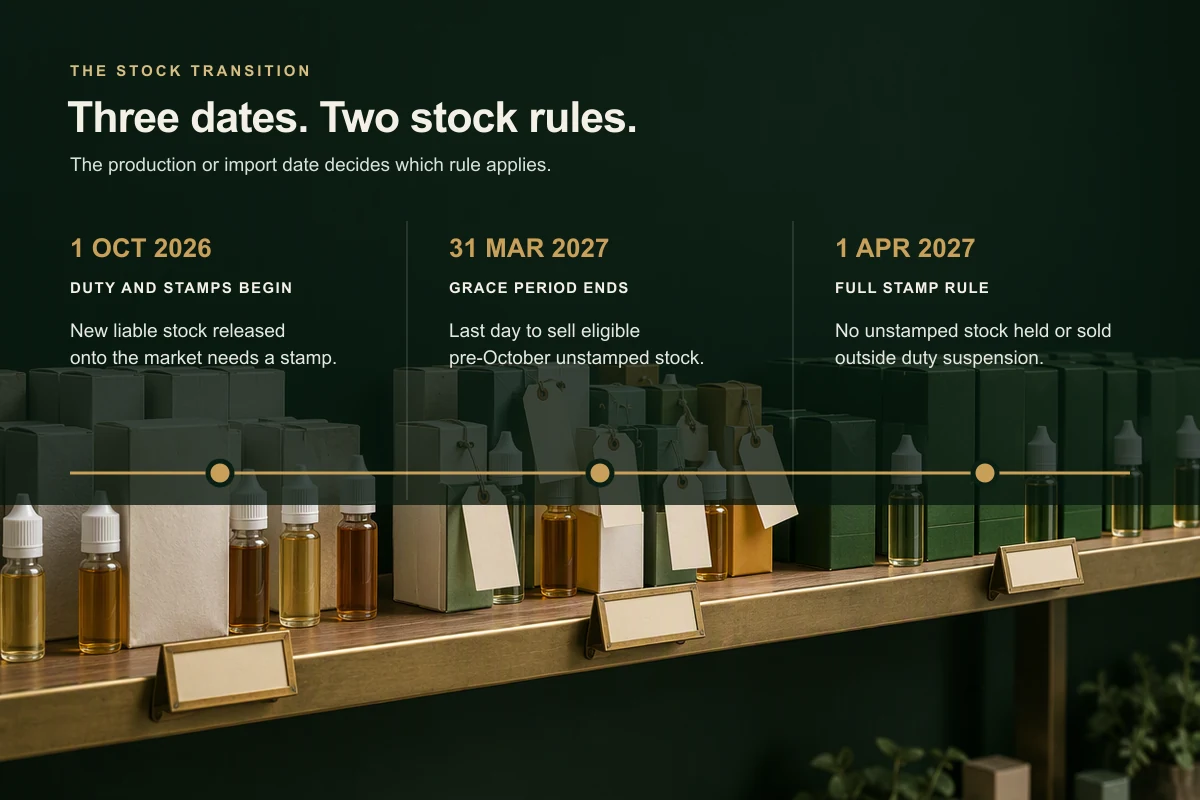
Quick summary: Vaping Products Duty is 22p per millilitre of liquid, whether it contains nicotine or not. New liable products released onto the UK market from 1 October 2026 need a duty stamp. Eligible unstamped stock produced or imported before that date can be sold until 31 March 2027. From 1 April 2027, do not sell or hold unstamped products outside duty suspension.

Vaping Products Duty UK 2026: the dates and rate
Vaping Products Duty, often shortened to VPD, is a new excise duty on vaping liquid. The rate is £2.20 per 10ml, which works out to 22p per millilitre. The rate does not change with nicotine strength. Nicotine-free liquid is covered too.
The duty applies to liquid in bottles, cartridges and pods, including liquids intended for vaping such as propylene glycol, vegetable glycerin and flavourings. It is the liquid that is taxed. A device with no vaping liquid does not add liquid volume to the duty calculation.
The Vaping Duty Stamps Scheme starts on the same date. A stamp must be fixed to the outermost retail packaging of liable products released onto the UK market from 1 October. The stamp is intended to stay attached when the package is opened, so do not treat a loose label, a wholesaler’s note or a stamp on a shipping carton as a substitute for the mark on the retail pack. HMRC explains the physical and digital marks in its guide to how vaping duty stamps work.
| Date | What changes | What a retailer should do |
|---|---|---|
| Before 1 October 2026 | Stamped products must not be released onto the UK market early | Check stock levels and ask suppliers how they will provide compliant new stock |
| 1 October 2026 | Duty and the stamp scheme begin | Check stamps on new liable products and keep evidence for any unstamped stock |
| 31 March 2027 | Last day of the grace period for qualifying unstamped stock | Finish selling that stock or agree a return or other lawful route |
| 1 April 2027 | Unstamped products outside duty suspension must not be held, sold or supplied | Keep unstamped items off sale and remove them from ordinary retail stock |
The date that matters for old stock is when it was produced or imported, not when your shop received it. Ask for that evidence if a supplier offers unstamped items after 1 October. HMRC’s guidance for retailers and wholesalers gives the transition rules and the records to retain.
Does a vape shop need to register or pay the duty?
If your business only sells or distributes duty-paid vaping products, you do not need approval for VPD or the Vaping Duty Stamps Scheme. In a normal retail purchase, the business upstream that manufactures or imports the products is responsible for the duty at the relevant duty point. A retailer should not create a VPD payment account just because the product appears on its shelves.
That answer changes if the business does more than resell duty-paid goods. A UK manufacturer, importer, approved warehousekeeper holding stock under duty suspension, business that affixes stamps, or representative acting for an overseas manufacturer may have registration, approval, return, record and payment duties of its own. Importers also need to consider the customs declaration and whether goods enter duty suspension immediately.
There can be more than one activity in a small business. A vape shop that orders finished goods from a UK wholesaler is in a different position from a shop that imports liquids directly, fills its own bottles or stores stock under an excise arrangement. If any of those apply, read the relevant HMRC approval guidance before trading under that arrangement. A retailer’s simple purchase checklist is not a substitute for an excise approval.
For businesses that are liable to account for the duty, HMRC says payments are due by the 15th of each month, with the next working day applying when the 15th is not a business day. Most retailers buying duty-paid stock will instead see the cost reflected in supplier prices or invoices. Keep that distinction clear in your bookkeeping, because it affects who files a return and who records a stock purchase.
How to check a supplier’s stock after 1 October
Start with the retail pack. Where a stamp is required, check that it is attached to the outermost packaging and seals the pack so it cannot be opened without damaging the stamp or package. Record the result against the product or batch rather than relying on a quick glance in the stockroom.
Then check who supplied the goods and whether the paperwork supports the stock. HMRC recommends retaining supplier information, invoices and delivery notes. If a product is unstamped after 1 October, ask when it was produced or imported and keep enough evidence to show why it qualifies for the grace period. A delivery date before October does not prove the same thing as a production or import date.
Use this short receiving routine for each delivery:
- Match the invoice and delivery note to the supplier and purchase order.
- Check whether each liable product has a stamp on the retail packaging.
- If it does not, record the batch and request evidence that it was produced or imported before 1 October 2026.
- Compare the volume and product description on the package with the supplier paperwork.
- Put a hold on stock when the stamp or origin is unclear, then resolve the question before sale.
If the stamp is damaged, reused, missing or fixed to the wrong packaging, contact the supplier and keep a note of the response and the action taken. HMRC says not to buy, supply or sell products that appear non-compliant unless the issue has been resolved and you can satisfy HMRC that the goods are legitimate. That is a sensible stock-control rule even when the initial problem turns out to be a packing error.
What happens to unstamped stock already in the supply chain?
The transition period is there for products already produced or imported before the duty starts. Retailers and wholesalers can store and sell that eligible unstamped stock through 31 March 2027. The period does not give suppliers permission to release newly made or imported liable stock without a stamp after 1 October.
Keep old stock identifiable. Use a batch field, shelf marker or inventory status that separates eligible unstamped products from stamped products and any stock still under duty suspension. The method can be simple, but the record should let someone else find the purchase, supplier and date evidence months later.
Before April 2027, count the remaining unstamped units by product and volume. HMRC says unstamped items must be sold, returned to the supplier, exported, destroyed or otherwise lawfully dealt with by 1 April 2027. Do not assume that being allowed to sell a bottle during the transition means it can stay in a retail cupboard afterwards.
If a supplier offers unstamped stock after the start date and cannot show it was produced or imported earlier, do not buy it for resale. If you already have it, stop the sale while you get advice. A low purchase price is not useful if the stock cannot be lawfully sold.
Work out the duty amount and the likely cost change
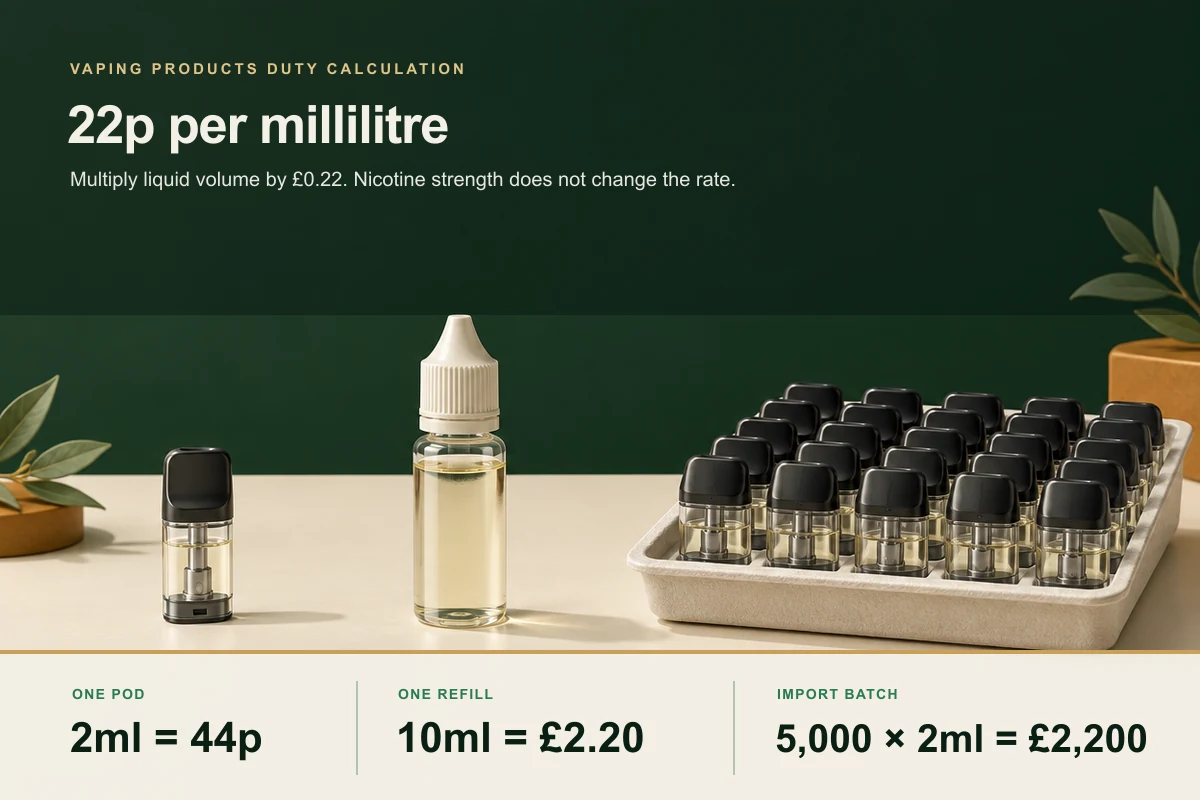
For a duty calculation, multiply the liquid volume in millilitres by £0.22. The amount is based on volume, not the price on the shelf or the amount of nicotine. HMRC’s payment guidance includes the rate, volume rules and examples. A manufacturer’s or importer’s monthly return is rounded down to the nearest penny after the return total is calculated.
Example 1: one 2ml pod
A 2ml pod contains 2 × 22p of liquid duty, which is 44p. It is not £2.20 per pod. The ten-millilitre rate is a way to state the rate, not a fixed charge for every item.
Example 2: 800 refill bottles
If a liable importer releases 800 bottles of 10ml liquid, the batch contains 8,000ml. At 22p per millilitre, the duty is £1,760. If the products are in a business’s duty-paid wholesale purchase instead, the retailer should reconcile the supplier invoice and the unit cost. It should not pay HMRC the same duty a second time.
Example 3: 5,000 pods
An importer releases 5,000 pods, each holding 2ml. That is 10,000ml of liquid in total. The VPD is £2,200 before any other costs. The calculation is 10,000 × £0.22. The importer needs records that support the product volume and duty declaration.
Example 4: a retailer’s gross margin
Suppose a 10ml bottle currently costs a shop £1.35 before VAT and its target gross margin is 30%. At that cost, a price of about £1.93 before VAT gives the target margin: £1.35 ÷ 0.70. If a supplier passed through the full £2.20 duty while every other cost stayed the same, the cost would become £3.55 and the same margin would require about £5.07 before VAT. That is an illustration, not a forecast of the shelf price. A supplier may change its own prices, and the shop’s costs, VAT treatment and margin policy matter too.
The last example is why a retailer should update its actual cost prices instead of adding a guessed amount to every ticket. Check a fresh supplier invoice, compare the cost by millilitre and product size, then review the price and margin in the till system. If your business is VAT registered, use the supplier’s VAT invoice and the normal VAT rules for the purchase. The VPD amount is an excise duty, not a figure to copy into a VAT return box by itself.
Keep a six-year stock and evidence trail
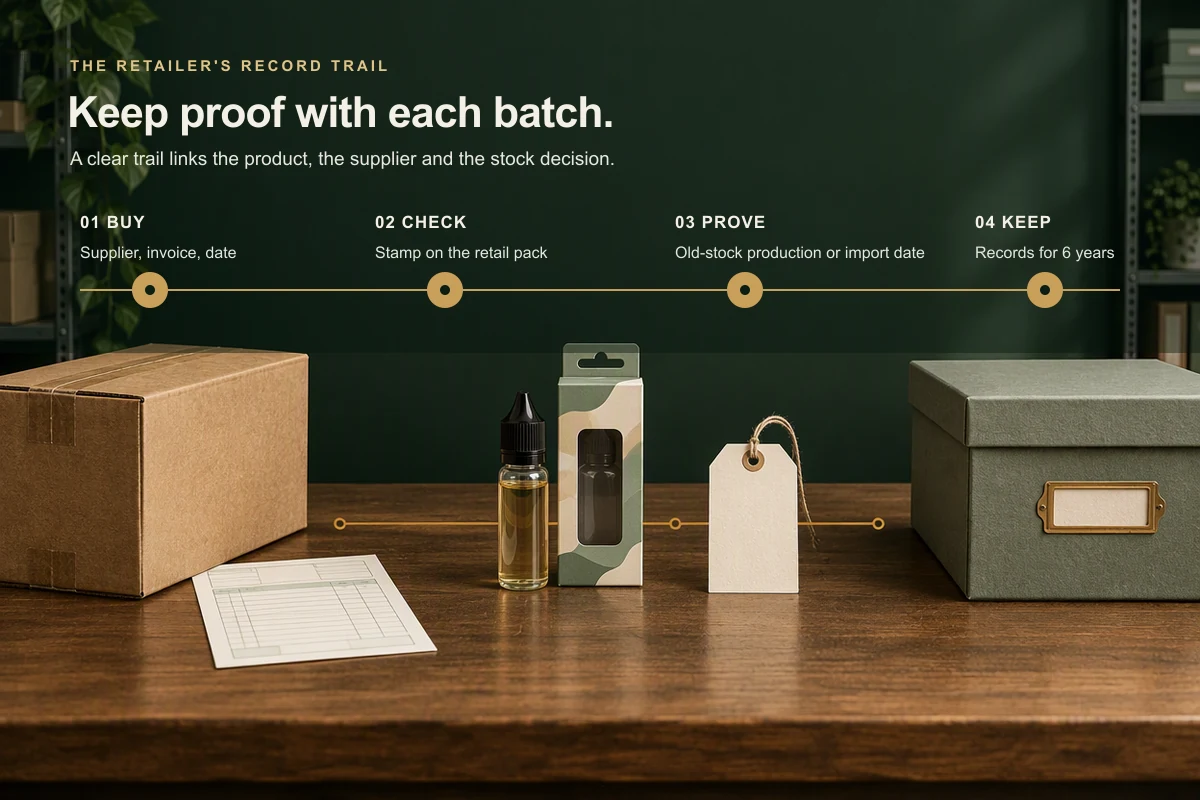
HMRC says wholesalers and retailers should keep records for at least six years. The records should show where products came from, who supplied them, which products were bought or sold, when they were produced or imported, what checks you made, and what you did when something looked wrong.
We suggest one inventory record per SKU or batch with these fields:
- Supplier name and contact details.
- Invoice number, delivery note and date received.
- Product name, SKU, liquid volume and quantity.
- Whether the retail package carried the required stamp when received.
- Production or import date for any unstamped stock.
- Link to the evidence supporting the pre-October date.
- Units sold, returned, exported, destroyed or still held.
- Any query raised with the supplier and the answer received.
Keep the accounting records connected to the stock evidence. If a supplier invoice lists products, shipping and duty-related amounts separately, retain the invoice as received and use the same breakdown in your bookkeeping. If an importer in your business files the duty return, reconcile the return to import entries, production records, volumes and the monthly payment. A second spreadsheet that never agrees with the ledger is just another place for errors to hide.
For day-to-day retailers, the bookkeeping job is usually to update inventory costs and margin reports, not to submit a VPD return. Our bookkeeping service can help put a repeatable stock reconciliation around supplier invoices. If the change affects sales invoices or input tax records as well, our VAT return support can help keep the sales and purchase records in order. The 13-week cash flow forecast guide is also useful if the higher stock invoice lands before the new selling price has settled.
A practical retailer checklist for October
Before you receive the first October delivery, count the stock you already hold and identify any unstamped items that may fall under the transition rule. Ask key suppliers how they will document production or import dates and when stamped stock will be available. Update the receiving checklist so the stamp check takes place before products are put on sale.
Once the new stock arrives, retain invoices and delivery notes, check the outer retail package and record any discrepancy. Keep pre-October unstamped stock separate in the inventory system, with its evidence close to the relevant batch. Review the remaining quantities each month as the 31 March 2027 end date approaches.
If your business imports, makes or stores vaping liquid under duty suspension, confirm whether your existing HMRC approvals cover the new duty and stamp rules. This article focuses on retailers and wholesalers buying duty-paid stock. The examples show the arithmetic, not a decision about who owes the duty. Your position depends on when a product is produced, imported or released from duty suspension, and on what your business does with it. If that route is unclear, check HMRC’s full guidance and get advice before buying or selling unstamped stock.
Vaping Products Duty UK FAQs
Does the duty apply to nicotine-free vape liquid?
Yes. The rate applies to vaping liquid whether it contains nicotine or not. It also covers liquid in bottles, cartridges and pods.
Do small vape shops need HMRC approval?
Not if they only sell or distribute duty-paid stock. A business that also manufactures, imports, holds duty-suspended products or carries out other regulated activities should check whether additional approval is required.
How long can I sell unstamped stock?
Until 31 March 2027, if it was produced or imported before 1 October 2026 and you keep evidence of that date. From 1 April 2027, unstamped products outside duty suspension must not be held or sold.
How much duty is on a 10ml bottle?
The duty is £2.20 on 10ml of vaping liquid. A 2ml pod has 44p of duty, and a 30ml bottle has £6.60, based on the same 22p per millilitre rate.
What records should a vape retailer keep?
Keep supplier details, invoices, delivery notes, stock records, production or import dates for unstamped items, stamp checks and any action taken over products that appear non-compliant. HMRC’s guidance says to retain these records for at least six years.
Does a retailer pay HMRC for each stamped bottle?
Usually not. A shop that only resells duty-paid products does not need approval for the duty scheme. The business liable at manufacture, import or another duty point accounts for VPD. The retailer should still check the goods and record the supplier cost.
The most useful step this week is to count your unstamped stock and ask suppliers for batch-level proof of when it was produced or imported. Put that evidence beside the invoice before the October deliveries begin.

About Golden Tree Consulting
ACCA Affiliated | MBA Qualified
Golden Tree Accounting & Business Consulting provides expert tax, bookkeeping, and advisory services to sole traders and SMEs across Croydon, London, Surrey, and Kent. With multilingual support and decades of combined experience, we help businesses stay compliant and grow.
Offices in Croydon and London Bridge.
Related guides

Crypto Tax UK 2026: Capital Gains, Staking Income and HMRC Records
Crypto tax UK 2026 explained with Capital Gains Tax rates, staking and mining income, exchange records, reporting routes and worked examples.
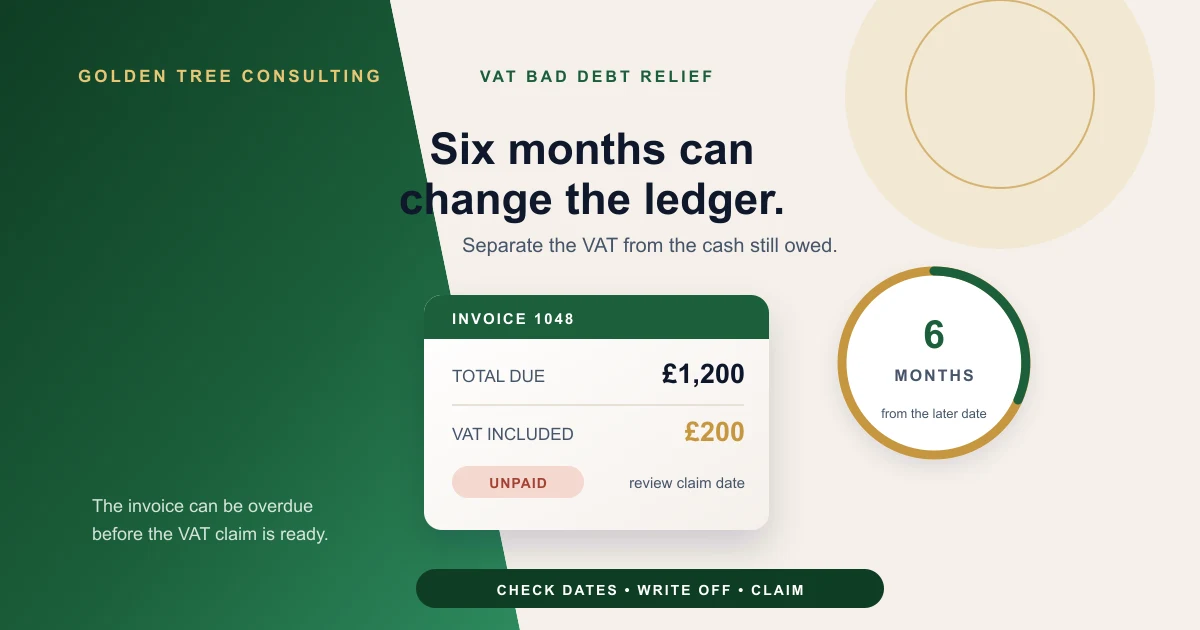
VAT Bad Debt Relief UK 2026: How to Reclaim VAT on Unpaid Invoices
VAT bad debt relief UK 2026 explained: check the six-month rule, calculate the VAT on unpaid invoices, claim it on your return and keep the right records.

Corporation Tax Payment Deadline: 9 Months and 1 Day After Your Year End
When UK companies must pay Corporation Tax: 9 months and 1 day after the accounting period ends, with a year-end table, the CT600 deadline, rates, payment methods and what to do if you cannot pay.