Pay Self Assessment Tax Through Your Tax Code in 2026: 30 December Deadline
Pay Self Assessment tax through your tax code in 2026: check the £3,000 limit, PAYE rules, 30 December deadline and what happens to payments on account.
 Golden Tree Accounting 7 October 2026 16 min read
On this page Show
- Pay Self Assessment tax through your tax code: what it means
- The Self Assessment tax code deadlines for 2026
- Who can pay Self Assessment through a tax code?
- What counts towards the £3,000 limit?
- How payments on account affect the amount due
- Is coding out the right payment method for you?
- What to do before 30 December
- If you miss the tax-code deadline or do not qualify
- Paying Self Assessment through your tax code: FAQs
The online deadline to pay Self Assessment tax through your tax code is 30 December 2026. It is earlier than the usual 31 January deadline for an online return and payment. If you also have a job or company pension taxed through PAYE, HMRC may be able to collect a qualifying 2025/26 balance through your 2027/28 tax code instead of asking you to pay that part in one go.
The amount is not written off. Your tax code is adjusted, and the eligible balance is usually collected in equal deductions over 12 months. The rules are specific: the balance must be under £3,000, you need PAYE income, and the return must reach HMRC by the right date. A payment on account or Class 2 National Insurance can make the figure on your statement look different from the amount HMRC can code out.
Quick answer: for an online return covering 6 April 2025 to 5 April 2026, submit it by 11:59pm on 30 December 2026 if you want HMRC to try to collect an eligible balance through your PAYE code. The relevant balance must be less than £3,000, excluding Class 2 NIC. You must already pay tax through PAYE, and HMRC must be able to collect the deductions from your salary or pension.
Pay Self Assessment tax through your tax code: what it means
HMRC calls this coding out. Instead of paying an eligible part of your Self Assessment balance directly by bank transfer or card, you have it collected through PAYE. HMRC adjusts your tax code for 2027/28, then your employer or pension provider deducts a little extra tax from each pay period. GOV.UK says deductions are made in equal instalments over 12 months.
It changes when and how you pay, not how much tax you owe. If your 2025/26 return shows an eligible balance of £2,400, coding out does not reduce that £2,400. It spreads collection across the following PAYE tax year. The amount is still paid to HMRC, alongside the tax due on your 2027/28 salary or pension.
This option is most relevant if you had untaxed income on top of employment income, or a small amount of self-employed or property income while also drawing a PAYE salary or company pension. Self-employment by itself does not create a PAYE tax code for HMRC to adjust.
The Self Assessment tax code deadlines for 2026
The 30 December date is a separate cutoff for this payment method. It does not replace the usual online return deadline. For the 2025/26 tax year, the main dates are:
| What you are doing | Deadline | What the date means |
|---|---|---|
| Filing a paper return and using the tax code option | 31 October 2026 | HMRC must receive the paper return by this date |
| Filing an online return and using the tax code option | 30 December 2026 | HMRC must receive the return by 11:59pm for the code-out option |
| Filing an online return by the standard deadline | 31 January 2027 | This is the usual online filing deadline |
| Paying the amount due by another method | 31 January 2027 | Pay the amount shown as due by this date, including any relevant first payment on account |
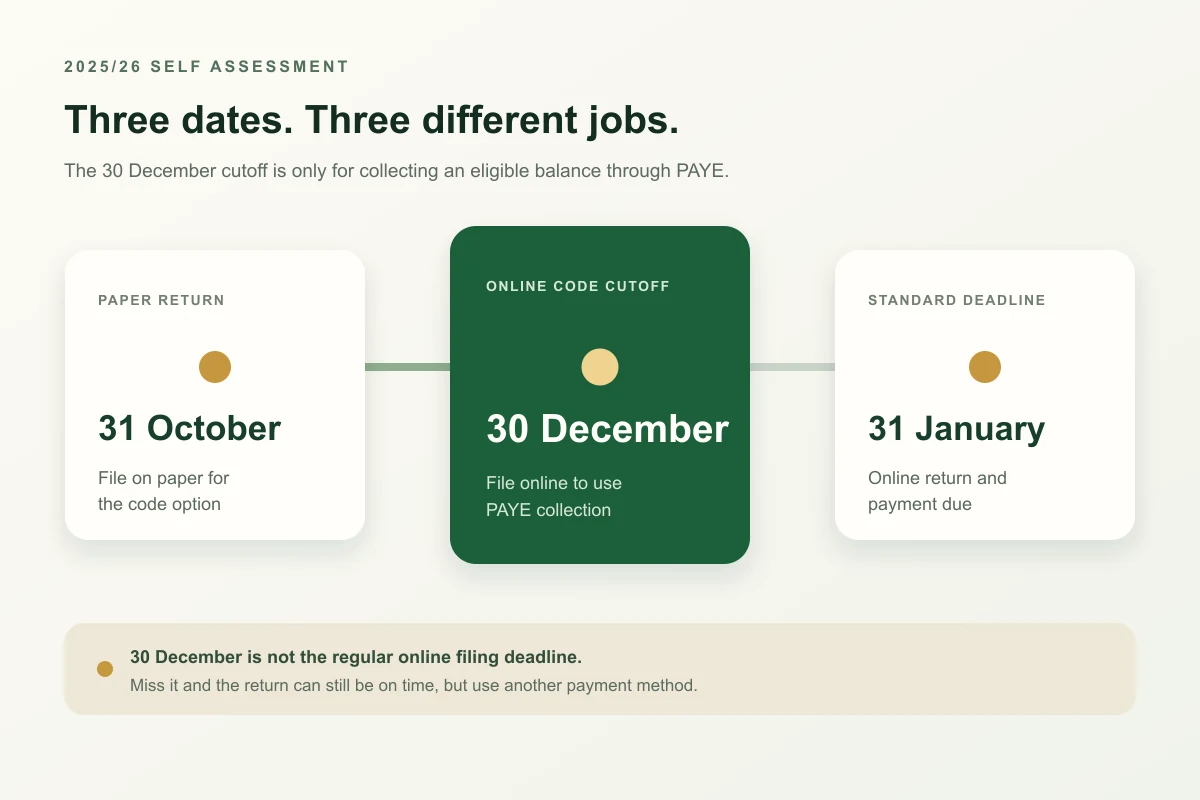
If you file online after 30 December but by 31 January, your return can still be on time. You will have missed the tax-code collection cutoff, though, so you will need another way to pay the amount due. Our guide to the 2026 paper Self Assessment deadline explains the October filing date and the late-filing rules.
The current HMRC deadline guidance sets out the 30 December cutoff alongside the 31 January online return and payment deadline. If you want the tax collected through PAYE, an earlier return also gives you time to check the calculation and your expected cash flow before January.
Who can pay Self Assessment through a tax code?
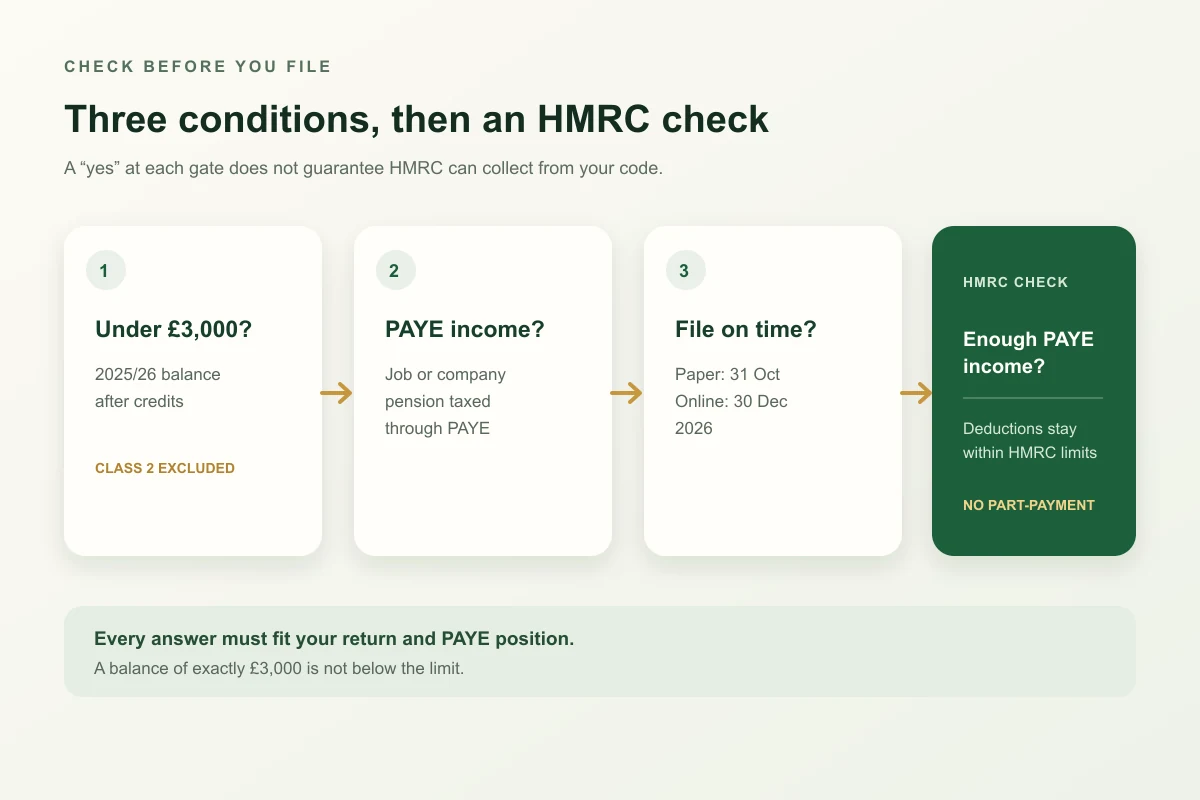
For the 2025/26 return, all of these points need to fit:
- Your eligible balance is less than £3,000. The 2026 SA100 return says the limit is for the 2025/26 tax year and excludes Class 2 National Insurance contributions.
- You already pay tax through PAYE. That could be from employment or a company pension. A tax code is needed so HMRC can collect the amount from income as it is paid.
- You file by the relevant cutoff. HMRC must receive a paper return by 31 October 2026 or an online return by 30 December 2026.
- There is enough PAYE income for collection. HMRC may not use this method if your income is too low or the deductions would be too high compared with your usual tax.
HMRC’s guidance on paying through your tax code says the tax code must be able to collect the amount. You cannot use this method if the deductions would take more than 50% of your PAYE income in tax or make you pay more than twice as much tax as you normally do. It is also unavailable if you do not have enough PAYE income.
The 2026 tax return form says HMRC will try to collect an eligible amount through wages or a pension by adjusting the 2027/28 tax code. If you do not want that, you can opt out on the return. Check the result and your HMRC Self Assessment account rather than assuming the option has been accepted automatically.
Class 2 National Insurance is separate
Class 2 NIC does not count towards the £3,000 limit, and it cannot normally be collected through a PAYE tax code. If you have a Class 2 amount on your calculation, arrange a separate payment. Class 2 rules changed in April 2024: most self-employed people no longer pay it as a compulsory charge, although some choose to pay voluntary contributions to protect their National Insurance record.
The distinction matters if your total statement is above £3,000. For example, your eligible 2025/26 balance might be £2,850 and a separate £200 Class 2 item might also appear. The code-out test is not simply “everything on the statement added together”. The Class 2 amount still needs its own treatment, and HMRC must confirm that the £2,850 balance and your PAYE circumstances meet the other conditions.
What counts towards the £3,000 limit?
Use the balance for the tax year shown in the tax calculation, after payments or credits that HMRC has applied to that year. Do not take an early estimate from your accounts, subtract money you plan to pay later, or compare the limit with a total that combines different tax years.
The 2025/26 SA110 tax calculation notes give a specific calculation for the amount that can be coded out. They call it “tax due minus payments or credits and Class 2”, and say the figure must be positive and below £3,000. The same notes calculate payments on account for the following year separately.
That means the £3,000 test is not a target to game by sending a small payment after seeing a £3,000-or-higher bill. HMRC says you cannot part-pay a bill to bring it below the threshold. Genuine payments and credits already included in the return calculation are different, but do not make a payment on the assumption that a few pounds will make coding out available.
Example 1: a balance below the limit
Sam has a PAYE job and reports freelance income on the 2025/26 return. After the tax calculation and credits already shown, Sam has an eligible balance of £2,400, with no Class 2 amount in that figure. Sam files online on 15 December 2026 and does not opt out. If HMRC can collect the amount from Sam’s PAYE income, the 2027/28 tax code can collect it in 12 equal deductions:
| Calculation | Amount |
|---|---|
| Eligible 2025/26 balance | £2,400 |
| Number of monthly deductions | 12 |
| Illustration of each deduction | £200 |
The £200 is an illustration of the arithmetic, not a guarantee of the exact change to each payslip. Actual PAYE depends on the tax code, pay frequency, income and any other coding adjustments. The Low Incomes Tax Reform Group’s example also shows £2,400 collected as £200 per month over 12 months.
Example 2: exactly £3,000 is over the limit
Priya’s eligible balance is £3,000. The rule is “less than £3,000”, so being exactly at the threshold is not enough. Paying £20 towards that bill to leave £2,980 does not make Priya eligible for coding out. She should plan to pay the amount due by another method, or check whether HMRC offers a Time to Pay arrangement if she cannot pay in full.
How payments on account affect the amount due
Payments on account are advance payments towards a later tax year’s bill. They are usually due on 31 January and 31 July. They are not the same as the remaining balance for the year that has just ended.
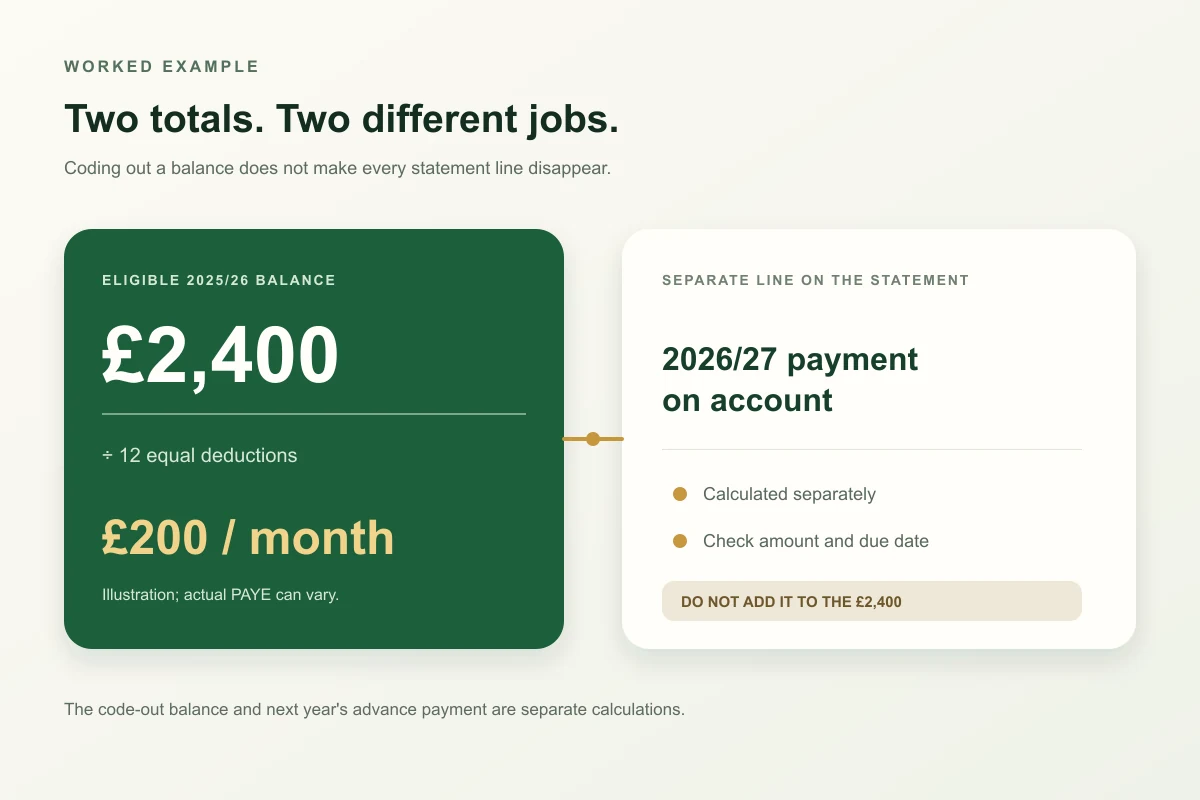
Your 31 January 2027 Self Assessment statement may therefore include more than one item: the balance for 2025/26 and, if required, the first payment on account for 2026/27. The 2025/26 code-out amount is calculated separately from the full statement total. HMRC’s 2025/26 calculation notes also use the amount coded out when they work out payments on account, so do not assume that the code-out option cancels every January or July amount.
For example, a taxpayer might have a £2,400 eligible 2025/26 balance and also see a separate first payment on account for 2026/27. The £2,400 may be collected through the 2027/28 code if all the conditions are met. The separate payment-on-account line still needs to be checked on the Self Assessment statement, including its amount and due date. It is not another £2,400 automatically added to the code.
If your income has fallen or more of your current-year income is now taxed at source, you may be able to claim to reduce payments on account. You need a reasonable estimate of the tax for that year. Reducing them too far can lead to interest and a penalty, so check the calculation before changing them. Our guide to the 31 July payment on account explains how the two instalments work.
Example 3: a payment on account makes the statement look larger
Lee’s 2025/26 calculation shows an eligible balance of £1,900. Lee also has a separate payment on account for the next tax year shown on the statement. It is a mistake to add that next-year instalment to the £1,900 and decide that the code-out limit has been crossed without checking the tax calculation. The two amounts have different tax-year labels and should be reviewed separately.
If the statement is unclear, compare the return calculation with the account statement or ask HMRC or your accountant to identify which line is the 2025/26 balancing amount, which is any payment on account, and whether Class 2 has been included. Keep that breakdown with the return. It is easier to plan when the totals have labels.
Is coding out the right payment method for you?
Spreading an eligible amount across a tax year can help if paying the full sum in January would put pressure on your household or business cash flow. It may also fit naturally if you already receive a monthly salary or pension. The downside is that your take-home pay will be lower during 2027/28, and the tax code can be harder to follow if several adjustments are already present.
Before relying on this option, ask yourself:
- Does the calculated 2025/26 balance fall below £3,000 after the payments and credits HMRC has included?
- Have I separated any Class 2 NIC and 2026/27 payment on account from that figure?
- Will I still have enough take-home pay once the extra deductions start?
- Would I rather pay the amount earlier and keep my 2027/28 tax code simpler?
The tax code route is a payment schedule, not a tax saving. If the monthly deductions would squeeze your regular budget, paying another way or discussing an arrangement with HMRC may be more suitable. For broader questions about return preparation and payment options, see our Self Assessment service and our guide to HMRC Time to Pay for Self Assessment.
What to do before 30 December
Use a simple sequence so the date does not get lost among the January deadlines:
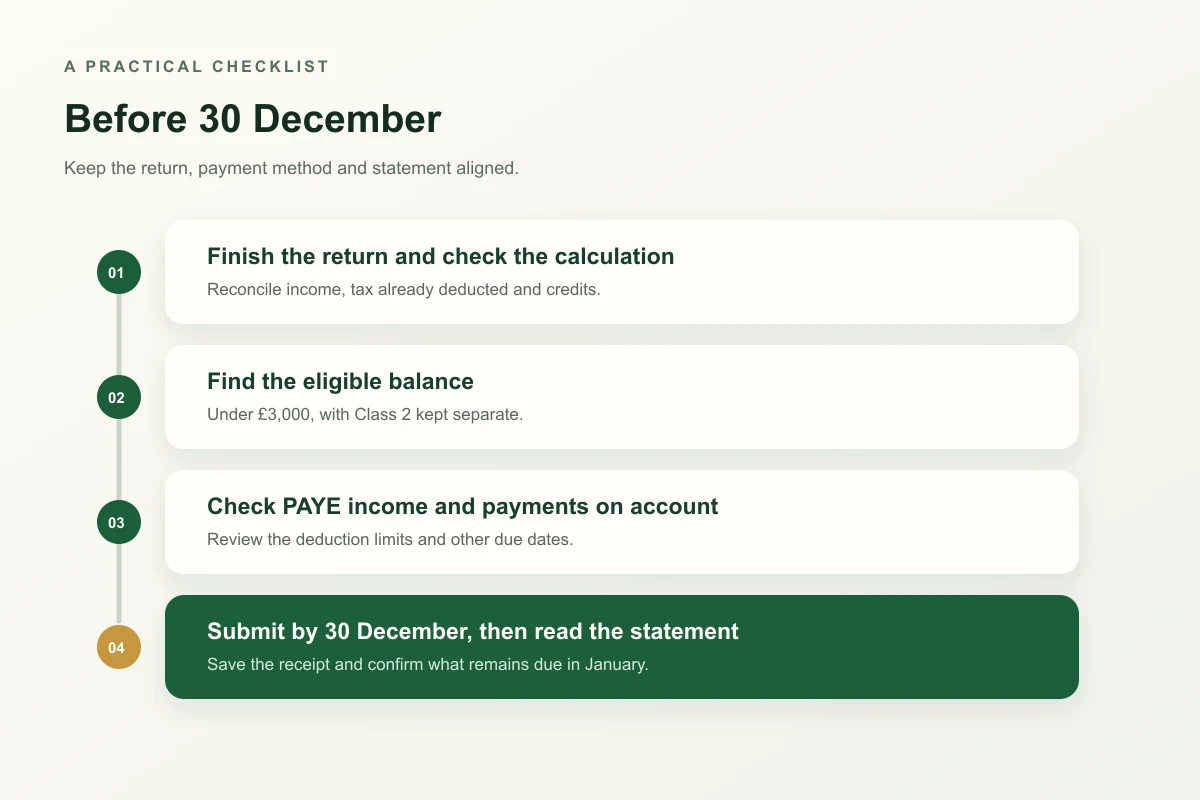
- Finish the return and check the calculation. Reconcile income, allowable expenses, tax already deducted and payments on account. If you need a refresher on filing, read our Self Assessment registration and first-return guide.
- Identify the code-out figure. Use the 2025/26 balance after credits, and keep Class 2 and payments on account separate.
- Check the £3,000 and PAYE conditions. A return below the limit still may not qualify if your PAYE income cannot support the deductions.
- Submit online by 30 December 2026. Save the submission receipt and review what HMRC says about the payment method. If you are filing on paper, HMRC must receive it by 31 October 2026 for the code option.
- Read the tax calculation and statement. Confirm what will be collected through PAYE and make a note of any separate payment due by 31 January 2027.
If you want an accountant to review the return before it is filed, our Self Assessment support team can help with the calculation and payment options. Your specific position may differ if you have several income sources, earlier tax debts or a PAYE code already adjusted for other amounts, so advice should be based on your own figures.
If you miss the tax-code deadline or do not qualify
Missing 30 December does not make the online return late if you still file by 31 January 2027. It does mean you cannot use the 2025/26 online code-out deadline. The amount HMRC says is due will need to be paid another way by 31 January unless you have an arrangement with HMRC.
If a single payment is difficult, look at the available HMRC payment options as early as possible. A Time to Pay arrangement has its own eligibility checks and terms; do not assume it has been agreed until HMRC confirms it. If you already owe HMRC or cannot keep up with payments, our Self Assessment payment difficulty guide covers what to check before asking for an arrangement.
If your return is not ready by 30 December, do not leave it unfiled just to preserve the possibility of coding out. Submit accurate figures by the standard deadline, then deal with the payment using the options available. Keeping the filing obligation and the payment plan separate is usually the clearest way to avoid a rushed or incomplete return.
Paying Self Assessment through your tax code: FAQs
What is the deadline to pay Self Assessment tax through my tax code in 2026?
For an online 2025/26 return, HMRC must receive it by 11:59pm on 30 December 2026 for the tax-code option. Paper returns must reach HMRC by 31 October 2026. The normal online return and payment deadline is 31 January 2027.
Can I code out a Self Assessment bill of exactly £3,000?
No. The amount must be less than £3,000. Class 2 NIC is excluded from the threshold, but it cannot usually be collected through PAYE.
Can I part-pay the bill to get below £3,000?
No. HMRC does not let you pay part of a bill of £3,000 or more to bring it under the limit. Use the balance and credits in the actual tax calculation.
Will coding out pay my payments on account?
The amount coded out relates to an eligible 2025/26 balance. Payments on account for 2026/27 are calculated separately, with the coded-out amount taken into account in HMRC’s calculation. Check each line on your Self Assessment statement.
Can I use this option if I am self-employed?
You may be able to if you also pay tax through PAYE, such as from a job or company pension. If your only income is self-employment, HMRC has no PAYE salary or pension from which to collect the deductions.
What if HMRC cannot collect the amount through my tax code?
If you are not eligible, or HMRC cannot collect enough through PAYE, pay by another method by the normal deadline. If you cannot pay in full, check HMRC’s current Time to Pay options and eligibility. Contact HMRC before the deadline where possible, and do not treat an application as an agreed payment plan until HMRC confirms it.
Before you submit, compare the tax calculation with the statement and mark each amount by tax year. If your eligible 2025/26 balance is under £3,000 and you want PAYE deductions, put 30 December 2026 in your calendar as the online cutoff. If the balance is £3,000 or more, or you do not have PAYE income, plan a different payment route before the 31 January deadline.

About Golden Tree Consulting
ACCA Affiliated | MBA Qualified
Golden Tree Accounting & Business Consulting provides expert tax, bookkeeping, and advisory services to sole traders and SMEs across Croydon, London, Surrey, and Kent. With multilingual support and decades of combined experience, we help businesses stay compliant and grow.
Offices in Croydon and London Bridge.
Related guides
P800 Tax Calculation Letter: Why You Got One and How to Get Your Refund
What a P800 tax calculation letter means for 2025/26, why HMRC sends one, how to claim a refund online, how underpaid tax is collected through your tax code, and what to do if the figures look wrong.
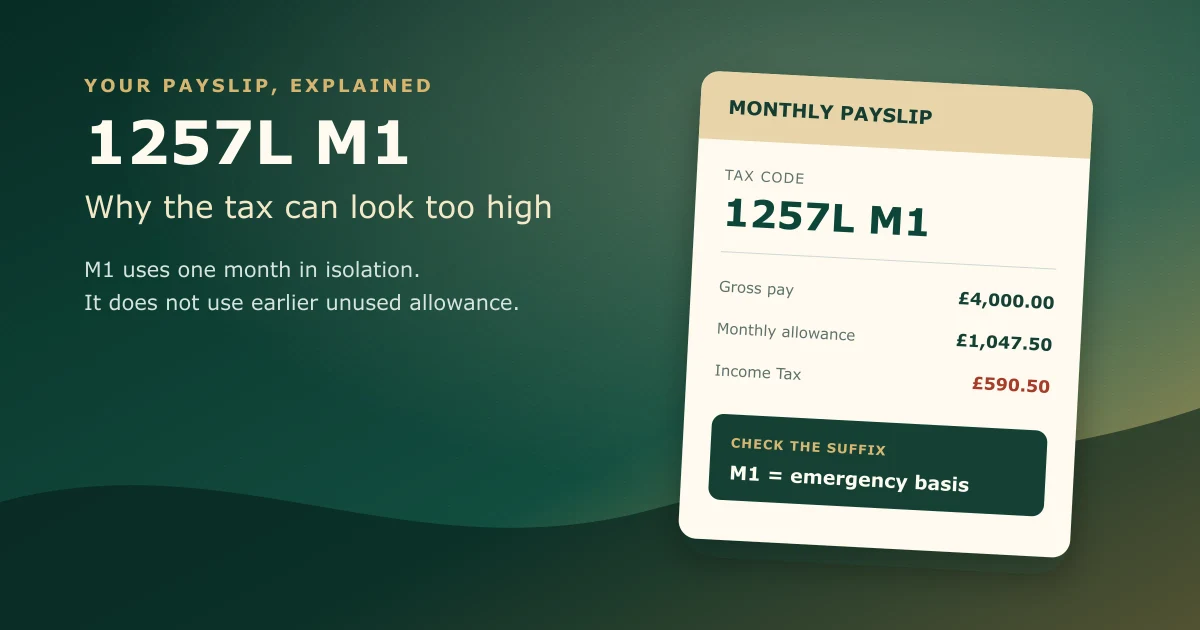
1257L M1 Tax Code Explained: Emergency Tax Guide for 2026/27
1257L M1 tax code explained for 2026/27, with emergency tax calculations, refund examples, and practical steps to correct your code.
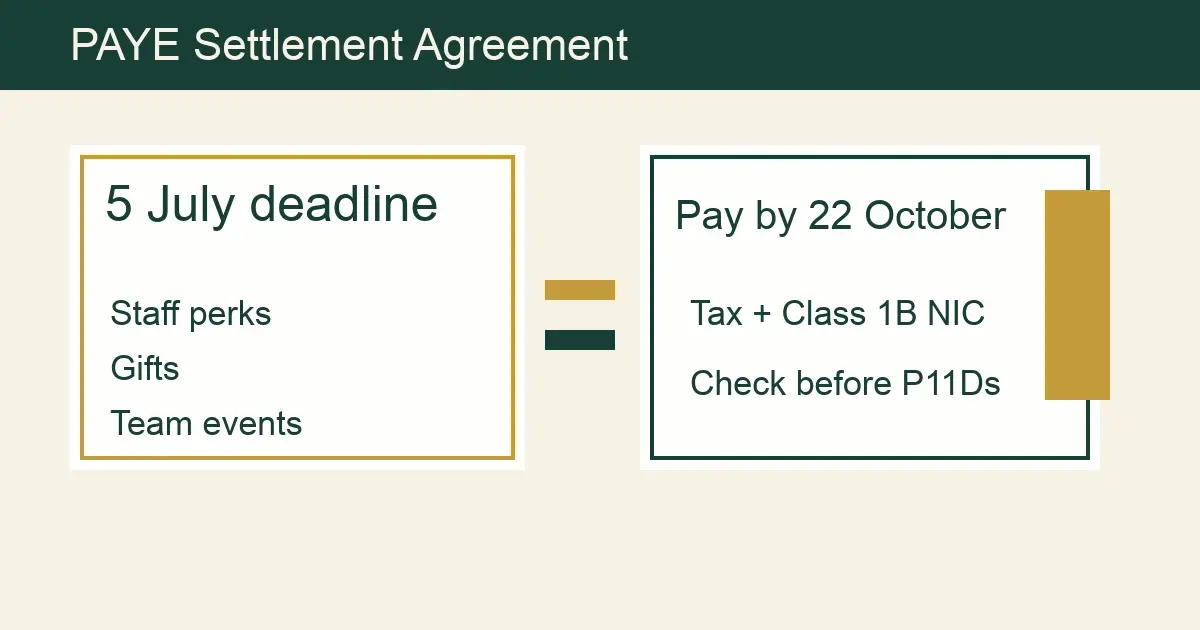
PAYE Settlement Agreement Deadline 5 July 2026: Employer Guide
PAYE Settlement Agreement deadline guide for 2026, with PSA dates, eligible benefits, tax gross-up examples, and employer checklist.