Self Assessment Payment Changes in 2029: What Small Businesses Need to Know
Self Assessment payment changes in 2029 bring more regular payments from April. See who may be affected, what is confirmed and how to prepare.
 Golden Tree Accounting 16 November 2026 17 min read
On this page Show
- Self Assessment payment changes in 2029: what is confirmed?
- How Payments on Account work today
- Who may be affected by the 2029 payment changes?
- What the new in-year payments might look like
- What happens in the 2029/30 transition year?
- How to prepare without guessing at the new schedule
- Self Assessment payment changes 2029: common questions
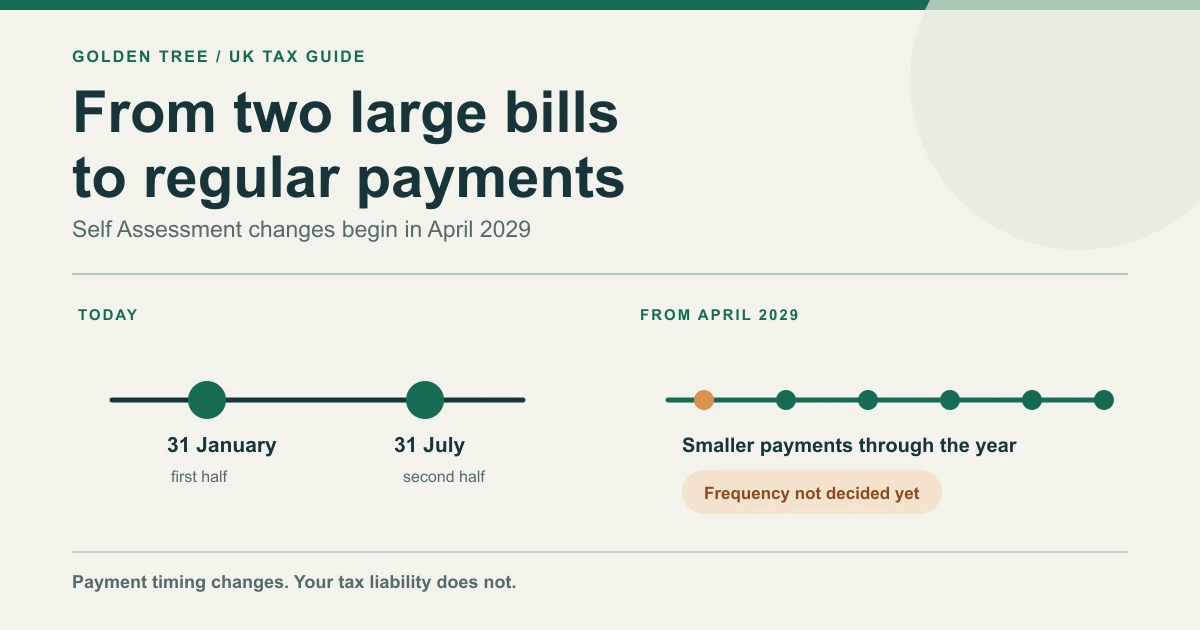
Self Assessment payment changes in 2029 will alter when some taxpayers pay Income Tax, not how much tax they owe. From April 2029, people who already make Payments on Account will move towards smaller, more regular payments during the tax year. HMRC has not decided whether those payments will be monthly, quarterly or another pattern.
The change is not in force yet. If you are preparing a return for the 2025/26 tax year, the online filing and payment deadline remains 31 January 2027. The existing January and July payment dates continue to apply until the new arrangements begin.
At a glance: from April 2029, taxpayers who make Payments on Account will pay more regularly during the year in which they earn the income. The government expects payments to be automated, with a choice to use PAYE for people who have enough employment or pension income. The annual Self Assessment return remains due by 31 January. HMRC has not published the new payment schedule or full transition details.
Self Assessment payment changes in 2029: what is confirmed?
The Budget 2026 announcement says that, from April 2029, taxpayers who make Payments on Account will make smaller, more regular contributions towards their tax bill throughout the year. Those payments will move closer to when the income is earned. The stated aim is to make large, unexpected tax bills less common and reduce the chance that people fall behind with tax payments.
Here is what the current government factsheet confirms, and what it leaves open:
| Question | Position at 16 November 2026 |
|---|---|
| When does the new arrangement start? | April 2029 |
| Who is in scope? | Self Assessment taxpayers who make Payments on Account |
| How often will payments be taken? | Not decided |
| How will the payments be collected? | Automated collection is expected, for example by Direct Debit |
| Is PAYE the only option? | No. People with enough PAYE income can choose that route if they prefer |
| Does the annual tax return stop? | No. Returns remain due by 31 January |
| Does this change the amount of tax owed? | No. It changes payment timing, not the tax liability |
The HMRC factsheet on timely Self Assessment payments says the payment frequency is still being developed with taxpayers and stakeholders. It also says a taxpayer will be able to update their information online if circumstances change. That matters for sole traders, landlords and other people whose income can rise or fall during a year.
HMRC’s summary of responses to the timely payments consultation says automated in-year payments, such as Direct Debit, will be the default. Eligible people can choose PAYE instead, and new digital tools are planned from 2028 to help taxpayers estimate liabilities and track progress. The consultation also recorded concerns about cash flow for people with irregular income. Those points are why it is too early to build a forecast around an assumed monthly or quarterly schedule.
The reform follows a consultation on how to collect Self Assessment tax closer to the point income is earned. The government’s current position is not a confirmed monthly plan. Articles that show a monthly or quarterly example can help explain the idea, but the examples are not a final payment timetable.
How Payments on Account work today
Payments on Account are advance payments towards a future Self Assessment bill. HMRC calculates them using Income Tax after tax deducted at source, such as through PAYE, and includes Class 4 National Insurance where it applies. It calls the amount used for the instalments the relevant amount. Capital Gains Tax and Student Loan repayments are not included in these advance instalments.
Under today’s rules, you usually make two payments. Each is normally half the relevant amount from the previous year, after tax deducted at source. They fall on 31 January and 31 July. When the return for that tax year is complete, HMRC compares the actual amount with what you have already paid. If the payments were too low, the remaining amount is a balancing payment, normally due by the following 31 January.
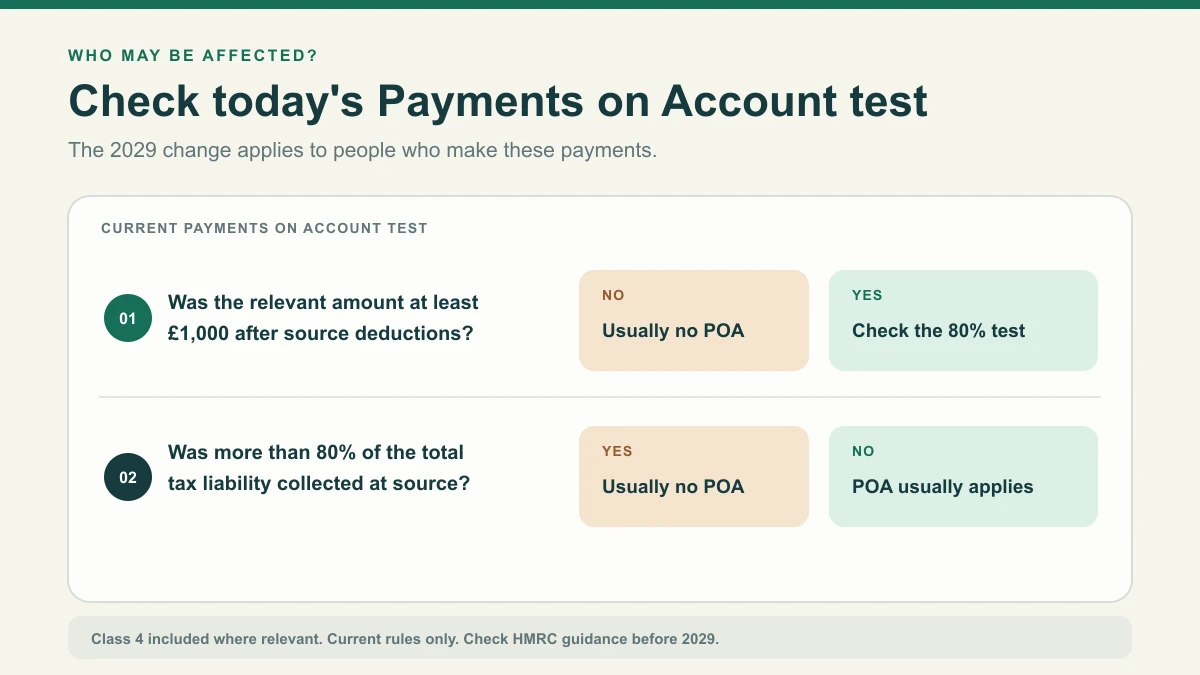
Payments on Account are usually required unless one of these exceptions applies:
- The amount used for the instalment calculation, after tax deducted at source and including Class 4 National Insurance where applicable, was less than £1,000.
- More than 80% of the tax liability used for the test was collected at source, for example through PAYE.
HMRC’s current Payments on Account guidance explains when payments are due and how to check them. Its legal framework defines the relevant amount and how tax deducted at source affects the calculation. The latest Tax Calculation Summary notes show how HMRC applies the current £1,000 and 80% tests, including Class 4 National Insurance where relevant. Your Self Assessment statement or online account shows whether HMRC expects you to pay.
For the examples below, assume the amount used for Payments on Account is £4,800, after tax deducted at source and including Class 4 National Insurance if it applies. The examples exclude Capital Gains Tax and Student Loan repayments, which are not included in these advance instalments.
Example: a £4,800 relevant amount
Say the relevant amount used to calculate your Payments on Account was £4,800. The first payment towards the following year’s amount would usually be £2,400 by 31 January. The second would usually be £2,400 by 31 July.
When you later file the return, suppose the amount covered by the Payments on Account calculation is £5,300. You have paid £4,800 in advance, leaving a £500 balancing payment. Under today’s system, that balance is due by the next 31 January. The figures are an illustration of the payment pattern, not a personal estimate.
Example: a first Self Assessment bill
If you have not made Payments on Account before, your first January can include the remaining tax due for the year just ended plus the first payment towards the next year. Assume the amount left after tax deducted at source is £4,800, no earlier Payments on Account have been made, and no Capital Gains Tax or Student Loan amount is due. January could then be £7,200: £4,800 to settle that year and a £2,400 first payment on account. A second £2,400 would usually be due in July.
That can feel like HMRC has charged you twice for the same year. It has not. The £4,800 settles the year on your return, while the £2,400 is an advance for the next one. Our guide to Self Assessment Payments on Account and the 31 July deadline walks through the current cycle in more detail.
Who may be affected by the 2029 payment changes?
The government says the new process will apply to taxpayers who are required to make Payments on Account. Under today’s test, the amount used for the instalment calculation generally needs to be at least £1,000, and 80% or less of the tax liability used for that test must have been collected at source. For some self-employed people, that amount includes Class 4 National Insurance.
That can include sole traders, freelancers, landlords and people with other untaxed income. It can also include someone who has a PAYE job but earns additional income that is not taxed through their salary. Having a job does not automatically put you outside the current test. What matters is the relevant amount and how much Income Tax was already collected at source.
Example: a bill below £1,000
If a landlord with no Class 4 National Insurance liability has a relevant amount of £950 after tax deducted at source, the current rule says they do not usually make Payments on Account. They normally pay the amount due through Self Assessment by the 31 January deadline. Since the 2029 reform is for people who make Payments on Account, a £950 relevant amount would not currently put them in that group.
Example: more than 80% collected through PAYE
Suppose a landlord’s assessed Income Tax was £20,000, including tax on rental income, and £17,000 had already been collected through PAYE. That is 85% of the assessed Income Tax, leaving £3,000 after tax deducted at source. The landlord would usually be outside the current Payments on Account test because more than 80% was collected at source, even though the remaining amount exceeds £1,000. The amount and percentage tests are separate.
The Budget 2026 factsheet describes the affected group by reference to the existing Payments on Account criteria. The detailed design is still being developed, so check the rules again as HMRC publishes implementation guidance. Do not assume that a current threshold will remain unchanged right up to 2029.
What the new in-year payments might look like
The government says payments will continue to be based on tax owed in the previous year. If your circumstances change, you will be able to update your information online. That should help prevent an old profit figure from dictating payments after your business has had a much quieter year, although the final process has not been published.
HMRC expects the payments to be automated, with Direct Debit given as one example. If you have enough income from a job or private pension, the factsheet says you will be able to choose to pay through PAYE if you prefer. That choice may be useful for someone who wants Self Assessment tax collected alongside other tax deductions. Someone who does not want their employer to see a changed tax code may prefer a direct route, if that option is available to them.
The government has not confirmed the frequency. Monthly payments might sound familiar because PAYE is usually deducted each pay period, and quarterly payments might sound familiar to people who already use digital tax reporting. Neither is a final rule for the new Self Assessment payment system. Wait for HMRC’s schedule before changing a standing order or building a cash-flow forecast around a particular number of instalments.
Payment timing is different from filing
The annual return is not being removed. HMRC says taxpayers must still file by 31 January each year. The new system changes when contributions are sent to HMRC, not the annual reporting deadline or the total amount owed.
This is also separate from Making Tax Digital for Income Tax. Quarterly updates are a way to report income and expenses for some taxpayers. They do not mean the 2029 payment frequency has been set at four instalments a year. If you are unsure which process you are looking at, separate the question into two parts: when do you send records or a return, and when does HMRC collect the tax?
For the current year, the online Self Assessment return and any tax due for 2025/26 are still due by 31 January 2027. If you make Payments on Account, the next relevant date after that is usually 31 July 2027. The current GOV.UK Self Assessment deadlines set out the dates in force today.
What happens in the 2029/30 transition year?
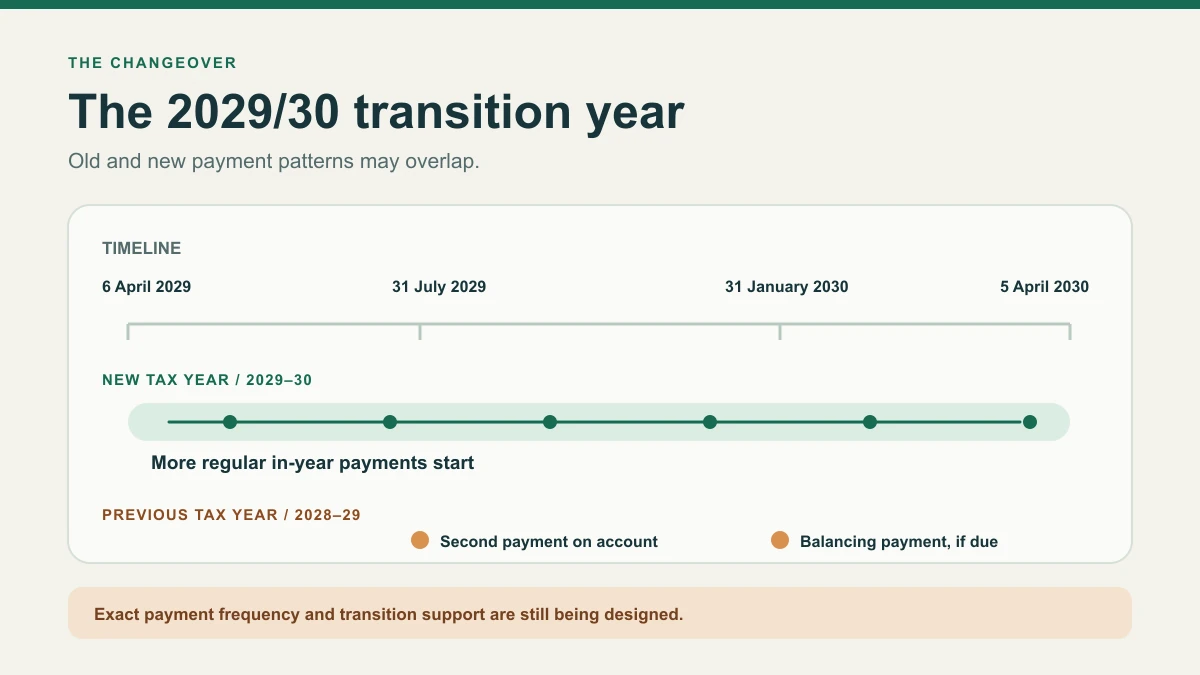
There will be a transition as HMRC moves people from the current timetable to the new one. The factsheet says taxpayers will need to make their final payment for the previous tax year while starting contributions under the new arrangements. That means cash for an older tax year and cash for the current one may be required within the same transition period.
For example, if the relevant amount used to calculate Payments on Account for 2028/29 was £4,800, the taxpayer would usually have a £2,400 second payment on account due on 31 July 2029 under today’s schedule. From April 2029, they would also start making contributions towards the 2029/30 liability under the new system. If the 2028/29 payments were not enough, a balancing payment could also be due by 31 January 2030.
That example shows why the first year needs attention. It does not calculate a taxpayer’s 2029/30 bill or say how much the new payment will be. HMRC has not published the final payment frequency, the calculation details or the transition support. It has said it will provide information and tools before implementation. Use the dates above to see the shape of the overlap, then wait for your own account and HMRC’s final timetable for exact amounts.
How to prepare without guessing at the new schedule
There is no need to change your payment method now because of the 2029 announcement. These steps will help you understand today’s position and make the later change easier to manage.
Check what you owe today
Sign in to your Self Assessment account and review the latest statement. Look at the balance due, any Payments on Account already made and the next date HMRC shows. For the 2025/26 return, the main online deadline is 31 January 2027. If you also have a PAYE tax code, our guide to paying Self Assessment through your tax code explains the separate 30 December 2026 cutoff for eligible balances.
Keep a working estimate of this year’s tax
Your latest return is a starting point for a forecast, not a promise that the next bill will be the same. Update the estimate when your profit, rental income, pension income or PAYE deductions change. A simple monthly check against actual income and payments can show early if the old figure is no longer sensible.
If your current income is lower than last year, HMRC lets you ask to reduce Payments on Account. The estimate should be realistic. If you reduce payments too far and the actual bill is higher, HMRC can charge interest on the shortfall. This current option is separate from the online forecast updates expected under the 2029 system.
Keep tax money visible in your cash-flow plan
Use a separate line in your cash-flow forecast for Self Assessment rather than treating the bank balance as available to spend. Record the tax year each payment relates to, its due date and whether it is an advance or a balancing amount. That will make the 2029 transition easier to understand when HMRC provides the new schedule.
If you already use a 13-week cash-flow forecast, add the 31 January and 31 July tax dates to it. Do not add made-up monthly payments for 2029 yet. Keep a note to review the forecast when HMRC publishes the timetable and when your next tax return changes the estimate used for payments.
Ask before changing how tax is collected
The Budget announcement is not a reason to move income, change an employment tax code or make voluntary payments without checking the effect. The new system will use previous-year tax information, and some people may have a choice between an automated payment and PAYE collection. Your employment income, pension, other tax deductions and how regular your business earnings are can all affect which route suits you.
If you are already worried about a tax bill, use the current rules rather than waiting for 2029. Our guide to HMRC Time to Pay for Self Assessment explains the existing route for people who cannot pay in full. The 2029 reform does not replace a payment arrangement for a bill that is due now.
We can review your current Self Assessment statement and payment dates through our Self Assessment support service. Your accountant can help you prepare questions for HMRC, but the exact 2029 payment amount and schedule will come from the final HMRC rules and your own tax account.
Self Assessment payment changes 2029: common questions
When do the Self Assessment payment changes start?
The government says the new arrangements will start from April 2029. The change is for taxpayers who make Payments on Account. HMRC has not decided how often payments will be collected.
Who will be affected?
The factsheet refers to Self Assessment taxpayers who are required to make Payments on Account. Under today’s test, the amount used for the instalment calculation generally needs to be at least £1,000, and 80% or less of the tax liability used for that test must have been collected at source. For some self-employed people, that amount includes Class 4 National Insurance. Check the official guidance again before 2029 because the design is still in progress.
Will I pay monthly or quarterly?
That has not been confirmed. HMRC says it will work with affected taxpayers and stakeholders on a schedule that can suit different income patterns. Treat any monthly or quarterly calculation published before the final rules as an illustration only.
Will I still file a Self Assessment return?
Yes. The government says annual tax returns will still be due by 31 January. The reform changes payment timing, not the filing date.
Will I owe more tax?
The government says the reform changes when you pay, not how much Self Assessment tax you owe. Your actual bill will still depend on the taxable income, deductions and rules for that tax year.
Can I choose to pay through PAYE?
If you have enough PAYE income from employment or a private pension, the factsheet says you will be able to choose PAYE collection if you prefer. Automated direct payments are another expected option. HMRC has not published all the practical details yet.
Why could 2029/30 feel more expensive?
The transition can put the final payment under the old system alongside the first payments under the new one. That can make the cash needed in the transition year higher than a normal year, even though the reform does not increase the tax liability itself. HMRC has not published the final schedule or support arrangements, so do not rely on a personal estimate until those details are available.
For the next return, check the amount on your Self Assessment statement and keep the January and July dates in your cash-flow plan. Revisit the plan when HMRC publishes the 2029 timetable, rather than treating an example as your payment notice.

About Golden Tree Consulting
ACCA Affiliated | MBA Qualified
Golden Tree Accounting & Business Consulting provides expert tax, bookkeeping, and advisory services to sole traders and SMEs across Croydon, London, Surrey, and Kent. With multilingual support and decades of combined experience, we help businesses stay compliant and grow.
Offices in Croydon and London Bridge.
Related guides
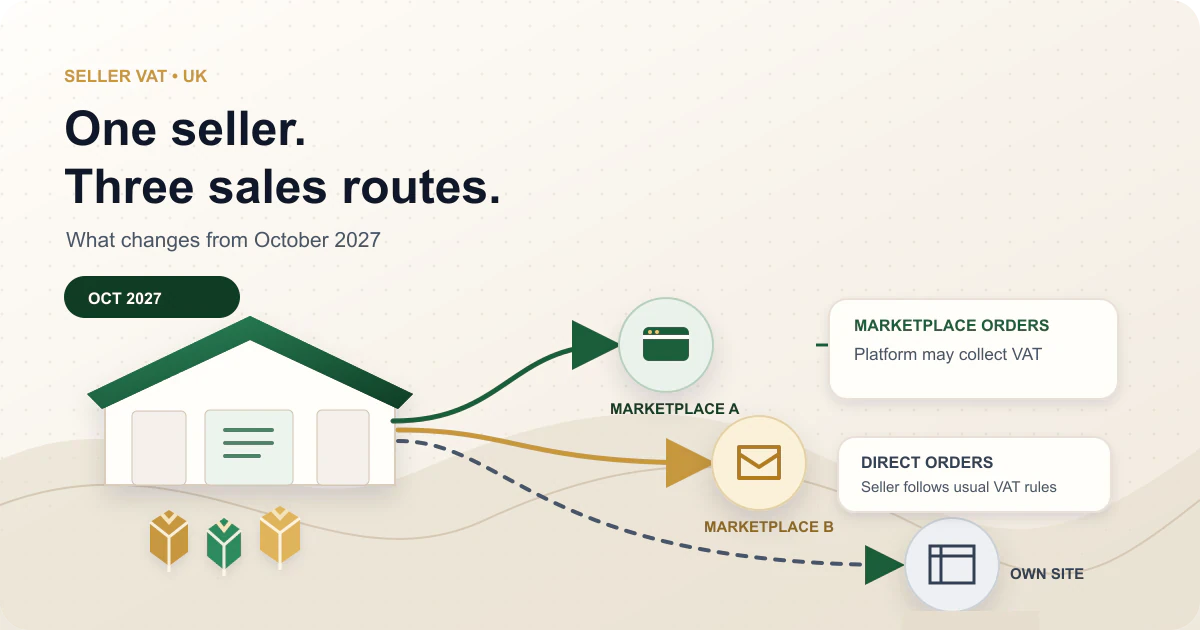
VAT Online Marketplace Rules UK: 2027 Guide for Small Sellers
VAT online marketplace rules in the UK change from October 2027. See the £90,000 per-platform test, exclusions and checks for small sellers.
Property Income Tax Rates 2027: What the Budget Rise Means for Landlords
Property income tax rates 2027 rise to 24%, 44% and 49% from 6 April. See landlord examples, mortgage interest relief and what to review.
VAT Error Correction UK: How to Fix a Return After Filing
VAT error correction UK guide: learn when to adjust your next return, when to notify HMRC, how to calculate the net error and what records to keep.